^^^ sounds like you're getting into freestyle if you keep getting that tail forward of centre...
No no Mark, those new old skool surf sailing boards that had the tail shaped into the middle just behind the nose but behind the mast track so you had more front foot control over the clew if you were under 65kgs on big Wednesday.
As we're into a heavier winds period, I thought I'd use my quad for a while. It's a bit sucky in bump and jump where the board lacks lift and liveliness but on a wave it can really do anything we ask.
Bad positioning, front foot, back foot, doesn't matter, will always turn and keep its momentum. Even hitting bad chop on the wave face. Pretty awesome.
Also the release on jumps is so smooth. I feel like it's better for backies than forwards and better front side than backside.
In the lulls it slows down quickly so it needs power, the board requires more work to keep going over rough terrain. Better use a bigger board than the sail size suggests. 87 vs 82 for 4.7 for example.
For light wind, heavy current, and such I wouldn't recommend. Unless one would really stick to the wave area where water state stays clean and smooth.
Alrighty, great news, got a replacement for my light wind board... a Goya One in 85L.
So far great board, planes really well and turns well too. Well rounded board. More details test later. And how nice does it feel to sail a light board wow!
Got to admit this whole front foot / back foot stuff has never made any sense to me.you generally use a lot of either on any board depending on where you are in a wave / trying to plane up / trying to control speed and power , trying to jam a turn or trying get an air.
I have ridden a ton of boards and cant relate to any boards that sailed more front or back footed.
You lean forward into the bottom turn and then transition to give her a bit of back foot to jam a top turn in the pocket. Or give it a little front foot lift as you hit the lip if you are trying to do an air.
These dynamics are simply constant with pretty much all of the Single fins, Thrusters, Quads and twins that i have ridden ranging from 260 cm right down to 220cmThe board is either in trim or it isn't - I have found good sailing trim has a perfect balance of pressure from both feet.
I suspect this terminology was from certain windsurf magazines that had to create content month in / month out and just ran out of sensible things to say around about 2012.
It's very easy to answer, try and front foot a frontside bottom turn on a freestyle board. What happens?
Right but you do want some planing abilities and the balance between planing and turning can be challenging. Hence the name freestyle wave.
All boards can be muscled back foot turned though for sure. I wanted something that could still turn decently over the front foot like the JP FSW and unlike the fanatic freewave stubby.
Although maybe not as intuitive as the JP, the One seems to be able to crank really hard at least when sail power is off 
I find when I concentrate on turning with just one foot I fall over. Maybe just me, mybe the beer or most likely, my boards all be crapolla.
A "front foot" jibe where I use the whole rail instead of leaning back and killing speed.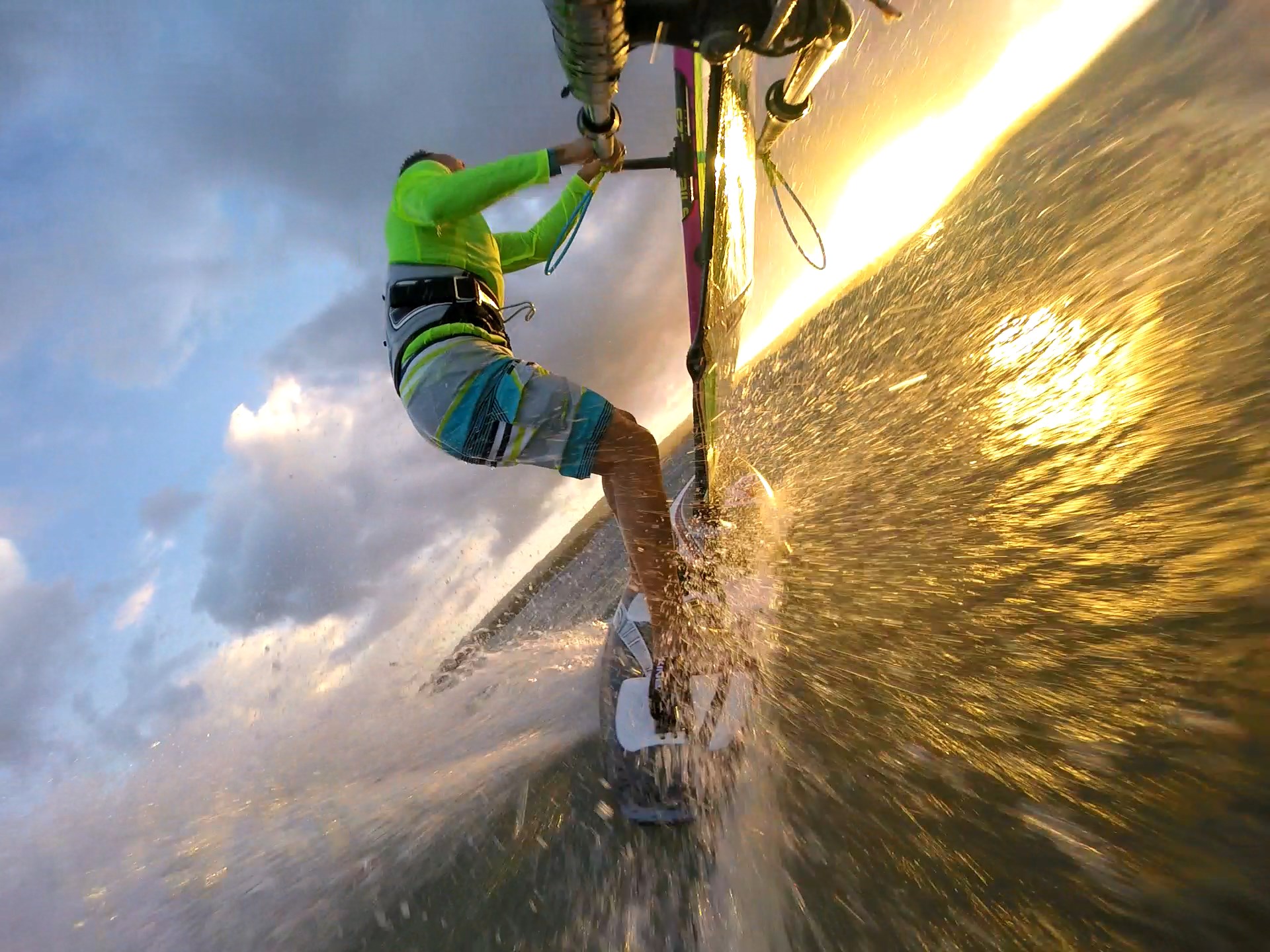
Note that my back hand could be farther back (despite the wide angle) and weight even more forward but whatever I like the shot!
EDIT: forum isn't liking non https link I think...
EDIT2: I asked Quattro their thoughts, looking forward to their answer.
? ?Gybes are neither back or front foot - they are a dynamic blend of both
You may be overthinking this....
He has a point about the traditional FSW boards. Matt have you tried wavesailing on a non "pure wave board" (and not a Dyno as they do turn).... it is awful compared to a real waveboard.
But if you need the early planing ability of a flatter rockered board then its a real tradeoff. BIG tradeoff.
So IMHO the thread / question has validity.
Until we got FSW boards in the last say 5yrs that actually turn pretty good, and big volume waveboards, it was a real downer to have to use a freewave in real waves
Select to expand quoteMark _australia said..
He has a point about the traditional FSW boards. Matt have you tried wavesailing on a non "pure wave board" (and not a Dyno as they do turn).... it is awful compared to a real waveboard.
But if you need the early planing ability of a flatter rockered board then its a real tradeoff. BIG tradeoff.
So IMHO the thread / question has validity.
Until we got FSW boards in the last say 5yrs that actually turn pretty good, and big volume waveboards, it was a real downer to have to use a freewave in real waves
The Windtechs Magic Bullet's whole design premise is super fast rockers and longer lengths with flex tail to allow turns- and the concept works really well. As a 93 kg rider I am out planing nearly everyone in the break when I ride it.
except Ben Severne- so I had a go on his pyro 82 and absolutely loved it. Even if it was a bit small for me-super Fast rockered awesome turning joy. I am looking at a Pyro 92 as my one board solution now.
i rode a Kombat waves back in the day (a free wave design) and it was awful. I tried a jP fsw at around the same time and hated it.
But one of my favourite boards ever is a kode 80 which was marketed as a fast wave board. i still have one finned up in the garage.
I also rode super bent boards like the original evo and the evil twin.
none of the boards rode or turned or trimmed more front or back foot.
I wonder if this front foot / back foot riding / turning myth has anything to do with boards that have the straps set up so that they arent trimmed properly?
7 times out of 10 when i get on other people's gear the straps are too far back (and the straps are almost always us set too tight)
Select to expand quoteReflex Films said..Mark _australia said..
He has a point about the traditional FSW boards. Matt have you tried wavesailing on a non "pure wave board" (and not a Dyno as they do turn).... it is awful compared to a real waveboard.
But if you need the early planing ability of a flatter rockered board then its a real tradeoff. BIG tradeoff.
So IMHO the thread / question has validity.
Until we got FSW boards in the last say 5yrs that actually turn pretty good, and big volume waveboards, it was a real downer to have to use a freewave in real waves
The Windtechs Magic Bullet's whole design premise is super fast rockers and longer lengths with flex tail to allow turns- and the concept works really well. As a 93 kg rider I am out planing nearly everyone in the break when I ride it.
except Ben Severne- so I had a go on his pyro 82 and absolutely loved it. Even if it was a bit small for me-super Fast rockered awesome turning joy. I am looking at a Pyro 92 as my one board solution now.
and you forgot, super short.
Matt that was my point. Those FSW boards you hated would not turn on a wave unless you stomped on the tail and / or overpowered the fin into a slide. Geez the JP FSW back then was a freeride with 5mm more tail kick
It is commonly reported that the stubby boards with back strap a long way back need a far more back footed bottom turn style than a pure DTL 'traditional' shape
So for someone who has always ridden very front footed traditional DTL style bottom turns, but wants to plane a bit earlier than on a DTL banana board - the question the OP raises is quite valid I think.
Still digesting some things to answer later but a quick list of front foot boards that are bullets:
Kevin Pritchard Custom 86L 55.5cm
windsurfing.lepicture.com/board-tests/#2018-Starboard-KP-Pro
Tabou DaCurve 85L 54.5cm
windsurfing.lepicture.com/board-tests/#2007-Tabou-DaCurve
JP FSW
windsurfing.lepicture.com/board-tests/#2012-JP-FSW
Also, loved the old RRD wave cult from mid 2000s.
Another great board is the Tabou 3S.
I really liked the Starboard Kode Wave but with the added weight, early planing was so-so. I wish I could try a dry one :D !
backfooted bottom turn?
never heard of it! call me crazy but you pretty much always need to have weight forward ( Or at least balanced) on bottom turns -for trim and max speed,
and then transition weight from inside to outside rail as you approach the lip / top of the wave
weight back in the top turn / or balanced to both feet depending on what the wave is doing.
to jam in a turn.
Or even keep wight a bit forward if going for a projecting aerial off a projecting lip.These are universal and constant truths - at least in my experience. Am i doing something wrong? This whole back foot / front foot thing (potentially mythical like a Unicorn) is overcomplicating things waaay too much. Windsurfing is just not that complex or difficult.
Check my test on the Angulo Triumph. And watch his style in Cape Verde. All back foot.
windsurfing.lepicture.com/board-tests/?utm_source=seabreeze.com.au#2016-Angulo-Triumph
The point is they all vary in how you weight the front or back foot and rail in a turn. U would not propose a slalom board is anything like a waveboard to turn just because weight forward and rail engaged is the only thing...?
EG: If you do a front foot driven bottom turn on an old school FSW that's great - its a beautiful laydown gybe. The perfect slalom gybe.
But as soon as you need to tighten that bottom turn on a wave, you can't. It just won't. Its 'stiff'. The expert may get away with a back foot stomp and force it - at the expense of speed - then get a nice top turn and drop again to accelerate... but most people killed the speed in the bottom turn and got munched when they tried to tighten that bottom turn. A waveboard would have done it easily. Tail rocker.
On a newer stubby style, they need less of a "laydown gybe traditional style hookipa" bottom turn = they want to do a more back footed bottom turn that is much tighter. Designed that way to make the most of crap waves - short tight bottom turn. Earlier planing rocker.
So yes it a blend of both with any board like you say Matt - but on some that blend of foot weighting is more forward or more rearward. You can't tell us all waveboards have the CoG between your feet in the same place, They vary.
After we accept that of course they are all different - in waveboards traditionally the front footed awesome laydown style that works amazing at Gnaraloo is different to say a fanatic stubby that planes early and is designed for shorter tighter bottom turns off the back foot. Magazine reviewers say that all the time. With that comes the generalisation that the former board is a little slower to get planing but better turning and the latter a little faster to get going but stiffer in a turn..
Mako vs nano
Da Curve vs Da Bomb
Fanatic quad vs Stubby
Starb quad vs Kode
etc
Its a pretty valid generalisation... there is no way your foot weighting in column 1 is anything like in column 2, and 1 planes a bit later than 2 generally. Testers and manufacturers say it all the time
So the OP raises a valid question of a "front footed board that still planes OK". Thats same as asking whats the 'waviest' FSW or the earliest planing 'pure wave board' - and I think it is what a lot of folks want in a board.
I'd agree with Reflex on this one. There are a lot of different factors that determine how a board will turn and how early they will plane.
where you have your body weight will always be critical for what type of turn you want to do but a back foot bottom turn , naaah.
I also wouldn't be putting a whole lot of faith in magazine testers, have you seen some of those guys sail ? 
Thanks Mark. Clarified my thoughts.
There are some wave boards that plane better than freewave boards too. And those are still controllable when down steep waves! Really great boards and must keep.
I do feel like manufacturers randomly make updates (they cannot test each individual volume) and it's up to us to determine what works!
I have compared my tests against boards and wind mag and nearly always come up with similar results. I though that was cool!
So all boards require the same foot pressure in a bottom turn?
And full on DTL oriented boards don't plane a bit slower? (In general)
I must be confused
No and no.
I don't see why they're being referred to as front footed boards and back footed boards. Why not just refer to them as what they are or what they do.
There is more than one type of down the line board as well as there is more than one type of small onshore wave boards.
No I think some are just over thinking it and making it more complicated than it needs to be
Alright well here are my completely shaper noobie ideas.
To get a nice front foot board, it must have both nose and tail rocker plus thin rails.
Thin rails let the board slice the water at speeds, minimize bouncing. Rocker increases grip safety.
Now the question is how much flat area so the board can plane. A fast board will be hard to dial when dropping down the wave but if the board can turn is it really an issue unless riding 2m+.
When I emailed Quattro, their reply was a bit too general to get a better concept in terms of shaping.
Some friends have gone the custom route, it may be what I end up doing in the future.