Select to expand quotejksmurf said..
@Paducah I weight 78kg. For sure where I was tring this was messy, swell one direction wave fetch from the other, wasn't easy conditions and I over-estimated my capabilities, I love gybing a windsurfing board, any size, technically a joy, but this one bit me. Flat water is definitely where I will try next.I use around 85cm mast yep, on a 125L JP SUP Foil with Twin Tracks, no straps.
Speed; yes my big foil isn't made for speed, but I haven't got to a point where I am carving the foil around, I was sort of waiting for it to "surf" around I guess.
Cheers
k.
That's the drawback of big, thick wings is they just don't glide as far. If you have access to an L or even one of the Mediums, you might want to give that a go. They will still have a lot of lift at your size but will glide much further giving you more time to deal with things. A cool part of windfoiling, for me, is that even a big, wide board with a long race fuse carves like a much smaller finned board. You don't have to carve hard (especially at first because they can really whip around hard) but do put a bit of pressure on that back foot as you enter.
If you aren't already doing it, start off with some S turns until you get a feel of the different radii as you change pressure. That's a fun thing to do in swell.
Select to expand quotesegler said..
Everywhere in the various foiling videos you see guys jibing with their leeward foot well back from the footstrap. See this one:
Maybe I am missing the point here, but I reckon I ride as front footed as anyone and my back foot is right near the back strap when I gybe, so not sure the front foot needs to be forward during gybing if someone has a front footed set up.
PS: having it near the back strap is particularly important when i come out of the gybe with lower speed so I can weight that foot to maintain flight.
Like most (every?) Sandman thread the Dunning-Kruger effect is getting really strong right now. The more folks that say he's wrong the more he doubles down.
I really hope beginners don't get sucked in by the strong statements of a person who sets their gear up so poorly that a professional coach can't gybe it using the correct techniques. I can only imagine the misery Andy had trying to teach his way around this level of pig headed ignorance.
Select to expand quoteGrantmac said..
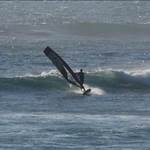
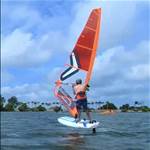
Tony (first picture) and Emily are using tiny sails in the Gorge. Mast base position isn't terribly critical. Emily also rides a huge foil mast. Notice both shots are in the flat water areas regularly used for photos.
Tony is also using the H2 foil, likely in B position, which I bought right around when that promo shot was taken. Not a very front footed foil in B position (I ran it exclusively in C) but again when you are using tiny sails in a fair amount of wind and flat water you can get away with lots.
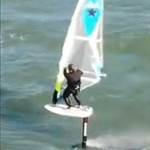
Notice the later Slingshot rider is also on a very small sail (I believe it was a 3.6) with a compact geometry so their mast base pressure isn't going to be significant.
Aero: I'm used to slogging waveboards, so having the mast next to my front foot and the back foot almost on top of the straps is a pretty regular thing for me. I don't bother tacking my small foil board when slogging, no point when doing pivot gybes is good practice for wavesailing.
In 2018 I first tried foiling in the gorge on the green slingshot wizard 125 and the Blue H2 wing in B position, and was basically breaching every run for the entire week. There was a dude there at event site on the same kit but with the H2 in C position and he was flying through gybes amazingly.
Is that your neck of the woods GMac?
Select to expand quoteaeroegnr said..Sandman1221 said..
Simon I think you are making what segler said into something else. Like segler my kit is balanced at speed, to initially get up I use a little back foot pressure really toe pressure and that can just be the big toe, when at speed and I get hit with a gust it really depends on the wing what I have to do, with F1080 cm2 wing need to use front foot pressure and/or mast foot pressure (pushing down on boom) to keep board level crosswind or heading upwind and sheeting in then just have front foot pressure like Andy Brandt said, with F770 cm2 wing a little front foot pressure as needed crosswind, with S670 cm2 wing nothing needed. Use the same stabilizer and shim for all three wings. This idea of having constant front foot pressure when foiling is just total BS IMO.
Needing MORE front foot pressure to go upwind makes zero sense to me. The 115+ shifts the wing forward, the 115doublePlus shifts it even further forward to get more extreme upwind/downwind angles for course racing. Should be the same for other race style foils, moreso for shorter fuselages with the effort further back. More rear foot pressure.
When underpowered and flying, I always have a heavily loaded back leg that burns out, even with the 115+, somewhere around 1/4 mile of flight my back leg is dead. More tailwing shim helps. Mast base further back helps.
When I'm pushing deep upwind, it's my back leg that burns. Same downwind.

Well when I had my camp with Andy, he wanted me to go away from him going hard upwind, try a gybe, then come back towards him again going hard upwind and then try anther gybe right in front of him. By going hard upwind, away and towards him, I was not wasting time slogging up to him after every run. I think that is easy to understand, right?
To go hard upwind he told me to lean out and sheet in, in order to do that he told me that I would have to use front foot pressure (to balance out the sheeting in). And he was right, I went the fastest upwind I have ever gone, and it was on my slowest/biggest wing! It makes sense, you sheet in hard so you need to counter balance with something, and that something is the front foot.
Select to expand quoteSandman1221 said..aeroegnr said..Sandman1221 said..
Simon I think you are making what segler said into something else. Like segler my kit is balanced at speed, to initially get up I use a little back foot pressure really toe pressure and that can just be the big toe, when at speed and I get hit with a gust it really depends on the wing what I have to do, with F1080 cm2 wing need to use front foot pressure and/or mast foot pressure (pushing down on boom) to keep board level crosswind or heading upwind and sheeting in then just have front foot pressure like Andy Brandt said, with F770 cm2 wing a little front foot pressure as needed crosswind, with S670 cm2 wing nothing needed. Use the same stabilizer and shim for all three wings. This idea of having constant front foot pressure when foiling is just total BS IMO.
Needing MORE front foot pressure to go upwind makes zero sense to me. The 115+ shifts the wing forward, the 115doublePlus shifts it even further forward to get more extreme upwind/downwind angles for course racing. Should be the same for other race style foils, moreso for shorter fuselages with the effort further back. More rear foot pressure.
When underpowered and flying, I always have a heavily loaded back leg that burns out, even with the 115+, somewhere around 1/4 mile of flight my back leg is dead. More tailwing shim helps. Mast base further back helps.
When I'm pushing deep upwind, it's my back leg that burns. Same downwind.
Well when I had my camp with Andy, he wanted me to go away from him going hard upwind, try a gybe, then come back towards him again going hard upwind and then try anther gybe right in front of him. By going hard upwind, away and towards him, I was not wasting time slogging up to him after every run. I think that is easy to understand, right?
To go hard upwind he told me to lean out and sheet in, in order to do that he told me that I would have to use front foot pressure (to balance out the sheeting in). And he was right, I went the fastest upwind I have ever gone, and it was on my slowest/biggest wing! It makes sense, you sheet in hard so you need to counter balance with something, and that something is the front foot.
Him telling you to add front foot pressure makes me think that you were trying to point too hard upwind and were barely above stalling speed. This is the only thing that makes sense to me. I have to push hard on the rear the higher I go upwind, and if I get wobbly I use front foot pressure to steer more downwind (yet, still upwind), and accelerate. The upwind angle I choose means a range between barely flying and going ~20mph upwind. I can still fly at 16mph or so with the 900 upwind but it's not as stable as 20mph and is a struggle to keep flying.
Select to expand quoteaeroegnr said..Sandman1221 said..aeroegnr said..Sandman1221 said..
Simon I think you are making what segler said into something else. Like segler my kit is balanced at speed, to initially get up I use a little back foot pressure really toe pressure and that can just be the big toe, when at speed and I get hit with a gust it really depends on the wing what I have to do, with F1080 cm2 wing need to use front foot pressure and/or mast foot pressure (pushing down on boom) to keep board level crosswind or heading upwind and sheeting in then just have front foot pressure like Andy Brandt said, with F770 cm2 wing a little front foot pressure as needed crosswind, with S670 cm2 wing nothing needed. Use the same stabilizer and shim for all three wings. This idea of having constant front foot pressure when foiling is just total BS IMO.
Needing MORE front foot pressure to go upwind makes zero sense to me. The 115+ shifts the wing forward, the 115doublePlus shifts it even further forward to get more extreme upwind/downwind angles for course racing. Should be the same for other race style foils, moreso for shorter fuselages with the effort further back. More rear foot pressure.
When underpowered and flying, I always have a heavily loaded back leg that burns out, even with the 115+, somewhere around 1/4 mile of flight my back leg is dead. More tailwing shim helps. Mast base further back helps.
When I'm pushing deep upwind, it's my back leg that burns. Same downwind.
Well when I had my camp with Andy, he wanted me to go away from him going hard upwind, try a gybe, then come back towards him again going hard upwind and then try anther gybe right in front of him. By going hard upwind, away and towards him, I was not wasting time slogging up to him after every run. I think that is easy to understand, right?
To go hard upwind he told me to lean out and sheet in, in order to do that he told me that I would have to use front foot pressure (to balance out the sheeting in). And he was right, I went the fastest upwind I have ever gone, and it was on my slowest/biggest wing! It makes sense, you sheet in hard so you need to counter balance with something, and that something is the front foot.
Him telling you to add front foot pressure makes me think that you were trying to point too hard upwind and were barely above stalling speed. This is the only thing that makes sense to me. I have to push hard on the rear the higher I go upwind, and if I get wobbly I use front foot pressure to steer more downwind (yet, still upwind), and accelerate. The upwind angle I choose means a range between barely flying and going ~20mph upwind. I can still fly at 16mph or so with the 900 upwind but it's not as stable as 20mph and is a struggle to keep flying.
Sorry, but like I said I was going the fastest I ever have upwind! I was going so fast that I foiled out 2 times in one run, and returned to the water and kept on going on the foil without out a significant change in speed! That is not anywhere close to stall speed
It sounds like you need a windfoil camp with Andy, he will be back in the late Fall.
Going upwind: "Drive the back leg to maintain lift". Sam Ross is also Lead Coach of the British IQFoil sailing team.
Select to expand quoteSandman1221 said..aeroegnr said..Sandman1221 said..aeroegnr said..Sandman1221 said..
Simon I think you are making what segler said into something else. Like segler my kit is balanced at speed, to initially get up I use a little back foot pressure really toe pressure and that can just be the big toe, when at speed and I get hit with a gust it really depends on the wing what I have to do, with F1080 cm2 wing need to use front foot pressure and/or mast foot pressure (pushing down on boom) to keep board level crosswind or heading upwind and sheeting in then just have front foot pressure like Andy Brandt said, with F770 cm2 wing a little front foot pressure as needed crosswind, with S670 cm2 wing nothing needed. Use the same stabilizer and shim for all three wings. This idea of having constant front foot pressure when foiling is just total BS IMO.
Needing MORE front foot pressure to go upwind makes zero sense to me. The 115+ shifts the wing forward, the 115doublePlus shifts it even further forward to get more extreme upwind/downwind angles for course racing. Should be the same for other race style foils, moreso for shorter fuselages with the effort further back. More rear foot pressure.
When underpowered and flying, I always have a heavily loaded back leg that burns out, even with the 115+, somewhere around 1/4 mile of flight my back leg is dead. More tailwing shim helps. Mast base further back helps.
When I'm pushing deep upwind, it's my back leg that burns. Same downwind.
Well when I had my camp with Andy, he wanted me to go away from him going hard upwind, try a gybe, then come back towards him again going hard upwind and then try anther gybe right in front of him. By going hard upwind, away and towards him, I was not wasting time slogging up to him after every run. I think that is easy to understand, right?
To go hard upwind he told me to lean out and sheet in, in order to do that he told me that I would have to use front foot pressure (to balance out the sheeting in). And he was right, I went the fastest upwind I have ever gone, and it was on my slowest/biggest wing! It makes sense, you sheet in hard so you need to counter balance with something, and that something is the front foot.
Him telling you to add front foot pressure makes me think that you were trying to point too hard upwind and were barely above stalling speed. This is the only thing that makes sense to me. I have to push hard on the rear the higher I go upwind, and if I get wobbly I use front foot pressure to steer more downwind (yet, still upwind), and accelerate. The upwind angle I choose means a range between barely flying and going ~20mph upwind. I can still fly at 16mph or so with the 900 upwind but it's not as stable as 20mph and is a struggle to keep flying.
Sorry, but like I said I was going the fastest I ever have upwind! I was going so fast that I foiled out 2 times in one run, and returned to the water and kept on going on the foil without out a significant change in speed! That is not anywhere close to stall speed
It sounds like you need a windfoil camp with Andy, he will be back in the late Fall.
You proved my point
Select to expand quoteSandman1221 said..aeroegnr said..Sandman1221 said..
Simon I think you are making what segler said into something else. Like segler my kit is balanced at speed, to initially get up I use a little back foot pressure really toe pressure and that can just be the big toe, when at speed and I get hit with a gust it really depends on the wing what I have to do, with F1080 cm2 wing need to use front foot pressure and/or mast foot pressure (pushing down on boom) to keep board level crosswind or heading upwind and sheeting in then just have front foot pressure like Andy Brandt said, with F770 cm2 wing a little front foot pressure as needed crosswind, with S670 cm2 wing nothing needed. Use the same stabilizer and shim for all three wings. This idea of having constant front foot pressure when foiling is just total BS IMO.
Needing MORE front foot pressure to go upwind makes zero sense to me. The 115+ shifts the wing forward, the 115doublePlus shifts it even further forward to get more extreme upwind/downwind angles for course racing. Should be the same for other race style foils, moreso for shorter fuselages with the effort further back. More rear foot pressure.
When underpowered and flying, I always have a heavily loaded back leg that burns out, even with the 115+, somewhere around 1/4 mile of flight my back leg is dead. More tailwing shim helps. Mast base further back helps.
When I'm pushing deep upwind, it's my back leg that burns. Same downwind.
Well when I had my camp with Andy, he wanted me to go away from him going hard upwind, try a gybe, then come back towards him again going hard upwind and then try anther gybe right in front of him. By going hard upwind, away and towards him, I was not wasting time slogging up to him after every run. I think that is easy to understand, right?
To go hard upwind he told me to lean out and sheet in, in order to do that he told me that I would have to use front foot pressure (to balance out the sheeting in). And he was right, I went the fastest upwind I have ever gone, and it was on my slowest/biggest wing! It makes sense, you sheet in hard so you need to counter balance with something, and that something is the front foot.
Sandman I agree with you on this
Sheeting in creates lift your front foot pushes back down on the wing making speed. It's called driving the wing with the front foot. This will give you more control overall. It's a simple concept that works this is how I ride.
Sounds like most people here need a lot more time on the water and less time making adjustment/gear fiddling or watching the tube.
Select to expand quoteGwarn said..
Sounds like most people here need a lot more time on the water and less time making adjustment/gear fiddling or watching the tube.
Well said 
Select to expand quoteGwarn said..Sandman1221 said..aeroegnr said..Sandman1221 said..
Simon I think you are making what segler said into something else. Like segler my kit is balanced at speed, to initially get up I use a little back foot pressure really toe pressure and that can just be the big toe, when at speed and I get hit with a gust it really depends on the wing what I have to do, with F1080 cm2 wing need to use front foot pressure and/or mast foot pressure (pushing down on boom) to keep board level crosswind or heading upwind and sheeting in then just have front foot pressure like Andy Brandt said, with F770 cm2 wing a little front foot pressure as needed crosswind, with S670 cm2 wing nothing needed. Use the same stabilizer and shim for all three wings. This idea of having constant front foot pressure when foiling is just total BS IMO.
Needing MORE front foot pressure to go upwind makes zero sense to me. The 115+ shifts the wing forward, the 115doublePlus shifts it even further forward to get more extreme upwind/downwind angles for course racing. Should be the same for other race style foils, moreso for shorter fuselages with the effort further back. More rear foot pressure.
When underpowered and flying, I always have a heavily loaded back leg that burns out, even with the 115+, somewhere around 1/4 mile of flight my back leg is dead. More tailwing shim helps. Mast base further back helps.
When I'm pushing deep upwind, it's my back leg that burns. Same downwind.
Well when I had my camp with Andy, he wanted me to go away from him going hard upwind, try a gybe, then come back towards him again going hard upwind and then try anther gybe right in front of him. By going hard upwind, away and towards him, I was not wasting time slogging up to him after every run. I think that is easy to understand, right?
To go hard upwind he told me to lean out and sheet in, in order to do that he told me that I would have to use front foot pressure (to balance out the sheeting in). And he was right, I went the fastest upwind I have ever gone, and it was on my slowest/biggest wing! It makes sense, you sheet in hard so you need to counter balance with something, and that something is the front foot.
Sandman I agree with you on this
Sheeting in creates lift your front foot pushes back down on the wing making speed. It's called driving the wing with the front foot. This will give you more control overall. It's a simple concept that works this is how I ride.
Sounds like most people here need a lot more time on the water and less time making adjustment/gear fiddling or watching the tube.
Thank you Gwarn!, was starting to think I had entered an altered reality.
Reminds me of an interview I saw once of a guitar player, they had learned on their own and had the most contorted body position I have ever seen while playing, their left arm was wrapped so far around the neck of the guitar that their face was a few inches from the fret board. The sound of their playing was very good, and that is why they got interviewed, but they looked like the hunchback of Notra-Dame playing a guitar, and it must of been real torture for their arm and back. So you can contort yourself to foil and do a foiling gybe too, but is that the the best for you body?, I know it was not for me!
Sandman - how about uploading a video so that we can see how you're foiling differently. Perhaps we'll learn something new
Select to expand quoteGwarn said..
[
Sounds like most people here need a lot more time on the water and less time making adjustment/gear fiddling or watching the tube.
You mean like this?  Headed back upwind after a finish.
or this. Pinching above a keelboat going upwind.
Select to expand quoteazymuth said..
Sandman - how about uploading a video so that we can see how you're foiling differently. Perhaps we'll learn something new
Oh boy, video, have thought about it, right now focused on the foiling gybe, and proper upwind foiling in between gybes (so I do not end up downwind after a couple of runs). Just Do not want to distract myself with video right now.
Select to expand quotethedoor said..Grantmac said..
Tony (first picture) and Emily are using tiny sails in the Gorge. Mast base position isn't terribly critical. Emily also rides a huge foil mast. Notice both shots are in the flat water areas regularly used for photos.
Tony is also using the H2 foil, likely in B position, which I bought right around when that promo shot was taken. Not a very front footed foil in B position (I ran it exclusively in C) but again when you are using tiny sails in a fair amount of wind and flat water you can get away with lots.
Notice the later Slingshot rider is also on a very small sail (I believe it was a 3.6) with a compact geometry so their mast base pressure isn't going to be significant.
Aero: I'm used to slogging waveboards, so having the mast next to my front foot and the back foot almost on top of the straps is a pretty regular thing for me. I don't bother tacking my small foil board when slogging, no point when doing pivot gybes is good practice for wavesailing.
In 2018 I first tried foiling in the gorge on the green slingshot wizard 125 and the Blue H2 wing in B position, and was basically breaching every run for the entire week. There was a dude there at event site on the same kit but with the H2 in C position and he was flying through gybes amazingly.
Is that your neck of the woods GMac?
I'm 500km north of the Gorge but I make trips occasionally.
I agree with the H2 being challenging foil, I could never get it to work in B position but I didn't ever use it on a Slingshot board.
Select to expand quoteGrantmac said..thedoor said..Grantmac said..
Tony (first picture) and Emily are using tiny sails in the Gorge. Mast base position isn't terribly critical. Emily also rides a huge foil mast. Notice both shots are in the flat water areas regularly used for photos.
Tony is also using the H2 foil, likely in B position, which I bought right around when that promo shot was taken. Not a very front footed foil in B position (I ran it exclusively in C) but again when you are using tiny sails in a fair amount of wind and flat water you can get away with lots.
Notice the later Slingshot rider is also on a very small sail (I believe it was a 3.6) with a compact geometry so their mast base pressure isn't going to be significant.
Aero: I'm used to slogging waveboards, so having the mast next to my front foot and the back foot almost on top of the straps is a pretty regular thing for me. I don't bother tacking my small foil board when slogging, no point when doing pivot gybes is good practice for wavesailing.
In 2018 I first tried foiling in the gorge on the green slingshot wizard 125 and the Blue H2 wing in B position, and was basically breaching every run for the entire week. There was a dude there at event site on the same kit but with the H2 in C position and he was flying through gybes amazingly.
Is that your neck of the woods GMac?
I'm 500km north of the Gorge but I make trips occasionally.
I agree with the H2 being challenging foil, I could never get it to work in B position but I didn't ever use it on a Slingshot board.
I have this theory that mastering a high lift foil like the H2 in C or infinity 76 in B or infinity 84 in C or the moses 790 was/is a crucial step in learning freeride windfoil. None of those wings could be ridden off the back foot, so if you did not get your weight forward you were gonna breach. Seems to me that most of the remaining good windfoil freeriders went through one of those wings on their path to advanced riding.
Most be other wings that required that style of riding
eg moses 720. One of our best local riders tamed that beast.
PS alternative theory is that if we had of started on less lifty wings we would have developed a less front foot style and would still be flying through gybes. I just doen't see any way to get a good low end without setting up for a front foot bias for normal powered up riding. Also If I am even footed during powered up riding then I may not have enough weight to shift back to stay flying through the gybe as I slow down.
PPS: I know I am repeating myself
So here is thing, if people want to say you need to have front foot pressure "because" they have a high lift wing/foil fine, just do not confuse people by saying everyone needs to ride with front foot pressure. And if they have not used my foil/wing/board setup then they should know to keep quiet, even I know that
They other thing I realized, is when you flip the sail in powered up conditions, the clew end of the sail as it swings around in front of the board is going to help pull the board/foil through the gybe via centrifugal/rotational force. But if the wind is too light you will lose that help from the clew/sail.
Select to expand quoteSandman1221 said..
So here is thing, if people want to say you need to have front foot pressure "because" they have a high lift wing/foil fine, just do not confuse people by saying everyone needs to ride with front foot pressure. And if they have not used my foil/wing/board setup then they should know to keep quiet, even I know that
Yeah higher aspect race and free race are completely different animals than what I do and it seems like those riders rely more on mast foot pressure than front foot pressure to keep the foil down.
One possible explannation for your comment about andy standing behind your straps could have been because he wants to ride in a way that demands heavy front foot and with your set up if he did this in the front strap board would not have flown. But his big waders could have been another explannation .
Select to expand quotethedoor said..Sandman1221 said..
So here is thing, if people want to say you need to have front foot pressure "because" they have a high lift wing/foil fine, just do not confuse people by saying everyone needs to ride with front foot pressure. And if they have not used my foil/wing/board setup then they should know to keep quiet, even I know that
Yeah higher aspect race and free race are completely different animals than what I do and it seems like those riders rely more on mast foot pressure than front foot pressure to keep the foil down.
One possible explannation for your comment about andy standing behind your straps could have been because he wants to ride in a way that demands heavy front foot and with your set up if he did this in the front strap board would not have flown. But his big waders could have been another explannation .
Well the AFS F series wings start out higher aspect and then get progressively higher. The F1080 does require front foot and/or mast foot pressure in the gusts to keep it in the water. But the idea, which segler explored, of setting up the kit so constant front foot pressure is required just seems so awkward IMO, and a real pain to boot as segler mentioned.
I have gotten around in two foiling gybes, 1 with a light touch down in the middle with front foot in the strap to sail flip and well powered up, while the other was level all the way around with front foot back 8-9" to sail flip in lighter conditions, and they felt comfortable and balanced. I am learning to know when I have enough wind pressure to get around the gybe (since I practice in light winds for safety) and where my front foot needs to be based on the wind pressure. Foiling gybe is a very complicated maneuver in light and gusty winds.
As for Andy, he could not get the rubber boots with lugged soles into the foot straps!, but the comment about having both feet back was about the foiling gybe, not regular flight from what I saw and understood. And he does weight a good bit less than me, so he needed to have his reduced weight farther back to balance the board through the gybe in light winds.
Select to expand quotethedoor said..Grantmac said..thedoor said..Grantmac said..
Tony (first picture) and Emily are using tiny sails in the Gorge. Mast base position isn't terribly critical. Emily also rides a huge foil mast. Notice both shots are in the flat water areas regularly used for photos.
Tony is also using the H2 foil, likely in B position, which I bought right around when that promo shot was taken. Not a very front footed foil in B position (I ran it exclusively in C) but again when you are using tiny sails in a fair amount of wind and flat water you can get away with lots.
Notice the later Slingshot rider is also on a very small sail (I believe it was a 3.6) with a compact geometry so their mast base pressure isn't going to be significant.
Aero: I'm used to slogging waveboards, so having the mast next to my front foot and the back foot almost on top of the straps is a pretty regular thing for me. I don't bother tacking my small foil board when slogging, no point when doing pivot gybes is good practice for wavesailing.
In 2018 I first tried foiling in the gorge on the green slingshot wizard 125 and the Blue H2 wing in B position, and was basically breaching every run for the entire week. There was a dude there at event site on the same kit but with the H2 in C position and he was flying through gybes amazingly.
Is that your neck of the woods GMac?
I'm 500km north of the Gorge but I make trips occasionally.
I agree with the H2 being challenging foil, I could never get it to work in B position but I didn't ever use it on a Slingshot board.
I have this theory that mastering a high lift foil like the H2 in C or infinity 76 in B or infinity 84 in C or the moses 790 was/is a crucial step in learning freeride windfoil. None of those wings could be ridden off the back foot, so if you did not get your weight forward you were gonna breach. Seems to me that most of the remaining good windfoil freeriders went through one of those wings on their path to advanced riding.
Most be other wings that required that style of riding
eg moses 720. One of our best local riders tamed that beast.
PS alternative theory is that if we had of started on less lifty wings we would have developed a less front foot style and would still be flying through gybes. I just doen't see any way to get a good low end without setting up for a front foot bias for normal powered up riding. Also If I am even footed during powered up riding then I may not have enough weight to shift back to stay flying through the gybe as I slow down.
PPS: I know I am repeating myself
I rode the I76 in C position ??
Then again I also ride race foils. All the same, better off the front foot.
Do you honestly think a LIGHTER person has to stand further BACK to balance a foil vs a heavier person?!
FWIW,
I've only been doing this a year on i76 windfoil.
Never thought about front foot/back foot bias when I started. More about being balanced and comfortable in the harness going to windward. Initial setup I couldn't keep the nose down a constantly foiled out. Move the sail mast forward which helped but my lower back would ache from tilting the rig forward to maintain mast base pressure. Basically realized
I need more body CG weight in front of front wing. I Was already in the front foot strap position, so only option was to slide foil mast back in the tracks. That at least got me in a comfortable flying position, then it was just fine tweaking and mainly TOW that fixed the rest. As far as foot pressure... going up wind in the harness, both feet feel equal with minor adjustments front to back as the wind speed and direction change. If wind conditions are stable. I'm balanced/no adjustments, and railing up wind. Off the wind is very dynamic with waves/swell etc. So foot pressure is where ever it needs to be to fly level.
My front foot never leaves the strap until I exit the jibe, and my back foot floats. With highly variable wind lines, I have to be fast on getting my back foot from the rail to the centerline of the board, so no rear straps. I don't fall much anymore, but when I do, it's usually from sailing into a hole of 3 knots from a 18 knot wind line. If I dont move the back foot inboard quick enough, the board rounds up quickly and I go for a swim. As far as foot position jibing.. Like the DOOR said, I've got to have one back far enough for mid jibe adjustments. At least at my level, no two jibes are the same .
Having said all this with my rig (slingshot compact geometry).. There is a guy on an IQ foil I've passed close by a couple times, and that rig looks compleeetly different and we're both small guys ~140lbs. He looks like an ant on a sailboard with that 9.0, but He hauls ass in little wind
Select to expand quoteazymuth said..Paducah said..
Top pix
Where are you foiling?
I'm grateful for the compliment. Means a lot.
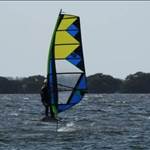
Home base is inland SE US large freshwater lake in the foothills of the Appalachians about 300m above sea level and where the second one was taken.
The photo with the HGO was taken recently in Florida.
Here's one taken yesterday when the wind vastly outperformed forecast - gusts were close to 30 kts. I had inadvertently left the small sails at home and went out on my 4.7. Foil is AFS 95 and F800/1080 wing. Not my most elegant session but only swam a couple of times.
Select to expand quotePaducah said..azymuth said..Paducah said..
Top pix
Where are you foiling?
I'm grateful for the compliment. Means a lot.
Home base is inland SE US large freshwater lake in the foothills of the Appalachians about 300m above sea level and where the second one was taken.
The photo with the HGO was taken recently in Florida.
Here's one taken yesterday when the wind vastly outperformed forecast - gusts were close to 30 kts. I had inadvertently left the small sails at home and went out on my 4.7. Foil is AFS 95 and F800/1080 wing. Not my most elegant session but only swam a couple of times.
Perfect day for the F700S wing (aka S670), I had it out in similar conditions twice with a 4.5, was so easy to control, kinda surreal because the wind is howling, 2-3' plus waves are blowing into the air, and I was foiling along comfortably!, but sheeting way out in the peak gusts.
But kudos to you for doing it with the F1080, I used to use the F1080 in those conditions with a 5.8, had to stop out on the water and let the +25 knot gusts pass because the sail was so overpowered it did not work properly.
Since all foil wings are lifting surfaces, the faster you go, the more lift you get. Basic physics.
This is why you progressively shift your weight subtly forward as you go faster. I set my geometry and shimming to start off with more back foot (70%) at slow speed (11 mph boat speed on the i76, for example), and balanced feet (50-50) at cruising speed (18 mph). At 22 mph it is all front foot. Most of us simply move our back foot forward at this speed. You see this in most of the videos.
Yes, the Moses 720 wing is a beast. You have to really keep the hammer down to keep it flying since it has a high stall speed. But, boy, is it fast. The Moses 950 is a cream puff in comparison.
Select to expand quotesegler said..
Since all foil wings are lifting surfaces, the faster you go, the more lift you get. Basic physics.
This is why you progressively shift your weight subtly forward as you go faster. I set my geometry and shimming to start off with more back foot (70%) at slow speed (11 mph boat speed on the i76, for example), and balanced feet (50-50) at cruising speed (18 mph). At 22 mph it is all front foot. Most of us simply move our back foot forward at this speed. You see this in most of the videos.
Yes, the Moses 720 wing is a beast. You have to really keep the hammer down to keep it flying since it has a high stall speed. But, boy, is it fast. The Moses 950 is a cream puff in comparison.
Agreed alround