Select to expand quoteaeroegnr said..Sandman1221 said..
It always important to remember it can be dangerous, that helps temper my foiling gybe attempts, was out the other day with short gusts so was not powered up enough, but decided to try anyway and was finishing the gybes on the water. But one time I got too back footed as the wind backed off and tail went down to water, let go of boom and bailed. What happened next was interesting, wind pushed sail forward and nose down, that pushed tail "back up" into the air since I had exited the back of the board, and I as I was falling straight down into the water saw the rear of the foil lift up out of the water. The trailing edge of the stab. slammed into my knee, I always wear leg coverings this time just thin compression pants, that saved me from a a nasty cut but still got a blood red line across my knee just under knee cap. I also got caught in the middle of the flip by a gust, it launched board forward and I smacked my elbow on the mast as I fell backwards, that was a month ago and elbow is just getting better (but on the day it felt fine). In both of those accidents I got back weighted during gybe, so will be careful to make sure I am slightly forward weighted going into the gybe. Would rather end with a planing gybe than like in the above accidents.
I try really hard to not let go of the boom and stay fast to avoid falling off the back but it does happen

Nice recliner, looks like your right hand is reaching for a beer!
But seriously, I like your rear exit since you are getting away from the foil. I tend to want to stay close to the board in a crash, but that is not a good habit.
So it's all a trade off. Front foot or back foot?
If you set up your gear for front-foot pressure all the time (like Grant espouses), you can more easily make jibes. i get that. Back foot comes forward to just behind the leeward footstrap, and then the switch is easy. Problem is that this setup is prone to breaches when foiling along, and it burns out my front leg. I hate foiling this way because it feels right on the edge of disaster all of the time. I'm constantly having to push down. Not that much fun.
If, on the other hand, you set up your gear with more back foot pressure until up to speed, then balanced between both feet AT SPEED (I prefer this), it is more difficult to make the jibe because keeping the pitch balanced is more technical while you do the dance. Yes, I agree about this from experience. However, I can foil along in gusty conditions with hugely varying speed without breaching. More relaxing and no leg burn. If I come down off the foil and do a regular planing jibe on the water, no biggie. I stayed dry, and my jibe was, maybe, 5 seconds slower to the new tack up on the foil.
Bruce Peterson prefers the latter setup, and he makes all his jibes, even one-handed. If he can make them, then so can I (well, maybe not ). This setup forces you to carry good speed into, and through, the jibe, which is a good idea anyway. He is always saying that if you want to freeride foil fast, you have to set up your gear this way. Otherwise, you are constantly fighting the pitch.
So, pick your poison. Front foot? Or back foot?
PS April is usually the beginning of summer here in eastern Washington state. However, we have been getting snow. Sheesh.
Select to expand quotesegler said..
So it's all a trade off. Front foot or back foot?
If you set up your gear for front-foot pressure all the time (like Grant espouses), you can more easily make jibes. i get that. Back foot comes forward to just behind the leeward footstrap, and then the switch is easy. Problem is that this setup is prone to breaches when foiling along, and it burns out my front leg. I hate foiling this way because it feels right on the edge of disaster all of the time. I'm constantly having to push down. Not that much fun.
If, on the other hand, you set up your gear with more back foot pressure until up to speed, then balanced between both feet AT SPEED (I prefer this), it is more difficult to make the jibe because keeping the pitch balanced is more technical while you do the dance. Yes, I agree about this from experience. However, I can foil along in gusty conditions with hugely varying speed without breaching. More relaxing and no leg burn. If I come down off the foil and do a regular planing jibe on the water, no biggie. I stayed dry, and my jibe was, maybe, 5 seconds slower to the new tack up on the foil.
Bruce Peterson prefers the latter setup, and he makes all his jibes, even one-handed. If he can make them, then so can I (well, maybe not ). This setup forces you to carry good speed into, and through, the jibe, which is a good idea anyway. He is always saying that if you want to freeride foil fast, you have to set up your gear this way. Otherwise, you are constantly fighting the pitch.
So, pick your poison. Front foot? Or back foot?
PS April is usually the beginning of summer here in eastern Washington state. However, we have been getting snow. Sheesh.
Agree with you about your setup, that is how my board is set up. Andy made one gybe after another on my setup, so it works! Now when I head hard upwind I sheet in and that makes me use some front foot pressure but nothing tiring, and for long cross wind runs I am balanced on the board. Just need to carry enough speed into gybe, and that takes more wind than what it takes to just foil along, that is what I am learning to do, judge wind speed separate from my ability to stay foiling. So have to plan the foiling gybe based on the gust, and if the gust drops off then just do a planing gybe, or if it drops off a lot then a tack. Some of my runs have a low wind zone at one end, so if I want the longest run have to sacrifice the ability to do a foil/planing gybe.
But after I learned to pump the foil in flight, thought I could use that in a foiling gybe to get around in low wind, maybe but will wait to get the normal foiling gybe working before trying to add that to it!
Select to expand quotesegler said..
So it's all a trade off. Front foot or back foot?
If you set up your gear for front-foot pressure all the time (like Grant espouses), you can more easily make jibes. i get that. Back foot comes forward to just behind the leeward footstrap, and then the switch is easy. Problem is that this setup is prone to breaches when foiling along, and it burns out my front leg. I hate foiling this way because it feels right on the edge of disaster all of the time. I'm constantly having to push down. Not that much fun.
If, on the other hand, you set up your gear with more back foot pressure until up to speed, then balanced between both feet AT SPEED (I prefer this), it is more difficult to make the jibe because keeping the pitch balanced is more technical while you do the dance. Yes, I agree about this from experience. However, I can foil along in gusty conditions with hugely varying speed without breaching. More relaxing and no leg burn. If I come down off the foil and do a regular planing jibe on the water, no biggie. I stayed dry, and my jibe was, maybe, 5 seconds slower to the new tack up on the foil.
Bruce Peterson prefers the latter setup, and he makes all his jibes, even one-handed. If he can make them, then so can I (well, maybe not ). This setup forces you to carry good speed into, and through, the jibe, which is a good idea anyway. He is always saying that if you want to freeride foil fast, you have to set up your gear this way. Otherwise, you are constantly fighting the pitch.
So, pick your poison. Front foot? Or back foot?
PS April is usually the beginning of summer here in eastern Washington state. However, we have been getting snow. Sheesh.
A front footed setup is nothing like how you describe. Doesn't burn the leg and definitely offers less breaching issues in chop.
Except for slalom and GPS guys every competent foiler runs a front leg bias for a reason.
I've run both setups extensively, in rolling swell. Have you?
Segler, here in another point, when I go into a foiling gybe underpowered with my front foot in the strap the nose goes down first and I turn it into a planing gybe, but if I move my front foot back 8-9" out of the strap and go into a foiling gybe even more underpowered then the board comes down flat on the water and that tells me I have everything balanced. So front foot position is important, but you still need enough wind to foil through the gybe. Looking at a session with hopefully steady winds and flat water soon, will see how it goes!
Select to expand quotesegler said..
So it's all a trade off. Front foot or back foot?
If you set up your gear for front-foot pressure all the time (like Grant espouses), you can more easily make jibes. i get that. Back foot comes forward to just behind the leeward footstrap, and then the switch is easy. Problem is that this setup is prone to breaches when foiling along, and it burns out my front leg. I hate foiling this way because it feels right on the edge of disaster all of the time. I'm constantly having to push down. Not that much fun.
If, on the other hand, you set up your gear with more back foot pressure until up to speed, then balanced between both feet AT SPEED (I prefer this), it is more difficult to make the jibe because keeping the pitch balanced is more technical while you do the dance. Yes, I agree about this from experience. However, I can foil along in gusty conditions with hugely varying speed without breaching. More relaxing and no leg burn. If I come down off the foil and do a regular planing jibe on the water, no biggie. I stayed dry, and my jibe was, maybe, 5 seconds slower to the new tack up on the foil.
Bruce Peterson prefers the latter setup, and he makes all his jibes, even one-handed. If he can make them, then so can I (well, maybe not ). This setup forces you to carry good speed into, and through, the jibe, which is a good idea anyway. He is always saying that if you want to freeride foil fast, you have to set up your gear this way. Otherwise, you are constantly fighting the pitch.
So, pick your poison. Front foot? Or back foot?
PS April is usually the beginning of summer here in eastern Washington state. However, we have been getting snow. Sheesh.
I really don't like the idea of having the foil set up with back foot pressure, which only balances out to equal foot pressure when you're foiling at speed.. The early Starboard and F4 / NP foils were typically set up in this manner.
It's the equivalent of setting your harness lines really far back on the boom, so that you're balanced at speed, because the centre of effort has wandered further back on your old freeride sail. So not an ideal situation.
As sails have developed, one of the goals has been to stabilise the draft so it doesn't mean the sail gets back handed.
So in my experience with the plus series of Starboard fuselages, they have gone some way towards reducing the extra lift at speed problem, by moving the front wing forward and reducing the tw angle.
The front pressure is now front front to neutral biased.
But more importantly, the foot pressure bias doesn't change that much with changes in speed.
My thoughts are that, if you have to add excess shims to get the necessary front foot pressure, the foil will always change its balance at different speeds, as the tw will add variable lift depending on speed .
Presumably this will add unnecessary balance complications through the gybe ...the foil will change its pressure requirements to keep it flying..as it slows or speeds up through the arc or down a wave.
Select to expand quotePaducah said..
How much do you weigh? I've only windfoiled the L - then I was just around 70 kg and it was pretty standard although not super speedy or glidey. Can you find a flatter spot to give it a few goes? Find a docile spot on a 15-20 day and I think you can give it a few goes without feeling totally freaked out the whole time. A lot of dealing with swell under foot, imho, is not looking down but keeping a laser focus on your exit - it allows your autopilot to keep you steady instead of so much having to think about it. Also, I assume you are using the 80/85cm masts? The shorter masts will absolutely require flat water for the learning phase, imho. I'm on 95s on my gear and partly because even with an 85, I'd foil out going over swell in bigger conditions.
As for tips, much of what was said above, this is what works for me: Speed is your friend - the power shuts off as you turn down wind, small arc in light conditions, big arcs more powered up, jibe in the gusts if not full powered, spot your exit through the window of the sail (don't look over the nose), bend the knees, extend front arm, open the backhand (over sheet only for like a second if at all) and really open the sail, sweep the sail across your face (make the harness lines go from one side to the other of your nose) and get it to the outside of the turn. Flipping sooner rather than later with the front hand beside the mast. Exit going somewhat downwind. And... it's okay to touch down a bit, especially on exit. No one is rating your jibes. However, the less time the board spends on the water, the less speed you'll lose.
Sorry about your injury. I know in your world, it feels like another is just around the corner but I think you've used up your quota of freak accidents. 
Thanks guys for all your comments and suggestions, very much appreciated!
@aeroegnr Sorry to hear about the after-effects of broken leg, I can imagine it must play on your mind a wee bit. Yeah I guess I just need to get back on the horse really, small steps, flat water!
@Paducah I weight 78kg. For sure where I was tring this was messy, swell one direction wave fetch from the other, wasn't easy conditions and I over-estimated my capabilities, I love gybing a windsurfing board, any size, technically a joy, but this one bit me. Flat water is definitely where I will try next.I use around 85cm mast yep, on a 125L JP SUP Foil with Twin Tracks, no straps.
Speed; yes my big foil isn't made for speed, but I haven't got to a point where I am carving the foil around, I was sort of waiting for it to "surf" around I guess.
@Sandman1221I think it was getting backwinded, per your experience, I sort of did a bit an S IIRC .
@Awalkspoiled Funny thimg is I winged that foil for a while, so pumping was quite natural; maybe I should try a smaller foil..
Lots to think about and try!
Cheers
k.
Put me in the "broke my fibula during the blown flying jibe" club. It took me four months to get back on the water and a couple of months after that to even try a jibe. I sailed sans foot straps for a long time and only recently put them back on. Still scared of them and the thought of not moving my foot back before jibing is really a non-starter. The only reason I put the straps back on was carrying the board and pumping.
Also, when I watch the videos of Greg & Emily they are going a lot slower than I am entering the jibe. (But faster leaving ??) and, if anything, they appear to be leaning back slightly in the photos on page 1. Their feet are still in the front straps though. Maybe I'll get over the mental hurdle, maybe not.
The, "go in at 4 and leave at 7:30" is something I've been working on. I'll re-emphasize it, thanks. In 30 years on the fin I never tried to sail switch and now I'm paying for it. Never got the hang of clew first either, but I'm trying now. The idea of "look ahead and spot your exit" is something that I haven't been doing and I will start immediately. Thank you for that.
Select to expand quoteBullroarerTook said..
The, "go in at 4 and leave at 7:30" is something I've been working on. I'll re-emphasize it, thanks. In 30 years on the fin I never tried to sail switch and now I'm paying for it. Never got the hang of clew first either, but I'm trying now. The idea of "look ahead and spot your exit" is something that I haven't been doing and I will start immediately. Thank you for that.
I've been playing around with this a lot with a big floaty board at subplaning speeds, and when doing shlogging jibes with the 9.0hgo when the wind drops. Just exiting clew first and sailing there for a while before the flip. Also using a small 5.0 in light winds and just ducking and flipping over and over, doing circles around a beginner I'm teaching to keep an eye on them. I've worked to ducking the 5.8 but that's the biggest so far.
It doesn't get the fear/speed carving stuff down but it helps me manipulate the sail so much better without having to look at it. When you can duck and do a flip back to normal sail position with your eyes on the horizon it really gives you confidence on the foiling jibe flip.
Select to expand quoteaeroegnr said..BullroarerTook said..
The, "go in at 4 and leave at 7:30" is something I've been working on. I'll re-emphasize it, thanks. In 30 years on the fin I never tried to sail switch and now I'm paying for it. Never got the hang of clew first either, but I'm trying now. The idea of "look ahead and spot your exit" is something that I haven't been doing and I will start immediately. Thank you for that.
I've been playing around with this a lot with a big floaty board at subplaning speeds, and when doing shlogging jibes with the 9.0hgo when the wind drops. Just exiting clew first and sailing there for a while before the flip. Also using a small 5.0 in light winds and just ducking and flipping over and over, doing circles around a beginner I'm teaching to keep an eye on them. I've worked to ducking the 5.8 but that's the biggest so far.
It doesn't get the fear/speed carving stuff down but it helps me manipulate the sail so much better without having to look at it. When you can duck and do a flip back to normal sail position with your eyes on the horizon it really gives you confidence on the foiling jibe flip.
The speed going into a foiling gybe is relative to the wing, some are slow and high lift like the i84, others are faster like the F1080. What has helped me a lot in getting comfortable with the speed needed to enter a foiling gybe, is to start out in the air and transition to a planing gybe before the sail flip, keeping the board on the surface of the water gives support and if things go sideways you are close to the water and foil is well under water. It is also fun, but need fairly flat water.
Good discussion. Useful for me at least.
Grant you have previously described your 70% front foot as having the sail mast base as far aft as possible and the foil as far forward as possible. You have said that this reduces the effects of gusts on pitch variation. This part of it makes sense since the whole geometry is compressed.
What I don't understand is how you can keep the foil in the water. I have tried this setup (many times), and it's breach city and a dead front leg.
Yes, I have foiled my back-foot-oriented setup on the famous rolling swells at 3-Mile Canyon in the eastern gorge. When I start to glide down a swell, the speed picks up, but I avoid the breach, even with the sail sheeted out. With the front foot setup, I can't imagine how you could glide down a swell without the foil breaching, especially if you luff the sail.
I'm probably missing something here.
When you've got the mast base back and most of the weight on your feet then having the power on and off doesn't effect pitch much.
For the short, steep swell I foil in I need a fast responding foil which is what compact geometry creates. How I balance a foil is if I need any back foot pressure to counter sheeting in upwind I move the mast base back. I'm actually having the track moved rearward in my board right now, it'll allow me to run the base about 4" forward of the front straps although I'm guessing I won't go quite that far.
That should also let me move the front wing back by using one of the fuselages I made, closer to a wingfoil geometry.
If the mast base is too far forward on a freerace foil there will be too much rake in the rig. You'll end up with harness lines too short and an inefficient setup while also being excessively front footed on what would otherwise be a balanced setup.
Select to expand quotesegler said.. When I start to glide down a swell, the speed picks up, but I avoid the breach, even with the sail sheeted out. With the front foot setup, I can't imagine how you could glide down a swell without the foil breaching, especially if you luff the sail.
I'm probably missing something here.
Try and get you weight fully over your front foot and push down on the boom as you fly down the swells. If you're still getting lifted turn even more downwind.
I've tried to show it in the video just posted
Select to expand quoteBullroarerTook said..
If we look at Greg on page 1 he has the sail mast full forward though.
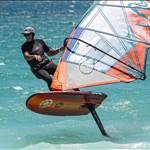
In the photo of Tony's one-hand jibe his mast base is all the way forward. Yes, the geometry of every board is different, but on this Wizard do you think his setup might be considered back footed? On my Wizard 125 and an i76 in B position I'm thinking about moving my mast base further forward--currently about a third back from the front of the track.
Everywhere in the various foiling videos you see guys jibing with their leeward foot well back from the footstrap. See this one:
Select to expand quoteGrantmac said..
I'm actually having the track moved rearward in my board right now, it'll allow me to run the base about 4" forward of the front straps although I'm guessing I won't go quite that far.
Sort of related. Something I've noticed when shlogging the foilx when the wind drops is that the mast base is so close to the front straps that it's easy to get tripped up in them when tacking. Much less of an issue with the iqfoil setup because of the width and strap positions.
Presumably the short nose boards are almost always being flown through jibes, but it has made me have to be extra careful with such a compact geometry board, even 145l, when the wind drops and there is still bay swell. I don't feel like I'll have swims of shame like I had with the wizard 114 but it's not like shlogging a small fin board with more nose volune.
Select to expand quoteaeroegnr
Sort of related. Something I've noticed when shlogging the foilx when the wind drops is that the mast base is so close to the front straps that it's easy to get tripped up in them when tacking. Much less of an issue with the iqfoil setup because of the width and strap positions.
Presumably the short nose boards are almost always being flown through jibes, but it has made me have to be extra careful with such a compact geometry board, even 145l, when the wind drops and there is still bay swell. I don't feel like I'll have swims of shame like I had with the wizard 114 but it's not like shlogging a small fin board with more nose volune.
That is why I have stayed with the Bolt 135, not perfect for foiling gybes though Andy did easily, but I can tack when I want to and is stable in waves and swell, and it is great for planing gybes, would not want to try a planing gybe on a short nosed foil board would risk catching the nose and crashing.
Tony (first picture) and Emily are using tiny sails in the Gorge. Mast base position isn't terribly critical. Emily also rides a huge foil mast. Notice both shots are in the flat water areas regularly used for photos.
Tony is also using the H2 foil, likely in B position, which I bought right around when that promo shot was taken. Not a very front footed foil in B position (I ran it exclusively in C) but again when you are using tiny sails in a fair amount of wind and flat water you can get away with lots.
Notice the later Slingshot rider is also on a very small sail (I believe it was a 3.6) with a compact geometry so their mast base pressure isn't going to be significant.
Aero: I'm used to slogging waveboards, so having the mast next to my front foot and the back foot almost on top of the straps is a pretty regular thing for me. I don't bother tacking my small foil board when slogging, no point when doing pivot gybes is good practice for wavesailing.
I see Grantmac has recently replied to this topic, but I cannot see their post, it is like they are hidden.
Select to expand quoteGrantmac said..
Tony (first picture) and Emily are using tiny sails in the Gorge. Mast base position isn't terribly critical. Emily also rides a huge foil mast. Notice both shots are in the flat water areas regularly used for photos.
Tony is also using the H2 foil, likely in B position, which I bought right around when that promo shot was taken. Not a very front footed foil in B position (I ran it exclusively in C) but again when you are using tiny sails in a fair amount of wind and flat water you can get away with lots.
Notice the later Slingshot rider is also on a very small sail (I believe it was a 3.6) with a compact geometry so their mast base pressure isn't going to be significant.
The Emily/Greg style is what I am trying to achieve. I sail on the SF bay with a 4.2 most of the time, followed by a 3.5 or a 5 usually with a 1500 or 1250 sqcm foil. I even use the Fringes like they (used to) do.
Select to expand quoteBullroarerTook said..Grantmac said..
Tony (first picture) and Emily are using tiny sails in the Gorge. Mast base position isn't terribly critical. Emily also rides a huge foil mast. Notice both shots are in the flat water areas regularly used for photos.
Tony is also using the H2 foil, likely in B position, which I bought right around when that promo shot was taken. Not a very front footed foil in B position (I ran it exclusively in C) but again when you are using tiny sails in a fair amount of wind and flat water you can get away with lots.
Notice the later Slingshot rider is also on a very small sail (I believe it was a 3.6) with a compact geometry so their mast base pressure isn't going to be significant.
The Emily/Greg style is what I am trying to achieve. I sail on the SF bay with a 4.2 most of the time, followed by a 3.5 or a 5 usually with a 1500 or 1250 sqcm foil. I even use the Fringes like they (used to) do.
Depends on if you want power carves or flagged riding but that would be a very small tweak. You'll notice the newest Slingshot boards have compact geometry.
Select to expand quotesegler said..
If, on the other hand, you set up your gear with more back foot pressure until up to speed, then balanced between both feet AT SPEED (I prefer this),
As your balance is becoming more front footed at speed, I think your foil setup has too much stabiliser downforce (either too big or too much angle). With the right stabiliser size and/or shimming you can minimise balance changes like that.
If I rode my board and it felt like that I would:
1) More the foot straps back (or foil forwards in tracks) so that it wasn't so back footed at slower speeds
2) Use a smaller stabiliser or reduce it's angle to avoid the balance becoming too front footed at high speed
I agree with Grantmac - moving the mast foot doesn't have much impact on balance
Select to expand quoteGrantmac said..
A front footed setup is nothing like how you describe. Doesn't burn the leg and definitely offers less breaching issues in chop.
Except for slalom and GPS guys every competent foiler runs a front leg bias for a reason.
I've run both setups extensively, in rolling swell. Have you?
I think riding in a front footed setup makes it easier to avoid breaches because you already have your weight forward and probably have your front knee slightly bent (instead of your rear knee). You can then quickly add more front foot pressure when needed by bending your front knee a bit more. That seems much faster to me than trying to change my weight bias from rear foot to front foot.
Simon I think you are making what segler said into something else. Like segler my kit is balanced at speed, to initially get up I use a little back foot pressure really toe pressure and that can just be the big toe, when at speed and I get hit with a gust it really depends on the wing what I have to do, with F1080 cm2 wing need to use front foot pressure and/or mast foot pressure (pushing down on boom) to keep board level crosswind or heading upwind and sheeting in then just have front foot pressure like Andy Brandt said, with F770 cm2 wing a little front foot pressure as needed crosswind, with S670 cm2 wing nothing needed. Use the same stabilizer and shim for all three wings. This idea of having constant front foot pressure when foiling is just total BS IMO.
Hey Simon and Grantmac, why don't you both start your own post on this topic, instead of polluting my post with BS that is intended to deliberately mislead people who do not know better?
Select to expand quoteSandman1221 said..
Simon I think you are making what segler said into something else. Like segler my kit is balanced at speed, to initially get up I use a little back foot pressure really toe pressure and that can just be the big toe, when at speed and I get hit with a gust it really depends on the wing what I have to do, with F1080 cm2 wing need to use front foot pressure and/or mast foot pressure (pushing down on boom) to keep board level crosswind or heading upwind and sheeting in then just have front foot pressure like Andy Brandt said, with F770 cm2 wing a little front foot pressure as needed crosswind, with S670 cm2 wing nothing needed. Use the same stabilizer and shim for all three wings. This idea of having constant front foot pressure when foiling is just total BS IMO.
Needing MORE front foot pressure to go upwind makes zero sense to me. The 115+ shifts the wing forward, the 115doublePlus shifts it even further forward to get more extreme upwind/downwind angles for course racing. Should be the same for other race style foils, moreso for shorter fuselages with the effort further back. More rear foot pressure.
When underpowered and flying, I always have a heavily loaded back leg that burns out, even with the 115+, somewhere around 1/4 mile of flight my back leg is dead. More tailwing shim helps. Mast base further back helps.
When I'm pushing deep upwind, it's my back leg that burns. Same downwind.

Select to expand quoteSandman1221 said..
Hey Simon and Grantmac, why don't you both start your own post on this topic, instead of polluting my post with BS that is intended to deliberately mislead people who do not know better?
I don't think I'm misleading anyone but if I am it certainly wasn't deliberate. Sorry to have caused offence - I will stay out of this topic.


Same rules as windsurfing.
Enter the turn full speed on a broad reach riding high on the mast.
Don't flatten the board out during the turn
With bigger sails you need to help it rotate with your back hand
don't overthink it
full speed on a broad reach
full speed on a board reach
To answer SimponP65's comment about shimming, I always shim my Moses and LP stabs for LESS down angle, which means LESS lift at a particular speed.
This has the effect of requiring more back foot to get initial lift, and it's faster. Once up to speed, it's beautiful and balanced.
For the i76 I don't shim. Stock is already perfect.
For the AFS-2 with F800 (now F1080) wing, I have to shim for MORE down angle. Otherwise, it requires far too much back foot.