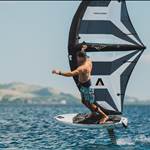
PW: Power Pack 3.6 / Pocket Rocket 3.6
Gear: 85L x 5'10 x 18" board, Armstrong MA890/130 Surf tail
Rider: ~80kg, 2nd season parawinging, riding Flow then PR, ~10 years general foiling
Style: mostly downwind, and up and downs
Conditions: variable wind: as low as 8 gusting 13kt / high as 21 gusting 26kt (4:15PM to 6:45PM), ~2-3 ft wind swell
No brand affiliations, I pay retail. PP on demo from Action Sports WA.
Out at Pinnaroo for a solid couple of hours in some pretty variable wind so got to put the PP through its paces in both overpowered, underpowered and goldilocks conditions in a very short space of time! Fire away with any questions I haven't answered.
Bottom line up front - the Power Pack an excellent parawing and it is very hard to fault. That said, it's not a Pocket Rocket killer. Here's the lowdown:
Stashing - Is pretty much faultless. The front line high split is a cinch, one grab and down it goes, every time. First time I did it in light winds I ended up with the parawing wrapped around my head as it just fell out of the sky when I grabbed it with the usual level of pull I would use for the PR. In strong winds, it is equally easy - you don't need to force the lines together like the PR, and it doesn't spin around like the PR will if you go the centre two line grab. The slightly thicker lines are much nicer to handle and less prone to a tangle as you are packing up. [PP wins]
Relaunch - far more consistent with the PR, the catching of the last rib doesn't happen. Out of 30 or so relaunches on foil I had one fail, where the A-lines wrapped around the B line centre knot and required a sit-down and untangle. The bar is less inclined to catch the A or C lines and is a nice size. [PP wins]
Riding - Exceptionally stable - if you have seen the promo videos of hooked in no-handed rides, this is not pro-level whitewashing, you can quite comfortably do this even in gusty, messy conditions. Hooked in, the ride upwind is comfortable and the wing sits there with rock-solid stability. Riding unhooked feels lighter on the bar, and the stall and dropping into the power zone is easy and controlled. The upwind capability is lacking as you have probably read/seen elsewhere. The conditions were so variable that it was difficult to get some solid long back-to-back runs to measure this, but eyeballing off Little Island there is at least 3-5 degrees difference. Again, I don't have the measurements to back this up, but it also feels slower - the more aggressive scallop at the back end feels like it is not as quick. Hopping back on the PR it is a joy powering upwind and feels faster. The PR is moving about more but just feels better. Think the difference between a high-aspect foil and a low-aspect foil, its not necessarily a bad thing, but there are sacrifices to increased stability. [PR wins]
Get Up - as per the literature, there is 'low-end grunt', but the slightly higher structural stability on the PR makes the pump up easier on the PR for me. I combine a pump up with a fairly aggressive wank of the wing which gets me up in fairly light conditions (see wind chart, rode this whole time). That didn't work as well on the PP. To be fair, first time on it so some technique changes may improve this, but I definitely could get up on the PR at a lower point. [PR wins]
Which one do you need?
So the $1700 question. should you get a Power Pack? Well, the short answers. if you already have a Pocket Rocket - probably not. If you're buying a new parawing - maybe.
Ultimately, the PP is a great downwinding parawing - but that brings us to the quandary of the sport - you don't really use a parawing when you downwind! You get up on foil and pack it away and hopefully don't pull it out again. So if you're only doing it once, do you need a really easy stash? And do you need to be able to relaunch on foil? Personally, in a downwinder my PW will be in use for under 5 minutes in a 1-hour session.
If downwinding is the only thing you do, then the PP is the no-brainer choice. But. if you don't have the time and resources to always be downwinding, the up and down session is the great joy of the sport. And for this, optimising for upwind performance is going to maximise your time riding. The PR remains my choice for an all-round parawing - it points higher and feels nicer riding upwind.
Choose the PP:
-If you primarily, or only downwind
-Speed of stashing and deploying on foil is important to you (eg wave-riding at a break)
-In larger sizes (I haven't tested though), or if your reach is shorter
(Caveat - I have a long arm span and my daily driver downwinding is the 3m, so the stash on that size doesn't bother me too much. In the larger sizes or if you have shorter arms, the PP may be a better option.)
General questions:
Can I learn on it? Can't see why not. I didn't see anything that would be an issue compared with the PR and the lines are a bit easier to manage.
Should I sell my PR's and buy PP's? No, unless one of the things above was going to make you change parawings anyway, there is nothing that will change your life.
Ultimately, both of these are sensational parawings, so don't overthink it - whichever way you're leaning in the Ozone space, you won't regret either of them (or a combination).
As a final aside, the new bag is great - I used that to put the parawing I wasn't using in while on the water, and forgot it was there.
Reference wind conditions (1615h-184h5)
Nice write up and comparison. You touched on something I haven't heard from anyone else and that's the speed of upwind which dives into the racing VMG stuff that most of us don't look at. Losing 4 degrees upwind doesn't sound bad, but losing it and doing it slower is tough to swallow for dedicated upwind/downwind riders for sure. If I'm not getting close to a 1:1 downwind/upwind ratio then I usually want to change it up.
CH3MTR4IL5 what a great detailed review.
You found the exact same negatives as I witnessed. Less pump for light wind get up, less up wind and slower.
I like that you noticed the pump up in light wind of the PR as too many reviews of the frigate have mistaken the static pull and bar pressure of the frigate for good light wind get up results.
I hope the PR v2 doesn't give up that light wind pump up as the way it holds its form as you pump it back in the window and then it accelerates forward with a lovely power spike, that if you can catch it with the bar, it ensures your success in getting off the water is locked in. I haven't witnessed any other brands with that possible bottom end that comes from familiarity with the PR. This is where i think Gav got it wrong.
absolute corker review and matched what i expected. Great nuance given mate brilliant.
And to yourself and anyboard I've been trying to explain that bottom end capability of the PR - low end grunt is not what it's cut out to be is it for starting. PR as you said accelerates forward from the back of the window (with a consequent power spike) match this with good board pumping and the bar catch . rinse and repeat this action quickly if needed . but the thing is your board now has momentum . just good board pumping and para control you are away..
Whilst the two others i've tried (only 2 mind you) drop back into the back of the window and . well stay there.  and you lose that board speed. As you said diff technique needed.
We did a overall downwind yesterday, but turned a small 7-8km DW into 25km . up winding and sending it on the best runners . was very glad to be on the PR for that.
ps how good are the Mas for para !!! Shoukd be getting the 890 size soon can't wait !
Select to expand quoteAnyBoard said..
CH3MTR4IL5 what a great detailed review.
You found the exact same negatives as I witnessed. Less pump for light wind get up, less up wind and slower.
I like that you noticed the pump up in light wind of the PR as too many reviews of the frigate have mistaken the static pull and bar pressure of the frigate for good light wind get up results.
I hope the PR v2 doesn't give up that light wind pump up as the way it holds its form as you pump it back in the window and then it accelerates forward with a lovely power spike, that if you can catch it with the bar, it ensures your success in getting off the water is locked in. I haven't witnessed any other brands with that possible bottom end that comes from familiarity with the PR. This is where i think Gav got it wrong.
If the PR v2 keeps the current canopy (or with minor tweaks) and go to the new lines and split A's they could be onto a winner.
Great review ??
I was hoping the PP would replace my PR's but sounds like I might need both ??
I was out at Pinnaroo with Jack at exactly the same time.
One thing that may not be clear from his excellent review, but was noticeable to me, was the wind range of the 3.6. The graph shows how variable the wind was and he seemed to manage the 3.6 well from 12 knots all the way up to 25. That's impressive. He always looked comfortable.
Of course, pilot skill is a major component in that. Nevertheless when compared to my experience at the same time, I switched back and forth between a 3 and 4m2 parawing. I'm a year behind Jack in the skills department though.
Ozone (correctly) positions the PP as suitable for sailors with experience. I can see how this wing amplifies the existing abilities of an experienced user.
Also, Ozone's recommended wind range for the PP and is remarkably wide across all the sizes. This may be underplayed in their positioning and marketing of the PP.
Based on what I saw, in the hands of an experienced sailor, the PP could be a one wing solution, eg the 3.6
from 12 - 25 knots. I find that very attractive and something to aspire to as I improve.
For now, my lesson from yesterday is to start taking two wings out with me more often. I initially thought that was a crazy concept, but can see the utility in the approach.

Select to expand quoteArthurAlston said..
I was out at Pinnaroo with Jack at exactly the same time.
One thing that may not be clear from his excellent review, but was noticeable to me, was the wind range of the 3.6. The graph shows how variable the wind was and he seemed to manage the 3.6 well from 12 knots all the way up to 25. That's impressive. He always looked comfortable.
Of course, pilot skill is a major component in that. Nevertheless when compared to my experience at the same time, I switched back and forth between a 3 and 4m2 parawing. I'm a year behind Jack in the skills department though.
Ozone (correctly) positions the PP as suitable for sailors with experience. I can see how this wing amplifies the existing abilities of an experienced user.
Also, Ozone's recommended wind range for the PP and is remarkably wide across all the sizes. This may be underplayed in their positioning and marketing of the PP.
Based on what I saw, in the hands of an experienced sailor, the PP could be a one wing solution, eg the 3.6
from 12 - 25 knots. I find that very attractive and something to aspire to as I improve.
For now, my lesson from yesterday is to start taking two wings out with me more often. I initially thought that was a crazy concept, but can see the utility in the approach.
Yeh this is a really good addition to Jacks review. Reason being I'm pretty much the same weight with a very similar board dimension wise and i know i woukd struggle in 12 -15 knots . I need to be on my game even with the 4.3 PR in that - and really need 14-15 especially in ocean swell to get going. Also i tend to run say the 780ha with a similar size tail so that's kind of equivalent to the 890ma as well. I'm only 3-4 months in. Experience def counts.
Jack you a natural or goofy and what side you generally taking off from ? (must admit pinnaroo is a lot flatter that where i start so another factor).
Also any starting tips would be appreciated .
True Arthur, and I didn't feel that the PP was overpowered at any point, I think it would push well into the 30kt mark. It would be good to compare overpowered as I suspect that the PP would be a lot more comfortable at the very top of the range compared with the PR which can get uncomfortable in bullets, and might be easier to control power when getting going in extreme conditions.
I don't think the PR has significantly less range though, and the 3.6 is definitely an awesome allrounder size in either model if you are only going to have a single parawing.
@WingmanWA - its really mining for tenths of points between the two, they are both great but I wouldn't take a bath on selling your PR's to replace with a PP though. As @Stormus touches on, the dream will be the next-gen best of both worlds, the mid-point between the two would be my perfect PW - a smidge less stability in exchange for speed and pointing, split the difference in the line lengths, and retain the rest of the characteristics of the PP and you'd have an all-rounder amazing machine with very little compromise.
@Anyboard/@eppo totally agree on the pump of the PR, one thing I noticed was if I am struggling with the PR I can bear off a long way (almost downwind) to get a bit of swell for a pop-up, and still retain power from the parawing, and then pump back through to 45 degrees off the wind and get going. This lets me ride the 3m in really light conditions (not whitecapping), if there is swell. If I tried this technique with the PP it didn't have the rebound from the parawing to power back up in time with my pump.
@eppo I am loving the MA's, the 790 rocks for downwinding and the 890 if its smaller, the 890/170 on a wave is the best balanced foil I've ever ridden, the only time I fall off is when the rail catches, it feels like actual surfing. Think I'm going to say farewell to the HA's (reference other thread about too many foils).
Select to expand quoteeppo said..
Jack you a natural or goofy and what side you generally taking off from ? (must admit pinnaroo is a lot flatter that where i start so another factor).
Also any starting tips would be appreciated .
I'm natural and generally starting that way (eg heelside out to sea). I rarely take off switch or toeside which is mostly weakness on my part - if I want to go upwind I'll do a flying foot swap to go switch.
In general my issues with takeoffs where that I was pointing too high. Coming from winging/kiting you tend to default to the across the wind takeoff. I start my pump now at about 45 degrees off wind, and if its light I will point the board a bit further downwind and jink it back across to 45 as I pump the parawing (see comment above).
But 90% of it is getting the board to release through the foot pumping, getting a balanced pump to pop the board is most of the work. Again coming from winging I tended to be back foot heavy and it took me a while to get more centred across the board and then pump the board so it releases off the water.
FWIW, the MA890 was a big lever for me in improving this, the HA's are a bit more skittish in the pop up, whereas a solid double leg pump gets the MA almost immediately out of the water at slow speed, and then the parawing does the rest. Once I had that technique, dropping down to the 790 I didn't notice any loss of bottom end takeoff (I would have ridden the 790 in yesterday's conditions, but I wanted to get some small downwind runs to test the stash and throw, and wouldn't have had enough glide at Pinnaroo).
Great advice above and i concur with the start up observations both as the basic technique and also the difference i found between the PR and the other lower aspect paras ive tried - one of them very low aspect the other more mid aspect. Of course bridles, weight and overall design comes into play . and of course experience with each wing. Hence why i'm not naming brands nor knocking them - too many factors involved.
But there is no doubt you can point further DW and pump the para through that 45 window you talked about. And infact you can repeat this movement a few times quickly which helps not only build board speed but gives you time to get your feet / body pumping correctly. Once i understood this then things got much easier.
Im still waiting for my ML75 (hopefully soon) which from riding this and the 65Ml in the past lends itself even more to the technique received above. The board i'm on now is a pretty decent para board shape, very stable, volume in the nose, Sqaured short tail, parallel rails and simple flat bottom - but it has drag until it doesn't if you know what i mean. If you mis time this deep in the window to 45 spike you will fall back from the swell line coming through and the board speed stops. Found the ML whilst lacking some good features of a para board does move and release earlier and allows you to apply that technique mentioned above to a greater extent. I predict a para board somewhere in between these boards will be ideal in the future.
Chem - I have some Mas on the way - JL it's all he uses now and he's ripping. We got inspired doing a secrets run with oskar and aiden (and watching guy at the flow thingy) . so weird how what foil type you want is shifting because of this para thing. As long term armie riders we were complaining for a long time for some higher aspect sup foil paddle wings with more glide and speed . then we started parawinging . and in the end the inherent turning ability of the armie wings are a massive bonus now! Who would have thought 
Great to know the start is easier . you are right the HAs which i use do require some board / water over the them and you need to keep it all going a bit before you commit to angling upwind and riding off. But i do love the 780Ha be hard to give it up . probably in weaker less powerful conditions it will have its place.
Thanks for the tips hey!
Select to expand quoteBWalnut said..
Nice write up and comparison. You touched on something I haven't heard from anyone else and that's the speed of upwind which dives into the racing VMG stuff that most of us don't look at. Losing 4 degrees upwind doesn't sound bad, but losing it and doing it slower is tough to swallow for dedicated upwind/downwind riders for sure. If I'm not getting close to a 1:1 downwind/upwind ratio then I usually want to change it up.
VMG is really the product of two things: how high you can sail and how fast you can do it -- in racing terms, cosine of the angle multiplied by speed.
So, if the difference between the P.Rocket and the P.Pack is 4 degrees, at about 45 degrees upwind sailing, exactly the VMG difference is as follows:
If you are sailing at 45 degrees with the P.Rocket and the Power Pack is sailing at 49 deg (a 4-degree difference), the VMG factor: cos(45) = 0.707 - cos(49) = 0.656 .... so the Upwind Performance Gap: = 0.927 (a 7.3% loss in VMG)
....7.3% VMG difference is massive in racing but not so relevant if you are free-riding or upwind for surfing !!
In practical terms, here's a AI contribution calculation (by Gemini) to reach 1 nautical mile upwind,

extra Time to Target is 19 seconds, into a total of 5 min sailing upwind, a massive time difference in racing but not so relevant if you are free-riding or upwind for surfing !!
_______
Also, talking about SPEED only, in foiling disciplines (Parawing or Wingfoil), the hydrodynamic drag from the foil is significantly greater than the aerodynamic drag from the wing. Because water is roughly 800 times denser than air, the foil's efficiency dictates your ability to maintain speed at tight angles.
Conclusion... In practical terms, rider skill and foil design are the primary drivers of VMG. A mediocre wing paired with a good / low-drag foil will always out-point and out-run the best parawing/ wing in the world paired with an average foil.
That calculation assumes that both parawings produce the same speed on the same foil, which I don't think is true. Your speed is not determined solely by the foil.
As your opening statement says, VMG is a
combination of speed and upwind angle, and my assertion is that at its maximum upwind angle, the PP is both pointing lower than the PR and is producing less speed.
Select to expand quoteCH3MTR4IL5 said..
That calculation assumes that both parawings produce the same speed on the same foil, which I don't think is true. Your speed is not determined solely by the foil.
As your opening statement says, VMG is a
combination of speed and upwind angle, and my assertion is that at its maximum upwind angle, the PP is both pointing lower than the PR and is producing less speed.
technically, you are right because the parawing+foil has different speed at different angles (aka, the Polar Diagram, which is the ultimate cheat sheet in racing) but it does not contradict my previous post, because the foil speed al higher angle (less upwind, like the Power Pack ) is FASTER than the speed at low angle (P.Rocket in this case)
I was really looking at this comment when I made mine:
"Again, I don't have the measurements to back this up, but it also feels slower - the more aggressive scallop at the back end feels like it is not as quick. Hopping back on the PR it is a joy powering upwind and feels faster." - CH3MTR4IL5
So, I'm thinking lower angles and traveling at slower speeds. Not same speed at different angles. Lower angles for me also equates to more jibes which can really add up in a river:

That's why I tend to rely on simple lap checks. When I'm riding and really trying to collect data I hit the lap reset button when I reach the end of my run, go upwind, then hit it again for the ride down and I compare the two times, aiming for 1:1.
FranP, other than rider skill being a relevant factor in vmg, I don't agree with anything you are saying.
The density of the fluid is only one parameter in the drag equation and does not automatically mean drag in the higher desnity medium is higher. John Shuttleworth showed, back in the 90s, the air drag for a very sleek catamaran sailing upwind was substantially higher than the water drag. A foiling vehicle, such as our boards, will relatively reduce the water drag substantially compared to the best displacement hull possible.
Your own 7.3% calculation completely ignores your assertion that both speed and angle matter, accounting only for angle.
You've completely ignored the input here from people who have actually ridden both the the PR sail higher and faster, contradicting them to make an apparently theoretically based assertion that the PR must sail slower because it is sailing higher.
The AI barf of a calculation is of very limited value, these tools are not remotely reliable for such kinds of calculations at this point. Correctly including the speed component of vmg in the calculation and you can easily end up with a 15 or 20% improvement in vmg. Or a whole extra lap for a typical 2km upwind/downwind run during a 2.5hr session. Hardly insignificant.
FranP, other than rider skill being a relevant factor in vmg, I don't agree with anything you are saying.
The density of the fluid is only one parameter in the drag equation and does not automatically mean drag in the higher desnity medium is higher. John Shuttleworth showed, back in the 90s, the air drag for a very sleek catamaran sailing upwind was substantially higher than the water drag. A foiling vehicle, such as our boards, will relatively reduce the water drag substantially compared to the best displacement hull possible.
Your own 7.3% calculation completely ignores your assertion that both speed and angle matter, accounting only for angle.
You've completely ignored the input here from people who have actually ridden both the the PR sail higher and faster, contradicting them to make an apparently theoretically based assertion that the PR must sail slower because it is sailing higher.
The AI barf of a calculation is of very limited value, these tools are not remotely reliable for such kinds of calculations at this point. Correctly including the speed component of vmg in the calculation and you can easily end up with a 15 or 20% improvement in vmg. Or a whole extra lap for a typical 2km upwind/downwind run during a 2.5hr session. Hardly insignificant.
PP Not faster but slower and worse than 5 degrees was my observation of someone I follow all the time on the same equipment as usual and I would expect them to be on my exact line normally. Vmg comparisons would be significantly different in real life. Those calculations are so practically wrong they are not even in the same game.
I have owned a 3.6PR since its release and recently demoed the 3.6PP and while I agree with most of the comments in the original posters excellent review i will add a couple of points.
I tested back to back ( several switches) in 17- 20 knots with some big lulls using a 90L mid length ( I weigh 85KG). First the PP felt way for powerful on the beach but this didn't translate on the water. I could get up easily on my PR and instantly fly upwind but struggled on the PP. The PP sits so far back it pulled sideways not forwards generating speed I ended up losing way more ground downwind in the starts with multiple non starts that I know I would have got up on my PR.
I feel the upwind angles of the PR at least 5deg better than the PP. This might be more over a long leg with typical lulls where you can still edge the PR and maintain a good angle but the PP tends to want to sit back in lulls dragging you onto a beam reach. It's night and day actually at the low end I feel.
When you factor in the ease of tacking the PR this further increases the benefit of the PR upwind. The PP with its shorter lines and canopy sitting back made it so much harder the chance of falling makes you think I'll gybe instead.
During testing the wind died with both wings to around 12 knots and I had to taxi back. On the PR I managed to get back to my launch point but had a walk of shame with the PP which just pulls you sideways/downwind underpowered. ( I think Ozone marketing is right to say PR better for beginners who spend allot of time taxi)
I also had some weird tangles due to my poor packaway with the PP which involved multiple bar passes which were hard to figure out something to do with the bridge line I think.
Overall I came away underwhelmed although I would like to try the PP again in solid wind and waves where the ease of pack down it what I'm looking for but for now I wouldn't trade the upwind performance of the PR.
Select to expand quoteKB7 said..
I have owned a 3.6PR since its release and recently demoed the 3.6PP and while I agree with most of the comments in the original posters excellent review i will add a couple of points.
Overall I came away underwhelmed although I would like to try the PP again in solid wind and waves where the ease of pack down it what I'm looking for but for now I wouldn't trade the upwind performance of the PR.
Thanks for adding your experience KB7- I also found the tacking harder but I am very inconsistent at it so couldn't guarantee that was a fault of the PP rather than my skills and adapting to it.
Your point on light wind is sound, I estimated my angle differences based on being in the powered sweet spot, but it felt like there was a much more pronounced delta at the low end. Less of an issue in perfect conditions but you certainly know about it when you reach the margins.
I also suspect you could get more out of the PR at the top end of the range where you can oversheet it right at the end of the wind window and jink a higher angle during gusts, but thats a fractional use case for most riders.
Select to expand quoteKB7 said..
I have owned a 3.6PR since its release and recently demoed the 3.6PP and while I agree with most of the comments in the original posters excellent review i will add a couple of points.
I tested back to back ( several switches) in 17- 20 knots with some big lulls using a 90L mid length ( I weigh 85KG). First the PP felt way for powerful on the beach but this didn't translate on the water. I could get up easily on my PR and instantly fly upwind but struggled on the PP. The PP sits so far back it pulled sideways not forwards generating speed I ended up losing way more ground downwind in the starts with multiple non starts that I know I would have got up on my PR.
I feel the upwind angles of the PR at least 5deg better than the PP. This might be more over a long leg with typical lulls where you can still edge the PR and maintain a good angle but the PP tends to want to sit back in lulls dragging you onto a beam reach. It's night and day actually at the low end I feel.
When you factor in the ease of tacking the PR this further increases the benefit of the PR upwind. The PP with its shorter lines and canopy sitting back made it so much harder the chance of falling makes you think I'll gybe instead.
During testing the wind died with both wings to around 12 knots and I had to taxi back. On the PR I managed to get back to my launch point but had a walk of shame with the PP which just pulls you sideways/downwind underpowered. ( I think Ozone marketing is right to say PR better for beginners who spend allot of time taxi)
I also had some weird tangles due to my poor packaway with the PP which involved multiple bar passes which were hard to figure out something to do with the bridge line I think.
Overall I came away underwhelmed although I would like to try the PP again in solid wind and waves where the ease of pack down it what I'm looking for but for now I wouldn't trade the upwind performance of the PR.
Yeh be honest that's exactly what i've experienced as i've mentioned above starting wise with a low, then a mid aspect para i've tried from other brands starting wise - it's just basic physics. Of course skill and experience will mitigate the difference - but the difference is the difference if you know what i mean.
Credit to ozone in that they clearly outline what each para does. For me and the crew who i ride with who mainly send it DW with other paddlers - pack and go - the PP looks spot on. Then again JL and I spend a lot of time heading well back upwind to meet up with the paddlers on a normal run to have fun riding with them. We are turning 18km runs into 25-30km because of that. Fck nose hey. We also spent a third of a DW run the other day in situ (upwind downwind) as the runners were so good - then we let rip downwind.
As someone said above a version two PR with slightly shortened bridles and material that doesn't have the same texture as your pubic hair would be one hell of a para.
Shout on to jack and crew on this thread with their starting tips - first run yesterday you could have whacked on a mask and dived for some crays it was that average - somehow i got going (albeit on my toes running. with the swell). I pretty much used a runner like paddling up and the nature of the PR not falling back into the window meant i could feather it to the 45 degrees and somehow popped up. Somehow gybed it, somehow packed it on nearly non existent runners and pumped my ass off for 8km until the wind came in enough to rest and put my lungs back into my body.
JL got up more easily of course on his goofy heel side running back with the swell but he's also a lot better than me at the wing, para starting, going upwind thing.
Anyhow long way of saying you do get much better at this over time 
This screw driver is a terrible hammer. They are different tools for different jobs, not sure why that bothers some. -happy v1 BRM Maliko rider
Gav's review sounds like it pretty much echos what most everyone else, including Ozone, is saying the PP is meant to do, and does.
Question for those using the PP:
Is everyone collapsing using the newly bundled center A lines? Or is anyone still grabbing all A lines?
Select to expand quoteCH3MTR4IL5 said..
Review is great as per Gav's usual. but I reiterate again my opinion about the upwind capability of the PP which is not that far off from the PR. Whoever comes from BRM Kanaha's and Ka'a learnt the hard way. Basically riding parawing on front lines and sail at 40-45deg. I have seen people reaching unreal angles, even on the Ka'a
also the review does not mention the much improved construction of the PP. It was reported in multiple venues how battens stitching and trailing edge of the Pocket Rocket developed issues over time. The PP addresses both.
pull wise there is no comparison. The PP starts earlier than the PR. Once again it is a matter of habits and people coming from BRMs will have an edge. With the PP sail has to be placed deeper and lower in the window compared to the PR to take off.
i am the guy outside the chorus here, and probably it is due to the condition specifics I usually ride. The PR in sizes 4.3 and 5 turned very poor, it was really bad for quick retracts and redeploys and very prone to line tangles. The PP improves ALL these issues.
Select to expand quoteBWalnut said..
Question for those using the PP:
Is everyone collapsing using the newly bundled center A lines? Or is anyone still grabbing all A lines?
Only the bundled As as far as I am concerned. Why would you want to grab all? Easier stow?
Select to expand quoteSlowlyButSurely said..CH3MTR4IL5 said..
Review is great as per Gav's usual. but I reiterate again my opinion about the upwind capability of the PP which is not that far off from the PR. Whoever comes from BRM Kanaha's and Ka'a learnt the hard way. Basically riding parawing on front lines and sail at 40-45deg. I have seen people reaching unreal angles, even on the Ka'a
also the review does not mention the much improved construction of the PP. It was reported in multiple venues how battens stitching and trailing edge of the Pocket Rocket developed issues over time. The PP addresses both.
pull wise there is no comparison. The PP starts earlier than the PR. Once again it is a matter of habits and people coming from BRMs will have an edge. With the PP sail has to be placed deeper and lower in the window compared to the PR to take off.
i am the guy outside the chorus here, and probably it is due to the condition specifics I usually ride. The PR in sizes 4.3 and 5 turned very poor, it was really bad for quick retracts and redeploys and very prone to line tangles. The PP improves ALL these issues.
I agree with this.
I've been on a 4.3 2 days now. Both days were pretty up/down, gusty conditions 17-30.
Day 1- I was overall happy, pretty lukewarm about upwind. By the end of day 2 with tweaks in approach I am completely satisfied with upwind angles which leaves me completely stoked given the other upgrades. Key point was sliding my single point harness line all the way forward on the bar. This wing can be ridden completely off the front lines and maintains shape/drive/stability. Bottom line is after 2 days of learning the wing, riding off the front lines low to the water, feathering sheeting, I was taking my usual lines back out to the peak. I had concerns with lower aspect wing with eating gust, but its also super stable, even tempered, handles gusts with ease. Another thing I sussed out day 2 getting up is that with the right sheeting angle, I could pump the PP much more aggressively than any other wing Ive tried. Point downwind, time a swell/gust and bam.. could get up really easily on the low end of its range. With how stable and nimble this wing is and the packability even overpowered, the redeploy, I'm happy I pulled the trigger.Select to expand quoteSlowlyButSurely said..BWalnut said..
Question for those using the PP:
Is everyone collapsing using the newly bundled center A lines? Or is anyone still grabbing all A lines?
Only the bundled As as far as I am concerned. Why would you want to grab all? Easier stow?
I generally like to stow using all front lines unless I'm completely lit as it saves a step trying to sort out the leading edge. At times I did with the PP. It does so / depowers easier than PR, shorter slick, seamless lines makes an easy grab even with 4.3. The change to stiffer battens, it seems to reflexively accordion neatly- redeploys quicker.
Select to expand quoteSlowlyButSurely said.. Only the bundled As as far as I am concerned. Why would you want to grab all? Easier stow?Select to expand quoteHoloholo said.. I generally like to stow using all front lines unless I'm completely lit as it saves a step trying to sort out the leading edge.
As Holoholo said, I prefer to skip the step of gathering the tips. Especially since I ride the smaller sizes at 3m and under. I find it smoother to grab all the lines, pull until the tips reach my hand, then stroke the center lines into position and stow. Doing it that way I don't actually have to look at the parawing while I am packing and stowing. The center line collapse is nice when overpowered for sure but I definitely have to look down to gather the tips.
So, I just wanted to confirm that both styles of collapsing are still good to go and there's no new reason/design that presents a full A-line collapse.
Select to expand quoteBWalnut said..SlowlyButSurely said.. Only the bundled As as far as I am concerned. Why would you want to grab all? Easier stow?Holoholo said.. I generally like to stow using all front lines unless I'm completely lit as it saves a step trying to sort out the leading edge.
As Holoholo said, I prefer to skip the step of gathering the tips. Especially since I ride the smaller sizes at 3m and under. I find it smoother to grab all the lines, pull until the tips reach my hand, then stroke the center lines into position and stow. Doing it that way I don't actually have to look at the parawing while I am packing and stowing. The center line collapse is nice when overpowered for sure but I definitely have to look down to gather the tips.
So, I just wanted to confirm that both styles of collapsing are still good to go and there's no new reason/design that presents a full A-line collapse.
Intrigued . so you grabbed all lines. pull until reach the tips . then stow . how are not not still having to collapse the battens into each either . they are still spread out at this point ?
Select to expand quoteHoloholo said..SlowlyButSurely said..CH3MTR4IL5 said..
Review is great as per Gav's usual. but I reiterate again my opinion about the upwind capability of the PP which is not that far off from the PR. Whoever comes from BRM Kanaha's and Ka'a learnt the hard way. Basically riding parawing on front lines and sail at 40-45deg. I have seen people reaching unreal angles, even on the Ka'a
also the review does not mention the much improved construction of the PP. It was reported in multiple venues how battens stitching and trailing edge of the Pocket Rocket developed issues over time. The PP addresses both.
pull wise there is no comparison. The PP starts earlier than the PR. Once again it is a matter of habits and people coming from BRMs will have an edge. With the PP sail has to be placed deeper and lower in the window compared to the PR to take off.
i am the guy outside the chorus here, and probably it is due to the condition specifics I usually ride. The PR in sizes 4.3 and 5 turned very poor, it was really bad for quick retracts and redeploys and very prone to line tangles. The PP improves ALL these issues.
I agree with this.
I've been on a 4.3 2 days now. Both days were pretty up/down, gusty conditions 17-30.
Day 1- I was overall happy, pretty lukewarm about upwind. By the end of day 2 with tweaks in approach I am completely satisfied with upwind angles which leaves me completely stoked given the other upgrades. Key point was sliding my single point harness line all the way forward on the bar. This wing can be ridden completely off the front lines and maintains shape/drive/stability. Bottom line is after 2 days of learning the wing, riding off the front lines low to the water, feathering sheeting, I was taking my usual lines back out to the peak. I had concerns with lower aspect wing with eating gust, but its also super stable, even tempered, handles gusts with ease. Another thing I sussed out day 2 getting up is that with the right sheeting angle, I could pump the PP much more aggressively than any other wing Ive tried. Point downwind, time a swell/gust and bam.. could get up really easily on the low end of its range. With how stable and nimble this wing is and the packability even overpowered, the redeploy, I'm happy I pulled the trigger.SlowlyButSurely said..BWalnut said..
Question for those using the PP:
Is everyone collapsing using the newly bundled center A lines? Or is anyone still grabbing all A lines?
Only the bundled As as far as I am concerned. Why would you want to grab all? Easier stow?
I generally like to stow using all front lines unless I'm completely lit as it saves a step trying to sort out the leading edge. At times I did with the PP. It does so / depowers easier than PR, shorter slick, seamless lines makes an easy grab even with 4.3. The change to stiffer battens, it seems to reflexively accordion neatly- redeploys quicker.
Okay good to know. Listen I challenge anyone to track upwind faster than my riding mate JLewis - he out angles everyone on the wing and now the para by some margin .It's what happens when you have literally hundreds more hours of foiling water time than anyone else
so his PPs are due soon - be very interesting to see after a few runs if he feels the same. Here's to hoping