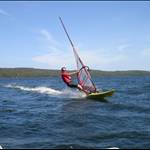
Select to expand quotecamerongraham said..

Hey Cameron does that board have two Tuttle box fittings?
Select to expand quoteberowne said..camerongraham said..
Hey Cameron does that board have two Tuttle box fittings?
No, they are just cable guides for when I run FoilDrive on this board (stick on plastic guides)
Select to expand quotedejavu said..
The JP R-Winger is 23" wide not 26" wide for the 6' 95 litre version -- I just checked the stats for this board. And yes, it does look interesting. I've ordered one and should have it in the spring (April). I also have the 106 litre Armstrong DW board and I'll probably only keep one.
You are right, I'm not used to inch...
Thanks
Select to expand quoteboardsurfr said..
Don't overlook that being narrow is just one aspect of the much-liked downwind boards. Many downwind boards also have a very "pointy", wave-piercing nose, and very similar tail. That's a very important part why the downwind boards can pick up speed much more easily than short, fat shapes.
Think of this as pushing the board through the water from the back, with someone standing on it. Basically, you need to push the water around, and the effort required will depend on (a) the projected area, as seen from the front, and (b) the "aerodynamics" of the shape - basically, a friction coefficient. Making the board narrower reduces the projected area proportionally, so you may need about 1/4 to 1/2 less "push" from that alone, depending on which widths you compare. The nose and tail shape reduce the friction coefficient, probably by at least a similar amount. So to get the board to accelerate to, say, 3 or 4 knots, you need only a fraction of the power than a short, fat board requires. Once you get into this speed range, the shape difference comes into place in an additional way, since you are approaching the hull speed (which depends only on board length). A "classical" shape at hull speed has to climb up the bow wave, going into semi-planing and then planing mode. This is literally an uphill battle that requires a lot of energy. The wave-piercing shape of the nose of a downwind board instead pierces the wave, allowing the board to gain more speed much more easily.
One way to feel the difference is by driving on a highway, rolling the window down, and putting your hand out of the window. Have it vertically first (thumb up), then turn it sideways (thumb forward). You'll feel a difference in how much the induced wind pushes on your hand that's similar to the difference between a classical and a downwind foil board shape.
Thanks to everyone for a great discussion. My theory has always been that the width for stability isn't required due to the keel effect of the foil. This is especially true if you ride a shortboard surfing, or you are used to the feel of a prone board. In larger waves a wider board is much slower from rail to rail. I designed a board around the criteria that boardsurfr mentions. After seeing the DW'er's ripping on 7" thick boards I designed my new board to be thicker and narrower. I basically made a micro DW'er. The board is 5'0" 19" wide and 62 liter and 4.9" thick. I am 86 KG and this is my one board quiver. The pros are that it gets my up in the lightest wind like one user mentioned by developing board speed with the wing...not pumping the foil. This is really important for foils that have a higher take off speed like the small HA's that we all love. I have not noticed any negative to the thickness and this is a waverider not a lawn mower.
My takeaway is that too much of most board's design is to assist with balance while on the water and mitigate touchdown friction. Much of those design elements make a board worse for actually riding on foil. My custom board checks all the boxes and provides an amazing foiling ride, but its not for everyone. As users here noted initial climb on balance is poor in rough seas, but I just use the wing as a balance point so its not an issue. The board is a dream in light wind, but is much more of a handful when getting started in rough nautical conditions. In these conditions the narrow element is a bitch on the water, but once you are flying the narrow board is totally superior.

Select to expand quoteSoloPelican said..boardsurfr said..
Don't overlook that being narrow is just one aspect of the much-liked downwind boards. Many downwind boards also have a very "pointy", wave-piercing nose, and very similar tail. That's a very important part why the downwind boards can pick up speed much more easily than short, fat shapes.
Think of this as pushing the board through the water from the back, with someone standing on it. Basically, you need to push the water around, and the effort required will depend on (a) the projected area, as seen from the front, and (b) the "aerodynamics" of the shape - basically, a friction coefficient. Making the board narrower reduces the projected area proportionally, so you may need about 1/4 to 1/2 less "push" from that alone, depending on which widths you compare. The nose and tail shape reduce the friction coefficient, probably by at least a similar amount. So to get the board to accelerate to, say, 3 or 4 knots, you need only a fraction of the power than a short, fat board requires. Once you get into this speed range, the shape difference comes into place in an additional way, since you are approaching the hull speed (which depends only on board length). A "classical" shape at hull speed has to climb up the bow wave, going into semi-planing and then planing mode. This is literally an uphill battle that requires a lot of energy. The wave-piercing shape of the nose of a downwind board instead pierces the wave, allowing the board to gain more speed much more easily.
One way to feel the difference is by driving on a highway, rolling the window down, and putting your hand out of the window. Have it vertically first (thumb up), then turn it sideways (thumb forward). You'll feel a difference in how much the induced wind pushes on your hand that's similar to the difference between a classical and a downwind foil board shape.
Thanks to everyone for a great discussion. My theory has always been that the width for stability isn't required due to the keel effect of the foil. This is especially true if you ride a shortboard surfing, or you are used to the feel of a prone board. In larger waves a wider board is much slower from rail to rail. I designed a board around the criteria that boardsurfr mentions. After seeing the DW'er's ripping on 7" thick boards I designed my new board to be thicker and narrower. I basically made a micro DW'er. The board is 5'0" 19" wide and 62 liter and 4.9" thick. I am 86 KG and this is my one board quiver. The pros are that it gets my up in the lightest wind like one user mentioned by developing board speed with the wing...not pumping the foil. This is really important for foils that have a higher take off speed like the small HA's that we all love. I have not noticed any negative to the thickness and this is a waverider not a lawn mower.
My takeaway is that too much of most board's design is to assist with balance while on the water and mitigate touchdown friction. Much of those design elements make a board worse for actually riding on foil. My custom board checks all the boxes and provides an amazing foiling ride, but it's not for everyone. As users here noted initial climb on balance is poor in rough seas, but I just use the wing as a balance point so it's w oars not an issue. The board is a dream in light wind, but is much more of a handful when getting started in rough nautical conditions. In these conditions the narrow element is a bitch on the water, but once you are flying the narrow board is totally superior.
Awesome board, I think you nailed it with the volume. Your board is short, under 5" thick and light. When you want more volume then you can only add length and thickness.and for winging you start to lose foil feel. I have a similar board as my main board as well, 4'11 60l but went a bit wider the make it thinner and get a wider platform to land jumps. 22 1/2" wide and at 88kg I use it 90% of the time.
Select to expand quotebolocom said..SoloPelican said..boardsurfr said..
Don't overlook that being narrow is just one aspect of the much-liked downwind boards. Many downwind boards also have a very "pointy", wave-piercing nose, and very similar tail. That's a very important part why the downwind boards can pick up speed much more easily than short, fat shapes.
Think of this as pushing the board through the water from the back, with someone standing on it. Basically, you need to push the water around, and the effort required will depend on (a) the projected area, as seen from the front, and (b) the "aerodynamics" of the shape - basically, a friction coefficient. Making the board narrower reduces the projected area proportionally, so you may need about 1/4 to 1/2 less "push" from that alone, depending on which widths you compare. The nose and tail shape reduce the friction coefficient, probably by at least a similar amount. So to get the board to accelerate to, say, 3 or 4 knots, you need only a fraction of the power than a short, fat board requires. Once you get into this speed range, the shape difference comes into place in an additional way, since you are approaching the hull speed (which depends only on board length). A "classical" shape at hull speed has to climb up the bow wave, going into semi-planing and then planing mode. This is literally an uphill battle that requires a lot of energy. The wave-piercing shape of the nose of a downwind board instead pierces the wave, allowing the board to gain more speed much more easily.
One way to feel the difference is by driving on a highway, rolling the window down, and putting your hand out of the window. Have it vertically first (thumb up), then turn it sideways (thumb forward). You'll feel a difference in how much the induced wind pushes on your hand that's similar to the difference between a classical and a downwind foil board shape.
Thanks to everyone for a great discussion. My theory has always been that the width for stability isn't required due to the keel effect of the foil. This is especially true if you ride a shortboard surfing, or you are used to the feel of a prone board. In larger waves a wider board is much slower from rail to rail. I designed a board around the criteria that boardsurfr mentions. After seeing the DW'er's ripping on 7" thick boards I designed my new board to be thicker and narrower. I basically made a micro DW'er. The board is 5'0" 19" wide and 62 liter and 4.9" thick. I am 86 KG and this is my one board quiver. The pros are that it gets my up in the lightest wind like one user mentioned by developing board speed with the wing...not pumping the foil. This is really important for foils that have a higher take off speed like the small HA's that we all love. I have not noticed any negative to the thickness and this is a waverider not a lawn mower.
My takeaway is that too much of most board's design is to assist with balance while on the water and mitigate touchdown friction. Much of those design elements make a board worse for actually riding on foil. My custom board checks all the boxes and provides an amazing foiling ride, but it's not for everyone. As users here noted initial climb on balance is poor in rough seas, but I just use the wing as a balance point so it's w oars not an issue. The board is a dream in light wind, but is much more of a handful when getting started in rough nautical conditions. In these conditions the narrow element is a bitch on the water, but once you are flying the narrow board is totally superior.
Awesome board, I think you nailed it with the volume. Your board is short, under 5" thick and light. When you want more volume then you can only add length and thickness.and for winging you start to lose foil feel. I have a similar board as my main board as well, 4'11 60l but went a bit wider the make it thinner and get a wider platform to land jumps. 22 1/2" wide and at 88kg I use it 90% of the time.
At 92kg, my go to board for 14+ conditions is 5'2 x 21 x 60l (omenfoils.com/collections/boards/products/flux). Agree with previous comments. If you have some wind, going ~-30l makes the board most stable when starting and more fun when up on the foil.
Select to expand quoteBigZ said..bolocom said..SoloPelican said..boardsurfr said..
Don't overlook that being narrow is just one aspect of the much-liked downwind boards. Many downwind boards also have a very "pointy", wave-piercing nose, and very similar tail. That's a very important part why the downwind boards can pick up speed much more easily than short, fat shapes.
Think of this as pushing the board through the water from the back, with someone standing on it. Basically, you need to push the water around, and the effort required will depend on (a) the projected area, as seen from the front, and (b) the "aerodynamics" of the shape - basically, a friction coefficient. Making the board narrower reduces the projected area proportionally, so you may need about 1/4 to 1/2 less "push" from that alone, depending on which widths you compare. The nose and tail shape reduce the friction coefficient, probably by at least a similar amount. So to get the board to accelerate to, say, 3 or 4 knots, you need only a fraction of the power than a short, fat board requires. Once you get into this speed range, the shape difference comes into place in an additional way, since you are approaching the hull speed (which depends only on board length). A "classical" shape at hull speed has to climb up the bow wave, going into semi-planing and then planing mode. This is literally an uphill battle that requires a lot of energy. The wave-piercing shape of the nose of a downwind board instead pierces the wave, allowing the board to gain more speed much more easily.
One way to feel the difference is by driving on a highway, rolling the window down, and putting your hand out of the window. Have it vertically first (thumb up), then turn it sideways (thumb forward). You'll feel a difference in how much the induced wind pushes on your hand that's similar to the difference between a classical and a downwind foil board shape.
Thanks to everyone for a great discussion. My theory has always been that the width for stability isn't required due to the keel effect of the foil. This is especially true if you ride a shortboard surfing, or you are used to the feel of a prone board. In larger waves a wider board is much slower from rail to rail. I designed a board around the criteria that boardsurfr mentions. After seeing the DW'er's ripping on 7" thick boards I designed my new board to be thicker and narrower. I basically made a micro DW'er. The board is 5'0" 19" wide and 62 liter and 4.9" thick. I am 86 KG and this is my one board quiver. The pros are that it gets my up in the lightest wind like one user mentioned by developing board speed with the wing...not pumping the foil. This is really important for foils that have a higher take off speed like the small HA's that we all love. I have not noticed any negative to the thickness and this is a waverider not a lawn mower.
My takeaway is that too much of most board's design is to assist with balance while on the water and mitigate touchdown friction. Much of those design elements make a board worse for actually riding on foil. My custom board checks all the boxes and provides an amazing foiling ride, but it's not for everyone. As users here noted initial climb on balance is poor in rough seas, but I just use the wing as a balance point so it's w oars not an issue. The board is a dream in light wind, but is much more of a handful when getting started in rough nautical conditions. In these conditions the narrow element is a bitch on the water, but once you are flying the narrow board is totally superior.
Awesome board, I think you nailed it with the volume. Your board is short, under 5" thick and light. When you want more volume then you can only add length and thickness.and for winging you start to lose foil feel. I have a similar board as my main board as well, 4'11 60l but went a bit wider the make it thinner and get a wider platform to land jumps. 22 1/2" wide and at 88kg I use it 90% of the time.
At 92kg, my go to board for 14+ conditions is 5'2 x 21 x 60l (omenfoils.com/collections/boards/products/flux). Agree with previous comments. If you have some wind, going ~-30l makes the board most stable when starting and more fun when up on the foil.
Never seen Omen boards before, they look great!
I think the wide tail with the beveled bottom works great for winging.
Can you just go narrow and make the volume up by going fatter rather than longer, or does length matter too for light winds? And if being fatter loses feel/connection with the foil can you have a very scooped deck?
So (making up dimensions) if a board is say 5' x 26" x 4.5" and another 5'x20"x5.5" with same back end, rocker (and I guess straighter sides) would the second get going earlier?
Can makers scoop volume out the middle where your feet go back down to 4.5" and maybe make the rim 6.5" to get feel back (Armstrong FG boards scooped a bit like this).
Of the two boards you listed the 20" wide would start much faster than the 26" wide. Length matters a lot for a variety of reasons better glide but also requires lower skill. It's easier to be out of fore to aft balance on a short board and that kills the momentum longer lengths have a bigger margin of error available
I know a few dedicated custom shapers/dw guys making scooped decks right now. They seem to like them, but I haven't tried them.