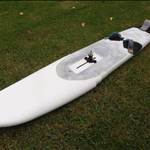
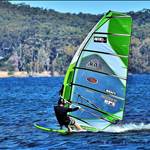
Keef , I don't think adding the wingers would have any advantage to your board. The idea of the wingers was to have a really wide, short high aspect planning surface, stepping down quickly to a reduced surface area in the tail, My flat is from 300 to 600 ( 1.5 mm tail rocker from 300-0)and the rocker is quite high under the mast track.
Adding the wingers to your board with it,s very flat drawn out rocker line would only increase the wetted surface ( unless you created the winger by taking material off) and do nothing other than increase drag (although may improve early planning a bit)
My board is a very different concept with the wingers being an intregal part of the overall design so just adding them to a board with a very different rocker probably would not work.
My 2c
Seeya Martin
Just decided to have a look at this thread as seeing bombora I expected to see spectacular pics of rails tripping 
I have to agree with Decrep regarding the recessed bits, starboard did this with their first slalom boards and I think it worked well but gimics don't work in windsurfing. Thin boards are great in all but a few areas, that being transitions. So really you want a board that is thin enough so you get nice control, and thick enough that you are not bogging down coming out of gybes etc.
Rocker, bottom shape and width all help boards to get onto the plane. It's a bit of compromise though, you can either go very small wetted area which is very efficient or horsepower a wide board into creating lift. Speedboards are awesome at planing ability for their size, they combine the small wetted area with flat rockers and it just works. I didn't mention fins in this as the theory of using them to get the board onto the plane is a bit oldschool now since if you can feel the fin enough to get you onto the plane you are really going to be feeling it at speed (*formula is a different beast though*).
Gestie mentioned my discussions about railshape. Waveboards you don't have alot of forces at play so it doesn't matter so much about the flatness of your foot position. Slalom boards you need more curve to help lock control into the board, imo essentially raise your toes and the rail shape should follow the contour of your arch. Anything substantially flatter than that you will have control problems in chop, anything more and you will get cramped feet.
I am noticing on alot of wide boards now with the rails being alot softer that foot position tends to suck, some are a bit too flat- bad when you start taking it through sharp standing chop. I notice that with boards I think the rail area is too shallow you often will get chop washing over the deck also (we sail at some weird angles to the chop here).
On humps in front of the straps, you just have to watch that like the F2 airpipes hump at the back if your foot slides thro so that your toes are resting on the hump you actually lock your foot into the strap. I only noticed it after someone said something on here about it, and i've had some great spills from it since.
Regarding the small person on the wide board- width disappears once you are planing, thickness doesn't. Maybe though look towards boards that are a bit narrower in the nose and tail.
BTW toes down once you go into lull or aren't moving very quick... the board will tell you when you need more force to hold it steady, then you go toes up 
hi keef,
yeah i don't think adding wingers would improve the speed of your board. it would definately improve planing threshold but at 16mm i doubt you would notice it. 3-5cm overall and you would notice it. but then you would need to also look at footstrap position etc. now cutting wingers into the board would be worth a shot for improving top end speed. but as stated prviousy the extra thickness in the board you are using may be just to much of an issue to begin with.
what was it you didn't like about the original board?
my comments on extra width are aimed at building thin boards, where you still require a certain volume. you either put it in the thickness or make the board wider. this thread was talking about how to build a narrow board and still get extra volume into the mix without upsetting the ballance. (enter the term virtual volume)
my vote is for wider over thickness. problem with wider is that you create more drag. hence the stepped tails, wingers, cutouts, channels etc. other boards use tail kick but that requires more skill to sail as you need to set the board at the right apparent angle.
taking an existing thick board and making it wider still is only really improving the light wind ability of the board.
the graphics i did were laser cut vynil sticker decals with sprayed base colour and template sprayed black spots. yes the vynil stickers are expensive. so that idea won't be used on future boards.
all of my graphics are template based with repeating patterns so they can be sprayed. i will try to get a screen printer to produce future templates. previous to this i have been cutting them myself on sticky back paaper with a laser cutter.
 i just finnished bending some 8mm divi to make some wings ,then martin told me im wasteing my time, and now you have told me my feet are going to get jammed between the strapps and the hump, you know mksevens if you had have told me that before i chopped my board you could have saved me a lot of time and effort
 , anyway if it doesnt work what i can do is stick heeps of foam padding and build it up to where it was and get a really soft ride
 and the board is too narrow to cut into it, i origonaly had cutouts in the tail but it made the tail to loose so i filled them in with divi and reshaped so there like little concaves and that works thats scarry and there was to much volume in the tail especilly going to windward in chop keep up the good work on those graphics and im looking forward to seeing the mk2
Hi Keef,
I probably should have asked these questions at the beginning but
how narrow is the tail?
why was there too much volume going upwind? was it bouncing out?
downwind rail catching can be resolved with chimes or softer rails.
*edit* if the board is for a heavy weight and the tail is really narrow my experience of modifying boards is that adding extra width will improve the range of the board. 
Keef actually wide boards are a bit the opposite- remember Formula boards are handled in 30+ knots in the chop. On wider boards you shouldnt be too quick to change down rig size as that power keeps the board in check. Where I have been quick to notice width is on water like that at burrum, where being flat you get too much lift from the board- it was one of the reasons I personally went to F2's over the falcon I had as the SX produces less lift at speed. I think you'll find that is one of the reasons why formula speed attempts are not done on flat water, no one will ever hold the boards down. So in short width gives you lift, chop gives you windage not lift.
Gybing there is so much more that affects it than width straight out. I noticed the width on 80 wide slalom and formula boards but under those problems were more about design where say a board bounces out of the arc etc. Again if you want something that gybes a little more like narrower designs go for a more rounded outline board with narrower tails etc.
With decreps 43cm board you really need to start looking at ways to keep everything low. I can understand the need for a board like that, alot would find it very hard to sail a board of that width with a bit of volume whilst off the plane. Personally i'v just gotten used to swimming 
Width is definitely not a bad thing, it lets you have softer rails yet still retain great upwind performance. Even the awesome Vando suffered on one race ages ago where he'd damaged a board or something and went to one of his old 280's and he found he couldn't go upwind at all. A current 105 board has a much wider range than an old 105 design.
There were a few boards which have floated around with various hump shapes but not so much in the board itself- F2 required a hump for the airpipes on some models, exo and mistral (I think) played around with footpad humps. Along similar thinking about volume mistral had a stepped centre section of the board to keep volume where it was required and thin the rails out (under footpads was kept normal), from what iv noticed this design produces a really stable board off the plane.
suffered on one race ages ago where he'd damaged a board or something and went to one of his old 280's and he found he couldn't go upwind at all. A current 105 board has a much wider range than an old 105 design.
No, falcons apart from the latest ones use very lifty bottom shapes. They plane earlier than the sx's because of this.
your board doesn't sound that unconventional to me keef. sounds pretty sweet actually.
i thought it might have been to much length lifting the nose due to wind and chop but at under 2400 long it's probably not that. both MK and myself have taken hack saws to boards to tame them by shortening the length. works quite well.
also thought it might have been to much nose rocker making the nose lift while going upwind through chop. 165 is not to bad also.
also thought it might have been v but you've got plenty up front.
i'm tending to agree with your idea the straps are to far part at the tail. i too have a no rocker speed/slalom board which was built for flat water and it does tend to suffer spinout going upwind through chop. a couple of other guys have sailed it and we all agreed it was because the straps were to far out on the rail. i haven't moved them inboard yet to test that as i've been mucking around with the freestyle board. i gave the freestyle board back ready for the mk2 version so i'll be testing the speed board strap settings again next time it blows. it is a wide board though. but definately setting the straps right out on the rail can cause problems when loading up the fin on shorter boards. unless of course your using big fins and really wide tails.
on a board with a tail width of 37cm i'd be looking at either one strap or 2 mounted only about 3cm apart. use the 2 straps in slalom mode. for me a board at that width and shape is a 25+ knot board. with a swim at some point.
if you went to 1 strap it would be possible to cut a winglet into the tail. by re shaping it into a pin tail. that's if you still feel there is too much volume going upwind. best not to change everything in one go however.
setting your fin to far forward can also promote spinout. the front of the fin should be level with the back of the rear strap. or there abouts.
from memory and in general terms
the fin box should be about 100mm from the tail measured along the bottom.
the distance from tail to the mast track should be about 1250.
straps should be between 350-400 apart from front of rear strap to back of front strap. more on freestyle. 450.
although this one is not as common rear strap around 230 from tail.
strap inserts 150-160 apart.
when you start to measure up different boards you find that give or take they are all the same setup of boxes, straps etc.
hmm fins are black magic in my mind. i have to agree with mk that on flat water the lift becomes more of a problem at the tail. up at burrum i was talking with some of the top guys about fin selection. i noticed watching everyone come down the run that the guys on 30cm fins were starting to look a little out of control at times. the guys in control were on 25-27cm fins. so i asked some of the guys over a beer and it was agreed that in chop they use bigger fins than on flat water as the lift is greater on flat water. same would also go for tail area as mk said.
helping wide tail boards gybe can be done a few different ways. i like heavy chamfers at the rail or a step near the rear strap.
JP tend to increase the curve of the rail plan outline from about the middle of the strap positions to the tail on some of their boards.
angulo went for the wingers. all of them work in my mind as it's the area between the front and rear strap that controls the lift for early planing and drive out of gybes.
the formula speed sailing was a favourite of mine for a long time. i tried in choppy and flat water and think i got a max of 28 knots or somehting. i did have problems in 20+ knots with an 8.5 keeping the board on the water so asked a few of the pro guys what they recommended. in the end it came down to longer harness lines and rigging big. they all said that anything under 10m wasn't enough to keep the board on the water and choppy water presented the best surface for speed sailing. 
a long ramble i know. but there's no wind anymore up here. so to recap.
yep, move your straps closer together at the tail.
edit* p.s. i forgot to mention. i like really soft rails on speed boards up front. like excessively soft. personally i think chimes are better for slalom. but not everyone may agree with that.
gesty ive done all the things you said, chimmed the front rails moved the front and back strapps inward but theres an extra hole on the front one to go outward,i use c3venom fins 28,30,36 the fin in the origional pic is a 32 that came with my CA55 i use a 6/7 rs6 a 5/8rss mk11 and a 5/0 concept the best time ive got is 30knts but thats cos i wasn't confident with the rails , ive managed to take 10mm off going down to the front strap, i remeasured the rocker and its flat from 300 and 1mm at 900, the board bogg's down when jibeing with the 6/7 but with the 5/8 and 5/0 its a different story so i need a bit more volume at the track and nose for the bigger sail, i'm still going to stick those wingers on just to see if theres any difference , you know with a board that size 16mm is a big difference, i have h80 divi ill just glue it on with vac shape it then bogg no glass shouldnt add to much weight and if it doesnt work ill sand them back , remember this is a proto so keep the suggestions comeing
nothing beats trying it so i'd definately go with the winglets. it should help with the bigger sails for sure. but 7m is very big for that board.
the first change i reckon worth investigating is the tail outline. it's an old school tail currently and needs more of a pin outline. board gybing could possibly be improved by making the outline more curved by turnig it into a pin or even a diamond tail. that will also reduce the area and drag at the tail. i kinda like the theory of increased arc in the plan shape at the tail to improve gybes.
also 900 flat is long for a flat. 600mm maybe better and will again help with gybing but i'll ask some gurus about that. will get back to you.
Keef , I agree with Gesalt. The board is very wide right in the tail for it,s overall width and I would be doing something to reduce the wetted are right in the tail (cutouts!!!!). Especially if you are going to add the wingers.
I would like to see a detail photo of what the bottom looks like in the tail after you filled your cutots in.
900-1200 flat was what you wanted with old longer designs, the new ones are a bit shorter.
Keef sorry can you recap the dimensions of this board- total width, volume etc. Is this intended for speed or slalom?
BTW your smallest fin is too big 


keef i had a chat with a shaper today about rocker.
now this is not the case for every design as it's a system. his preference for speed was for continuous rocker. approx 10-15mm from the boards balance point and about 150mm nose rocker from the balance point.
as fas a flat goes. 900 is old school, if you were to use a flat then 300mm would be about max length on a speed board.
it was his opinion that to long a flat section causes the board to trip up. he also thought 37mm tail width was wide for a speed board of 70lt
i also noticed looking at your images that your cutout seem to arc away from the fin so that the flat area behind the fin is wider than the area at the front of the fin. (could just be the photo)
my thoughts are that this would cause lots of drag and definately release the tail due to turbulence making the board skiddy, at a minimum the cutout needs to be paralell to the fin so the water releases cleanly and if possible tapper towards the tail so the flat area behind the fin is narrower than the flat area in front of the fin.
(i hope that makes sense).
also cutouts need to have a vertical face to the recess. otherwise they stick the board to the water. so avoid chamfers or raking side walls. unless of course the recess rakes in on itself. like a dovetail joint, that will give a very clean release.
also looking at your rails i think they are way way too sharp. i'd soften then off either with a freestyle type tuck ie. 60/40 apex (my personal favourite) or a decent chime. the difference between chime and tuck is more about upwind. i find chimes allow railing of the board for upwind performace where as tucks require the board to be carved upwind.
) gesty as i said i dont have a problem with the speed ' i allso would like to point out that this board isnt a speed board, its a fast flatwater blaster,
Hi ya Keef, don, t make the cut-outs parallel with the fin, run it at about 3 deg. I tried this on my old speed board, worked much better (less drag) at 3 deg. The rocker line sounds like it’s too flat. A little tail rocker might help.
for my sailing conditions the rocker is perfect, the only problem was there was to much volume in the strapp's and the tail, and the rails were catching on downwind runs, but if its the rocker being to flat maybe thats the problem , the board dosen't look to hot but i dont have trouble passing isonic's ,CA's,falcons once ive sorted a few things ill do another one, and one thing i will be doing is recess the mast track, pads and strapp's into the board and ill work the volume out from there , they say gimmics dont work but being practable does
hi keef,
yep he means 3 deg to the centreline of the board. ie. so they taper towards the centreline *double edit* like mr loves picture....
the channels on my boards also do this.
*edit* i should clarify this. the channels actually taper towards the rail as it's like the cutout but in reverse. still there is a taper.
anyone or decrepit  do you think the rocker could have changed while it was in the bag because it was defernatly flatter yesterday, and now its settleing back down either as the weather is cooler or the resin is cureing because the rocker from 300 to 700 is lifting, where yesterday it was defernately quite flat @ 900
i had the bag pulling 35 pressure which is high normal is 25 but i thought i needed more pressure cos of the deep inserts ill have another look tomorrow if anyone has had this problem let me know
this thread is allmost done but ill do another post after all the changes and a test run, thanks for everyones input and the pm's you have all been a great help

These were about 20mm deep and turned this board into a dream to sail, esp in small chop. The TM fin was pretty good too