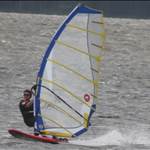
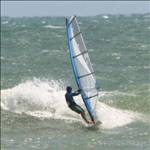
ive been watching a post on the KA speed week at durrum and i have noticed 50% of the pics are sailing with there toes pointing up
i don't know if anyone can remember the bombora dromedery, it had a hump thought the middle, and as i remember it was the most comfortable sailing position to sail , you could push on it too lift the windward rail and trim the board,
well there doesn't look like there's going to be any wind for a few days so im going to take the router to my board and recess the footstraps about 25mm that will get my feet closer to the water and be able to put more pressure on the board rarther than the strapps, possitive or negative comments are welcome but wat ever im going to do it 
ps sorry to the sailor in the pic , im useing your pic as a demo, if you dont want it there ill take it off, im sorry but i dont know whow you are if i did i would have asked your pomission ,sorry keef
Good luck with the Dromedary project. When I lived in the Illawarra region in the 90s friends of mine had a Dromedary. Even back then in the days of dedicated slalom boards it was a bit of an oddity. I quite enjoyed using it on light wind days and it seemed to go alright on the plane, but not as good as my Bombora Zot. However its true the Dromedary was easier on the feet than flat decked boards.

Select to expand quotemineral1 said...
Keef, how about posting pics of before, during and after mods, to see difference
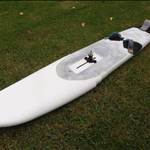
ok mineral the strapps and pads are off the board ready to go tomorrow, i allso have to change the rail rocker so ill take a few pics as i go ,as you can see there is enough meat in the tail and front strapps to recsess 25mm the board at the moment is about 65 lts "heres a good shot"


hi Keef,
My first board was a Bombora dromaderry, bought from BT at south nowra. 2 fin boxes under it, one at the tail and one up under the mast base. Came with two dolphin type fins, massive spin out with any type of speed. The tail was about 2 ft wide from memory.
Also I think the javalin that merv sailed had a hump too, it was hollow with a bung at the front.
Tim
 and ive still got that BT wave board under the house (i'm sure it was yours), i havent heard it barking lately so i guess it is well and truley dead, its the blue one the one you first started doing forwards on and still in one piece keep your eye on this post tim this is the best board ive done , it doesnt look too good at the moment, the plugs are going in today
interesting observation keef,
i wonder how many of the sailors at the comp got feet cramps?
as for the photo, the sailor in the photo won last years comp so he is a very quick guy.
i know MK on the forum has some views on board rail design versus foot position as we've spoken about it at the beach. without quoting him it went something along the lines of rail shape versus comfort versus toe's. or somehting like that. certainly made plenty of sense to me at the time.
 its allmost impossible not too.
what the?
seriously mate i wasn't making any negative comments about anyone. sorry if you took it that way.
sailing with toes up tends to cramp the feet. that's why i posed the question.
my comment on the sailor winning last years comp was more just about stating that toes up doesn't necessarily mean sailing slower.
was all intended to be constructive.
its allmost impossible not too.
Hey Keef you board is starting to look like mine now, I've done a similar thing with my starboard footstraps, I haven't sailed it enough to see if I want to do the port side as well. And of course my forward rails had a very heavy chine to start with.
Keef,
I reckon that anyone who does serious plastic surgery on their board has:
a) Balls
b) Guts
c) A willingness to experiment that is totally awesome
Can't wait to see how it turns out!
, the pluggs went in today so its back in the bag tommorrow
well being a heavier guy myself and having tried loads of boards at different widths/volume/lengths/thicknesses
i'd have to say width is more important,
if the goal is to keep the board thin for control and still maintain a certain volume then i'd be adding it into the width (early planing)
and drawing it throughout the board with fairly straight rails through the middle and a nice fat nose.
problem for heavyweights is that using a narrower board with lots of volume does little for early planing. plus just adding more thickness into the tail for more volume on widish boards just upsets the volume distribution making them hard to tack and dredge.
in my mind the perfect board is relatively thin 3", nice and wide (dependant on wind strength), has even volume distribution throughout the length and 2.4m long.
it is possible to make wide boards gybe better, either loads of tail rocker (slow) or lots or curve in the outline from the middle of the straps to the tail or steps in the last part of the tail or in the bottom around the rear strap.
Gesty, width is great in lighter winds, but once it gets over 25kt, narrower starts looking good.
Which is fine if the wind doesn't drop out too much.
Some people have an aversion to swimming a small speed board a kilometre back to shore.
Keef, hopefully I'll get to try my board again tomorrow, and be able to give you a report.


 and your on the water
yeah i don't want to suggest your wasting your time. in my mind all options need to be explored otherwise it's not possible to decide which outcome works the best.
to share some of my experiences so far, doing very similar things to both yourself and decrepit, see below. certainly it's not a list of everything i've tried.
lightwind planing
thick versus wide
thick - 70cm wide board, lots of thickness about 270 long. using big fins, to get the early planing. it worked to a degree but the boards were prone to porposing and had a limited wind range with the nose lifting out of control at speed.
then tried wide, formula. wow. early planing, lots of speed and massive amounts of control. no rocker, used several version with different bottom shapes that got wider and wider.
which morphed into
proto 120lt wide slalom board (no rocker) - a reduced version of the formula board. 220 long 72cm wide, great board and fast, and very controllable even in 20+ knots with a 6.4m on it. although needs softer rails for chop than the formula plus the "lack of" length made it harder to tack. still way way better than the old school narrow and thick board mentioned above of similar volume.
then went to speed
speed - proto 50cm speed board - plenty of thickness for extra volume for my weight, 90lt approx, so very thick for it's width. unfortunately, the thickness led to control problems at speed as the board wanted to roll from side to side when on the run. plus the hard rails up front made it a risk when hitting boat wake. front rails were chimed which resolved the wake issue but board still to thick in my mind. (i guess this is what decrepit is trying to overcome). anyways, thinner resolved the board roll issue but meant a lot less volume.
then tried freestyle
proto freestyle board - "reduced bottom shape similar to decrepits board" then running into a duck tail. basically a wide board at the deck and a reduced outline underneath simialar to a gun surfboard outline. great at speed in good wind, gybed very well but lacked early planing ability. not a good outcome for a freestyle board.
so modified that board -
by filling in the reduced bottom shape to take it from 37cm wide at 30cm from tail to 42cm wide at 30cm from tail. this also made the rear rails sharper but we kept the duck tail. wow, what a difference that made. early planing improved, tracking improved and speed still the same. board an absolute pleasure to sail. no difference was made to rocker or length of flat at all.
now working on mk2 freestlye, wider tail still, 45cm at 30 cm from tail and thinner throughout. i've learnt that the width between the straps of the hull is very important. the duck tail now has a chamfer as tail thickness is less.
can't wait to sail that.
looking at starboard. they impress me with inovation, they are now designing boards with wingers that are still wide between the straps and up front with little rocker. all of my experiences so far suggests that this is the way to go. mr love's boards have similar tails also.
Gesty, seems to me your aversion to thickness, may be the height of your feet above the water line.
This will, as I've found out, induce lack of control of the board's attitude. Sailors weight is acting to roll the board in the same direction as the fin is, ie to leeward, means the ankles have to be used for control. At speed the body's reflexes just aren't fast enough. The closer to the water line the rider's weight is acting, the more stable the board will be.
And a similar thing for the mast base, the closer that is to the water line, the more stable the board will be.
That doesn't mean the board has to be thin, both mast track and feet can be lowered, without sacrificing much volume.
Or do you think there is some other effect, happening here.
Edit, of course gybing may be an issue, once feet are out of the lowered area, but I've yet to work that out.
think i've come to the same conclusion as yourself.
but my aversion to thickness is more than just board rolling, on bigger boards that's not so much of a problem, but lack of width does kill allround performance and early planing for heavywights.
definately lowering the mast and feet would help but i'm not sure it's really enough as i think it's the thickness through the entire length of the board that needs to be looked at. getting the axis of mass lower to the water may be the best solution. so to keep the volume the board needs to be wider in general terms for it's reduced thickness.
but i'm only talking about narrow boards. wide boards it's not such a problem. the thing that heavy guys figure out is that width means everything. i guess up until the drag is to high.
so introducing winglets, steps etc allows the width up front and the reduced tail behind the front straps for less drag etc.
*edit* looking at the angulo magnum with the cutout to the rail. personally i don't think they needed to keep the deck at a different width. the tail of the board could have just stepped in so the deck outline was the same as the tail. except of course if the straps don't fit anymore.