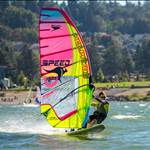
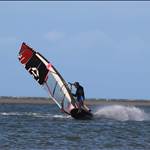
It is quite fascinating to look at PWA slalom racing like that latest finale in France.
But for us could be also very interesting to have a look at GPS log of our competitors.
To see how that best of the best are doing on this extreme choppy water: what speeds and how well gybes come out.
Can we get access to one of those GPS logs?

BTW maybe also somebody knows how to add here the link to this excellent video that is available in Vimeo format ( I don't know how to copy a link from facebook Vimeo video to here) (?)
I have the response from competitor there. Maciej Rutkowski.
He explained that nobody usually uses GPS on racing.
But he estimates max speed on this exactly run at around 32 knots on this chop...
"Maciek Rutkowski Nie mamy ale mo?emy mie? nikt nie zabrania, jest to po prostu kolejna rzecz ktora gdzie? Ci sie dynda gdzies przeszkadza czy cos wiec nikt w zawodach nie uzywa (na treningu jak najbardziej). W tak gestym chopie, bardzo watpie zeby ktos przekroczyl 34 wezly. Obstawialbym bardziej 32 na pierwszej prostej"
Slalom in those high wind situations is all about straight line speed - IMO
The gybe speed isn't really a factor as more focus on just staying upright, not collecting anyone and making the gybe is more important for the overall race.
Also with downwind slalom you'll never get the alpha as your 50m radius is too tight. Gybe exit speeds maybe faster but there is no need to keep it tight to get back to the starting point.
The Fuerteventura finish between AA and Matteo i reckon is faster than 32.
If you are a professional athlete, you dont want to give your competitors an advantage - if they had your logs and not vice versa, then they would have a competitive advantage.
If no one was wearing a GPS, any 'estimate' is pure speculation and likely to be WAAAAY off reality.
Not saying it was faster or slower. Could be either by a significant amount....
In this age of logging sports data on everything, I am surprised those competitors are not logging and analysing their races with GPS. And of course, they would be unlikely to want to share their data.
Agree. but if one-day rules changes and everybody needs to carry GPS (I( don't know what for but anyway) then all will be in the same boat. Everybody could spy on everybody else.At the end, it is nothing more with getting as much information as we can.If somebody wants today could possibly calculate speeds electronically - that means one may have the technology to spy on another, and others don't have.
It is better if all have the same access to information.
watching other disciplines on TV there are already streaming competitors actual speeds.
I think that same approach with even streaming live speeds in PWA racing may only improve our / public experiences.By seeing final straight race and one of racer chasing peaking unbelievable speeds will quite fascinating to watch.
For many not involved into windsurfing, watching races could be quite boring, they may not even understand rules well.
Anything that increases public reception could be good for our sport.Like watching Americas Cup for example - how much better we feel knowing exact speeds of every boat.At the end, those PWA sailors do not sail for themselves only. They are hired and paid professionals to deliver spectacle for public.
Let imagine how it may look in a few years from now.
Race starts.
Once the screen at one side appears table with all several competitors and showing exactly actual position and speed.The camera may focus on one or two but this way we could observe the position of everyone involved. Usually, we are interested in our favorite sailor, not the one in the front only.I think that individual GPS streaming and programs to display position are already in existence.Something like Dylan did for us to watch racing recently.
It already happens macro. The Olympic sailing was streamed live with gps data and speed. The Sydney Hobart race does it each year. The PWA doesn't want to pay for it, it's up to the organisers. All the pro racers use it in training.
most of the pwa guys have gps watches, they just don't share their tracks.
Mostly used in training sessions and to choose gear.
The Raceboard Worlds in QLD had GPS tracking on them.
It was good to watch the lines.
Even PWA sometimes have problems with control their 5 m2 sails when wind gusts 40 knots !

Select to expand quotesailquik said..
In this age of logging sports data on everything, I am surprised those competitors are not logging and analysing their races with GPS. And of course, they would be unlikely to want to share their data.
I talked to a slalom racer here in the US who trains almost every windy day about GPS. He absolutely did not want to use a GPS. Others do, but it seems a bit questionable how much a GPS really helps in slalom training. The start, jibes, and experience seem to be more important than straight line speed. Our fastest sailor here does ok in slalom, but he's usually not in the top 3. He has great alphas, but jibing in a crowded field around a buoy is not quite the same. Even straight line speed in slalom conditions can vary so much due to changes in wind and chop that training with other slalom sailors is more informative.
Select to expand quotesailquik said..
In this age of logging sports data on everything, I am surprised those competitors are not logging and analysing their races with GPS. And of course, they would be unlikely to want to share their data.
It would seem to be a great benefit if all the competitors tracks were available for review, but in isolation not so much because the goal is to beat the guy beside you, without his or her tracks you can't really review the race.
Select to expand quoteboardsurfr said..sailquik said..
In this age of logging sports data on everything, I am surprised those competitors are not logging and analysing their races with GPS. And of course, they would be unlikely to want to share their data.
I talked to a slalom racer here in the US who trains almost every windy day about GPS. He absolutely did not want to use a GPS. Others do, but it seems a bit questionable how much a GPS really helps in slalom training. The start, jibes, and experience seem to be more important than straight line speed. Our fastest sailor here does ok in slalom, but he's usually not in the top 3. He has great alphas, but jibing in a crowded field around a buoy is not quite the same. Even straight line speed in slalom conditions can vary so much due to changes in wind and chop that training with other slalom sailors is more informative.
Agree with that.
Slalom racing has more in common with a drag race than a sailing race. Theres not much benefit in analysing others tracks because there are far to many momentary variables.
better to go out training with other competitors than trying to run analysis on gps info
I have been thinking more about GPS logs for the entertainment of others then racers itself.
Every one of us wants to imagine himself on that PWA racing course.
But is not possible. So knowing what speed there are doing 2s, 5s and nautical mile we could estimate how far our skill is apart from theirs in similar conditions. If we know wind speed and chop size we possibly could recall ourselves sailing in most similar conditions.
I could already foresee one-day personal wind speed meters/ loggers to be invented.
Tiny, small devices installed on the top of the mast that could record wind speed and direction.Doesn't matter that this is not real wind speed but resultant of our speed and wind - still very interesting data mine. If we now add our wind readings to our speed graph sailing we could draw conclusion how well our gear perform at every aspect.
1. If sudden gust during bear off - did you use the lot - or wasted
2. During alpha - how well we exploit that wind power
3. If that is the hole in a wind that cripples our gybe or lack of our technique?
4. what could compare what angle to the wind we could achieve using combinations or sail setup and fins.4.For racing like sailing, we could calculate later what is the most effective angle to the wind to cross the distance upwind.
I can't wait for anemometer logger to be added to our GW-60 as extension/ option.
Maybe Locosys manufacturer could already be thought about Blue Tooth device installed on that mast to transmit wind data to GPS logger?Then after years of waiting we could eventually compare our sailing to others in very similar conditions. Accelerometer added as another sensor to our log give is an idea about wave/ chops - water condition to complete the picture. In fact, we don't need even everything on our wrist in the form of a watch. Any smartphone-size device could be safely hidden in the backpack or PFD and connected by Bluetooth to watch like display, wind sensors etc. The problem of the battery will be solved also and smartphone could instantly transmit data to land and viewers. So our PWA races could carry smartphones one day, equipped with one smart application.
Select to expand quoteMacroscien said..
It is quite fascinating to look at PWA slalom racing like that latest finale in France.
But for us could be also very interesting to have a look at GPS log of our competitors.
To see how that best of the best are doing on this extreme choppy water: what speeds and how well gybes come out.
Can we get access to one of those GPS logs?
BTW maybe also somebody knows how to add here the link to this excellent video that is available in Vimeo format ( I don't know how to copy a link from facebook Vimeo video to here) (?)
off topic gents.. any link you can provide to this video clip..I saw this but I couldn't figure out where it came from..regards
french championship last week in marseillehttps://livestream.com/accounts/13634278/events/7200087/videos/154225632
Select to expand quotemathew said..
If you are a professional athlete, you dont want to give your competitors an advantage - if they had your logs and not vice versa, then they would have a competitive advantage.
In windsurfing, How??? No offence Matt, but you have access to Spotty's logs, why haven't you studied them to make you faster? Could it just be plain and simple that he is a better sailor??
Select to expand quotesick_em_rex said..mathew said..
If you are a professional athlete, you dont want to give your competitors an advantage - if they had your logs and not vice versa, then they would have a competitive advantage.
In windsurfing, How??? No offence Matt, but you have access to Spotty's logs, why haven't you studied them to make you faster? Could it just be plain and simple that he is a better sailor??
The point of having measurable data, is to eliminate personal bias... use the data to help you a) decide on which aspect is your weakest, b) be able to do back-to-back comparison. The whole effort is so that you can determine if you are having a net-positive gain.
=> technology helps you analyse your weaknesses.
With two tracks, you can compare your around gybe marks -> if your track is faster over that length, you then go ahead and compare the start-gate timing -> if you are faster, you look elsewhere, etc... => you then go out and train on some other aspect which is slower.
[ no offence..? hmm... you really didn't think car-racing got faster by someone using magical pixie dust in the air intake... or that Olympic swimming gets faster because that thought positive thoughts? ... this isn't the dark ages of mystical dragons. ]
My comment about why PWA sailors are not logging every aspect of their performances was slightly tongue in cheek. (In a world now where everything about everything in sports seems to be logged). Although, I am sure there is stuff to be learned from even just their own tracks.
Of far more interest would be all sailors wearing live logging GPS for the purpose of TV coverage and spectator viewing. At the moment, most windsurfing racing is not really much of a spectator sport, with the action taking place so far away that the participants are mere specs in the distance. TV type coverage has made it possible to enjoy the spectacle, and live GPS statistics and positioning maps/overlays would only enhance that.
Given that the PWA struggles to finance just the live telecast, (according to Ben Proffit) I can't see the adoption of expensive live tracking happening any time soon.
It could happen Andrew, but at the expense of the organizer, not the pwa. (same thing with the live by the way, it is not paid by the pwa)
I'm working on it for the New Cal event, might have found something not too $$$, just need to see with the techs at PWA to find out how to broadcast it.
On topic, I saw A2 use his gps one whole afternoon while deciding which mast to choose (including mismatching bottoms and tops) he'd go out, come back, check speed, de-rig, swap mast, go back, and this for hours..... amazing !!
Select to expand quoteseanhogan said..
It could happen Andrew, but at the expense of the organizer, not the pwa. (same thing with the live by the way, it is not paid by the pwa)
I'm working on it for the New Cal event, might have found something not too $$$, just need to see with the techs at PWA to find out how to broadcast it.
On topic, I saw A2 use his gps one whole afternoon while deciding which mast to choose (including mismatching bottoms and tops) he'd go out, come back, check speed, de-rig, swap mast, go back, and this for hours..... amazing !!
Good to hear that it may happen Sean. I guess it all comes down to sponsorship money.
I watched the New Cal. event live last year and really enjoyed it. One of the few events I have been able to follow.  I spoke to Ben at Geraldton last year about the possibilities to enhance the telecasts and he pointed out that they did it on something of a shoestring budget. Technical enhancements would add a lot of personnel and expense to it that was just not available at the time. It could obviously be done far better, but finding and justifying the budget is the difficulty.
I am not surprised to hear that about A2. I watched at Luderitz as he spent quite some time rigging his sails on 3 or 4 different masts looking for something until he was satisfied. I have to admit that I was struggling to see the differences he was looking for. He is not on top of the game by chance. He obviously puts an extraordinary amount of work into it, and it obviously pays dividends.
Select to expand quoteMacroscien said..
I have the response from competitor there. Maciej Rutkowski.
He explained that nobody usually uses GPS on racing.
But he estimates max speed on this exactly run at around 32 knots on this chop...
If the estimate was from a competitor I'd think it's pretty accurate, plus or minus a knot or so, as long as he takes a gps out in chop every now and then to stay calibrated. Chop is a good speed reference. It's on flat water where you can be way out. A bit like driving on a freeway . You think you're still doing 110 but then look down at the speedo to find it's closer to 130.
Select to expand quoteIan K said..Macroscien said..
I have the response from competitor there. Maciej Rutkowski.
He explained that nobody usually uses GPS on racing.
But he estimates max speed on this exactly run at around 32 knots on this chop...
If the estimate was from a competitor I'd think it's pretty accurate, plus or minus a knot or so, as long as he takes a gps out in chop every now and then to stay calibrated. Chop is a good speed reference. It's on flat water where you can be way out. A bit like driving on a freeway . You think you're still doing 110 but then look down at the speedo to find it's closer to 130.
Yes, that might only be the case if the sailor in question actually did use a GPS regularly, which he seemed to say he did not, in which case it would be a pure guess and highly unreliable.
I like the freeway analogy Ian, but of course that never happens to me!! 
Select to expand quotesailquik said..Ian K said..Macroscien said..
I have the response from competitor there. Maciej Rutkowski.
He explained that nobody usually uses GPS on racing.
But he estimates max speed on this exactly run at around 32 knots on this chop...
If the estimate was from a competitor I'd think it's pretty accurate, plus or minus a knot or so, as long as he takes a gps out in chop every now and then to stay calibrated. Chop is a good speed reference. It's on flat water where you can be way out. A bit like driving on a freeway . You think you're still doing 110 but then look down at the speedo to find it's closer to 130.
Yes, that might only be the case if the sailor in question actually did use a GPS regularly, which he seemed to say he did not, in which case it would be a pure guess and highly unreliable.
I like the freeway analogy Ian, but of course that never happens to me!!
MR explain that he regularly use GPS during training, but not during races.
As to expenses and budget, I think that modern smartphone will be sufficient for PWA racing TV cast.
There are already plenty of applets that allow constant/ instant remote monitoring. In such case all investment organizers need to afford is set of local SIM card and plastic bags for smartphones for every competitor.
We obviously don't want to pay roaming costs and signal delay while sailors arrive from all over the world, different countries.
Select to expand quoteMacroscien said..sailquik said..Ian K said..Macroscien said..
I have the response from competitor there. Maciej Rutkowski.
He explained that nobody usually uses GPS on racing.
But he estimates max speed on this exactly run at around 32 knots on this chop...
If the estimate was from a competitor I'd think it's pretty accurate, plus or minus a knot or so, as long as he takes a gps out in chop every now and then to stay calibrated. Chop is a good speed reference. It's on flat water where you can be way out. A bit like driving on a freeway . You think you're still doing 110 but then look down at the speedo to find it's closer to 130.
Yes, that might only be the case if the sailor in question actually did use a GPS regularly, which he seemed to say he did not, in which case it would be a pure guess and highly unreliable.
I like the freeway analogy Ian, but of course that never happens to me!!
MR explain that he regularly use GPS during training, but not during races.
As to expenses and budget, I think that modern smartphone will be sufficient for PWA racing TV cast.
There are already plenty of applets that allow constant/ instant remote monitoring. In such case all investment organizers need to afford is set of local SIM card and plastic bags for smartphones for every competitor.
We obviously don't want to pay roaming costs and signal delay while sailors arrive from all over the world, different countries.
From my conversation with Ben, the greatest expense is for personnel. But they truly do it on a shoestring budget with two people. Even one extra person to manage the technology would break the budget.
And I suggest that even the use of phones, sim cards, an App and waterproof bags would take some expense and management.
Granted, the possible solutions are not too hard to imagine, and the possible enhancement of the telecasts would be great, but as said before, everything costs, and someone has to pay for it.
Select to expand quotesailquik said..Macroscien said..sailquik said..Ian K said..Macroscien said..
I have the response from competitor there. Maciej Rutkowski.
He explained that nobody usually uses GPS on racing.
But he estimates max speed on this exactly run at around 32 knots on this chop...
If the estimate was from a competitor I'd think it's pretty accurate, plus or minus a knot or so, as long as he takes a gps out in chop every now and then to stay calibrated. Chop is a good speed reference. It's on flat water where you can be way out. A bit like driving on a freeway . You think you're still doing 110 but then look down at the speedo to find it's closer to 130.
Yes, that might only be the case if the sailor in question actually did use a GPS regularly, which he seemed to say he did not, in which case it would be a pure guess and highly unreliable.
I like the freeway analogy Ian, but of course that never happens to me!!
MR explain that he regularly use GPS during training, but not during races.
As to expenses and budget, I think that modern smartphone will be sufficient for PWA racing TV cast.
There are already plenty of applets that allow constant/ instant remote monitoring. In such case all investment organizers need to afford is set of local SIM card and plastic bags for smartphones for every competitor.
We obviously don't want to pay roaming costs and signal delay while sailors arrive from all over the world, different countries.
From my conversation with Ben, the greatest expense is for personnel. But they truly do it on a shoestring budget with two people. Even one extra person to manage the technology would break the budget.
And I suggest that even the use of phones, sim cards, an App and waterproof bags would take some expense and management.
Granted, the possible solutions are not too hard to imagine, and the possible enhancement of the telecasts would be great, but as said before, everything costs, and someone has to pay for it.
The recent Raceboard Worlds on a Moreton Bay use a real time tracking system that worked really well
Select to expand quoteJohn340 said..The recent Raceboard Worlds on a Moreton Bay use a real time tracking system that worked really well
Very interesting! Does anyone know what the system was and who supplied and ran it?