Not the scientific response but...
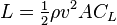
In WA many sailors note that summer easterlies (coming off warm land) do not have the same power as seabreeze SW of the same wind speed. You can see the difference in gear used fairly clearly in the 15 knot range. A 15 knot easterly usually sees larger gear being used than a 15 knot seabreeze.
I always put it down to the weight of the wind, i.e. hot wind (like a summer easterly), for a given volume, would have less weight. Not sure how accurate that is looking at the maths above.
Select to expand quoteP.C_simpson said..
Yes a 20 knot seabreeze in Western Australia is much more powerful than on the East Coast..
i thought that was because its more consistent in wa ?
well I was never good at maths in school.... 
or is it "in maths at school" ??? wasn't good in grammar also it seems !!
Or maybe the cloud just produces a sort of atmospheric Venturi and compresses the wind just a fraction more than when it has an open ski to travel through. No proof of this just a theory.
The real demonstration of wind shear is during a winter storm, you rig a 4.2 for the smooth water on the bay, and fly overpowered offshore. once it comes to a waterstart in a steep 4 metre waves and swell the problems begin.
The wind is howling just out of reach of a sail being held a 25 deg above the horizontal.
Anybody got any good ideas ???
Select to expand quoteSHEETIN said..
20 knots is the same strength regardless of the direction.
Only if you can negate every other variable, of which there are many.


Select to expand quotesboardcrazy said..
Surely 20kts is 20kts? 
yes. but no.
I throw (I'm very strong you know)...:
- 1m-cubed of water at you at 1m/s,
- 1m-cubed of lead at you at 1m/s,
... water weighs 1 tonne, lead weighs 11 tonnes...
In the real world when we are sailing around, cold-air is more dense than warm air... aka it is heavier (thus the water/lead comparison).
"More dense" means "more air molecules" per unit volume, which means more of them to impart their force onto your sail.
Or if you like: "PV=nRT"...
P = pressure... usually reasonably constant for a given area that you will be sailing in (but not always).
V = volume... in our context, it would be the volume of air that the sail moves through... but whatever it is, it doesn't change
R = is the gas-constant... which is... a constant.
T = is the temperature
n = is the number-of-moles... aka density... aka the number of air molecules
Increase T, decrease n.
Decrease the number of air molecules, the less of them hit your sail... so less force imparted onto it.
...so while 20kn is 20kn, the colder 20kn will be more effective.
is the relationship between t and n linear?
in the back of my mind is the idea that 20 knots is 20knots regardless because the wind with a higher density will do less work to make the wind gauge register 20 knots.
Select to expand quotemathew said..sboardcrazy said..
Surely 20kts is 20kts?
yes. but no.
I throw (I'm very strong you know)...:
- 1m-cubed of water at you at 1m/s,
- 1m-cubed of lead at you at 1m/s,
... water weighs 1 tonne, lead weighs 11 tonnes...
In the real world when we are sailing around, cold-air is more dense than warm air... aka it is heavier (thus the water/lead comparison).
"More dense" means "more air molecules" per unit volume, which means more of them to impart their force onto your sail.
Or if you like: "PV=nRT"...
P = pressure... usually reasonably constant for a given area that you will be sailing in (but not always).
V = volume... in our context, it would be the volume of air that the sail moves through... but whatever it is, it doesn't change
R = is the gas-constant... which is... a constant.
T = is the temperature
n = is the number-of-moles... aka density... aka the number of air molecules
Increase T, decrease n.
Decrease the number of air molecules, the less of them hit your sail... so less force imparted onto it.
...so while 20kn is 20kn, the colder 20kn will be more effective.
All correct, but as previously posted earlier in the thread, the temperature is measure in Kelvin. Hence if the ave temp is 30deg and the difference in temperature between shade and sun is max 5 deg Celcius, then when converted to Kelvin the difference is 300degK to 305degK which is less than 1.6%. I don't believe we could objectively feel the difference. I personnaly don't feel that the wind blows stronger in the shade unless it is actually blowing stronger like in a rain squall.
With regard to comments that WA 20knt wind is stronger than 20knt in Qld. The difference in temp between a WA SWer and Qld NEer is max 10degC. Hence the % change in temp measured in Kelvin is 3.2%. Again, I don't think we could objectively feel this
What interests me is the difference in wind strength in relation to the temperature of the water that I'm sailing over.
Where I sail in the tropics includes a river mouth, inshore weed reefs, current lines and sea grass flats. There have been days when sailing in 15/18kts of Northerly the reefs are almost perfectly defined as calm patches. You can plane across the edge and stop,blob across then off again. I feel the wind is wedged upwards due the water temp in this situation. At other times the effect is far more subtle but still there. The wind get choppier and the micro gusts more frequent ect. Sunlight and cloud also have an effect.
Select to expand quoteevlPanda said...
Oh man
What is it now? April? God Damn it.
Another weekend of no sailing.
Whoah.
Don't forget humidity that can alter things by as much as ummm 3% at 40c I think, ok maybe we can forget humidity