I've been wanting to post this observational theory for a long time and yesterday's sail has prompted me.
It is quite noticeable in light to moderate winds that when sailing from sunshine to shade (cloud or headland cover in late afternoon) the wind feels that little bit more powerful and believe it not to be an increase in wind speed but rather an increase in air density as the warmer air in sunshine doesn't have the same oomph as it does when (maybe) slightly cooled in shade. My theory seems to support the wind feeling much stronger on sunset just after you come in as darkness wins out. I know that 20knots in colder weather (our South easters) is considerable stronger than 20knots in our hot seabreezes (north easters).
Don't know if this is as noticable down south but sailing in the tropics it is and wondering if there is any scientific basis to my theory or is it just a psychological phenomenon (i.e. it appears to be windier in the shade as the water surface shows the wind effect more clearly than when in full sunlight)?
I equate this effect to cricketers who swear they can swing the ball more if bowling with cloud cover.
Second this question. How much does air pressure affect power? I know that wind speed and power are not linear. (make sense?)
I have noticed when surfing that sometimes when the clouds roll in the swell dies and vice versa which I believe is wind related.
this can be a 20minute cycle for eg.
Panda,
Do you mean barometric pressure? good question although it's counter intuitive that a high pressure system produces a "stronger" 20knot wind than say a low pressure system 20knot wind.
Select to expand quoteSHEETIN said..
20 knots is the same strength regardless of the direction.
not sure i agree. I seem to recall from high school physics that (generally) when temperatures increases the molecules in the air gain more kinetic energy and hence move faster. When they move faster they will also 'generate' more space between them and the air will there forhave less density / energy in it because there are fewer particles ..
This is why 15knots in summer has less power to it than 15 knots in winter where its cooler and particle are closer together..
isn't there a physics teacher here on SB who can confirm?
From en.wikipedia.org/wiki/Lift(force), the lift on the sail is:
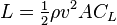
ρ is air density. Air density is proportional to pressure, and indirectly proportional to temperature.
So moving from into an area of colder air would increase the forces on your sail. The effect will be small, though, since we are talking absolute temperatures, not degrees Celsius (e.g. 2% difference for 6 degree Celsius).
In the summer, high pressure and temperature tend to move in the same direction, so the effects can cancel each other out (at least partially).
In the winter, high pressure often means lower temperatures, so you end up with 20 knots giving you a lot more pressure than 20 knots on a summer day. Unfortunately, all the extra rubber you have to wear to survive means you need the extra power.
Why 20 knots on Maui are a lot more than 20 knots at most other places nobody knows.
Cooler air is more powerful because the particles are closer together = more dense
Not sure if the temp change of a few degrees under a cloud is noticeable enough?
Recently been on sailing trip to Japan and 5 knots there feels about 10 knots local wind. The temp difference between both places was about 15 degrees
I don't think there's any argument that denser air (colder) is more powerful (force) than warmer air travelling at the same speed. It's just if such a small change of sailing between sun to shade can (does) cause a noticable effect.
Yes a 20 knot seabreeze in Western Australia is much more powerful than on the East Coast..
it's good to see wind gusts farther out on sunnier days therefore more wind that one can catch earlier and would definitely feel more windier .. well in my opinion
Select to expand quotesausage said..
I don't think there's any argument that denser air (colder) is more powerful (force) than warmer air travelling at the same speed. It's just if such a small change of sailing between sun to shade can (does) cause a noticable effect.
It could be mostly illusory. Your bod does subliminal interpretations for you all the time. If you go out on a bicycle and squeeze the handlebars as if you are squeezing the brakes you get a strong illusion of acceleration because your hand pressure tells your brain you should be slowing down.
Sailing from warm to cooler air against your skin will feel faster I think.
Sailing in the sun you get a bit wet and feel the cooling afforded by rapid evaporation so you associate speed with that particular feeling. When you go into cool air you experience the same feeling but it's not due to speed. It just feels that way.
Just a thought.
I like your maths Panda although that's no guarantee it's right either. . Thanks for taking the time. Now can anyone work out the force differential between air in shade v air in sunlight with all other factors being equal. Maybe there are localised pressure differences that are at play as well (pure speculation)
Has anyone else experienced this phenomenon or is it just my finely tuned senses playing tricks.
A good frontal freezing cold 25 knots off the Southern Ocean definitely kicks more punch than a 25 knot warm northerly, absolutely something in the difference in air density due to temperature.
I have no doubt there are localised pressure differences and wind differences in play. guys racing around courses use these to their advantage.
as I mentioned above. sit out in the surf waiting for wind waves to come through and you notice the waves vary as the clouds above vary.
Racing dinghies on really light days it was always a good idea to sail towards larger clouds
Select to expand quoteDunkO said..
Racing dinghies on really light days it was always a good idea to sail towards larger clouds
Agree DunkO, my coach always said to sail on the edge of the clouds.... no idea why though, I just did it!
I always wondered about this after moving from Auckland to SEQ. Always felt it was windier in Auckland and we tended to use about a 1m smaller sail on avg than in SEQ. But nothing beats sailing in warm weather without a wetsuit 
There will be more wind under the dark isolated clouds as cold air falls out of them. We call them dumping clouds and are better if a little rain falls as well. You get a lift off the edges. They differ from the higher,larger generally white in colour as that is warm moist air rising and sucks the air from the surface so not as much wind under those ones.
This all differs from what can be described as "blanket rain" which covers the whole area and this will normally restrict the airflow and slow the wind.
I always thought a wind metre measured the windspeed at the location,
So if your in the antarctic or hawaii 20 knotts is 20 knotts.
Select to expand quoteFez said...
There will be more wind under the dark isolated clouds as cold air falls out of them. We call them dumping clouds and are better if a little rain falls as well. You get a lift off the edges. They differ from the higher,larger generally white in colour as that is warm moist air rising and sucks the air from the surface so not as much wind under those ones.
This all differs from what can be described as "blanket rain" which covers the whole area and this will normally restrict the airflow and slow the wind.
great answer. Have you got any thoughts on fronts and isolated storms.
always noticed the windwood side has more wind but it gets confusing with other cloud around
Select to expand quotemonaro said..
I always thought a wind metre measured the windspeed at the location,
So if your in the antarctic or hawaii 20 knotts is 20 knotts.
Yes 20 knots is 20 knots but think of it like a 1kg brick hitting you (warm less dense air) at 20knots as opposed to 5kg brick hitting you (cold denser air) at 20 knots. The colder air at the same speed has much greater force on your sail i.e. you get more power from the same size sail in colder conditions than in warmer conditions at the same wind speeds.
Thanks for that too Fez - makes sense although even the shade from our headland late afternoon appears to generate the effect.
The water looks 'windier' when the sun is shining on it and less 'windy' when its in shade. Its due to there seeming to be more white water.
Well I always thought there was not much difference but Boyles law says the difference between a temp of 0 degrees and 15 degrees is 5% more force at 0 degrees.
Select to expand quoteFez said..
There will be more wind under the dark isolated clouds as cold air falls out of them. We call them dumping clouds and are better if a little rain falls as well. You get a lift off the edges. They differ from the higher,larger generally white in colour as that is warm moist air rising and sucks the air from the surface so not as much wind under those ones.
This all differs from what can be described as "blanket rain" which covers the whole area and this will normally restrict the airflow and slow the wind.
That is part of the answer - air going down out of rainclouds and up into the other clouds, and sometimes this can be quite noticeable. Air density change with air temperature and pressure is another part, but a relatively small effect. But what has a big effect is how "smooth" the wind is. Air that flows over cooler water or land will be quite smooth and powerful but air flowing over water or land that is warmer than the air will be heated and down in power. Think of a pot of water on the stove. The warming of the air can produce quit a lot of turbulence. Sails work much more efficiently, and produce more power, in smooth air than in unsteady air. An America's cup wind guy I once knew said they would measure this "wind shear" and use it in their tactical decision-making, so quite a noticeable effect.
Select to expand quoteFez said..
There will be more wind under the dark isolated clouds as cold air falls out of them. We call them dumping clouds and are better if a little rain falls as well. You get a lift off the edges. They differ from the higher,larger generally white in colour as that is warm moist air rising and sucks the air from the surface so not as much wind under those ones.
This all differs from what can be described as "blanket rain" which covers the whole area and this will normally restrict the airflow and slow the wind.
Nice and often experienced! How'd you come up with this credible explanation?
The most important factor in assessing wind strength is wind gradient. A sea breeze wedges under the warm easterly and gradient is very steep bringing 80% wind strength to within a metre or so of the surface. Warm wind will bounce over a warm surface and there will no be so much wind at windsurfer sail height. The friction of larger waves will totally upset surface wind. Gradient doesn't just affect strength, the wind direction in lightweight weather can change thru 30 deg, over 10 metres of height, when sailing big boats you have very different sail settings from one tack to another.
I guess if you want to be nearly free of gradient problems, then those tea bag things they hang in the sky is the way to go.........I prefer gradient !
I am a sailing coach by profession JP747 and this is easily observed by a racer and can take advantage.
That's correct jaymac.
Also drag on the surface will turn the true wind to the right of true wind direction in Southern Hemisphere and left of true direction in Northern Hemisphere. Rougher the surface the more angle change. Easily seen at Airport runway at Botany Bay.