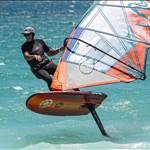
here a picture of a friend in west oz who still uses a 284 mistral flow @ 113 litre ..he uses it with 7,4 and 6,6 .he said he just likes it and doesn't care what people think ..he kicked my arse on it in rough chop one day .. .how many feet is that oldskool ..? I think these longer boards are a great idea ...

Perhaps the "nine four" graphic has nothing to do with the length but is a homage to the year 1994 ?
Not sure what happened in 1994 that might be relevant.
The George Foreman grill was first sold if that matters.
Select to expand quoteTardy said..
here a picture of a friend in west oz who still uses a 284 mistral flow @ 113 litre ..he uses it with 7,4 and 6,6 .he said he just likes it and doesn't care what people think ..he kicked my arse on it in rough chop one day .. .how many feet is that oldskool ..? I think these longer boards are a great idea ...
Still have my Flow 94 - 266 long. Lovely board with a 6.5 or 5.5
Select to expand quoteCarantoc said..
Perhaps the "nine four" graphic has nothing to do with the length but is a homage to the year 1994 ?
Not sure what happened in 1994 that might be relevant.
The George Foreman grill was first sold if that matters.
LOL ...maybe it could be sails up to and including 9,4 ?? 
Tardy my man, depends if you round up or down or even truncate to one or two decimal places. Tolerances vary.
Mr Lufkin sez 284 = 9'33/4" , 287 =9'5".
If youd like i will work it out in .000"?
Kinda like when you use Pi (3.14) for everyday use.
Scientists will use Pi to about 20decimal places. They will get a different answer.
Also like when a chippy whacks a house together a few mm here or there doesnt matter. But when he builds a cabinet he must be spot on.
What tolerances do they use to build a sailboard?
Select to expand quoteremery said..
In the mid-80's custom slalom boards really took off. I purchased a Precision Equip one for the 2nd (I think) Ledge to Lancelin. It was gorgeous, just heavy compared with modern boards. I'd love to move the mast track back and replace the US box with tuttle/powerbox to see how it goes with modern sails.
It would be interesting to see how the specifications compare with the Cruise Missile.
i dont think moving the track back will make much differance as the track is postioned over were the nose rocker blends in to the midle of the board .i only ever used late model sails on the old boards and you could find a spot to set the mast foot ,also old boards have got no volume in the tail to surport rider and sail in lighter winds.changing to pb or tuttle you need a bit off meat in the tail newer fins are deffinatly better if you can fit them
Select to expand quoteolskool said..
...Scientists will use Pi to about 20decimal places....
well,..... look I don't mean to be a stickler but old habits die hard so...
Pi is a function in itself and real scientists won't round Pi to anything, they will use Pi as Pi.
Only pseudo-scientists will see Pi as a decimal string, probably because they understand geometry in terms of degrees and not radians.
What's Pi converted to imperial ?
Look what turned up at Dutchies today - I reckon it's dreaming about nailing the ocean 30 knot nautical mile 

Gonna be too much fun smokin windswells downwind on this puppy
Nice one Andrew.

I wonder if there was a Patrik influence. When every manufacturer was going short and wide for freeride he went (relatively) long and thin and the seemingly huge volume was an irrelevant measure to other boards. I love the 125L, 8'3", 67cm wide and the 155L, 8'4", 79cm. So I'd love to give the Cruise Missile a go and see how far you can push that design concept. I also find the idea of a relatively small fin for large sails appealing. Really looking forward to hearing how the go.
Select to expand quotepaddymac said..
I wonder if there was a Patrik influence. When every manufacturer was going short and wide for freeride he went (relatively) long and thin and the seemingly huge volume was an irrelevant measure to other boards. I love the 125L, 8'3", 67cm wide and the 155L, 8'4", 79cm. So I'd love to give the Cruise Missile a go and see how far you can push that design concept. I also find the idea of a relatively small fin for large sails appealing. Really looking forward to hearing how the go.
A shorter and wider board is fastest, there is really no way out of it. Patrick Slalom boards are around 230, the Free Race slightly longer at 234-238, the Freerides longer yet at 252-254. A longer board requires less sail power to take off, if the flat rocker section is longer, and that is why length is added for more "recreational" boards. You do pay a price in control if you sail maxed out, but a freeride board is not really supposed to be sailed maxed out ... Shorter slalom boards came about around 2007-2008, with Carbon Art a notable hang out at 250, until they saw the light a few years later and shortened.
But just comparing recreational freeride boards, there is quite a huge difference between a 135L Patrick F-ride, at 71 x 252, and the Cruise Missile 60 x 287 (or is it 284.5?). Two very different beasts.
Select to expand quoteduzzi said..
A shorter and wider board is fastest, there is really no way out of it. Patrick Slalom boards are around 230, the Free Race slightly longer at 234-238, the Freerides longer yet at 252-254. A longer board requires less sail power to take off, if the flat rocker section is longer, and that is why length is added for more "recreational" boards. You do pay a price in control if you sail maxed out, but a freeride board is not really supposed to be sailed maxed out ... Shorter slalom boards came about around 2007-2008, with Carbon Art a notable hang out at 250, until they saw the light a few years later and shortened.
But just comparing recreational freeride boards, there is quite a huge difference between a 135L Patrick F-ride, at 71 x 252, and the Cruise Missile 60 x 287 (or is it 284.5?). Two very different beasts.
errr.. no. Speed at the high end is about low wetted surface area and control, and both of these are improved by going narrower. The fastest board I own is a 47cm wide Mistral speed board, the second fastest a 55 wide Mistral speed board. Both are over 240 long. Length reduces the sub-planing hump in the drag curve, allowing you to get onto the plane and stay there with less effort.
Modern slalom boards are designed to be fast over a PWA slalom course: slightly downwind, high speed gybes, rapid accelerations. They are sticky at the low end, requiring a bear-off and some pumping to get going when underpowered.
This is all fine if you are young and athletic, can travel to places that have lots of steady wind, and are happy with boards that feel twitchy and nervous. For me, even sailing in WA, I'm often sailing in sub-optimal conditions - gusty, choppy, with some upwind work to get home (Liptons).
For those days where the wind isn't perfect, I'd like a board that does everything: goes upwind pretty well, gets going easily in lighter stuff, goes seriously fast when the wind boots in, gybes like its on rails, handles nasty chop at speed in full control, and is a pleasure to sail in all conditions.
That's what this board is for, and actually, I think it is what a lot of people are looking for. For me, I see this board replacing 3 other boards, which I am selling or have sold, so it will also significantly simplify my sailing.
Select to expand quotePacey said..duzzi said..
A shorter and wider board is fastest, there is really no way out of it. Patrick Slalom boards are around 230, the Free Race slightly longer at 234-238, the Freerides longer yet at 252-254. A longer board requires less sail power to take off, if the flat rocker section is longer, and that is why length is added for more "recreational" boards. You do pay a price in control if you sail maxed out, but a freeride board is not really supposed to be sailed maxed out ... Shorter slalom boards came about around 2007-2008, with Carbon Art a notable hang out at 250, until they saw the light a few years later and shortened.
But just comparing recreational freeride boards, there is quite a huge difference between a 135L Patrick F-ride, at 71 x 252, and the Cruise Missile 60 x 287 (or is it 284.5?). Two very different beasts.
errr.. no. Speed at the high end is about low wetted surface area and control, and both of these are improved by going narrower. The fastest board I own is a 47cm wide Mistral speed board, the second fastest a 55 wide Mistral speed board. Both are over 240 long. Length reduces the sub-planing hump in the drag curve, allowing you to get onto the plane and stay there with less effort.
Modern slalom boards are designed to be fast over a PWA slalom course: slightly downwind, high speed gybes, rapid accelerations. They are sticky at the low end, requiring a bear-off and some pumping to get going when underpowered.
This is all fine if you are young and athletic, can travel to places that have lots of steady wind, and are happy with boards that feel twitchy and nervous. For me, even sailing in WA, I'm often sailing in sub-optimal conditions - gusty, choppy, with some upwind work to get home (Liptons).
For those days where the wind isn't perfect, I'd like a board that does everything: goes upwind pretty well, gets going easily in lighter stuff, goes seriously fast when the wind boots in, gybes like its on rails, handles nasty chop at speed in full control, and is a pleasure to sail in all conditions.
That's what this board is for, and actually, I think it is what a lot of people are looking for. For me, I see this board replacing 3 other boards, which I am selling or have sold, so it will also significantly simplify my sailing.
+1
Select to expand quotePacey said..duzzi said..
A shorter and wider board is fastest, there is really no way out of it. Patrick Slalom boards are around 230, the Free Race slightly longer at 234-238, the Freerides longer yet at 252-254. A longer board requires less sail power to take off, if the flat rocker section is longer, and that is why length is added for more "recreational" boards. You do pay a price in control if you sail maxed out, but a freeride board is not really supposed to be sailed maxed out ... Shorter slalom boards came about around 2007-2008, with Carbon Art a notable hang out at 250, until they saw the light a few years later and shortened.
But just comparing recreational freeride boards, there is quite a huge difference between a 135L Patrick F-ride, at 71 x 252, and the Cruise Missile 60 x 287 (or is it 284.5?). Two very different beasts.
errr.. no. Speed at the high end is about low wetted surface area and control, and both of these are improved by going narrower. The fastest board I own is a 47cm wide Mistral speed board, the second fastest a 55 wide Mistral speed board. Both are over 240 long. Length reduces the sub-planing hump in the drag curve, allowing you to get onto the plane and stay there with less effort.
Modern slalom boards are designed to be fast over a PWA slalom course: slightly downwind, high speed gybes, rapid accelerations. They are sticky at the low end, requiring a bear-off and some pumping to get going when underpowered.
This is all fine if you are young and athletic, can travel to places that have lots of steady wind, and are happy with boards that feel twitchy and nervous. For me, even sailing in WA, I'm often sailing in sub-optimal conditions - gusty, choppy, with some upwind work to get home (Liptons).
For those days where the wind isn't perfect, I'd like a board that does everything: goes upwind pretty well, gets going easily in lighter stuff, goes seriously fast when the wind boots in, gybes like its on rails, handles nasty chop at speed in full control, and is a pleasure to sail in all conditions.
That's what this board is for, and actually, I think it is what a lot of people are looking for. For me, I see this board replacing 3 other boards, which I am selling or have sold, so it will also significantly simplify my sailing.
The differential in displacement speed due to length is trivial, you are taking fractions of a knot. What matters for early take off is everything else: rocker, rails, volume distribution, bottom hull shape.
Besides that, I am not sure what you are objecting to. I was just stating the obvious: that slalom boards are the fastest boards for all out speed. They are. Quite incontrovertibly so. (Outside of a speed course, of course.) (And yes, all out speed on a windsurf means downwind.) Which does not mean that they are the boards that you want to buy, or that a free race (or free ride) board might not be a better board for you. I just bought a Starboard Futura 71 (228 long by the way) because I know that I don't have the energy or desire any longer to sail constantly overpowered.
BTW: my faster board ever is a 2008 Carbon Art 52 x 250. Which means nothing, really, other that it just so happens to be the fastest board I owned like the Mistral 55 is for you. But I am sure that the current version is much better at 54 x 235, and I am ready to bet it is so in the high sea conditions in which the 52 x 250 got in trouble. (Just for the record current CA speed boards are at the 237 cm mark.)
Select to expand quoteduzzi said..Pacey said..duzzi said..
A shorter and wider board is fastest, there is really no way out of it. Patrick Slalom boards are around 230, the Free Race slightly longer at 234-238, the Freerides longer yet at 252-254. A longer board requires less sail power to take off, if the flat rocker section is longer, and that is why length is added for more "recreational" boards. You do pay a price in control if you sail maxed out, but a freeride board is not really supposed to be sailed maxed out ... Shorter slalom boards came about around 2007-2008, with Carbon Art a notable hang out at 250, until they saw the light a few years later and shortened.
But just comparing recreational freeride boards, there is quite a huge difference between a 135L Patrick F-ride, at 71 x 252, and the Cruise Missile 60 x 287 (or is it 284.5?). Two very different beasts.
errr.. no. Speed at the high end is about low wetted surface area and control, and both of these are improved by going narrower. The fastest board I own is a 47cm wide Mistral speed board, the second fastest a 55 wide Mistral speed board. Both are over 240 long. Length reduces the sub-planing hump in the drag curve, allowing you to get onto the plane and stay there with less effort.
Modern slalom boards are designed to be fast over a PWA slalom course: slightly downwind, high speed gybes, rapid accelerations. They are sticky at the low end, requiring a bear-off and some pumping to get going when underpowered.
This is all fine if you are young and athletic, can travel to places that have lots of steady wind, and are happy with boards that feel twitchy and nervous. For me, even sailing in WA, I'm often sailing in sub-optimal conditions - gusty, choppy, with some upwind work to get home (Liptons).
For those days where the wind isn't perfect, I'd like a board that does everything: goes upwind pretty well, gets going easily in lighter stuff, goes seriously fast when the wind boots in, gybes like its on rails, handles nasty chop at speed in full control, and is a pleasure to sail in all conditions.
That's what this board is for, and actually, I think it is what a lot of people are looking for. For me, I see this board replacing 3 other boards, which I am selling or have sold, so it will also significantly simplify my sailing.
The differential in displacement speed due to length is trivial, you are taking fractions of a knot. What matters for early take off is everything else: rocker, rails, volume distribution, bottom hull shape.
Besides that, I am not sure what you are objecting to. I was just stating the obvious: that slalom boards are the fastest boards for all out speed. They are. Quite incontrovertibly so. (Outside of a speed course, of course.) (And yes, all out speed on a windsurf means downwind.) Which does not mean that they are the boards that you want to buy, or that a free race (or free ride) board might not be a better board for you. I just bought a Starboard Futura 71 (228 long by the way) because I know that I don't have the energy or desire any longer to sail constantly overpowered.
BTW: my faster board ever is a 2008 Carbon Art 52 x 250. Which means nothing, really, other that it just so happens to be the fastest board I owned like the Mistral 55 is for you. But I am sure that the current version is much better at 54 x 235, and I am ready to bet it is so in the high sea conditions in which the 52 x 250 got in trouble. (Just for the record current CA speed boards are at the 237 cm mark.)
I have a 60cm wide, 89l Fanatic Falcon and a Carbon Art SL52 of slightly lower volume. The Falcon is faster over chop and better for gybing and accelerating out of the gybe in those conditions due to its width. Get to a good speedsailing spot like Liptons (Mandurah) or Lilacs (Albany) and it's a completely different story. The CA52 has higher top speeds and gybes like it's on rails. Most of my PBs are with the CA52. IMHO, for a given volume, skinny and long is the way to go for flat water conditions
Select to expand quoteduzzi said..
The differential in displacement speed due to length is trivial, you are taking fractions of a knot.
The displacement speed in knots is 1.34 times the square root of the waterline length in feet. For a 9.3 foot board that,s 4.1 knots for a 7.5 foot board it's 3.7 knots. But it's more than that. Upwind angles are dependant on drag and if you back the 9'4'' board back to 3.7 knots, when the wind fades a nautical mile offshore, it will fly upwind (in comparison). Much less tiring maintaining straight and level on a board with an extra foot of length.
At the peak of the "go shorter" push I had a Naish Hybrid 7 foot zero. It had some good points but I did once get caught out, windless, a nautical mile or more off Broulee Island. I replaced it with the longest free ride available at that time 7'10". A world of a difference. I suspect a 9'4" board would almost qualify as seaworthy.

First sail on the cruise missile today, went out overpowered with a 7.0m Mach2 in 20+knots of wind at Liptons. Board was excellent, nice and fast, able to sail fairly deep downwind in chop without feeling sketchy. Went upwind well, despite only having a 20cm Lockwood Delta on.
Best thing was the gybing, it's amazing. In over 40 years of windsurfing I've only had one other board that gybed like this, like it was on a rail in the water. I've been wanting to get that feel back, and this board has it. In flat water you go into the gybe as fast as you like, lean in hard and it bites in and carves around like a carving turn on snow skis. It felt great.
Even better thing is how well the colour scheme coordinates with my sails, great forward planning Neil!
Select to expand quoteduzzi said..
The differential in displacement speed due to length is trivial, you are taking fractions of a knot.
Correct. But I didn't say that wasn't trivial. I said that extra length reduces the sub-planing hump which you get with wide boards. And please don't say that it isn't so, it's an established phenomenon. The graph below shows resistance of planing hulls of different slenderness ratios, and in the worst case the pre-planing hump on the resistance curve is actually higher (i.e. more resistance) than at higher speeds.

This is one reason that a longer, more slender board can be easier to sail, when you are getting onto the plane you don't need to pump the way you need to with a wide board, and the rig doesn't load up as much. The board doesn't feel as sticky in its acceleration due to it having a more linear resistance curve.
Select to expand quotePacey said..
First sail on the cruise missile today, went out overpowered with a 7.0m Mach2 in 20+knots of wind at Liptons. Board was excellent, nice and fast, able to sail fairly deep downwind in chop without feeling sketchy. Went upwind well, despite only having a 20cm Lockwood Delta on.
Best thing was the gybing, it's amazing. In over 40 years of windsurfing I've only had one other board that gybed like this, like it was on a rail in the water. I've been wanting to get that feel back, and this board has it. In flat water you go into the gybe as fast as you like, lean in hard and it bites in and carves around like a carving turn on snow skis. It felt great.
Even better thing is how well the colour scheme coordinates with my sails, great forward planning Neil!
Looked great on the water Pacey and your smile afterwards said it all
Select to expand quotePacey said..duzzi said..
The differential in displacement speed due to length is trivial, you are taking fractions of a knot.
Correct. But I didn't say that wasn't trivial. I said that extra length reduces the sub-planing hump which you get with wide boards. And please don't say that it isn't so, it's an established phenomenon. The graph below shows resistance of planing hulls of different slenderness ratios, and in the worst case the pre-planing hump on the resistance curve is actually higher (i.e. more resistance) than at higher speeds.
This is one reason that a longer, more slender board can be easier to sail, when you are getting onto the plane you don't need to pump the way you need to with a wide board, and the rig doesn't load up as much. The board doesn't feel as sticky in its acceleration due to it having a more linear resistance curve.
swriously.
did you happen to notice this is for 450kg loads....
Select to expand quoteGestalt said..Pacey said..duzzi said..
The differential in displacement speed due to length is trivial, you are taking fractions of a knot.
Correct. But I didn't say that wasn't trivial. I said that extra length reduces the sub-planing hump which you get with wide boards. And please don't say that it isn't so, it's an established phenomenon. The graph below shows resistance of planing hulls of different slenderness ratios, and in the worst case the pre-planing hump on the resistance curve is actually higher (i.e. more resistance) than at higher speeds.
This is one reason that a longer, more slender board can be easier to sail, when you are getting onto the plane you don't need to pump the way you need to with a wide board, and the rig doesn't load up as much. The board doesn't feel as sticky in its acceleration due to it having a more linear resistance curve.
swriously.
did you happen to notice this is for 450kg loads....
It's a general principle that applies across the board.
Select to expand quoteIan K said..duzzi said..
The differential in displacement speed due to length is trivial, you are taking fractions of a knot.
The displacement speed in knots is 1.34 times the square root of the waterline length in feet. For a 9.3 foot board that,s 4.1 knots for a 7.5 foot board it's 3.7 knots. But it's more than that. Upwind angles are dependant on drag and if you back the 9'4'' board back to 3.7 knots, when the wind fades a nautical mile offshore, it will fly upwind (in comparison). Much less tiring maintaining straight and level on a board with an extra foot of length.
At the peak of the "go shorter" push I had a Naish Hybrid 7 foot zero. It had some good points but I did once get caught out, windless, a nautical mile or more off Broulee Island. I replaced it with the longest free ride available at that time 7'10". A world of a difference. I suspect a 9'4" board would almost qualify as seaworthy.
are you seriously suggesting that this board would give you 0.4 knots advantage off the line and that would make a world of difference to you...
Select to expand quotePacey said..Gestalt said..Pacey said..duzzi said..
The differential in displacement speed due to length is trivial, you are taking fractions of a knot.
Correct. But I didn't say that wasn't trivial. I said that extra length reduces the sub-planing hump which you get with wide boards. And please don't say that it isn't so, it's an established phenomenon. The graph below shows resistance of planing hulls of different slenderness ratios, and in the worst case the pre-planing hump on the resistance curve is actually higher (i.e. more resistance) than at higher speeds.
This is one reason that a longer, more slender board can be easier to sail, when you are getting onto the plane you don't need to pump the way you need to with a wide board, and the rig doesn't load up as much. The board doesn't feel as sticky in its acceleration due to it having a more linear resistance curve.
swriously.
did you happen to notice this is for 450kg loads....
It's a general principle that applies across the board.
but the effect of that principle varies depending on weight and AOA and your board is not 450kg. so really......
you are talking about the first 10m of motion then a windsurfer is away and none of this matters anymore.
after that. things like going upwind, staying on the plane, acceleration etc are all better with wide boards. why do you think wide boards became the norm. because they kicked the **** out of the board from the late 90's so all manufacturers changed.
again i'm not saying your board isn't fast off the wind. it is narrow and that is an advantage for controlling lift.
but. it's not correct to suggest the flat rocker and extra length makes the board perform better off the wind because the severn fox completely shreds that idea.
by the way the reviews of the fox say that it feels a little stuck off the mark compared to the wider slalom boards...
Thought I was stating the obvious. You can't have sailed two boards of even slightly different lengths in 5 knots of wind? When you're sailing a bit offshore getting back comfortably if the wind drops is a consideration.
taken from lindsay lords naval architecture of planing hulls. please read the bottom of the page..

Select to expand quoteGestalt said..
but the effect of that principle varies depending on weight and AOA and your board is not 450kg. so really......
Magnitude of the effect varies with scale, but the general principle applies regardless.
And just so you know I am not terminally biased against wide boards, one of my favourites is my Mistral 137 at 82cm wide. It's a great board and a lot of fun in the right conditions. But it is surprisingly sticky when underpowered as the extra wetted area just slows you down rather than get you planing early. And in a big breeze and chop it can be a real handful.
Select to expand quotePacey said..Gestalt said..
but the effect of that principle varies depending on weight and AOA and your board is not 450kg. so really......
Magnitude of the effect varies with scale, but the general principle applies regardless.
And just so you know I am not terminally biased against wide boards, one of my favourites is my Mistral 137 at 82cm wide. It's a great board and a lot of fun in the right conditions. But it is surprisingly sticky when underpowered as the extra wetted area just slows you down rather than get you planing early. And in a big breeze and chop it can be a real handful.
not sayin you are biased. also not saying the boards aren't awesome. honestly wish the guys doing this the best and sincerely hope they win some events and break some records.
but. the language surrounding these boards is very very questionable. so i'll be keeping the $3200 in my pocket for now.
The pictures of this board really make me want to try one out but they'll probably only be in Australia for now, will dream about it in the USSelect to expand quotePacey said..
First sail on the cruise missile today, went out overpowered with a 7.0m Mach2 in 20+knots of wind at Liptons. Board was excellent, nice and fast, able to sail fairly deep downwind in chop without feeling sketchy. Went upwind well, despite only having a 20cm Lockwood Delta on.
Best thing was the gybing, it's amazing. In over 40 years of windsurfing I've only had one other board that gybed like this, like it was on a rail in the water. I've been wanting to get that feel back, and this board has it. In flat water you go into the gybe as fast as you like, lean in hard and it bites in and carves around like a carving turn on snow skis. It felt great.
Even better thing is how well the colour scheme coordinates with my sails, great forward planning Neil!
Select to expand quoteGestalt said..
not sayin you are biased. also not saying the boards aren't awesome. honestly wish the guys doing this the best and sincerely hope they win some events and break some records.
but. the language surrounding these boards is very very questionable. so i'll be keeping the $3200 in my pocket for now.
And just to clarify in case there is any doubt, I have no financial interest in this, I paid for my board just like everyone else. I was however one of the first to commit to buying one several months ago because I agreed strongly with the design principles, and so far it hasn't disappointed. I'll probably get to try it in lighter conditions tomorrow, I'll let you know how it goes
Select to expand quotePacey said..duzzi said..
The differential in displacement speed due to length is trivial, you are taking fractions of a knot.
Correct. But I didn't say that wasn't trivial. I said that extra length reduces the sub-planing hump which you get with wide boards. And please don't say that it isn't so, it's an established phenomenon. The graph below shows resistance of planing hulls of different slenderness ratios, and in the worst case the pre-planing hump on the resistance curve is actually higher (i.e. more resistance) than at higher speeds.
This is one reason that a longer, more slender board can be easier to sail, when you are getting onto the plane you don't need to pump the way you need to with a wide board, and the rig doesn't load up as much. The board doesn't feel as sticky in its acceleration due to it having a more linear resistance curve.
Right, but do you think that makes difference for the boards I was comparing? Say, a Patrik Slalom 125L at 230x72 against a Patrik F-ride 125L at 251 x 67. I really doubt it, but it would be nice to see the numbers. If you go to higher aspect ratios it might be significant, and maybe the 287 x 60 of the missile adds that effect to the other shape factors I mentioned that I think have a much greater influence. Aspect ratio of race boards are much higher, see for example the Phantom Race 377 x 67, but again it is apple and oranges for more than one factor. The Phantom is 270L in the regular version ...