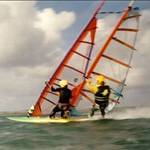
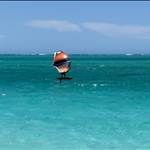
In actual fact MW is from the future, he is giving us the product of the 23rd Century, and our 21st century minds cannot integrate such advanced technological knowledge. In the future there will be a statue of him erected at every major windsurf venue in the world, all with the title "The First Unrecognised Wsurf Genius". The second unrecognised genius was Hardie, but that is another story. This story began when I decided to use my gravitational speed accelerometer to have a peek into the future, and low and behold I landed in the year 2297 at the Peel Inlet. What I saw left me breathless, the inflatable MWsails were being rigged by robots on the beach, rigging time had now been reduced by 50%, and it was only taking the robots 45 minutes to have each of the sails fully rigged. Sea levels had risen by 50cm and not the 100cm as predicted, though none of the natural speed runs dominated by Stroppo Hardie Doddi, and Elmo were left in existence. The Mandurah Mob, now a team predominantly populated by gorgeous young women (Unfortunately my captaincy of the MMob had been 2 centuries too early and I could not practice the 20th century custom of abusing my power as Captain to take advantage of these stunning creatures), anyway I digress. The stunners had installed man made speed runs to suit every wind direction, and were the current inter-stellar champions of the GPSTC.......... to be continued
Select to expand quoteImax1 said..
Man made speed run for all directions , would that be a round pond ?
Imax you are a man of limited imagination no wonder MW is beyond you , THis was the late 23rd century, depending on the wind direction, activated automatic dykes would rise out of the water at 135 degrees to the wind direction.........
Select to expand quotehardie said..
THis was the late 23rd century, depending on the wind direction, activated automatic dykes would rise out of the water at 135 degrees to the wind direction.........
Oh Buggger, don't think I'll live that long, hardie can you go back and move that contraption forward in time? I'm not interested in the lovelies but the dukes sound good!
The only question - will it work as MW says?
Yes, the Americas Cup main sail is made up of two symmetrical pieces making one big asymmetrical sail WITH TWIST. MW sail design accomplishes the same thing, but with no twist. The sail works, but the issue is how well does it work. So that's why on the water testing by competent sailors will provide a more definitive answer. Other windsurfing sail designers generally make changes to their designs from year to year. I know in some cases, dozens of prototype sails are made, refined, tested, changed, re-made, tested, etc. before the final product goes into full production. This is where MW is handicapped. He may get lucky and produce something that works well enough to establish a viable market, but that's going to be very long shot.
Whether MW is a marketing incompetent or genius doesn't matter too much. In the next year, The sail will be either a success or flop, and that will be based mostly on the sail's performance, not marketing.
Select to expand quoteNCUSAGUY said..
The sail will be either a success or flop, and that will be based mostly on the sail's performance, not marketing.
That's mighty naive. Try finding Maui Sails in a windsurf shop in the US. A few years ago, lots of stores carried MS, and many windsurfers liked the sails a lot. The sails are still ok, but you won't find them anymore. The downward slide started when McGaingot rida marketing/sales guy whose importance he did not understand. He took over his work and pissed off important people. Stores in the US stopped carrying MS. Many windsurfers who used MS for years switched (often to the brand the marketing guy now represents), and would not use MS if they'd get it for free.
It is very common for technical types to think they just have to develop a better product, and "the world will beat a path to their door". In 999 of 1000 cases, they are wrong. If it's really a good product and attracts venture capital, the founders are pushed aside most of the time, and relegated to a purely technical role. Exceptions exist, but they are rare.
MWsails stated that "People NEVER satisfied with their achievement or sports gear that they already have". He promises that his sails are "100% better" in all aspects, including speed, sailing angles wind range, and jibing. He uses PR tactics he copied from Trump, and seems to hope that he'll get a similar base of followers who believe everything he says, without any regard for facts.
MWsails "built sail with average sailor in mind". Which "average sailor" will spend $1200 on a sail that's harder to rig that current sails, and heavier? Most won't even think about it.
Even with a great and excellent marketing, getting a new windsurfing product sold is difficult. Fanatic's new stubby shapes have received fantastic reviews in magazines and from everyone I know who tried one. At our local beach, we have about 20-30 regular sailors; most freeride; many could use new boards, and a Fanatic Blast or Freewave STB would be a huge improvement. To actually sell a stubby to one of the locals required multiple visits with demo gear, a demo tent at our annual windsurfing festival, a full endorsement by the best local windsurfer, and a significant discount. That was to sell it to a guy who was in the market for a new board and has plenty of money, and who indeed sees the board as a huge improvement over his previous board. The guys who did the demos were very enthusiastic and friendly, represented a long-established and well-known store, and worked closely with the manufacturer/distributor to get the demos organized.
If it took that much effort to get one board that only had advantages sold, how much effort will it take to get a sail sold that has some obvious disadvantages, including harder rigging, higher price, and unknown manufacturer and durability?
Select to expand quoteNCUSAGUY said..
The only question - will it work as MW says?
Yes, the Americas Cup main sail is made up of two symmetrical pieces making one big asymmetrical sail WITH TWIST. MW sail design accomplishes the same thing, but with no twist. The sail works, but the issue is how well does it work. So that's why on the water testing by competent sailors will provide a more definitive answer. Other windsurfing sail designers generally make changes to their designs from year to year. I know in some cases, dozens of prototype sails are made, refined, tested, changed, re-made, tested, etc. before the final product goes into full production. This is where MW is handicapped. He may get lucky and produce something that works well enough to establish a viable market, but that's going to be very long shot.
Whether MW is a marketing incompetent or genius doesn't matter too much. In the next year, The sail will be either a success or flop, and that will be based mostly on the sail's performance, not marketing.
Sure , Why did you assume that my sail doesn't have twist? It's about 20 degrees , Twist on my sail changes with AOA. Small sail twist helps to utilize more lift on small AOA and get rid of flutter without using micro battens as it has been done before. Twist on my sail has different purpose than on regular sail . My sail built for maximum lifting surface in all conditions, As sail profile go up it changes in width and thickness accordingly. More narrow and thin profile is subject for stall first , compare to wider and thicker profiles. To prevent wingtip stall and" breath" air to thicker surface where most of the lift is generated , my sail has designed twist angle. This is why wing tip on my sail is narrow, wider tip will induce more twist ( all been experimented). On my CFD blog sail is twisted at 20 degrees. I can provide projection from the top to prove it. By the way, i can see that only few people truly understand role of the twist on regular sail , I can explain but ,nah , don't want to inflame another unreasonable flame from my numb nuts critics . And you right , marketing is based on performance , this is why I feel free to slap them a bit. By the way, this is me been very nice.
Boardsurfr,
I said that MW's success would be a very long shot, but failed to qualify that with what you added. Previously, I said that his market will be just a segment of the full windsurfing line, mostly freeriders, so even if his design turns out to be wonderful product, it will still be an uphill battle to produce, distribute, market and sell the sail. Unless it's performance is clearly better than what's available today, it will have no chance.
I know about Maui Sails, I have used Barry Spanier's designs since he was at Neil Pryde in the 80's, then Gaastra, then his own business. I have ten of his sails, but nothing new in the last two years. I haven't changed over to S2 Maui just yet.
MW,
For some reason, I thought that you had said that your wing sail had a fixed shape and no twist. Sorry I made that assumption/mistake.
MW sails .
Will we ever get to try one ???
Send one down , we can pass it around , ( I'd be a good tester , I'm very average )
We will test it's durability , ease of rigging and performance.
We can then leave our honest thoughts on your product.
I know we sound like **** stirrers ( that's a national pastime ) , I believe we will leave an honest view of your sail despite all of this hoo haa.
I understand your " all attention is good attention " philosophy but we really need to have a go at one.
Problems with that ?
Select to expand quoteMWsails said..John340 said..
The finished product looks great.
I have a few questions
- what are the comparative sizes of current PWA race sails to the 4.5 & 5.8 MW Storm?
- similarly, what are the expected wind range for each sail for a 85kg sailor on a 110lit slalom board?
- have you or other sailors used the Storm for GPS sailing and is there any GPS data available for these sessions?
- is there any leach twist or is it not necessary?
- do you have any video of the sail in use?
- is the specification for the mast unique to the Storm or can current constant curve masts be used?
- how does the sail account for different boom heights or is there only one height available?
-
Hey John! Leach twist about 5 degrees . Boom adjustments 11 inches closed on each side with adjustable velcro strips ,mast sdm 460 wind range 14 - 42 kt.
You win Sparky, I couldn't help myself.
MW, you posted this morning that the leech twist is 20 degrees, but responded to my question, in November, that it is 5 degrees.
I'm gone for good now. Hopefully everyone else will follow and this topic will die a natural death.
Select to expand quoteJohn340 said..MWsails said..John340 said..
The finished product looks great.
I have a few questions
- what are the comparative sizes of current PWA race sails to the 4.5 & 5.8 MW Storm?
- similarly, what are the expected wind range for each sail for a 85kg sailor on a 110lit slalom board?
- have you or other sailors used the Storm for GPS sailing and is there any GPS data available for these sessions?
- is there any leach twist or is it not necessary?
- do you have any video of the sail in use?
- is the specification for the mast unique to the Storm or can current constant curve masts be used?
- how does the sail account for different boom heights or is there only one height available?
-
Hey John! Leach twist about 5 degrees . Boom adjustments 11 inches closed on each side with adjustable velcro strips ,mast sdm 460 wind range 14 - 42 kt.
You win Sparky, I couldn't help myself.
MW, you posted this morning that the leech twist is 20 degrees, but responded to my question, in November, that it is 5 degrees.
I'm gone for good now. Hopefully everyone else will follow and this topic will die a natural death.
Twist subject to change with AOA accordingly. On small AOA or when sail relaxed is about 5 degrees. Look at the pictures . You gone for good, is excellent news. Dont come back, cause you promise and never leave. Be the man!
Select to expand quoteJohn340 said..MWsails said..John340 said..
The finished product looks great.
I have a few questions
- what are the comparative sizes of current PWA race sails to the 4.5 & 5.8 MW Storm?
- similarly, what are the expected wind range for each sail for a 85kg sailor on a 110lit slalom board?
- have you or other sailors used the Storm for GPS sailing and is there any GPS data available for these sessions?
- is there any leach twist or is it not necessary?
- do you have any video of the sail in use?
- is the specification for the mast unique to the Storm or can current constant curve masts be used?
- how does the sail account for different boom heights or is there only one height available?
-
Hey John! Leach twist about 5 degrees . Boom adjustments 11 inches closed on each side with adjustable velcro strips ,mast sdm 460 wind range 14 - 42 kt.
You win Sparky, I couldn't help myself.
MW, you posted this morning that the leech twist is 20 degrees, but responded to my question, in November, that it is 5 degrees.
I'm gone for good now. Hopefully everyone else will follow and this topic will die a natural death.
This whole twist thing took off, I was really interested in the question of do the simulations represent real world sailing which no one has answered , all that is needed is a wind meter on a stick in real sea conditions and measure wind speed at different heights? maybe there is no wind speed change at all maybe its 5 knots ?
For ****s sake , give us a try , Well let u know how it goes , why is it sooo bloody hard ?
MW you should not be waffling on about your product here on an Australian site if we can't even touch one.
Thats it I'm going home !
Select to expand quoteImax1 said..
Man made speed run for all directions , would that be a round pond ?
Sure just like a circular airport runway
Select to expand quoteImax1 said..
For ****s sake , give us a try , Well let u know how it goes , why is it sooo bloody hard ?
MW you should not be waffling on about your product here on an Australian site if we can't even touch one.
Thats it I'm going home !
Yes Imax, you say that now. But are you really "going home"? Looking forward to hearing from you on page 23. (When you still haven't seen this sail yourself)
Select to expand quoteolskool said..Imax1 said..
Man made speed run for all directions , would that be a round pond ?
Sure just like a circular airport runway
Only thing "circular" are these arguments.
Select to expand quoteMark _australia said..MWsails said..Sail that we produce, is more than just replacement for entire quiver. This is one step forward, radical game changer. Imagine that average sailor now would be able safely achieve much higher speeds, refine and progress in skills, sail in conditions previously considered as "survival" .
And we do have to imagine as you haven't proven it.
Oops I said I was out. Who used the train wreck analogy for this thread? 
Welcome back Mark. See you again by at least page 17. ( when you do your thorough report on how you enjoyed using the wingsail, and the posting of your personal gps data).
Select to expand quoteSimon100 said..
This whole twist thing took off, I was really interested in the question of do the simulations represent real world sailing which no one has answered , all that is needed is a wind meter on a stick in real sea conditions and measure wind speed at different heights? maybe there is no wind speed change at all maybe its 5 knots ?
The amount of twist in real world sailing varies quite dramatically according to a lot of factors, and boat sailors tend to think about varying the twist a lot more than windsurfers. With their more complex and extremely efficient rigs, boat sailors can often dial twist in or out, and if you're sailing well you could adjust the relevant controls 15 times in a 10 minute beat, as well as using the sheets to affect twist every few seconds. If you look at a boat's sails you'll normally see tufts of dacron near the luff and hanging off the leach, and by using these to indicate the wind flow the sailors will adjust the controls to ensure that they have the right amount of twist.
In a big swell in light winds, the twist can be enormous because the wind low down is so disturbed by the waves. Another factor is temperature; air higher above the ground is less slowed by friction than the air close to the ground or water surface. Allegedly if cool air is flowing over warm ground or water, the wind layers mix as the heated air rises. That churns the slower-moving lower air with the faster-moving upper air so there is less speed difference as you go higher up, therefore there is less need for twist. Alternatively, if warm air is flowing over cool ground there is less mix between the layers of air and therefore the lower air (which is slowed dramatically by friction with the land) is at a much lower speed - so you need more twist in your rig at the top where it meets the faster moving air.
Twist is also very good for acceleration and maintaining airflow in difficult conditions, so sometimes you may want more twist on one tack (ie bashing into waves) than the other when you may be going along the waves and therefore going faster. And then of course, if you are racing tactics come into it; if you want to sail higher and slower you reduce twist, if you want to sail lower and faster you give more twist.
Sailing on a high inland lake I find I can barely get enough twist in my boat's rig a lot of the time. The same boat sailing against the same people on the coast in the same wind strength needs much less twist. In high performance cats, with their extremely tall high aspect rigs, sail twist takes on another new dimension which I'm still coming to terms with.
The Kiwi America's Cup team built a whole wind tunnel that allowed the windflow to be twisted to study this sort of thing. Frank Bethwaite did some testing which he wrote about in the book Higher Performance Sailing, but for good boat sailors adjusting twist in and out is pretty much a reflex action.
Select to expand quoteChris 249 said..Simon100 said..
This whole twist thing took off, I was really interested in the question of do the simulations represent real world sailing which no one has answered , all that is needed is a wind meter on a stick in real sea conditions and measure wind speed at different heights? maybe there is no wind speed change at all maybe its 5 knots ?
The amount of twist in real world sailing varies quite dramatically according to a lot of factors, and boat sailors tend to think about varying the twist a lot more than windsurfers. With their more complex and extremely efficient rigs, boat sailors can often dial twist in or out, and if you're sailing well you could adjust the relevant controls 15 times in a 10 minute beat, as well as using the sheets to affect twist every few seconds. If you look at a boat's sails you'll normally see tufts of dacron near the luff and hanging off the leach, and by using these to indicate the wind flow the sailors will adjust the controls to ensure that they have the right amount of twist.
In a big swell in light winds, the twist can be enormous because the wind low down is so disturbed by the waves. Another factor is temperature; air higher above the ground is less slowed by friction than the air close to the ground or water surface. Allegedly if cool air is flowing over warm ground or water, the wind layers mix as the heated air rises. That churns the slower-moving lower air with the faster-moving upper air so there is less speed difference as you go higher up, therefore there is less need for twist. Alternatively, if warm air is flowing over cool ground there is less mix between the layers of air and therefore the lower air (which is slowed dramatically by friction with the land) is at a much lower speed - so you need more twist in your rig at the top where it meets the faster moving air.
Twist is also very good for acceleration and maintaining airflow in difficult conditions, so sometimes you may want more twist on one tack (ie bashing into waves) than the other when you may be going along the waves and therefore going faster. And then of course, if you are racing tactics come into it; if you want to sail higher and slower you reduce twist, if you want to sail lower and faster you give more twist.
Sailing on a high inland lake I find I can barely get enough twist in my boat's rig a lot of the time. The same boat sailing against the same people on the coast in the same wind strength needs much less twist. In high performance cats, with their extremely tall high aspect rigs, sail twist takes on another new dimension which I'm still coming to terms with.
The Kiwi America's Cup team built a whole wind tunnel that allowed the windflow to be twisted to study this sort of thing. Frank Bethwaite did some testing which he wrote about in the book Higher Performance Sailing, but for good boat sailors adjusting twist in and out is pretty much a reflex action.
Twist on my sail comes naturally, as self adjusting motion. Just like you said " reflex action" Nothing to brag about. Because our craft is very small and compact , sail design has very limited mechanical options. I consider it more trickery than actual design. In my following CFD blogs you will see that area of low pressure moves up when sail racked back ( natural position on high speed) , this is not beneficial because too much leverage over sailor, so proper amount of twist needed to compensate . I experiment a lot with different width of wing tip. Basically built larger sail and cut it down inch by inch till get desired result. So twist on my sail is designed to generate descent amount of lift without having too much leverage over sailor. This is something that I can't just seat and design on computer, have to do a lots of "hands on" experimenting. You know,I didn't spend 5 years doing nothing. Anyway it was greatest adventure , I hope will continue. Thanks to my critics, this blog generate so many good comments on design and clicks that goes beyond of my comprehension.
Select to expand quoteImax1 said..
For ****s sake , give us a try , Well let u know how it goes , why is it sooo bloody hard ?
MW you should not be waffling on about your product here on an Australian site if we can't even touch one.
Thats it I'm going home !
Haha , Listen I'm really sorry. I can't just send sail to Australia without knowing everything about tester. It really breaks my heart to say no. As winter goes here we building our inventory and working on some issues we heard in here, My associates thinking to use last year R&D models for demo, but I thinking that we should dedicate few new sails for it. I'm pretty sure that I will convince everyone to sell last year models for very good discounted price. Performance of these models as good as new with few cosmetic imperfections. PM me in end of February if you interested see if I can cut the deal. As a craftsman I did a lots of free work for my friends and even clients, I don't really value things that I built in the past and don't need anymore. But you my friend of course and not really my friend. You know...
Select to expand quoteImax1 said..
Sparky , I'm trying really hard .....
I give you credit for it!
Select to expand quotehardie said..
Imax you are a man of limited imagination no wonder MW is beyond you, THis was the late 23rd century, depending on the wind direction, activated automatic dykes would rise out of the water at 135 degrees to the wind direction.........
What! Haven't they mastered wind direction made to order yet?
Select to expand quotesailquik said..hardie said..
Imax you are a man of limited imagination no wonder MW is beyond you, THis was the late 23rd century, depending on the wind direction, activated automatic dykes would rise out of the water at 135 degrees to the wind direction.........
What! Haven't they mastered wind direction made to order yet?
SQ man of little foresight, of course they could manipulate the wind, it was just cheaper to build automated dykes, As a famous president in the 20th century once said "it's the economy stupid"
Select to expand quoteSparky said..
I think they already have automated dykes.
Sparky, Sparky, Sparky.......... Not in the Peel Inlet, and not automated to spring up at 135 degrees to the prevailing wind direction they don't, you gotta wait 200 years for that buddy, get with the program, No wonder MW is so frustrated by you blokes
Select to expand quoteSparky said..
I think they already have automated dykes.
And they will send you one to demo as well if you ask nicely.
Select to expand quoteSwindy said..Sparky said..
I think they already have automated dykes.
And they will send you one to demo as well if you ask nicely.
Swindy, they won't send him a demo dyke coz they are too poor, you gotta pay up front if you want an automated dyke, however in the late 23 Century all products have become try before you buy, and yes the automated dykes which raise themselves at 135 degrees to the wind are available for a one month free demo from David Dukes Dinky Dykes