Dam!
Naish 120 crossover 2018, it's a sup, windfoil etc...
Yesterday I set it up to try some prone surfing and after putting the foil in, I noticed a bit of movement of the foil. Gave it a few more harder wiggles from front to back and got a squeaking sound and I noticed the underside of the board, in front of the US boxes and even between the US boxes, was moving.
Further examination was that it was soft in front of us boxes and between.
I fixed up a soft deck a few years ago by sanding back the deck and then applying some fibreglass but I think I can't do that here. It just looks deeper. I took a video if you are interested. It is hard to see the movement though.
Doing one now.
Major surgery..... not just delam, that all needs to come out and a big block of PVC foam inserted, bonded to deck and bottom. Now the skin has delaminated its a much bigger area, the glass job will need to be full width and about 600mm of board length. Basically rebuilding the whole back of the board, bar the rails. You get to keep the rails.
The hole, and (some of) what's going in it:

owwwww double damn Van Damn even.
If you wouldn't mind Mark, can I get all my questions ready and get back to you in a few days? That way my stupidity will come in one big blast. At the moment this project would be well out of my comfort zone but I am thinking it could be a great challenge.
Also, I think I found out how the water has been getting in. Do you think possibly poor construction?

Yes poor construction. I think in the first couple years all the companies scrambled to get foil stuff out and the box (track) installs were crap. The one I'm looking at is same as a windsurf US box install with foaming resin and a bit of token glass, and they figured more glass patches over top would do it - but clearly not. It handles side load of a 30cm fin, not a metre of foil torque and the engineer bloke should be sacked for allowing it.
The secondary problem is once it moves, the glass rapidly separates from the edges of the box as glass doesn't stick well to the Chinook style plastic boxes (tracks). They needed to rough it up more, but factory will never do that they just bung it in.
I think the solution is carbon moulded tracks on PVC foam to solve the moving issue and the skin adhesion issue. I'm making some now in between other jobs
Select to expand quoteMark _australia said..
Yes poor construction. I think in the first couple years all the companies scrambled to get foil stuff out and the box (track) installs were crap. The one I'm looking at is same as a windsurf US box install with foaming resin and a bit of token glass, and they figured more glass patches over top would do it - but clearly not. It handles side load of a 30cm fin, not a metre of foil torque and the engineer bloke should be sacked for allowing it.
The secondary problem is once it moves, the glass rapidly separates from the edges of the box as glass doesn't stick well to the Chinook style plastic boxes (tracks). They needed to rough it up more, but factory will never do that they just bung it in.
I think the solution is carbon moulded tracks on PVC foam to solve the moving issue and the skin adhesion issue. I'm making some now in between other jobs
I'd beg to differ. If you've never been there before or seen how any of it works you won't really have a clue.
Yep, there's been some fcuck ups from some of the brands but further down the track they're all getting sorted now.
Mark is right. In early foil boards, tracks coming loose was a somewhat common problem, since nobody had experience. I strongly doubt that many (any?) companies used engineers to calculate loads; more likely, the shapers just reinforced the boxes some more, tested it for a few sessions, and then send the specs of to the factories.
When you do the repair, it would be great if you could post pictures of how the boxes were put in. Most likely, what is missing is a firm connection to the top of the board that prevents the front of the tracks to work loose over time. Without a solid connection, the box just floats on the compressible foam, and it's just a question of time until things start moving around.
Here's an image of a track install:
 I had glued PVC to the sides and bottom of the tracks. On the back, the padded tracks attached to the existing foil tuttle box on the side, keeping the back from moving. Near the front, I dug a hole to the top layer, and filled it with poor foam. This kept the front from moving up and down on the foam. I've used another board with a very similar install for more than 110 foil sessions without any problems.
Select to expand quoteMr Hooper said..Mark _australia said..
Yes poor construction. I think in the first couple years all the companies scrambled to get foil stuff out and the box (track) installs were crap. The one I'm looking at is same as a windsurf US box install with foaming resin and a bit of token glass, and they figured more glass patches over top would do it - but clearly not. It handles side load of a 30cm fin, not a metre of foil torque and the engineer bloke should be sacked for allowing it.
The secondary problem is once it moves, the glass rapidly separates from the edges of the box as glass doesn't stick well to the Chinook style plastic boxes (tracks). They needed to rough it up more, but factory will never do that they just bung it in.
I think the solution is carbon moulded tracks on PVC foam to solve the moving issue and the skin adhesion issue. I'm making some now in between other jobs
I'd beg to differ. If you've never been there before or seen how any of it works you won't really have a clue.
Yep, there's been some fcuck ups from some of the brands but further down the track they're all getting sorted now.
Definitely not sorted yet looking at the way the fin box was fitted to one of my boards
boardsurfr - I don't know if the pillar of polyurethane has the compressive resistance to make a difference there ...... but if its working, its working 
Bonding to the deck has its disadvantages (sorta) and of course you then need to reinforce the deck lam. Like a good bottom hit to thruster fins - the inserts get damaged, pushed in, whatever. If they're bonded to the deck you might not get damage but its lifted the deck lam a little and you don't know. So you get a couple more sessions and then the repair is far more significant. Trade-offs.
So - many ways to skin a cat and every repair presents differently but my thoughts on this one
Cut a long slot up the centre thru to the deck, strip of divinycell 15mm thick with 2 x carbon lapped over (one is just around the strip). Using offcuts and gap in middle is irrelevant and its a rocking motion with foil that loads front and rear.

The big block shown earlier, with carbon and glass wrap. Now any movement becomes resisted by a strong shearing force at the sides, rather than just the deck laminate bond which peels away from the substrate easily. Plus stiffness of carbon.
20kg on top gives it all a good squish, and is flattening the slightly warped deck lam (underneath) as it all sets up.

Loads of info on standupzone about foil boxes. Mainly wing foil.
What seems to be working is a mixture of the 2 repairs above. A large HD foam block in the bottom. Then the fin boxes set into HD foam blocks a bit bigger than the box that go all the way through the board. Carbon over the 2 box inserts then put them in going all the way through the board. You end up with 2 pillars that go through the board. Trim them flush with the deck and laminate top and bottom.
Loads of pics and better explanation on standupzone.
Select to expand quoteMark _australia said..
boardsurfr - I don't know if the pillar of polyurethane has the compressive resistance to make a difference there ...... but if its working, its working
Bonding to the deck has its disadvantages (sorta) and of course you then need to reinforce the deck lam. Like a good bottom hit to thruster fins - the inserts get damaged, pushed in, whatever. If they're bonded to the deck you might not get damage but its lifted the deck lam a little and you don't know. So you get a couple more sessions and then the repair is far more significant. Trade-offs.
The pillars create a non-compressible connection to the top sandwich. The pillars don't need to hold the entire force acting on of the wing - they just need to prevent compressions of the core which start very small, but then get larger over time.
If you connect to a top layer sandwich as in my example, I don't think a reinforcement of the top is necessary. The sandwich already distributes the load. But if it's a SUP-type construction, with glass directly over the core, then you'd definitely have to reinforce the top, too, and also use a larger connection, like what tarquin1 describes.
The plug idea was also described in an article in the German Surf magazine about track back installation for foiling, although I think they used bits of PVC foam in epoxy with a lot of filler. That should be even stiffer than PU, but you'd have to be careful about how much heat is generated when it polymerizes, or the plug will be surrounded by air after melting the styrofoam around it.
Took it over to a mate who makes fins, foils, and repairs boards for a living. He likes the fins and foil stuff but hates repairing boards, so he is always very happy to impart info. There is a little bit of a language problem though.
Anyway, he reckons that the affected area goes right out to the fin inserts (maybe) and about 3/4 up the board.
Like all my stuff, I got it on the cheap but I am thinking of buying something new, hiding the board in my uncle in-laws garage and hopefully one day I have the time, patience ect.. to replace the foam. I am just a little bit time poor, at the moment, but on the other hand finally getting more "savings" (money that is temporarily not spent) through the door.
Then again I could fill the US boxes and use it as an SUP, or make a plate that runs the length of the US box and squeeze the US box to the fiberglass, preventing more water getting in.
I don't want to see a "good/newish" board go to waste but hanging out with the kids is also important and that would be the time that I would have to take from them to do this job.
Select to expand quoteboardsurfr said..
The plug idea was also described in an article in the German Surf magazine about track back installation for foiling, although I think they used bits of PVC foam in epoxy with a lot of filler. That should be even stiffer than PU, but you'd have to be careful about how much heat is generated when it polymerizes, or the plug will be surrounded by air after melting the styrofoam around it.
That's what I'm getting at - 30-35kg pour foam vs 80kg or 100kg PVC foam. I really don't know that it is doing a lot
Making pillars much better with hi density foam, or stuff like SUP shaft etc.
So - bit more
After block was sanded off to bottom countours, lots of carbon and glass.

Then noticed the top wanted to delam where old tracks had pushed upwards, so top bonded back on (as only minor) and a nice long stringer of 10mm x 30mm divinycell with uni carbon each side was inset:

Then a carbon uni strip on top, 2 x glass over and front foot glass patch:

Bung some tracks in, carbon and glass over, bit of router work then paint:
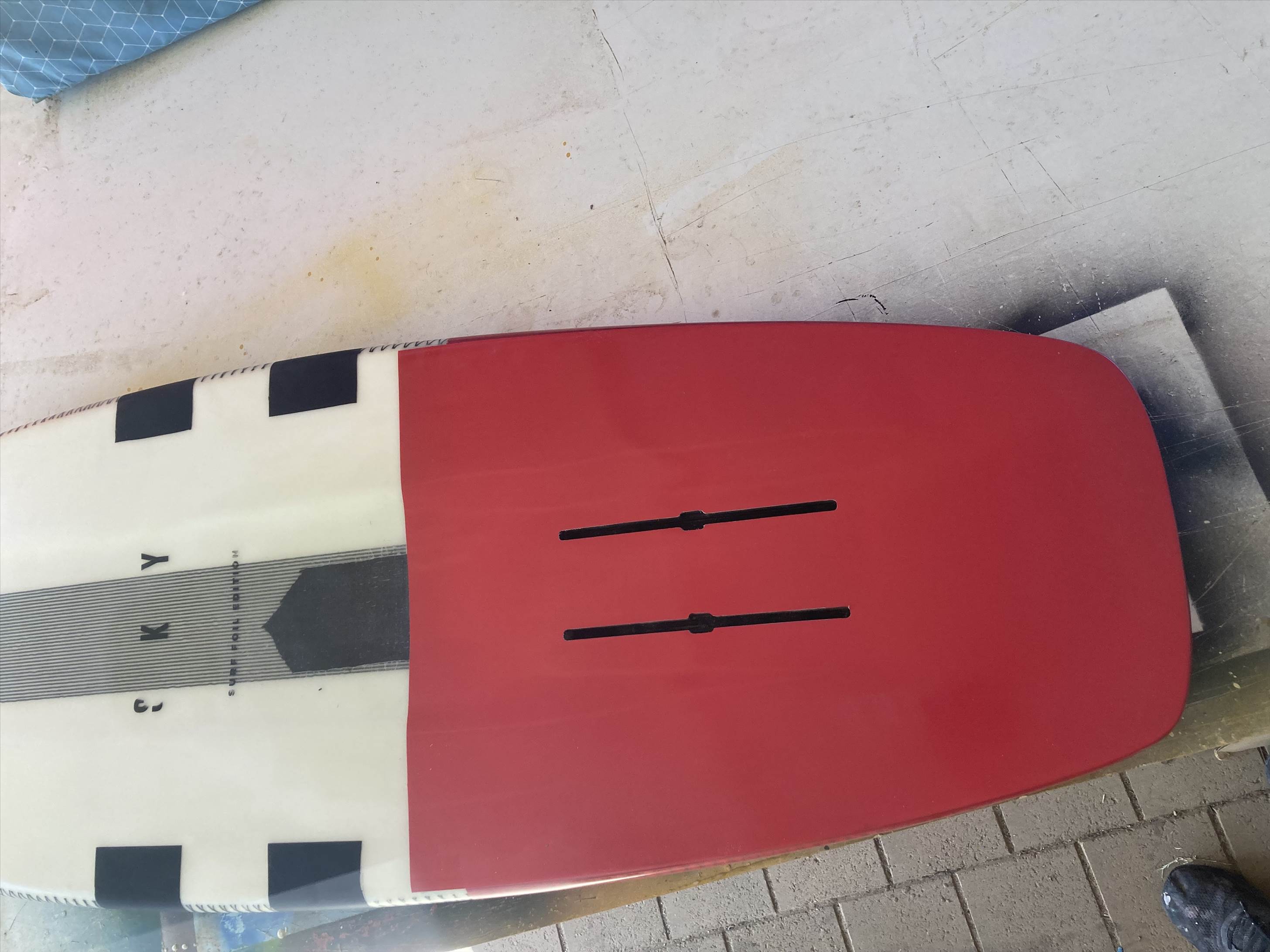
Then same with deck, red in clear = candy apple, couple black stripes.
Done, Bob's ya aunty.

Select to expand quoteMark _australia said..
Yes poor construction. I think in the first couple years all the companies scrambled to get foil stuff out and the box (track) installs were crap. The one I'm looking at is same as a windsurf US box install with foaming resin and a bit of token glass, and they figured more glass patches over top would do it - but clearly not. It handles side load of a 30cm fin, not a metre of foil torque and the engineer bloke should be sacked for allowing it.
The secondary problem is once it moves, the glass rapidly separates from the edges of the box as glass doesn't stick well to the Chinook style plastic boxes (tracks). They needed to rough it up more, but factory will never do that they just bung it in.
I think the solution is carbon moulded tracks on PVC foam to solve the moving issue and the skin adhesion issue. I'm making some now in between other jobs
if you are making/selling carbon US / PB / SB boxes i'd be keen to talk.
^^^ so far only slot, DT, and long tracks for foil coming sometime......that will be incorporated with the DT cassette as one unit......
Select to expand quoteMark _australia said..
So - bit more
After block was sanded off to bottom countours, lots of carbon and glass.
Then noticed the top wanted to delam where old tracks had pushed upwards, so top bonded back on (as only minor) and a nice long stringer of 10mm x 30mm divinycell with uni carbon each side was inset:
Then a carbon uni strip on top, 2 x glass over and front foot glass patch:
Bung some tracks in, carbon and glass over, bit of router work then paint:
Then same with deck, red in clear = candy apple, couple black stripes.
Done, Bob's ya aunty.
Great repair job, but honestly seems like a waste of money from the customer's perspective!, unless the entire board top/rails/bottom was covered with a water tight outer-layer cause whatever you did not cover up is going to delaminate and then leak sooner or later based on the known construction problems.
ummm, no.
all the bad stuff is gone, new stuff put in. You do not need to wrap the whole board in glass to make it water tight... but there are a lot of steps not shown here
Select to expand quoteSandman1221 said..Mark _australia said..
So - bit more
After block was sanded off to bottom countours, lots of carbon and glass.
Then noticed the top wanted to delam where old tracks had pushed upwards, so top bonded back on (as only minor) and a nice long stringer of 10mm x 30mm divinycell with uni carbon each side was inset:
Then a carbon uni strip on top, 2 x glass over and front foot glass patch:
Bung some tracks in, carbon and glass over, bit of router work then paint:
Then same with deck, red in clear = candy apple, couple black stripes.
Done, Bob's ya aunty.
Great repair job, but honestly seems like a waste of money from the customer's perspective!, unless the entire board top/rails/bottom was covered with a water tight outer-layer cause whatever you did not cover up is going to delaminate and then leak sooner or later based on the known construction problems.
Geez, in one thread you're telling everyone they can just use handyman thickened epoxy to bog things up. Now you're telling us you need to re glass a whole board if there's a ding !
Make up your mind will ya !!
Select to expand quoteMr Hooper said..Sandman1221 said..Mark _australia said..
So - bit more
After block was sanded off to bottom countours, lots of carbon and glass.
Then noticed the top wanted to delam where old tracks had pushed upwards, so top bonded back on (as only minor) and a nice long stringer of 10mm x 30mm divinycell with uni carbon each side was inset:
Then a carbon uni strip on top, 2 x glass over and front foot glass patch:
Bung some tracks in, carbon and glass over, bit of router work then paint:
Then same with deck, red in clear = candy apple, couple black stripes.
Done, Bob's ya aunty.
Great repair job, but honestly seems like a waste of money from the customer's perspective!, unless the entire board top/rails/bottom was covered with a water tight outer-layer cause whatever you did not cover up is going to delaminate and then leak sooner or later based on the known construction problems.
Geez, in one thread you're telling everyone they can just use handyman thickened epoxy to bog things up. Now you're telling us you need to re glass a whole board if there's a ding !
Make up your mind will ya !!
Okay, he milked the owner of the board! First it was box needs replacing, obviously, but anyone should have been able to tell deck was delaminated too at the start, but waited until into box repair before telling owner. So to owner, "your in $300 or more for box repair and now it is going to cost you another $300 for deck, and that is it!", but if you told owner what it needed at get go they would of backed out and you know it! Now in a year or two when rest of original deck starts to delaminate you will get them for another $300! Honestly, how can you say only 3/4 of original factory layup was bad and rest is still good?, Jeeze
And for the money the guy paid you to repair a lost cause board, he could of bought a good secondhand board!
Nothing of the sort happened - and you would not have a clue what the discussion was with the owner or quoting process!
So WTF??!!!
For the record it was $250, and I stuck by that when I needed to put a bit more work into it. That sometimes happens after you cut into it and discover more. At that point I sent pics and videos to the owner and said its worse than we thought, it will take a lot longer but I will not charge more, what do you want to do? He said please proceed.
You're outa line man.
Select to expand quoteSandman1221 said..Mr Hooper said..Sandman1221 said..Mark _australia said..
So - bit more
After block was sanded off to bottom countours, lots of carbon and glass.
Then noticed the top wanted to delam where old tracks had pushed upwards, so top bonded back on (as only minor) and a nice long stringer of 10mm x 30mm divinycell with uni carbon each side was inset:
Then a carbon uni strip on top, 2 x glass over and front foot glass patch:
Bung some tracks in, carbon and glass over, bit of router work then paint:
Then same with deck, red in clear = candy apple, couple black stripes.
Done, Bob's ya aunty.
Great repair job, but honestly seems like a waste of money from the customer's perspective!, unless the entire board top/rails/bottom was covered with a water tight outer-layer cause whatever you did not cover up is going to delaminate and then leak sooner or later based on the known construction problems.
Geez, in one thread you're telling everyone they can just use handyman thickened epoxy to bog things up. Now you're telling us you need to re glass a whole board if there's a ding !
Make up your mind will ya !!
Okay, he milked the owner of the board! First it was box needs replacing, obviously, but anyone should have been able to tell deck was delaminated too at the start, but waited until into box repair before telling owner. So to owner, "your in $300 or more for box repair and now it is going to cost you another $300 for deck, and that is it!", but if you told owner what it needed at get go they would of backed out and you know it! Now in a year or two when rest of original deck starts to delaminate you will get them for another $300! Honestly, how can you say only 3/4 of original factory layup was bad and rest is still good?, Jeeze
And for the money the guy paid you to repair a lost cause board, he could of bought a good secondhand board!
Really? after seeing the cheap factory construction do you think a good 2nd hand board exists?
Select to expand quoteMark _australia said..
ummm, no.
all the bad stuff is gone, new stuff put in. You do not need to wrap the whole board in glass to make it water tight... but there are a lot of steps not shown here
Beautiful job Mark.
Select to expand quoteSandman1221 said..Mr Hooper said..Sandman1221 said..Mark _australia said..
So - bit more
After block was sanded off to bottom countours, lots of carbon and glass.
Then noticed the top wanted to delam where old tracks had pushed upwards, so top bonded back on (as only minor) and a nice long stringer of 10mm x 30mm divinycell with uni carbon each side was inset:
Then a carbon uni strip on top, 2 x glass over and front foot glass patch:
Bung some tracks in, carbon and glass over, bit of router work then paint:
Then same with deck, red in clear = candy apple, couple black stripes.
Done, Bob's ya aunty.
Great repair job, but honestly seems like a waste of money from the customer's perspective!, unless the entire board top/rails/bottom was covered with a water tight outer-layer cause whatever you did not cover up is going to delaminate and then leak sooner or later based on the known construction problems.
Geez, in one thread you're telling everyone they can just use handyman thickened epoxy to bog things up. Now you're telling us you need to re glass a whole board if there's a ding !
Make up your mind will ya !!
Okay, he milked the owner of the board! First it was box needs replacing, obviously, but anyone should have been able to tell deck was delaminated too at the start, but waited until into box repair before telling owner. So to owner, "your in $300 or more for box repair and now it is going to cost you another $300 for deck, and that is it!", but if you told owner what it needed at get go they would of backed out and you know it! Now in a year or two when rest of original deck starts to delaminate you will get them for another $300! Honestly, how can you say only 3/4 of original factory layup was bad and rest is still good?, Jeeze
And for the money the guy paid you to repair a lost cause board, he could of bought a good secondhand board!
Is this like your Starboard foil conspiracy theory?
surely you're not proposing Mark is a lizard person here to drain windsurfers bank accounts one quality repair at a time? Sheesh, you're going to be here for a while Mark..
Select to expand quoteMark _australia said..
For the record it was $250
What ??
Tell 'im he's joking.
He could have tossed the board and got two sets of jousting sticks for that.
Looks an incredible repair for $250.
Next time I need something done I'm paying the post and sending it to ya.
It's often said here. If only the board manufacturers would give up their obsession with weight, put an additional 500g worth of sensible strengthening and reinforcements in we would all be happier people.
i agree. but.
i have a lot of boards of varying weights and the light ones are way more fun for blasting and jumping. so i guess its swings and round abouts.
I think they forget (on purpose ) that most windsurfers are closer to or over the 100kg mark, and not the 75kg rider weight they are designed to handle.
An extra 30 odd kgs put a hell of a lot more pressure on the gear.
Its a bit like putting a 1 tonne winch on a 5 tonne vehicle and complaining that it breaks.
The manufactures need to make them to suit the real world rider........but then they would last and you wouldnt continually need a new one or repairs, more money in their pockets.
The apprentice says " Hey boss, if we reinforce this bit and strengthen this bit, the board will last forever "
The boss answers " Then we are out of business "
I seem to think it's about brochure weight . That is what sells .
15 years ago it was acceptable for a 125 litre freeride board to be 9.5 kg . A lot of those boards are still alive today .
Now a 125 litre freeride has to be under 8.0 kg and is lucky to last it's warranty .
Apart from fancy material names , construction hasn't changed .
Skimping is the new cool.
Some of those earlier plastic coated composite boards were light and indestructible . Before vent plugs were needed . Maybe the sun was different then ? Also before deck grip was needed . A bitch to repair , but never needed it .