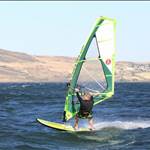
Since the foiling sails and their differences first came onto the scene, with the (original) tighter leech needed to push down against the foil (larger front wing than the PWA sailors use now), it made me think about mast foot pressure.
I still think that "you cant use a freeride sail on a slalom board because it wont pin the nose" which people used to talk about is nonsense. Also general over use of mast foot pressure. To me its the feel that I get when speed increases, it doesnt feel like MFP from the sail is there.
Anyway, latest P7 video from Andrea Cucchi testing 2 8.2 protos, 1 designed for 460 mast and the other 490. Not just 1 sail and 2 masts, as the 2 sails are cut differently to suit the masts.
2:10 in he says he prefers the 490 mast 8.2m sail as the stiffer 490 mast is lifting up the board more. Maybe what he is feeling is the 490 sail is pushing down less? It was easier to rail the board with that setup as well, presumably because that rig was more solid.
The 490 8.2 was faster in light and strong winds.
I wish he would give 10s average of 5 runs though, as 1 peak max speed can be more about a gust and flat water at the time.
Select to expand quotePhilUK said..gorgesailor said..PhilUK said..
A few have mentioned damage to the deck of boards when a UJ breaks. When I broke a tendon the safety rope did its job. I slogged back in expecting some damage to the board, but there was none. I think the extension just made contact with the deck plate.
Since then, whenever I buy a new UJ, I make sure the safety rope is kept as short as possible, so if the tendon does break, the extension will again just come into contact with the deckplate. The blue/black rope on Chinook UJs gets junked straight away and replaced with formuline as thats stronger. They come with only 1 piece of rope weaved through the holes top and bottom, so if a stop knot comes undone or the rope snaps, thats the rope rendered useless. So I use 2 separate ropes. Never had a tendon break since then, but better safe than sorry.
You obviously haven't bought a UJ in a while either... Chinook have been using Dyneema for like 10 years
Now you mention it, the last one I bought might have had Dyneema, but still just 1 piece and too long as I replaced that. Maybe the extension/boom had the blue/black rope but could have been older stock.
Be careful shortening it. If you make it too short - especially if tied separately it could bind & rip your mast track right out. The 1pc design allows the the rope to be shorter without binding - limiting the distance from the plate if the tendon breaks...
Good chat that Ben had with the designer from Pryde sails.
About half way through he talks about the boards effect and how sails changed from pressing down to more forward drive.
Select to expand quoteMatt UK said..
Good chat that Ben had with the designer from Pryde sails.
About half way through he talks about the boards effect and how sails changed from pressing down to more forward drive.
This is a great video to watch - especially for us sail designer nerds, past or present.
I also have a huge respect for Robert Stroj, as the Pryde designer - and of course for Antoine Albeau who does so much development work on the quiet, listing every detail of each of his sailing sessions in a little notebook which he carries constantly.
Both these guys are from a sail design heritage or design approach that I too was brought up with - so full respect to what is being said here, and which is not commercial plugging or promotional blagging like we saw in many other videos served up in this thread...
On topic, Robert here talks about several things that determine how a sail drives forward, while minimising drag.
1) The change of foot shape is about creating a foil 'end plate' that closes the gap for the sail - but which works with the chosen mast angle or uprightness the sailor wishes to work with. So optimal sail foot shape is a function of the sailor's stance, and also has to work with the board trim of each board. If you change the foot design, then you may also need to alter the overall sail plan shape for each sail size. To be fair, that 'end plate' is probably only important when hoping to break speeds records. Modern free ride slalom sails have a foot shape which still works with different sailor stances, and with different mast rakes.
2) Robert acknowledges here, how the tightness of the leech is one way of determining downward force on the board. The tighter the leach, the more leverage from the upper sections of the rig you get. It's that leverage that creates a downward force, but a tight leach may also give you sail control problems - and board handling issues.
3) The new bit here (for me) is the discussion about how much fullness should be in the luff panels in the lower sections of the sail. Robert suggests that some down force originally came from having the sail cut very full below the boom, but he says that using a more upright stance - and an upright rig - means you can have a flatter sail luff entry below the boom. The suggestion is that that that flatter cut is then faster, in terms of drag - and maybe that's what got Albeau the new speed record.
4) The last part of this video is about how you technically structure the lower part of a modern twin luff slalom sail. There is a 'conflict of interest' when adding fullness below the boom and when also applying the huge downhaul tensions of modern sails. So Robert here talks about his vertical seam shaping, plus the unique way in which Pryde control the cam tension on the mast. If you are new to nerdy cam sails discussion, you may not know that originally slalom sail cams pushed against the mast using batten buckle tension, (and that was how cams were patented as a design advance), but later the battens were set in fixed length pockets where the cams were placed on the batten ends and held in place with velcro inside the twin luff sleeve. In this latter case the cam tension on the mast is then determined by spacers added where the cam fits onto the batten end. But Pryde do this slightly differently.
Thanks for posting this.