Ever been going flat out, and I mean proper fast on the edge, then sheeted out a bit..... nose rises and you're screwed?
Select to expand quoteBasher said..
I'll see if I can find time to watch that, but we are in danger of talking at cross purposes here. If you are foiling then that is fundamentally different from fin windsurfing.
A foil generates huge upward lift that means the windfoiler has a very different sailing stance from the fin windsurfer.
Foil sails, as a result, are generally more high aspect and cut with a tight leach. The race courses usually sailed by foilers are also different, often with more downwind work (as per the IQfoil class).
Even for downwind slalom, we foil in lighter wind but still at great speed, meaning the apparent wind angles we set our sails to are totally different. On a broad reach in light wind you stay fully sheeted in on a foil board, so there is less need for sail twist. That's a massive discussion in itself.
With all due respect, please watch the video, you might update your thinking about foiling and this topic a bit. What you've said here and elsewhere suggests to me that, while you bring a wealth of knowledge and experience, certain thoughts you have about foiling are a bit outdated. While it's true that at the beginner end of the pool, there are some important differences in stance, the more one progresses, imho, the more things begin to converge again. For an example, beginners are taught to keep over the board, as you say to, to counter the lift. More advanced windsurfers, however, easily get their weight outboard.
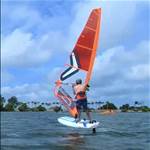
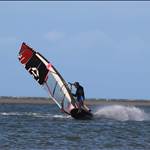
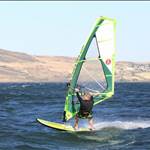
As for sails, etc., if you don't want to listen to Patrik's explanation, take a look at these ladies and see how similar (and outboard) the foil sails are set to the slalom sail. The foilers are taking the same exact marks as Sarah-Quita (so much for us doing different courses). Looking at the top of Justine Lemeteyer's sail, as Jerry Lee Lewis once said, "there's a whole lot of shaking going on."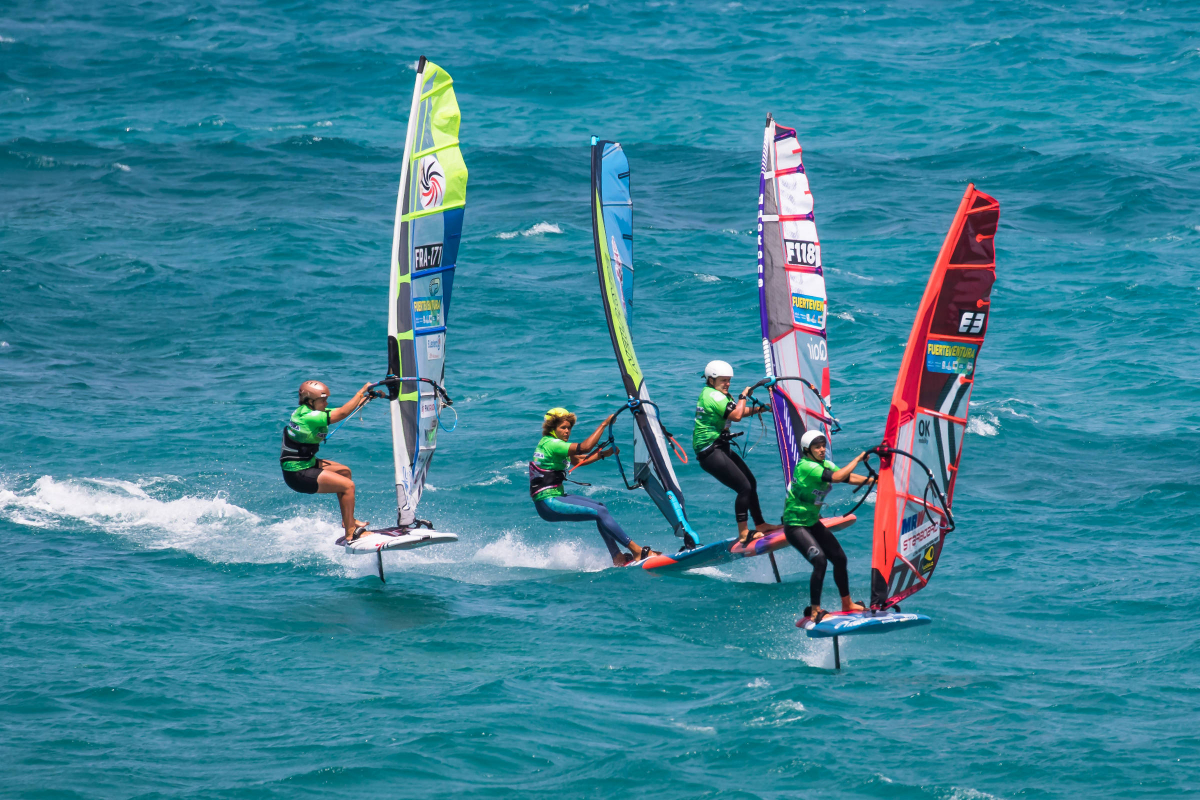
Berowne posted a great video of Will McMillan in light air and, at the end, you can see something very similar to the classic 7 stance that most fin windsurfers would recognize. Even in light air (pretty much not a white cap in sight), you can see a substantial amount of twist in his sail, too. Here's a screen grab

Select to expand quotePaducah said..Basher said..
I'll see if I can find time to watch that, but we are in danger of talking at cross purposes here. If you are foiling then that is fundamentally different from fin windsurfing.
A foil generates huge upward lift that means the windfoiler has a very different sailing stance from the fin windsurfer.
Foil sails, as a result, are generally more high aspect and cut with a tight leach. The race courses usually sailed by foilers are also different, often with more downwind work (as per the IQfoil class).
Even for downwind slalom, we foil in lighter wind but still at great speed, meaning the apparent wind angles we set our sails to are totally different. On a broad reach in light wind you stay fully sheeted in on a foil board, so there is less need for sail twist. That's a massive discussion in itself.
With all due respect, please watch the video, you might update your thinking about foiling and this topic a bit. What you've said here and elsewhere suggests to me that, while you bring a wealth of knowledge and experience, certain thoughts you have about foiling are a bit outdated. While it's true that at the beginner end of the pool, there are some important differences in stance, the more one progresses, imho, the more things begin to converge again. For an example, beginners are taught to keep over the board, as you say to, to counter the lift. More advanced windsurfers, however, easily get their weight outboard.
As for sails, etc., if you don't want to listen to Patrik's explanation, take a look at these ladies and see how similar (and outboard) the foil sails are set to the slalom sail. The foilers are taking the same exact marks as Sarah-Quita (so much for us doing different courses). Looking at the top of Justine Lemeteyer's sail, as Jerry Lee Lewis once said, "there's a whole lot of shaking going on."
Berowne posted a great video of Will McMillan in light air and, at the end, you can see something very similar to the classic 7 stance that most fin windsurfers would recognize. Even in light air (pretty much not a white cap in sight), you can see a substantial amount of twist in his sail, too. Here's a screen grab
Yes the IQFoilers set at something like +4cm of downhaul for slalom, which really opens up the upper leech most of the way to the mast on the HGO. Dropping to +2cm or less an average guy like me can feel the difference even though from what I remember that still has a lot of opening at the top. Even on fin that sail will work, and it feels a bit weird because of the cut, but it will do its thing. Same with the foil glides on fin.
Seems like a matter of degree. Foiling tighter (not drum tight) upper really does help upwind and in lighter wind, but there's still twist. I've gotten better at recognizing symptoms in feel and adjusting downhaul/outhaul on fin and foil. Even recently this week I know from re-trimming on the water with fin I can feel 1/2cm downhaul difference, and adjustable outhaul is even easier to notice because you can trim it in-flight. The coach down here during the debrief of that one race even mentioned that if you take things seriously you will get an adjustable downhaul so that on the water you get familiar with what is going on (I still haven't done that, maybe I won't but I can appreciate the trim experience with feel it gets). Those guys are also getting lots of masts and selecting their favorite ones because they behave differently. I obviously haven't tried that, and wonder if I could even tell the difference.
The twist and wind gradient from the surface on up, and its change with wind speed vs. apparent wind probably plays a role here, but then there's the dynamic twist effect which seems to really matter in specific masts behaving different and it's dynamic enough that I don't think I fully see the bigger picture.
I promise I will watch the Patrik video and report back. I have huge respect for that guy.
If someone can direct us to the part of the discussion where they talk abut sails that would help - given this talk is mostly about foils and the two videos last over two hours.
I'm not claiming to be a foil expert but I will stick with my belief that foiling stance is different from the fin windsurfing racing stance. Obviously with a foil you have vertical 'mast' plus a horizontal pair of foils, and it's the horizontal foils which lift the kit clear of the water.
For sure, beginners and those learning use big front foils, and the lift is then even greater at slow speeds, whereas the top guys now use narrower - and therefore faster - foils. But the upward lift still has to be there to get the board out of the water.
A planing windsurf board with a fin uses hydrodynamic lift from the hull and torque lift from the fin to get the board 'flying', but the sailor stance is to push more sideways against the fin and to hold the rail down against the torque lift.
The apparent wind difference between the two styles of craft is more pronounced in light winds - wind speeds when a normal windsurf board would not even be planing. The differences in rig design are not dissimilar to those differences found between ice yacht rigs and those of open ocean racing yachts.
Foil sails will still have some twist to set the rig luff at the correct angle of attack to the apparent wind direction at each height of the rig, and sails will still open at the head to depower. But it's all a different set of parameters from conventional fin slalom sailing.
Most recreational sailors can however still use the same set of sails for both disciplines - you just tune the sails slightly differently when on a foil.
The most fascinating races are where we have a downwind slalom with both fin sailors and foilers. The foilers invariably win because of maintaining speed through the turns. The fins might have a slight speed advantage when heading downwind in very windy conditions, but at all other times - and on other points of sailing - the foils win hands down.
The key with all water sports is to have fun and to do what suits you, and to chase what works at your local sailing spot. And so I have no bias or wish to take sides in a pointless them or us debate.
If someone else has a view on when or how the rig helps to 'hold the nose down', then let's hear it.
having gone through the whole wind foil evolution starting from the early course racing days to downwind slalom and occasional speed foiling, I'm with Paducah on this one: differences in sail design -- and sailor stance -- between (comparable) fin and foil racing sails are becoming smaller and smaller. check the short clip below for illustration (and bonus points for who can identify the spot); spoiler: the wind foiler is current outright foil speed record holder so let's presume that he knows what he's doing ;)
imho the main remaining difference in fin and foil slalom racing sails (disclosure: I occasionally do both) are minimal, and mostly relate to the different lift points between fin (under the back foot) and foil (under the front foot), i.e. the center of effort being further back/forward (which is also related to the higher aspect point already mentioned). this is far more difficult to change by sail tuning (even changing battens can only do so much). loose leech on the other hand is no different (anymore), albeit perhaps less visible in foil sails because of their higher aspect ratio.
I'm sure that foiling will continue to develop. But at the moment if you check the stats for slalom sails and foil sails from each brand they are consistently higher aspect for foiling sails.
So your typical 8.5m foiling sail rigs on a 540 mast, whereas your typical 8.5 fin slalom sail rigs on a 490 mast.
Being used in lighter wind, the foiling sail often has a narrower head and tighter leech. The fin slalom sail has a wider head, and is set with more twist, but is shorter in the luff.
As I say, that may continue to change.
yes, no doubt we won't be standing still.
and also yes, absolutely re aspect ratio, but my point is that there is more going on. I forgot I posted this pic on this forum five (!) years ago -- i.e. my attempt at recycling a 12.2 fw sail into a +/- 10m foil sail. the outline turned out to be very close (luff, boom) to the 10m evo flight of that era, but even from the picture you can see that profile is very deep (much deeper than the evo flight) and the CoE relatively further back. while actually worked reasonably well for foiling and was unsurprisingly super quick to get going, it did not work as well (as in, didn't have the range) as the 10m dedicated foil racing sail I eventually managed to get my hands on.
After more thinking about what would happen to the mast base if the tendon snapped..... It would depend on what point of Sail. If powered up cross wind I would think it would go up. If powered pointing high upwind , it would move sideways into the wind . If fully powered up going off the wind ,it wound bash down into the board. So I think it goes all over the place , depending. Just my seat of the pants feeling.
Select to expand quoteBasher said..
I'm sure that foiling will continue to develop. But at the moment if you check the stats for slalom sails and foil sails from each brand they are consistently higher aspect for foiling sails.
So your typical 8.5m foiling sail rigs on a 540 mast, whereas your typical 8.5 fin slalom sail rigs on a 490 mast.
Being used in lighter wind, the foiling sail often has a narrower head and tighter leech. The fin slalom sail has a wider head, and is set with more twist, but is shorter in the luff.
As I say, that may continue to change.
Foils use higher aspect sails not only for aerodynamics but because the much shorter booms bring just a bit more stability in the CoE and makes it much easier to fly level. Smaller size sails are much closer to fin dimensions and a lot of us just use fin sails in sizes 6-6.5 and below especially for freeriding. From what I've read, slalom sails need more drive out of the jibes and the longer boom lengths help with that. If you look at the dimensions of sails from about 25 years ago, the specs are surprisingly closer to modern foil sails, higher aspect than their modern day counterparts. Comparisons can be difficult because head shapes are also different but more than a few 25 yr old freeride and slalom sails have boom lengths pretty close to modern foil sails in the same "size". (2002 is the oldest NP catalogue they have online with dimensions although the RS and V8 are missing that year www.neilpryde.com/pages/archive )
The discussion of sail behaviour, iirc, is about 21:28 in the Part 2 video I posted above. Yes, it's dense. I'm having to digest it over multiple drives to my local. I appreciate that you are willing to watch it.
Select to expand quoteImax1 said..
After more thinking about what would happen to the mast base if the tendon snapped..... It would depend on what point of Sail. If powered up cross wind I would think it would go up. If powered pointing high upwind , it would move sideways into the wind . If fully powered up going off the wind ,it wound bash down into the board. So I think it goes all over the place , depending. Just my seat of the pants feeling.
But that's internal forces. It's best to start with the external forces on the system as whole. The system is board rider rig. External forces are gravity aerodynamic and hydrodynamic. At constant speed net forces and moments add to zero.
But for a given configuration of sail and rider and thus position of the C of G there are an infinite number of combinations of internal forces that could maintain the configuration. Take weight off the backfoot and weight off the mast foot. Still in equilibrium. Might have to apply a bit of wrist twist on the boom but from a distance the configuration looks exactly the same and it will continue at the same speed. Same if you press on the backfoot, you will automatically add mast foot pressure. If you had very strong wrists and forearms and ankles you could sail with no tendon. Which way it goes when it breaks suddenly at your own particular comfortable sailing setup is a bit arbitrary.
Select to expand quoteMark _australia said..
Ever been going flat out, and I mean proper fast on the edge, then sheeted out a bit..... nose rises and you're screwed?
www.seabreeze.com.au/Videos/View/15552108/Windsurfing/Windsurfing-High-Speed-wipeout/
Select to expand quoteBasher said..
I'm glad everyone is still engaging with this - I thought you'd all got bored.
I wasn't dissing the Point Seven video, and please watch it to the end if you can be bothered - because it says nothing about what we are talking about here.
... just watch it again paying attention, you'll find where it is discussed
Select to expand quoteDoggerland said..
Newtonians have entered the chat

Probably the only sensible contribution to the topic of what contributes to mast foot pressure!
Select to expand quoteJohn340 said..Doggerland said..
Newtonians have entered the chat
Probably the only sensible contribution to the topic of what contributes to mast foot pressure!
If you think 'mast foot pressure' is just about gravity - or the weight of the rig - then I doubt you can follow this discussion at all.
You could start by eating the apple, and then ponder over what 'lift' is.
Select to expand quoteBasher said..John340 said..Doggerland said..
Newtonians have entered the chat
Probably the only sensible contribution to the topic of what contributes to mast foot pressure!
If you think 'mast foot pressure' is just about gravity - or the weight of the rig - then I doubt you can follow this discussion at all.
You could start by eating the apple, and then ponder over what 'lift' is.
There are four forces acting on the board
- Self weight of the sail & board
- The weight of the sailor acting through the harness / boom and foot straps
- Lift generated by the sail
- Lift generated by board buoyancy and or the movement of the board / fin / foil through the water
This is obviously a dynamic relationship, The proportion of the sail and sailor's weight acting through the boom changes depending on the centre of mass of the sail / sailor and the rake of the sail. The lift from the sail depends on design, trim and angle of rake. The lift from the board/fin/foil depends on design and trim. However in accordance with Newton's laws of motion, if the board remains in contact with the water (i.e not jumping waves or breaching), then generally at any point in times these forces are in equilibrium.
The OP question was "How do some sails press down on the board". Gravity acting on the sail and the sailor through the harness and boom of the sail are the downward forces (eg the first two forces above). Lift from the sail and the board/fin/foil are the upwards force.
Select to expand quoteJohn340 said..
Lift from the sail and the board/fin/foil are the upwards force.
Apart from lift above the boom, that has a rotational moment, wanting to push the nose down. Any thing that decreases this lift will take pressure off the nose, anything that increases it will push the nose down. That's one of the reasons, more downhaul can increase your speed, nose comes up, whetted are decreases.
Select to expand quotedecrepit said..John340 said..
Lift from the sail and the board/fin/foil are the upwards force.
Apart from lift above the boom, that has a rotational moment, wanting to push the nose down. Any thing that decreases this lift will take pressure off the nose, anything that increases it will push the nose down. That's one of the reasons, more downhaul can increase your speed, nose comes up, whetted are decreases.
Mike, I think we basically agree. Rotational moment needs a fulcrum, force and distance the force acts from the fulcrum. I presume the fulcrum is where the tail of the board is in the water. The force is the combined mass of the sail and the weight of the sailor, acting through the harness / boom through the mast base and foot straps. Obviously the rake of the sail and the position of the sailor affects what proportion of gravitational force acts through the mast base and foot straps. If you raise the boom, move the mast base and foot straps back there is a smaller proportion of gravitational force on the mast base and hence requires less balancing lift so the wetted surface decreases. Conversely if you lower the boom and or move the mast base and foot straps forward there is proportionally more gravitational force on the mast base, more balancing lift and hence more wetted surface area.
Select to expand quotePaducah said..
I've seen this mentioned many times especially in relation to slalom race sails but what are the actual forces that make this happen (apart from sailor pressing down on either harness or boom)?
That Patrik video you posted, the foiling one, 21.28 in, wasn't he talking about when you raise the boom the lines are more verticle so when you sink into the harness that adds weight downwards through the mast foot. So he wasn't talking about the sail itself forcing the nose down.
Select to expand quotePhilUK said..Paducah said..
I've seen this mentioned many times especially in relation to slalom race sails but what are the actual forces that make this happen (apart from sailor pressing down on either harness or boom)?
That Patrik video you posted, the foiling one, 21.28 in, wasn't he talking about when you raise the boom the lines are more verticle so when you sink into the harness that adds weight downwards through the mast foot. So he wasn't talking about the sail itself forcing the nose down.
Keep watching and listening for another few. He gets into the other nuances including mast construction, battens, etc. Elsewhere, he mentions, too, that some sails lift and others don't (e.g. in discussions about gear testing). I don't know if he means that in absolute or relative terms.
Select to expand quoteJohn340 said..decrepit said..John340 said..
Lift from the sail and the board/fin/foil are the upwards force.
Apart from lift above the boom, that has a rotational moment, wanting to push the nose down. Any thing that decreases this lift will take pressure off the nose, anything that increases it will push the nose down. That's one of the reasons, more downhaul can increase your speed, nose comes up, whetted are decreases.
Mike, I think we basically agree. Rotational moment needs a fulcrum, force and distance the force acts from the fulcrum. I presume the fulcrum is where the tail of the board is in the water. The force is the combined mass of the sail and the weight of the sailor, acting through the harness / boom through the mast base and foot straps. Obviously the rake of the sail and the position of the sailor affects what proportion of gravitational force acts through the mast base and foot straps. If you raise the boom, move the mast base and foot straps back there is a smaller proportion of gravitational force on the mast base and hence requires less balancing lift so the wetted surface decreases. Conversely if you lower the boom and or move the mast base and foot straps forward there is proportionally more gravitational force on the mast base, more balancing lift and hence more wetted surface area.
Think of the sailor as the fulcrum, the forward push of the sail above the boom creates a rotational moment around your harness hook and gives a downward force on the mast foot. Sail force below the boom would do the opposite. Generally the force from above the boom would create a greater rotational moment due the length of the mast. Think about the amount of forward rotation generated in a forward loop, it's the same action, you sheet in and there is just no water to push back!!
Select to expand quoteMark _australia said..
Ever been going flat out, and I mean proper fast on the edge, then sheeted out a bit..... nose rises and you're screwed?
Yes indeed. All drive is lost and replaced by drag, and the result can be catastrophic.
Try telling that to John340, who thinks the only forces applied are from gravity acting against lift.
Select to expand quoteJetlag said..
Think of the sailor as the fulcrum,
I think the fulcrum is on the boom at the hands/harness lines
Select to expand quoteBasher said..Mark _australia said..
Ever been going flat out, and I mean proper fast on the edge, then sheeted out a bit..... nose rises and you're screwed?
Yes indeed. All drive is lost and replaced by drag, and the result can be catastrophic.
So if drive above the boom and thus rotational force is replaced by drag and that rotational force going the other way, would that pull the nose up?
That's just a question, not a statement of fact. Worth discussing.
What a peculiar thread. It largely consists of people arguing back and forth over things they fundamentally seem to agree on - just phrased differently.
And one person being consistently rude.
There's always one on every forum, I suppose.
Select to expand quotesaid..
What a peculiar thread. It largely consists of people arguing back and forth over things they fundamentally seem to agree on - just phrased differently.
And one person being consistently rude.
There's always one on every forum, I suppose.
It always gets sloppy on the third page. Sometimes even on the second. Full on fights broke out on a stiff vs flexy fin debate. That was a great popcorn thread.
Select to expand quoteImax1 said..said..
What a peculiar thread. It largely consists of people arguing back and forth over things they fundamentally seem to agree on - just phrased differently.
And one person being consistently rude.
There's always one on every forum, I suppose.
It always gets sloppy on the third page. Sometimes even on the second. Full on fights broke out on a stiff vs flexy fin debate. That was a great popcorn thread.
Very true.
In fairness, the arguments start because it is a complex topic to fully understand. There are people with different abilities trying to join in and then, if you are certain of something that applies when sailing on a lake, then you might not accept what those who sail on the sea find.
In this thread we've also got foil sailors and fin sailors on different gear, some sailing upwind and others only heading across the wind or more downwind in slalom, and the optimal sail design will change in each case.
The original topic gets lost, but we either 'hold the board nose down' by leaning forwards more, or by setting the mast more upright, or by tightening the leech of the sail.
A few have mentioned damage to the deck of boards when a UJ breaks. When I broke a tendon the safety rope did its job. I slogged back in expecting some damage to the board, but there was none. I think the extension just made contact with the deck plate.
Since then, whenever I buy a new UJ, I make sure the safety rope is kept as short as possible, so if the tendon does break, the extension will again just come into contact with the deckplate. The blue/black rope on Chinook UJs gets junked straight away and replaced with formuline as thats stronger. They come with only 1 piece of rope weaved through the holes top and bottom, so if a stop knot comes undone or the rope snaps, thats the rope rendered useless. So I use 2 separate ropes. Never had a tendon break since then, but better safe than sorry.
Select to expand quotePhilUK said..
A few have mentioned damage to the deck of boards when a UJ breaks. When I broke a tendon the safety rope did its job. I slogged back in expecting some damage to the board, but there was none. I think the extension just made contact with the deck plate.
Since then, whenever I buy a new UJ, I make sure the safety rope is kept as short as possible, so if the tendon does break, the extension will again just come into contact with the deckplate. The blue/black rope on Chinook UJs gets junked straight away and replaced with formuline as thats stronger. They come with only 1 piece of rope weaved through the holes top and bottom, so if a stop knot comes undone or the rope snaps, thats the rope rendered useless. So I use 2 separate ropes. Never had a tendon break since then, but better safe than sorry.
You obviously haven't bought a UJ in a while either... Chinook have been using Dyneema for like 10 years
Select to expand quotegorgesailor said..PhilUK said..
A few have mentioned damage to the deck of boards when a UJ breaks. When I broke a tendon the safety rope did its job. I slogged back in expecting some damage to the board, but there was none. I think the extension just made contact with the deck plate.
Since then, whenever I buy a new UJ, I make sure the safety rope is kept as short as possible, so if the tendon does break, the extension will again just come into contact with the deckplate. The blue/black rope on Chinook UJs gets junked straight away and replaced with formuline as thats stronger. They come with only 1 piece of rope weaved through the holes top and bottom, so if a stop knot comes undone or the rope snaps, thats the rope rendered useless. So I use 2 separate ropes. Never had a tendon break since then, but better safe than sorry.
You obviously haven't bought a UJ in a while either... Chinook have been using Dyneema for like 10 years
Now you mention it, the last one I bought might have had Dyneema, but still just 1 piece and too long as I replaced that. Maybe the extension/boom had the blue/black rope but could have been older stock.