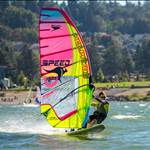
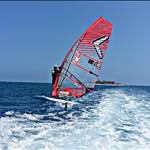
I am in the process of modding an old slalom board and was about to put in inserts for straps.
I might just forgo this and do the foil mounts.
To start with I'm just bolting my Zeeko Alloy foil to board. The wing will be small but I don't mind a bit of extra speed on takeoff.
Or maybe I won't like the extra speed.
Fun times ahead.
Day 6 35" mast 5.8 Loft Oxygen sail Mistral 112 Slalom Logged time: 0.75 hour Wind 10 to 18 mph
Day of experimentation with harness use. Used a waist harness to take some load off the mast foot when hooked in. Using the harness calms down the foil and results in smoother flight with better pointing ability and lower ride height. Unhooked the foil immediately lifts more out of the water but is a few knots slower and needs constant correction to maintain even ride height. With the harness found I could bring the mast foot back about an inch for same control. I'm running the distance between leading edge of the foil mast and mast foot between 42" and 44". Could also bring the boom height up slightly to compensate for less mastfoot pressure using the harness. Got pumping onto the wing totally dialed, now to master fully foiling jibes. Very gusty wind which makes maintaining even ride height tricky, will be interesting to get out in a steady breeze to do some speed runs now I'm comfortable flying.
Major learning points.
Waist harness best for flying hooked in.
Harness clams down the wing for smooth flight.
Gusty winds tricky for even height flying.
Can point higher using harness.
Roo,
A very helpful resource for those who are starting out foiling, or who may be one day. Thanks for making the effort to document your insights.
The major learning points are very useful.
Day 7 35" mast 5.8 Loft Oxygen sail Mistral 112 Slalom Logged time: 0.5 hour Wind 8 to 15 mph Wing 22" MtoM 44.2"
Max speed 17.048 knots, Best 10s 16.287 knots, 5 x 10 s 15.197 knots
Dialed in setup for the rig and spent some time collecting gps data for analysis. Top speed of 17 knots today in lighter wind than the last few flights. Seems with good pumping technique the board gets to around 6 knots where the wing can be pumped with the legs and lift off occurs at 10 knots. Shorter harness lines provide less control so back to longer setup for next session.
Major learning points.
Shorter harness lines provide less control in flight, longer allow you to get the rig away from you into more upright trim position.
Select to expand quoteDay 710 35" mast 6.4 Naish Stealth 6.4 sail RRD 112 Slalom Logged time: 1.5 hour Wind 8 to 15 mph Wing 27" MtoM 44"
Probably time for an update. Was a windy summer so flying was put on hold until conditions got a bit tamer. Lots of interest in windfoiling here with up to a dozen out on one day. Tried out some different size wings and setups a couple of days ago. Wind was averaging 10 gusting 15 and used a Naish Stealth 6.4 cambered race sail on a RRD 112 slalom board. The large 27" wing was so easy to use with the new configuration, by switching the fuselage around and moving the front wing more forward the setup became front foot biased. Made it easy to keep the board trimmed out and avoid the dreaded gurgle. With the front foot in the strap and the back foot moving around to trim wing angle it made it much easier to keep gliding through the lulls. The added benefit with the bigger wing was the extra glide made it better for jibes, even at slower speeds it keeps flying so the board doesn't splash down mid turn. The front foot bias allowed me to find the sweet speed setup to drive the board quicker, it's all about getting a slight nose down attitude to get the wing into slippery mode and then load up the rig while hooked in to the harness. The slight mast foot pressure keeps the board trimmed in neutral glide mode so you can feed in more power and not rise up too high on the foil. Time to try out some more wings, Slingshot now have 5 different sizes than fit onto the Hoverglide setup.
Major learning points.
<div>Front wing forward makes the setup more front foot biased, great setup for speed and gliding. Big wings much better for learning to jibe.
Hi, I am very new to windfoiling. Just after first session, with Fanatic Falcon 130 + ZEEKO Alloy Windfoil combo. The conditions were gusty, and I felt overpowered with 7.2, when the board started to levitate (? :)). Hard day :).
Thanks for sharing your learning points. Please can you make some recommendations concerning the sail size, please? I mean for instance: with standard foil, you would take 8.5 m2 as adequate. What about size with windfoil? What is the 'rule'? 1 size smaller, 2 sizes smaller (-15%, -30%)... Thank you.
one and a half size smaller when you are learning, then when you've got it : 2 sizes smaller 
Select to expand quoteseanhogan said..
one and a half size smaller when you are learning, then when you've got it : 2 sizes smaller
Thanks. One and half size smaller - so I will try 2 sizes smaller low wind trim first, and1 size smaller with high wind trim if it won't be enough 
Yesterday I made some progress with foiling  , unfortunately also with some 'nice' crashes
  . It seems to me pretty difficult to keep the board in desired flight level, to pilot it
  . Can anyone help with advice, please?
1. It always has tendency to fly out of the water with more speed, and wind. I found out pushing the mast a bit forwards, and opening the sail helps. But what is the right reaction, when it starts to rise, to keep the foil in the water, and keep flying?
2. Is there a comfortable position when flying? In my case it is quite a heavy excersize, not only for hands, and back, but also for back leg, standing in front of back footstrap. Also do not feel safe, and relaxed at all - just small failure, and the plane will crash feeling - hope it goes away with practice.
3. From Roo's post it is clear that better to have special board for foiling to make small adjustments with back foot. My idea was one-board-can-do-it-all. Is it possible?
Learning points (I would appreciate correction):
- Moving the mast to more forward position helpes to make flying more controllable (with this setup it seems to me the board is flying totally flat - nose is not up).
- It is better to use the front footstrap to start flying, and take control over the flight.
- It is better not to use the back footstrap, because it takes the board to max speed even before flying, and the control is much worse, and the crashes are pretty dangerous.
- The stance when flying is much more about standing on the board than hanging on the sails (different body position to standard gliding).
- Harness is a must, but it is a bit tricky to use it with this different stance (will try to put the boom a bit higher, as Roo wrote).
Thank you
Funny, feels like reading all that happened to me when I began...
Pushing on the boom with front hand will help stabilize and when you feel the foil is close to coming out bear away downwind (scary but very effective !!)
Stance : at the beginning you'll have to stand like if going upwind on a normal board (front leg bent) the better you get the more you will sail with extended legs (and go faster)
One board does it all is "do able" but not the best, clearly a dedicated board will help you improve and go faster with better control.
The main asset of the foil board being the straps in the same line.
Yes for the mast base advanced, really helps control the flight
Front strap while beginning is okay, but you will soon see you need the back strap to go fast and control the flight and in that case it's better to engage before taking off. (also helps pumping into flight)
Harness : shorter lines really help too !
Well Slingshot, this certainly beats your first attempt at promoting your foil to windsurfers

Select to expand quoteseanhogan said..
Funny, feels like reading all that happened to me when I began...
Pushing on the boom with front hand will help stabilize and when you feel the foil is close to coming out bear away downwind (scary but very effective !!)
Stance : at the beginning you'll have to stand like if going upwind on a normal board (front leg bent) the better you get the more you will sail with extended legs (and go faster)
One board does it all is "do able" but not the best, clearly a dedicated board will help you improve and go faster with better control.
The main asset of the foil board being the straps in the same line.
Yes for the mast base advanced, really helps control the flight
Front strap while beginning is okay, but you will soon see you need the back strap to go fast and control the flight and in that case it's better to engage before taking off. (also helps pumping into flight)
Harness : shorter lines really help too !
Sean, thanks a lot for your quick reply, and help. I wanted to try first, but yesterday the wind was very weak. Concerning the back strap I will try to make it loose as much as possible.
Thinking about attempt with my 8.5 cambered sail in low wind conditions. My idea was to postpone after being able to ride nocam 6.4, and 7.2 'safely'. But yesterday I wasn't able to pump into flight with nocam 7.2 :(. What do you think?
Has anybody opened up a school yet? A google search turns up a place in the Caribbean but somewhere a bit closer might tempt me
@Fanfalz
8.5 cammed is a lot to begin with ! (you'll be uphauling it quite a lot !)
with your setup (nice work on the falcon by the way, saw it on FB), you should get going in 10/12 knots with the 7.2.
Maybe push your mast further to the front of your rails and make sure your stab has negative set up for light wind (ie pushing the foil up)
@Mr Milk
come over to new cal , aloha windsurfing give lessons on a rs/one convertible board with the NP foil (most stable gear around at the moment) 
Up and flying around in two hours time !
Mr Milk, Kite & SUP in Lake Macquarie will be offering lessons later in the year.
Windfoil season is on again in the Gorge. 9 Windfoils out yesterday evening, today was just 2 of us. Used the bigger lightwind setup with a 6.4 race sail on a RRD 112 liter slalom board. Had a new deep Tuttle box fitted to use with the Slingshot foil. Only maxed out at 17 knots, but takeoff was at 6 knots board speed. Most of the sailors here are using standard slalom boards and sails smaller than 6 meters. They are heading out in whitecap conditions rather than lighter winds. The new longer fuselage on the Slingshot allows you to mount the mast in multiple positions which makes it easier to tune the setup to different boards and sails. If you are using dedicated foil boards and smaller sails the shorter fuse is preferable for better maneuverability but less stability in a straight line.
Select to expand quoteseanhogan said..
@Fanfalz
8.5 cammed is a lot to begin with ! (you'll be uphauling it quite a lot !)
with your setup (nice work on the falcon by the way, saw it on FB), you should get going in 10/12 knots with the 7.2.
Maybe push your mast further to the front of your rails and make sure your stab has negative set up for light wind (ie pushing the foil up)
Thanks again, Sean. Hope my Falcon will survive my learning... I better went on water with 7.2, although I had to watch how others can start easily with classical light wind setup, and I was suffering by many times not successful pumping. You are right, in 10/12 knots I could get it it going.
Shorter lines (20"), upwind stance, pushing the mast to the front, very loose back straps helped a lot. Now I am able to 'take control' over flight with my right hand as the front hand. Unfortunately in the opposite direction I still have serious troubles with control over speed, stability, wind gusts, and flight level . Hope to have chance to continue with learning soon.

Select to expand quoteRoo said..
Most of the sailors here are using standard slalom boards and sails smaller than 6 meters. They are heading out in whitecap conditions rather than lighter winds.
What size of slalom board are they using? I am interested in limits of my 130l, 81cm wide slalom board. With 6.4 it was OK. But not sure with smaller sail / in stronger wind. Thank you.
105 to 120 liters seems to be popular here. You just need enough flotation to be able to uphaul. With bigger sails you can use bigger boards in lighter winds.
Select to expand quoteFANFALZ said..Roo said..
Most of the sailors here are using standard slalom boards and sails smaller than 6 meters. They are heading out in whitecap conditions rather than lighter winds.
What size of slalom board are they using? I am interested in limits of my 130l, 81cm wide slalom board. With 6.4 it was OK. But not sure with smaller sail / in stronger wind. Thank you.
I was so desperate to go out foiling one day in 16 + knots that I plugged my son's 4.8 freestyle sail on my 129 RRD (85 wide) and it worked a treat.
It seemed like the sail was just there for you to hold on to.
Very neutral but worked just fine.
Select to expand quoteseanhogan said..FANFALZ said..Roo said..
Most of the sailors here are using standard slalom boards and sails smaller than 6 meters. They are heading out in whitecap conditions rather than lighter winds.
What size of slalom board are they using? I am interested in limits of my 130l, 81cm wide slalom board. With 6.4 it was OK. But not sure with smaller sail / in stronger wind. Thank you.
I was so desperate to go out foiling one day in 16 + knots that I plugged my son's 4.8 freestyle sail on my 129 RRD (85 wide) and it worked a treat.
It seemed like the sail was just there for you to hold on to.
Very neutral but worked just fine.
Sean, have you modified the boards at all?
Seems there are two schools of thought on the windfoils. The high wind group using small sails and boards and the lightwind racers going for full on race cambered gear on 130 liter plus boards in 7 knot winds. It's great there's been a divergence in a short space of time with a range of choices. The option to buy a windfoil that plugs into your existing equipment is a great option and will help further the sport and grow foiling. It allows windsurfers to try it without making a huge financial outlay, they then have the option of buying specialised gear if they want. A win win for everyone.
Select to expand quoteBSN101 said..
Sean, have you modified the boards at all?
Yes I have, at first I thought a wooden spacer in the box between the foil and the top of the board would suffice. It worked a while but was a pain to adjust every time and the wood would suffer from the pressure applied.
So I actually poured some epoxy charged with micro balllons to fill the gap. Now I've got the most perfect snug fit. No movement whatsoever !
The foil will always try to move up and forward, so, depending on the foil head you really need to address this issue.Horue and other brands provide various type of tabs/plates to prevent this.
Some people re inforce the top deck, I'm still considering as so far I haven't seen anything happen.
Fanfalz's Zeeko foil uses its plate mount as support for Tuttle box. Lowers loads about 70%.
moving CoG forward always helps stability which on a windsurfer is done by moving body mass, commitment to harness, mast foot position and pressure.
smaller boards are ok but you will want to have rear foot further outboard as you speed up and sometimes the narrow boards leave no room to move.