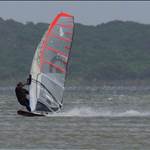
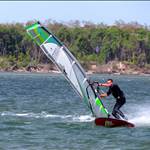
I've been watching the evolution of foiling on a windsurfer with interest for the last 9 months. WindFoiling as it has become known has taken off in more ways than one! It's an incredible sight to see and one of the most exciting, coolest advancements in the sport for a long time.
While still in its infancy it holds incredible benefits for sailing in lightwind locations and also amazing potential for pushing speed boundaries in choppy water found wherever its windy. The latter really interests me and I envisage being able to do forty knots down the middle of the Gorge in the nastiest conditions within a year or two.
Overseas in France seems to be the epicenter for WindFoil development with only two companies in the Gorge starting to explore its potential. Tony Logosz has been one of the pioneers of windsurfing in the USA before starting Slingshot kites and developing KiteFoiling. He's now come back to windsurfing and used his incredible R&D skills to get flying on a windsurfer. I've partnered with him to get me up to speed and help develop the next generation of SpeedFoiling.
Slingshot developed a graduated program of flight training for kiting and the same principles apply to windsurfing. www.slingshotsports.com/2016-Foiling-Flight-School-mast-package#.V4USU9QrKUM
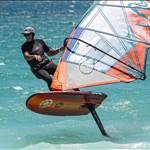
Using an extruded alloy mast that has an adapter at the top to fit into deep tuttle/tuttle/powerbox fin boxes, it will plug into any windsurfing board. Ideally something in the 110 to 130 liter range is ideal so you can uphaul in light winds when waterstarting is not possible. The mast connects to an alloy fuselage at the bottom which has a larger fiberglass wing at the front and a smaller one at the rear. The length of the fuselage and positioning of the wings are crucial to get a windsurfer to fly. Different length mast are available for flight training, starting with a 15" one for taxi and getting used to getting up on the foil without going to high, an intermediate 24" touch and go one to get more confidence flying before graduating to 30" for solo mode! 35.5" is for hover mode when you've graduated flight school. http://www.slingshotsports.com/2016-Hover-Glide-NF2#.V4UUmtQrKUM

Once foiling not much power is needed so a small sail is all that is required. Something in the 5 to 6 meter range is perfect to get started. You don't even need a harness it's so effortless.
I've kept a flight log of my training and will keep it updated on a regular basis, feel free to ask any questions and give feedback as my adventure in WindFoiling begins.
Day 1
40" mast 5.3 Naish Force Custom 120 liter wide board
Logged time:0.5 hour
Check your ego at the door, you end up spending lots of time in the water and endure multiple crashes...you will get wet and lots of water up your nose! The first time you get up on the foil and fly will alter your perception of windsurfing for ever. It's an incredible feel but over so quickly as the foil comes up out of the water and this followed by the first of many crashes. Leaning back puts lots of angle on the wing and it climbs until it runs out of water, gets airborne, loses lift and stops flying. Lesson, get your weight forward to level out, also get your weight off you back foot onto the front foot with toes down. Forget about pumping, just let the board come up to speed, 11 knots is take off velocity for the wing, then gradually feed your weight forward to level off. You need to swing your body/shoulders forward as you rake the rig back to noramalise the forces and balance the board out. The view 3 feet above the water is incredible, a totally different perspective to normal windsurfing, so you find yourself looking down immediately in front of the board......bad move, you go where you look so it's inevitable a crash soon follows. Just like flying a plane look at the horizon or in the Gorge the other side of the river. Everything balances out and the flights last much longer each time.
Major learning points.
It's a long way up so look into the distance and not down.
You go where you look.
Don't lean back, get your weight forward.
It's all about finesse and subtle movements, brute force not required.
Day 2
15" mast 5.3 Naish Force Mistral 112 Slalom
Logged time: 0.75 hour
Taxi training to get used to flying on the foil but at a safe height so crashes aren't as bad! If anything a little bit harder than being on the full 40" mast, the board never really gets up above the water but goes into a ground effect gliding mode which lets you get used to flying level. It's better to have a little bit bigger sail so the board can come up onto the plane then lift onto the foil without pumping. Really only need a hour or so in this short mast mode to get the feel for straight and level flight.
Day 3
35" mast 5.9 Loft Oxygen Mistral 112 Slalom
Logged time: 2 hour
Boy this is addictive, 2 hours on the water went by in a flash. The sensation when flying is hard to describe, it's so quiet and effortless when everything is in balance. You start feeling the effect subtle differences make, moving the mast slightly forward to control the boards angle and keep the nose down as you feed in more power to prevent the foil rising up out of the water and stalling. Pressure through your front foot with toes down to keep the board level front to rear and rear foot toe pressure to keep it level side to side so the foils stay in a neutral position and glide better. It's all about balance of forces but in a more subtle way than normal windsurfing. One big lesson today was to stop choking the sail and move the hands forward on the boom to let it breathe more and open up the sheeting angle. You get so used to going for maximum power on a slalom/speed board to drive off the fin but there's no need to do this on a foil. Putting the rear hand between the harness straps on the boom and the front one between the front strap and boom head seems to be the optimum position for controlling the foiling height. It makes it easier to sheet out and bleed off foil load in the gusts to keep everything straight and level.
Major learning points.
Easier on the longer 35" mast once you get used to the height above the water.
Mast position and mast foot pressure are like the joystick in a plane, move mast back to rise up on the foil, forward to come back down, center to keep level.
Sheeting angle is like the throttle/power on a plane, more sheeting equals more power equals more speed and the foil lifts more. Nose down to stay level.
Hand position on the boom critical to trim, forward on boom to balance out the rig for smooth even power, don't oversheet.
Hi Roo
thanks for the feedback !
could you provide the wind conditions/strentgh for your sessions, as a guide for what size sail to use.
+ what's your weight ?
Waiting for my foil to arrive....  I was lucky to be taught by Benjamin Tillier(taroa/np developer) so was up and going on the first session, can only confirm everything you said !!!
+ never let go the boom !!!!
I did buy an helmet for the first few sessions to come.
Do you waterstart with the foil ? I tried but was touching the foil and was too affraid to slice my foot so gave up and uphauled.
Admin !!! : we need a windfoil section, please !!! 
Nice report and good to see you verified that the short mast was only good for half an hour.
As with kite foiling that first session is all about bashing your ego and forcing you to accept you have to go back to basics.
I believe you probably would have progressed the same staying on the 30" or 35" masts.
Just had a look on the Slingshot site,
Foil complete (35.5 mast) $900
Flight School set of 3 masts $170
I didn't see any reference to windsurfing (only quick look)
At that price its really interesting & a lot more budget friendly to the masses.
Bulk order anyone?
those slingshot masts seem a tad short (longer is 76 cm) compared to what all the other brands are doing (for windsurfing)
average is 90 cm.
maybe more kite designed ?
I guess they haven't upgraded their website with the windfoil option yet.
Select to expand quoteseanhogan said..
Hi Roo
thanks for the feedback !
could you provide the wind conditions/strentgh for your sessions, as a guide for what size sail to use.
+ what's your weight ?
Waiting for my foil to arrive.... I was lucky to be taught by Benjamin Tillier(taroa/np developer) so was up and going on the first session, can only confirm everything you said !!!
+ never let go the boom !!!!
I did buy an helmet for the first few sessions to come.
Do you waterstart with the foil ? I tried but was touching the foil and was too affraid to slice my foot so gave up and uphauled.
Admin !!! : we need a windfoil section, please !!!
G'day Sean,
was out today on a KA Koncept 5.8, wind was averaging 15 mph, gusts to 18 and lulls to 10. I weigh 185 pounds. Pretty much been that wind range each time I have WindFoiled so far. Was up on the first day, it's just finesse and doing longer runs that takes practice. You learn something new every flight! I waterstart if there's a gust but have learnt to be aware of the wings, I have the scars on my legs from the first few sessions to prove it. Wear booties and a long wetsuit when learning. You can also use the wings as a step to get up in lighter conditions.
I'm up for getting a foil at the price mentioned above.
Roo - interesting write-up thanks, I look forward to reading about your progression 
Cheers JJ
Select to expand quoteRAL INN said..
Nice report and good to see you verified that the short mast was only good for half an hour.
As with kite foiling that first session is all about bashing your ego and forcing you to accept you have to go back to basics.
I believe you probably would have progressed the same staying on the 30" or 35" masts.
I wanted to go through the full flight training program on the different length masts so I could document the process. Ideally I would think a 24" and 35" would be what most competent windsurfers would need. Not everyone is as aggressive learning so the 15" is good to get the initial sensation of flying.
Select to expand quoteBSN101 said..
Just had a look on the Slingshot site,
Foil complete (35.5 mast) $900
Flight School set of 3 masts $170
I didn't see any reference to windsurfing (only quick look)
At that price its really interesting & a lot more budget friendly to the masses.
Bulk order anyone?
Slingshot are still putting the program together so probably a few more weeks until they are available with all the adapters and posted on the website.
Select to expand quoteseanhogan said..
those slingshot masts seem a tad short (longer is 76 cm) compared to what all the other brands are doing (for windsurfing)
average is 90 cm.
maybe more kite designed ?
I guess they haven't upgraded their website with the windfoil option yet.
Sean my first day was on a carbon 40" mast, believe me it was a long way up until I got used to looking at the horizon. Again for most people the 35" is ideal but the 40" gives you more margin to keep flying through the jibes. I have a 10 foot length of mast I'm cutting into various lengths to see what they are like to ride.
Just a couple of questions.
If this was the normal hover glide mounted to a windsurf board. What mods to the board to mount the plate to board?
The carbon mast you refer to. Was that the SS Silencer made by LP or the LP windsurf foil??
At moment we are faced with Carbon dedicated windsurf foils or use kite foils with plate mounts which opens up using the lower cost Alloy foils around. Of these the offerings from Cabrinha, Naish, and Liquid force are plane too draggy.
The SS hover glide uses similar draggy mast and extruded fuselage but better designed wings albeit still low speed orientated.
But if kite foils are a good option then the performance alloy foils from Alpine, Levitaz, TKF, and Zeeko(with its multiple wings and mast lengths to choose from) really give a value for money way to get into windfoiling.
Of course Carbon foils will always be the choice of the serious Foileur.
Kean, love the reports and please keep sending. Very interested in this, great for Sydney.
really great to have so much feedback ! Thanks again Roo !
I heard about the wetsuit for leg protection, good advice ! might have to invest !!
Any difference in handling/sensations with a cammed sail ? (the ka )
Select to expand quoteRAL INN said..
Just a couple of questions.
If this was the normal hover glide mounted to a windsurf board. What mods to the board to mount the plate to board?
The carbon mast you refer to. Was that the SS Silencer made by LP or the LP windsurf foil??
At moment we are faced with Carbon dedicated windsurf foils or use kite foils with plate mounts which opens up using the lower cost Alloy foils around. Of these the offerings from Cabrinha, Naish, and Liquid force are plane too draggy.
The SS hover glide uses similar draggy mast and extruded fuselage but better designed wings albeit still low speed orientated.
But if kite foils are a good option then the performance alloy foils from Alpine, Levitaz, TKF, and Zeeko(with its multiple wings and mast lengths to choose from) really give a value for money way to get into windfoiling.
Of course Carbon foils will always be the choice of the serious Foileur.
The mast was the Hover Glide 35" that bolts into an adapter to fit the fin box, in this case a deep tuttle. Adapters for tuttle and powerbox will also be available. No mods were done to the board, it just bolts straight in. The carbon 40" setup I used was also made by Slingshot, a proto Tony made that also bolts into a deep tuttle box. The mast is not as draggy as you think, 20 knot cruising speeds are very easily reached, it's the wings that really govern speed. I've been testing with the GPSLogit chatting in my ear and with the Slingshot setup takeoff speed is 11 knots to get up on the foil with a max so far of 20 knots with my limited ability. The whole idea with the alloy setup is to introduce people to the sport in an affordable way where they can use existing equipment, 110 to 130 liter board and 5 to 6 m sail, and try out WindFoiling without spending a bucket load on a carbon setup that can easily be trashed running aground etc. Once you become proficient you can sell the alloy setup to a mate and invest in the carbon go fast version!
Day 4
35" mast 5.8 KA Koncept cammed sail Mistral 112 Slalom Logged time: 0.5 hour Wind 10 to 18 mph
Time to step it up a notch after yesterday's session where it all started to click. Rigged a fully cammed sail to check the handling characteristics on the foil, Tony has been using my 5.4 EVO 6 on his carbon 40" setup to great effect. The drive from the KA is not ideal on the WindFoil for some reason, it didn't feel as responsive as the Loft Oxygen and the drive was lower so more finesse required to keep the board at a constant height. In gusts the power couldn't be bled off as easily so had one or two instances of the wing coming out of the water. Learning to understand the different sounds it makes, when it starts gurgle you know you've gone too high and the front wing is about to get airborne so best to sheet out and move the mast forward slightly to bring the nose back down for straight and level flight. Also couldn't point as high with the Koncept, may have to move the mastfoot position back to loosen up the feeling so it's easier to change direction. Got aggressive with the pumping to get up on the foil, initially pump the rig to get the board moving speed goes up to around 8 knots then pump the board with your feet to get the wing working then it pops up on the foil at around 10-11 knots boardspeed. Foot pumping great when going into a lull to keep gliding.
My son took it out for an hour, his second time, and was up foiling smoothly after he got his foot pressure corrected. He was using too much heel pressure which puts some angle on the wing, banking like in a plane, and the board turns upwind but then you have to fight it with the rig to get it tracking straight again.
Major learning points
Heel pressure makes the balance unstable, keep pressure on the toes for balanced flight.
To glide through lulls pump with the feet to keep up on the wing.
Fully battened sail easy to use than cammed sail in light winds.
When the foil gurgles drop the nose or bail out.
Great work there Roo!
Sounds like you almost need to move the footstraps inboard a bit free ride style so as you are standing more on top of the board rather than the edge.
Keep up the commentary, hope to see the movie soon
interesting thread,
dumb Q..what happens if you run a bigger sail on a foil,,eg 7ish...lot of what I have seen ppl use wave sails etc...but then the NP set up seems to stay with the one sail the 7.8? What happens if you get overpowered on a foil?
like the idea of the medium foil..not so high in the air... Fin manufacturers must be salivating at all this foil stuff potentially going on, extra Buisness out of no where! Must a be a million different possible foil design options, height now comes into it , not just speed. Like the idea of the slingshot low $ entry cost, power and tuttle box,
Kiting has a 'Bi' directional foil out now also...(sits in the middle of a twin tip board) now there is a head mess...imagine a twin tip foil windsurfer?
Thanks Elmo,
being out as far as possible gives you more control of the wing, i.e. more leverage to be able to load and unload it. Thing of it as longer control movement so easier to make fine adjustments to get it balanced. Being closer in to the center line reduces the leverage so more load needed to effect a change.
Select to expand quoteJonesySail said..
interesting thread,
dumb Q..what happens if you run a bigger sail on a foil,,eg 7ish...lot of what I have seen ppl use wave sails etc...but then the NP set up seems to stay with the one sail the 7.8? What happens if you get overpowered on a foil?
like the idea of the medium foil..not so high in the air... Fin manufacturers must be salivating at all this foil stuff potentially going on, extra Buisness out of no where! Must a be a million different possible foil design options, height now comes into it , not just speed. Like the idea of the slingshot low $ entry cost, power and tuttle box,
Kiting has a 'Bi' directional foil out now also...(sits in the middle of a twin tip board) now there is a head mess...imagine a twin tip foil windsurfer?
All the Pryde development has been focused on using big sails, AA is running an 8.6 on his setup. Benefit is you can get going in lighter winds but the size of the wing needs to be adjusted to compensate. When you get overpowered you sheet out as much as possible and just let the sail weather-vane and not produce power, that's why the cambered sails work so well as they retain their shape when they are not loaded and glide better than a full battened sail. If you can't depower the sail the foil will keep lifting as speed increases so you push the mast forward and push down with your front foot to lower the nose and not fly out of the water.
There are so many potential variations with mast length, wing size, shape etc. We are just at the infancy of WindFoiling, it's going to be exciting to see where we are in a year or two.
Videos of this on Youtube look amazing with a windsurf board. With a SUP... not so much 
Ha that's better!
I still reckon the jibes 30 seconds into this video look the mutts though:
I've been foiling with the Horue LW foil for several months.
My experience is windsurfers don't need the shorter masts for learning. It actually hurts our learning. Less margin for error.
The short mast does make sense for kiting though. They crash different than windsurfers.
Windsurfing a foil is easier than kiting a foil.
a windsurfer on day one, pops up and crashes hard maybe twice before they learn not to push down with back foot so hard. After that, they take it easy and just barely foil. Often skimming the tops of waves. The waves kissing the bottom on occasion adds stability. There is no reason to rush your skills and foil at full height unless you like being a show off.
Skills progress naturally from then on without drama.
Day 5 35" mast 5.8 Loft Oxygen sail Mistral 112 Slalom Logged time: 0.75 hour Wind 10 to 18 mph
Back to the fully battened sail as I didn't feel comfortable on the KA. Immediately more control and straight up onto the foil. Mastered pumping, initially you pump the sail to get some speed then pump the foil with your feet to pop up out of the water. Mast goes forward to level the board out and you're away. Can go across the river fully foiled now and started attempting foiling jibes. Got 2/3 of the way through before crashing, the key is to keep the sail's mast aligned with the foil's mast, as soon as it goes out of alignment the foil takes over and turns you back out of the turn. Also need to keep the sail forward otherwise the weight on the tail causes the foil to lift too much. Always check for any seaweed on the wing, you can't get up flying if there is, got half way across the river before I realised it was the cause for not being able to fly. Played around with mast foot position, too far back and it's hard to control the height and keep the board level. Two inches forward and everything smoothed out nicely.
Put the GPS on Tony to check on liftoff speeds and Vmax. With his 27" carbon foil he took off at 7-8 knots boards speed with a Vmax of 18.79 knots. On my 22" front wing my takeoff is around 11 knots with a 20.9 knot peak.
Major learning points
Check for weed if you can't get up flying.
Lean the mast forward and into the turn for a smooth jibe.
Pump up onto the wing using your feet in light winds.
Mastfoot position forward to smooth out flight and easy control.
Small wings are faster but need more board speed to take off.
Select to expand quotesupSURFmachines said...
I've been foiling with the Horue LW foil for several months.
My experience is windsurfers don't need the shorter masts for learning. It actually hurts our learning. Less margin for error.
The short mast does make sense for kiting though. They crash different than windsurfers.
Windsurfing a foil is easier than kiting a foil.
a windsurfer on day one, pops up and crashes hard maybe twice before they learn not to push down with back foot so hard. After that, they take it easy and just barely foil. Often skimming the tops of waves. The waves kissing the bottom on occasion adds stability. There is no reason to rush your skills and foil at full height unless you like being a show off.
Skills progress naturally from then on without drama.
Where are you?
And even with kitefoiling the use of short struts is of minimal value in the big picture of learning.
Add the extra board control of having mast foot pressure to the equation and there is even less need for short struts. In fact I believe short struts delay the point when you get to learn to control rate of rise which leads to stable on foil flying.
I'd be interested to know about if you feel any flex in your rig and anything that has contributed to damage that those of us heading down this path could benefit from.
Select to expand quoteRAL INN said..
Where are you?
And even with kitefoiling the use of short struts is of minimal value in the big picture of learning.
Add the extra board control of having mast foot pressure to the equation and there is even less need for short struts. In fact I believe short struts delay the point when you get to learn to control rate of rise which leads to stable on foil flying.
I'd be interested to know about if you feel any flex in your rig and anything that has contributed to damage that those of us heading down this path could benefit from.
I'm in Florida, USA. Yesterdays session on my 6.5m
Some video after 4 hours of practice for me and 3 hours for my son. The short mast is great for getting a feel for controlling the foil and maintaining straight and level flight with easy landings. Not every one learns at the same pace so it's a good alternative for less aggressive windsurfers.
<a href="
SupSurfmachine, I'm wondering about your going strapless. How does it feel?
Plus I have had some feedback from testing in France that indicates windfoils may need more reinforcing in relation to kitefoils.
When riding does there seem to be any flex feel?
Select to expand quoteRAL INN said..
SupSurfmachine, I'm wondering about your going strapless. How does it feel?
Plus I have had some feedback from testing in France that indicates windfoils may need more reinforcing in relation to kitefoils.
When riding does there seem to be any flex feel?
Strapless is very easy. The loads are very light. It's easier, and safer than straps. Easier because you're free to move your feet and make small adjustments. Footstraps can't be in the ideal spot for all situations! and they are usually in the wrong place for foiling on stock boards. You are flying the board with your feet. Making small adjustments really helps. Not being in straps eliminates the chance of sprained ankles during slow twisty falls while learning. Just ask any kiter how many sprained ankles they know about. My advice, find old windsurfer and strip deck of straps and pads. Replace with SUP deck pad.
I dont feel any flex riding. I can flex it on the beach with my hand.
I build boards, so I made the Tuttle box installation extra strong. I think manufactureres will build stronger boxes and rate these boxes for foil use in 2017. Until then, just don't hit things.