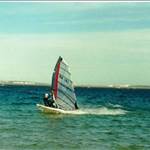
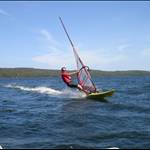
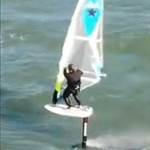
This topic will most likely be boring or no value to you if you are:
1) "no white caps - no foiling" sailor
2) you have permanent access to steady winds 10+mph or 9+kt (or at least predictable forecastable above 6mph or 5kt)
3) US Gorge /Hood River sailor where a BIG sail is 6m (nobody sells there any bigger)
BUT if you are interested what my 4 years and roughly 6000 miles with experimenting and customizing variety of foiling gear has brought me to this point then stay tuned.
Frustration channeled into Perseverance ("Tell me it is impossible, and I prove you wrong" attitude):
Perfect example is my yesterday session. forecast was 8-12mph main wind with gusts forecasted between 12-20mph.
Actual wind in range from 0-7mph with max gust for a day recorded at 10.3mph.
Well, I still had a decent day with sufficient number of foiling flights to do 20 miles total and plenty of positive energy afterwards.
You can read the complete report at our NW Windtalk:
"4/5/23 Wednesday Southerly - Lk WA Report"
groups.io/g/nw-windtalk/topic/4_5_23_wednesday_southerly/98098877
If you are also interested more in statistics for USA, Washington State, Seattle Area Winds on Lkae Washington and what it means to spend average 8h per week TOW and 40 miles a week (2000+ miles total for 2021) here is more info:
What can Lake Washington deliver 12 months in a year even for "Heavier Dude" ? - Stats & Analysis
groups.io/g/nw-windtalk/message/76194
Lets focus on Some Gear first.
What Sail ?
I currently own 33 windsurfing/windfoiling sails from Maui Sails (MS), Gaastra, Aerotech, Severne, Sailworks (SW), Loft, Goya, North Sails, Neil Pryde, Mistral, Naish. Too many probably.
But my main message for ultralight wind windfoiling (earliest flights) is that:
1) it has to be big enough in 9-12m range for someone like me in 90kg+ category (and no pumping).
2) Cam or RAF (no cam) does not really matter in ultralight winds in BAF (beam reach mostly) sailing.
I tried: Loft Oxygen & Switchblades, variety of Sailworks NXes & Retros, Goya Mark 2 (foil sail), several Gaastra Nitros, Severne Overdrive & Gator,
3) sail needs to be tuned for least lose leech or no lose leech meaning less downhaul and rigged on longer & stiffer mast e.g. old Race 100 Carbon 550cm mast (or paring with stiffer top piece).
4) Light Weight Sail (if possible) - the most joy I had with Loft Oxygen 10.8m (cam-less free race sail) at only 13lb. I even did not want to try Maui Sails TR-8XT 12m at almost 20lb, nor Severne Reflex 11m at almost 20lb too, nor Aerotech VMG 11.7m at 18lb.
5) High Aspect Sail (if possible) - e.g. the "magic" of Loft Oxygen is that it is HA. Luff at 564cm and boom only 268cm. For foiling in general HA sails have more power up above so they compensate for lift from the hydrofoil when gust hits you (self balancing).
What Board ?
I experimented with variety of boards: Exocet RF91 (155L), RF81 (186L), Slingshot Flyer280 (280L), Starboard Go180L, Go 200L, Formula 100.5cm 167L and now Race 100 (208L).
My main learnings are:
1) "legacy" boards (Go, FW) have much better volume distribution and are much more efficient at slogging and building up speed (without pumping)
2) "legacy" boards (Go, FW) have much better tracking at up wind angle while slogging. For example the large cut outs in SB Race 100 are the worst at slogging ! The board pretty much slides sideway (drifts) at board speed ~2mph. Therefore something Great for lifting the board out of the water (shedding the water) and smoother touchdowns is a Nightmare for upwind slogging ! Something to think about.
3) the board has to be as wide as possible - 100cm
There are so many debates about wide board required for UP /Down Wind leverage (started with formula FW boards) vs race bords or long narrow boards. It is not to be debated here. We are talking about BAF performance.
We can all already agree for decades that viscous drug is corelated to surface area (or referred also as "wetted area") the board travels on so you would think shorter wider board is equivalent to narrower longer board.
BUT
When you have a heavy sailor using large sail, the MBP (mast base pressure) pushes the board down then narrow long board "plows" or "sinks" through the light chop / small waves while wide board "bounces off" or "slides" only on top of the crests of the chop.
So the shedding of the water (minimizing wetted area) is superior in wider boards.
BTW: Try skinny tires on bicycle riding through the packed snow. Good luck.
4) "the magic" of concave board bottom (sometimes double or triple or quadruple)
So far I have not seen anyone talking about but you can see many boards even from the 1980 and 1990s using multiple concave bottom shape (e.g. many Mistral Boards). So do the Starboard Gos from 2000s having double concave bottom.
You know the water meniscus properties how it "sticks" to everything, right ?
So if you have flat bottom or round bottom then when the board rides on the water the air in front of the board escapes to the sides of the board and board sticks to the water.
Now. if the concave bottom travels over water, the sides of the concave bottom are still stuck to the water but the air in the middle creates a air bubble that now can not escape to the sides. This is reducing the wetted area. Board gets going & planing faster !
Did you know or think about it?
So Consider this as Part 1. I do not want to overwhelm anybody with too much info at one go.
In Part 2 I will be talking about hydrofoils.
I did test the extreme. Even built bi-plane hydrofoil using Slingshot Infinity 84 & 76 at total 3600cm2 surface area.
I tested it in multiple configurations for Windfoiling:
1) my custom adapter (foils close by)
2) using Slingshot Taxi ultra short mast between hydrofoils (wider foil separations)
I also tested it in "controlled environment" using trolling motor measuring the effect on board speed and board lift.
Links from the past:
Unfortunately all embedded pictures and graphs are gone from older NW Windtalk Posts like this one from 2020:
What is performance of using 2 hydrofoils in Windfoiling in so called "bi-plane mode" ?
groups.io/g/nw-windtalk/topic/76009270


Stay Tuned !
OK Here it comes Part 2:
Hydrofoils
Please note that the following graph has been made manually based on 100s of my sessions, GPS Boards Speed graph and Wind graphs analysis over 4 years period. This reflects specific mechanisms as to what happens in specific Phases which I will explain after the graph.

Zone 1:
Zone 1 you can call the phase of "drag anchor" or "you wish you had no hydrofoil".
Principle: the bigger the hydrofoil the worse the effect.
There are two dominant group of factors at place:
1) "Total Drag" that should be divided into "Parasitic" & "Induced"
Parasitic should be further divided into 3:
a) Viscous/ Skin Friction - related to water stickiness to the surface of the object.
Think: large surface or wetted area (in windsurfing terms)
b) Pressure / shape - related to shape and or cross section of the object.
Think: cube shape (one of the worst) vs thin elliptic shape (one of the best)
c) Interference - any interaction negative between front wing and stab & mast & fuse (also at connector joints) - for now we can just ignore and acknowledge that is none dominant effect.
For now what is important to remember that "Parasitic" Drag is correlated to V (Speed) and dominant at lower speeds.
"Induced" Drag is correlated to V2 (Speed Squared) becomes dominant rapidly with growing speed.
2) "Your Shovel/foil digging ditches" - Surprise, Surprise ?!
Now you read long discussion on Seabreeze: "Foil-Mast-angle". Right ?
All foil masts have some positive angle between board bottom and fuselage so if you ride the foil your board nose is up. Right ?
It is all fine when you have enough speed to move your weight to the back of the board and bring nose further up. Your front wing gets positive angle of attack and lift is further generated. All works well.
BUT
When you are slogging and standing at your sail mast base (to balance the board for displacement sailing) your foil actually pull the board down / nose underwater ?!
So now you know, you wish you had no foil in Zone 1:
Zone 2:
Zone 2 can be called "sweet spot range" or "high efficiency phase" is a bit complex because it is about 2 effects at the same time:
1) Increased lift from the foil
2) Board Transitioning from Displacement into Planing then in the air.
After board leaving the water, you do not need more speed (unless racing or liking more speed), you are already flying with high efficiency. Higher speed generates more lift and more induced drag (Zone 3).
If you look at the graph you will realize that each foil has its "sweet spot range" where it "shines" or outperforms the other.
Zone 3:
Zone 3 is again where the bigger the foil, the more lift it generates the more induced drag.
You will feel it in your legs when the gust comes. Sails pulls you forward but the foil/board stays behind by induced drag creating "anchoring effect". Medieval stretcher. Ouch !
That is why well balanced Race Foils Shine even further because with proper shim the range can be widen even further.
BTW This is Part 2 but there will be also Part 3.
My current plan is for at least several sections:
e.g. Where to find some good references, to cross check what I posted so far.
What other factors to consider, like foil mast length.
Essential flat water reading skills, gust reading, location selection, etc, etc.
Very interesting.
What about a bi-modal bi-plane? I would imagine you could benefit from reducing drag once you have lift in the foils, and get the top foil out the water once you are moving. Maybe would cause issues with re-entry?

Cornwallis makes a good point. would you try swapping the shorter mast to the top so that foil rides out of the water and when up just cruze on the lower wing? Might get a bit wobblly!?
I wonder if some of the new super large SUP foils would help?
www.seabreeze.com.au/forums/Stand-Up-Paddle/Foiling/Best-foil-for-Downwind
some are like 1.5m wide!
Select to expand quotecornwallis said..
Very interesting.
What about a bi-modal bi-plane? I would imagine you could benefit from reducing drag once you have lift in the foils, and get the top foil out the water once you are moving. Maybe would cause issues with re-entry?
Couple of comments from my side.
1) We discussed on Seabreeze bi-plane hydrofoil Developments and also Horue multi wing configurations back is 2019 so 3.5 years ago
You can find more info here (and pictures and videos):
www.seabreeze.com.au/forums/Windsurfing/Foiling/Double-foil#2417879
2) Horue probably discontinued multi wing config due to multiple factors:
a) they came up with bigger single wing
b) due to complexity
c) concern about "interference" / unexpected interactions (downwash / upwash) between the wings at different speeds and attack angles
e) having even 2 high aspect (HA) wings in the bi-plane config is no longer having an effect of HA efficiency
Just my 2c
3) Yes, you are right. There would be "step function" implications at exit and reentry of the top foil with the water - in straight line foiling.
I think that is something a windfoiler could learn to deal with at low speeds but I guess the stresses on the bolts /joints and complexity here killed that project.
Another thing: what about turning and banking to a side? Upper wing tip would start slicing the water at steeper turns. Could rider learn to deal with it too?
4) Conclusion from my bi-plane testing (with my custom short adapter and Slingshot taxi mast like in the pictures and the graph) was that at board speeds from 0-10mph, it did not matter on the speed nor behavior if I used foils close by or further apart.
Please note that I tried to test the effect of the extreme combined wing surface sizes (3600cm2) at low speed while Horue had combined surface of only 1770cm2 at the time. Now the equivalent of Slingshot Quantum 100 or former Infinity 76 in surface areas.
Select to expand quoteberowne said..
I wonder if some of the new super large SUP foils would help?
www.seabreeze.com.au/forums/Stand-Up-Paddle/Foiling/Best-foil-for-Downwind
some are like 1.5m wide!
Hi Berowne,
Great to hear from you ! I love your project "F4Foils Tuning Tips - Towards 30 knots!" !
A lot of Great Work !
If you examine my GPS Board Speed to Wind Speed graph, you will realize that the bigger the wing the harder it becomes to ride (and less efficient) if the wind picks up (Going to Zone 3) and smaller wings gradually become more "max board speed for the same wind".
Yes, you can take off in less wind but what range of wind is it best for ? So for combined 3600cm2 it is 5-6mph wind range.
Please examine carefully the graph.
That is why I used it only for that testing in 2019 & 2020.
BTW I will write more about some thoughts and conclusions from people who tested 1.3m span wings. Also what HA does. And what are benefits and what are not.
Again, I want to focus on the: "Ultralight wind (~5mph or ~4kt) windfoiling BAF for older "Heavy Dudes" 90kg+ and no pumping"
Couple of comments, first WOW! really interesting information and data! Thanks!
1) board, I use a Goya Bolt slalom board and find it works great in light winds because it is easy to get moving on the water with sail pumping, now I weigh 82 kg. I have been on short/wide foil boards and they plow through chop and waves, a lot more drag versus a longer/narrower slalom board that pierces waves IME. The longer board also is a big plus in high speed down wind runs (not swell riding) because it helps get over the backside of oncoming wave crests.
2) foil rake, I have my foil rake set to 0.0 degrees using a shim, so sail pumping gets board moving quickly in stronger winds, BUT in light winds 9-10 knots with sail mast base at 38.5" to front foil screw, the nose of board does want to lift up first which does what you say and affects foil angle, so I move my front foot forward of foot strap to push/hold board nose down and keep board level, then I move front foot back just as I start to plane on the water in order to lift off the water. That takes advantage of the efficient shape of a slalom board to build up speed on the water, versus plowing through the chop or waves on a short and wide foil board. The wider the board the more resistance when on the water.
OK, changing the Plan (sort of), after giving some explanations about bi-plane above and Berowne question about 1.3m - 1.5m span wings.
Part 3:
"Thinking Outside the Box" or Applying Other People's Work from different sports to "our windfoiling cause"
If you remember, at the beginning I mentioned to test bi-plane effect (largest surface of combined wings) instead of rig / sail and wind power using trolling motors. You create more "controlled environment" and take out of equation variable wind and many other factors.
What if we want to look at "hydrofoil performance" from Human Power perspective ?
Forget about human arm power, you got to look at leg power !
"Wake Thief" has done Fabulous Studies and made many YouTube Videos on finding a way for human to foot pump they way for up to 2 to 3 minutes. You can learn a lot from them for "our windfoiling cause" in ultra light winds.
First we need to look at their GPS Board Speed range.
Average to Lower Pumping speed is at about 8mph (max sustainable for the longest ride)
Their maximum pumping speed is close to 13mph
Lets extrapolate it and add it to my graph and replace "Wind Speed" with "Energy / Input Power"

And here is the screenshot from "Wake Thief" YouTube Video: "AXIS 1300 flight record attempt & product review for lake foil surfing"

Here are the wing specs from another screenshot:
The conclusion of the video can be summed up.
Yes, Axis 1300 (High Aspect 9.9 - High Efficiency while surface 1700cm2) gets you higher max speed (12.6mph)
BUT
The "turtle" that wins the efficiency race towards max time flight is still Axis 1150 (Mid Aspect 7.4 while surface just a notch larger at 1778cm2).
Conclusion:
So for Minimum input energy the HA is not the answer at these speeds (think also about wind speed as input energy).
I can elaborate separately what is going on at different time.
Now look at my graph again. As a Human Being for the longest sustainable flight you want to use as little energy as possible for the longest time. That means that for 8mph board speed Slingshot i99 at 2374cm2 (99.9cm wing span) is the potential "turtle".
Yes, more surface area wing could find a lower sustainable speed for longer run. That is still to be seen.
Please note there is another Outstanding Video by "Wake Thief" about how Hydrofoils work:
"How Hydrofoils Work: The physics of foils & how we might fly forever"
It has 28k views and is 2 years old. I read all the comments, even hydrodynamic PHDs praising the video.
However Nobody noticed that the video has 2 significant mistakes:
1) they mix up "Viscous Drag" with "Parasitic Drag". Please note "Parasitic Drag" (apart from "Viscous Drag") has also a major component as "Pressure / shape / form Drag" - This is the one that exerts dominant force on bicycle rider !
2) at about 8min in the video they talk about Viscous Drag Coefficient at 0.007 then Induced Drag Coefficient at 0.018
then they are adding to Total Drag Coefficient at 0.025
They are coming to conclusion that Viscous Drag is lower than Induced Drag.
Then they plug Total Drag Coefficient into the equation: D=1/2CdpV2A.
My problem with that is that "Viscous Drag" is correlated to V (speed) while both "Pressure / shape / form Drag" & "Induced Drag " are correlated to V2 (speed squared) so the equation is only for "Pressure / shape / form Drag" and can be also "Induced Drag".
However there are separate equations where "Induced Drag" is proportional to L2 (lift squared that means V4 - speed quadrupled) divided by V2 (velocity squared) so after reducing "Induced Drag" is proportional to V2 (velocity squared).
That also leads to wrong overall picture as to what Drag component contributes its dominance at each point, increases with speed at what rate and how much.
If you really want to understand better "Viscous Drag" vs "Pressure / shape / form Drag" then watch another 2 videos from someone that actually teaches it Michel van Biezen: Episodes 19, 21, 22, 23
e.g. "Physics - Fluid Dynamics (23 of 32) Buoyancy, Viscosity, and Drag Forces Compared: Trial 3"
Slow light Ball: "Viscous Drag" Dominant (proportional to V)

Fast Heavy Ball: "Pressure / shape / form Drag" Dominant (proportional to V2 - speed squared)

Shape of the object factor (Cd) on "Pressure / shape / form Drag" not the "Viscous Drag" !

O Man !
I will be blamed again that "Marek again writes a "White Paper" or writing material for PHD".
While I only want to help "Ultralight wind (~5mph or ~4kt) windfoiling BAF for older "Heavy Dudes" 90kg+ and no pumping".
Will think about Part 4:
Select to expand quoteSandman1221 said..
The wider the board the more resistance when on the water.
If so, why all that long and narrow boards have failed miserably integrating hydrofoil ?
In 2019 I thought so too so I bought Slingshot Flyer 280 and started testing and comparing with GPS Watch.
I guess the easiest way to express it is with: "picture tells the thousand words, moving picture tells thousand still pictures".
This is the 2019 Video of my Friend Darius L who started pioneering ultra light wind flying on Lake Washington while "no white caps" and saying "bye, bye" to everyone in the video. He probably by now exceeds 12000 miles on Lake Washington.
Many times we watched Darius Flying and people wondering: "how does he bloody do that?!"
At your weight and desired lack of physical effort you would average far faster on a proper old school raceboard.
And no, you haven't actually tried that. We've covered it before.
But a raceboard is technical and challenging. Two things you avoid at all costs for some reason.
I will just say this: I don't see any advantage (even for your stated goal) to rigging anything conventional (i.e. non-foil specific) sail over 10m. That said, one of the most powerful sails I've foiled on was my cut down NP12.2. The additional luff and foot of FW designed sails over 10m otherwise just add weight and drag, your enemy to getting on foil. And agree with Grantmac; if you're not willing to pump at least somewhat, at those wind speeds you probably shouldn't be on a foiling (or planning) craft.

Select to expand quoteGrantmac said..
At your weight and desired lack of physical effort you would average far faster on a proper old school raceboard.
And no, you haven't actually tried that. We've covered it before.
But a raceboard is technical and challenging. Two things you avoid at all costs for some reason.
Grant,
After 43 years of windsurfing (long boards first through the 80s and 90s) do I have a right to pursue what I want ?
Am I adult enough (now also being a Grandparent) to know what works for me ?
Do you know what BAF is (beam reach sailing)?
BTW: I got enough longboards in my possession (including actual Raceboard) and I spend enough time with them also posting some reviews on NW Windtalk about them.
Here is the list:
1) SS Flyer 280
2) Mistral Superlight One (mint condition)
3) Mistral Superlight One (modified for racing)
4) Mistral Superlight II (real Race Board)
5) F2 Lightening 1984
6) Mistral Competition TCS 1986
All that Raceboard talk in ultra light to light winds is great at leeward railing UP Down Wind. I posted about it. Grant got credit for "leeward railing" contribution.
Grant,
You got to shift gear from 1990s to 2000s at least when the whole world forgot about "longboards" and shifted focus to "the lightest wind and earliest planing boards".
Did you watch my YouTube Video from Sydney Australia late 90s & year 2000 ?
Longboards already were "boring" for BAF Sailing.
Now we are in the Era of Hydrofoils. Wake up Grant !
Select to expand quotebel29 said..
I will just say this: I don't see any advantage (even for your stated goal) to rigging anything conventional (i.e. non-foil specific) sail over 10m. That said, one of the most powerful sails I've foiled on was my cut down NP12.2. The additional luff and foot of FW designed sails over 10m otherwise just add weight and drag, your enemy to getting on foil. And agree with Grantmac; if you're not willing to pump at least somewhat, at those wind speeds you probably shouldn't be on a foiling (or planning) craft.
Bel29,
Foil Specific Sails:
I do own one sort of larger Foil specific sail: "Goya Mark 2 9.5m", I spent some time with it. I do not see much value in it versus my other larger sails I mentioned before.
Please note that I spend decent time using Sailworks NXes 9.1m, 9.9m, 10.8m (also several Retros in these sizes). They in earlier days NXes where referred as "poor man flyers" in particular removing lower cam. Plenty of people have done that before me.
Pumping:
There is a "young bronco" approach or "racer" approach and there is "wisdom of the ages" approach by:
a) building speed with the "right board" and the "right foil"
b) using tall sail on 550cm mast that you can off load you weight into the harness (using vertical part of the vector from sail force - yes, uplift) and drive the force forward
Here is Simplified & Exaugurated version that you can understand Horizontal & Vertical vector components from Sail Force (perpendicular to the sail) and counteracting Sailor Force (also Horizontal & Vertical components).
Yes it is the simplified model "not splitting further the hair" on MBP down Force, Sailor Legs, Board leverage, lateral resistance etc. etc.
Forget for the moment I am a Windfoiler, I am a Winger now. Simplified model again.
The main message here for "Heavy Dudes" that you need to off load part of the "heavy behind" to use portion of sail uplift to get on foil.
I do not consider it "traditional pumping". It is "weight offloading".
Obviously if you want to "bump it" (not pump it) with your leg muscles couple of times then it is additionally beneficial ( but only optional).
Regarding Fitness for Older Heavy Dudes:
Questions to Bel29 & GrantMac:
1) Can you last 6-8h sessions at one go (adjusted for your age) doing 65 miles frequently in when winds vary from 5-20mph and you are not allowed to change anything in your gear? No going to shore ?
2) Can you swim continuously (adjusted for your age) 2.6km (1.6mile) in one hour or 5km (3.2mile) in just over 2 hours ?
If you can't then you are not allowed to be telling me BS like: "if you're not willing to pump at least somewhat, at those wind speeds you probably shouldn't be on a foiling (or planning) craft."
May the Sail Force be with all Windfoilers of Good Will.
For "Unhappy Trollers" go and get yourself some TOW. Your attitude may change and you then may also appreciate hard work of others and create your own post where other "Unhappy Trollers" can s**t on your hard work.

Select to expand quotemareks360 said..bel29 said..
I will just say this: I don't see any advantage (even for your stated goal) to rigging anything conventional (i.e. non-foil specific) sail over 10m. That said, one of the most powerful sails I've foiled on was my cut down NP12.2. The additional luff and foot of FW designed sails over 10m otherwise just add weight and drag, your enemy to getting on foil. And agree with Grantmac; if you're not willing to pump at least somewhat, at those wind speeds you probably shouldn't be on a foiling (or planning) craft.
Bel29,
Foil Specific Sails:
I do own one sort of larger Foil specific sail: "Goya Mark 2 9.5m", I spent some time with it. I do not see much value in it versus my other larger sails I mentioned before.
Please note that I spend decent time using Sailworks NXes 9.1m, 9.9m, 10.8m (also several Retros in these sizes). They in earlier days NXes where referred as "poor man flyers" in particular removing lower cam. Plenty of people have done that before me.
Pumping:
There is a "young bronco" approach or "racer" approach and there is "wisdom of the ages" approach by:
a) building speed with the "right board" and the "right foil"
b) using tall sail on 550cm mast that you can off load you weight into the harness (using vertical part of the vector from sail force - yes, uplift) and drive the force forward
Here is Simplified & Exaugurated version that you can understand Horizontal & Vertical vector components from Sail Force (perpendicular to the sail) and counteracting Sailor Force (also Horizontal & Vertical components).
Yes it is the simplified model "not splitting further the hair" on MBP down Force, Sailor Legs, Board leverage, lateral resistance etc. etc.
Forget for the moment I am a Windfoiler, I am a Winger now. Simplified model again.
The main message here for "Heavy Dudes" that you need to off load part of the "heavy behind" to use portion of sail uplift to get on foil.
I do not consider it "traditional pumping". It is "weight offloading".
Obviously if you want to "bump it" (not pump it) with your leg muscles couple of times then it is additionally beneficial ( but only optional).
Regarding Fitness for Older Heavy Dudes:
Questions to Bel29 & GrantMac:
1) Can you last 6-8h sessions at one go (adjusted for your age) doing 65 miles frequently in when winds vary from 5-20mph and you are not allowed to change anything in your gear? No going to shore ?
2) Can you swim continuously (adjusted for your age) 2.6km (1.6mile) in one hour or 5km (3.2mile) in just over 2 hours ?
If you can't then you are not allowed to be telling me BS like: "if you're not willing to pump at least somewhat, at those wind speeds you probably shouldn't be on a foiling (or planning) craft."
May the Sail Force be with all Windfoilers of Good Will.
For "Unhappy Trollers" go and get yourself some TOW. Your attitude may change and you then may also appreciate hard work of others and create your own post where other "Unhappy Trollers" can s**t on your hard work.
I find it ... an "interesting choice" when someone decides to dismiss the advice of a very high level windfoiler/windsurfer out of hand.
I have a 74 yr old windsurfing/windfoil buddy who pumps like a madman. For anyone who's reasonably fit and at a decent skill level, pumping should be something that's just another tool in the tool box. It doesn't have to be Olympic level levitating in 6 kts, but a few good pumps in a small puff can make a big difference on a light day. btw, there's nothing remarkable about going out on a 5-20 day on one set of gear. For a lot of us, that's just another day on the water.
There's too much other stuff in your post to unpack at this point. Enjoy your long, long days on the water.
Select to expand quotemareks360 said..cornwallis said..
Very interesting.
What about a bi-modal bi-plane? I would imagine you could benefit from reducing drag once you have lift in the foils, and get the top foil out the water once you are moving. Maybe would cause issues with re-entry?
Couple of comments from my side.
1) We discussed on Seabreeze bi-plane hydrofoil Developments and also Horue multi wing configurations back is 2019 so 3.5 years ago
You can find more info here (and pictures and videos):
www.seabreeze.com.au/forums/Windsurfing/Foiling/Double-foil#2417879
2) Horue probably discontinued multi wing config due to multiple factors:
a) they came up with bigger single wing
b) due to complexity
c) concern about "interference" / unexpected interactions (downwash / upwash) between the wings at different speeds and attack angles
e) having even 2 high aspect (HA) wings in the bi-plane config is no longer having an effect of HA efficiency
Just my 2c
3) Yes, you are right. There would be "step function" implications at exit and reentry of the top foil with the water - in straight line foiling.
I think that is something a windfoiler could learn to deal with at low speeds but I guess the stresses on the bolts /joints and complexity here killed that project.
Another thing: what about turning and banking to a side? Upper wing tip would start slicing the water at steeper turns. Could rider learn to deal with it too?
4) Conclusion from my bi-plane testing (with my custom short adapter and Slingshot taxi mast like in the pictures and the graph) was that at board speeds from 0-10mph, it did not matter on the speed nor behavior if I used foils close by or further apart.
Please note that I tried to test the effect of the extreme combined wing surface sizes (3600cm2) at low speed while Horue had combined surface of only 1770cm2 at the time. Now the equivalent of Slingshot Quantum 100 or former Infinity 76 in surface areas.
I thought to add the drawing as I think the idea of two foils is compelling, with precedent in laddered hydrofoils in naval application. Other interesting variable speed is from Moth sailing with wands and variable camber foil sections.
1) I suppose foil design has had the largest jump in user friendliness balanced with performance since then, a 2023 foil has the best balance of ease of use, low end lift, top end speed etc. Perhaps a good opportunity to revisit.
2) Horue I suspect was aiming to optimise different characteristics, primarily turn? Seems unnecessary but I'm glad they did it.
3) This is exactly where the modern foil would be quite interesting. Armstrong MA foil range have deliberately built a foil to optimise for smooth early lift, stability while partially ventilated, smooth re-entry etc. Combine that with the bottom Armstrong HA foil that is of the most efficient wing on the market and the versatility would be something unique.
Agree with you mareks about getting weight out over the water and off of board/foil when pumping sail to get up onto the foil. That is what I learned from Andy Brandt, and it makes all the difference in light winds, or when you are at the low end of the wind range for a sail/foil wing combination. Extend the arms and lean out over the water while unhooked, and pump the sail until you get planing, and then can add foil pumping as needed when you return to an upright stance. Of course need to keep board/foil as level as possible and on course, which is not easy, so need to pay attention to board while leaning out and pumping sail.
Select to expand quotePaducah said..mareks360 said..bel29 said..
I will just say this: I don't see any advantage (even for your stated goal) to rigging anything conventional (i.e. non-foil specific) sail over 10m. That said, one of the most powerful sails I've foiled on was my cut down NP12.2. The additional luff and foot of FW designed sails over 10m otherwise just add weight and drag, your enemy to getting on foil. And agree with Grantmac; if you're not willing to pump at least somewhat, at those wind speeds you probably shouldn't be on a foiling (or planning) craft.
Bel29,
Foil Specific Sails:
I do own one sort of larger Foil specific sail: "Goya Mark 2 9.5m", I spent some time with it. I do not see much value in it versus my other larger sails I mentioned before.
Please note that I spend decent time using Sailworks NXes 9.1m, 9.9m, 10.8m (also several Retros in these sizes). They in earlier days NXes where referred as "poor man flyers" in particular removing lower cam. Plenty of people have done that before me.
Pumping:
There is a "young bronco" approach or "racer" approach and there is "wisdom of the ages" approach by:
a) building speed with the "right board" and the "right foil"
b) using tall sail on 550cm mast that you can off load you weight into the harness (using vertical part of the vector from sail force - yes, uplift) and drive the force forward
Here is Simplified & Exaugurated version that you can understand Horizontal & Vertical vector components from Sail Force (perpendicular to the sail) and counteracting Sailor Force (also Horizontal & Vertical components).
Yes it is the simplified model "not splitting further the hair" on MBP down Force, Sailor Legs, Board leverage, lateral resistance etc. etc.
Forget for the moment I am a Windfoiler, I am a Winger now. Simplified model again.
The main message here for "Heavy Dudes" that you need to off load part of the "heavy behind" to use portion of sail uplift to get on foil.
I do not consider it "traditional pumping". It is "weight offloading".
Obviously if you want to "bump it" (not pump it) with your leg muscles couple of times then it is additionally beneficial ( but only optional).
Regarding Fitness for Older Heavy Dudes:
Questions to Bel29 & GrantMac:
1) Can you last 6-8h sessions at one go (adjusted for your age) doing 65 miles frequently in when winds vary from 5-20mph and you are not allowed to change anything in your gear? No going to shore ?
2) Can you swim continuously (adjusted for your age) 2.6km (1.6mile) in one hour or 5km (3.2mile) in just over 2 hours ?
If you can't then you are not allowed to be telling me BS like: "if you're not willing to pump at least somewhat, at those wind speeds you probably shouldn't be on a foiling (or planning) craft."
May the Sail Force be with all Windfoilers of Good Will.
For "Unhappy Trollers" go and get yourself some TOW. Your attitude may change and you then may also appreciate hard work of others and create your own post where other "Unhappy Trollers" can s**t on your hard work.
I find it ... an "interesting choice" when someone decides to dismiss the advice of a very high level windfoiler/windsurfer out of hand.
I have a 74 yr old windsurfing/windfoil buddy who pumps like a madman. For anyone who's reasonably fit and at a decent skill level, pumping should be something that's just another tool in the tool box. It doesn't have to be Olympic level levitating in 6 kts, but a few good pumps in a small puff can make a big difference on a light day. btw, there's nothing remarkable about going out on a 5-20 day on one set of gear. For a lot of us, that's just another day on the water.
There's too much other stuff in your post to unpack at this point. Enjoy your long, long days on the water.
Paducah & Others,
Don't get me wrong. I read all the comments carefully. I very much appreciate and value constructive criticism. A Person actually "Deposits to Relationship Bank Account" as per book "7 habits of highly effective people". A Person also contributes to the Community: "Be part of Solution instead of being part of the Problem".
"Pump or not to Pump - this is the question"
As we all know, someRacers, if only allowed, would pump their way all the way through the race in light wind.
IMHO: In Leasure / Recreational Windfoiling for Older Heavier People, pumping only makes sense when after"reasonable effort"you can sustain the flight. That is what I call"return on investment".
Paducah also used words out of my frequent vocabulary:" tool in the tool box." exactly.
BUT
In any "Scientific Experiment" the Researchers have to decide what to focus on and also sometimes set the criteria and often make "variables" into "constant" or take some "factors out of equation".
Therefore:
I purposely set this topic"no pumping"so the focus can stay on: "Anything else can be done to reach the goal ?"
That is why I want to focus on "other tools" e.g.:
a)"sailor weight off loading using sail vertical uplift vector"- because nobody talks about it
b) Using specific"Legacy Board"that beats pretty much any specifically built for foiling"foiling board" at smoothly reaching the earliest planing without any pumping.
etc. etc.
Focus:
You want to put your average fitness elderly family member and have a safe joy of foiling in very light winds without falling.
You do not tell you Grandma to go to the gym and lift weights like hell because using your own words: "I have a 74 yr old windsurfing/windfoil buddy who pumps like a madman"
Foil specific Sail:
Yes, I am very well aware that people have been cutting (trimming) older race sails to make them more HA (shorter booms).
I also posted what people do to further "customize" and "tune" legacy sails for foiling in particular for wide range gusty conditions
Link here:
www.seabreeze.com.au/forums/Windsurfing/Foiling/Mast-base-position-?page=2#2811373
BUT
That is not the topic here. Stay focused. Or create separate Topics like
"Value of pumping in Windfoiling"
and/or
"Value of Foil Specific Sail in Foiling in wind range X, in style Y etc"
Again, lets focus on "Ultralight wind (~5mph or ~4kt) windfoiling BAF for older "Heavy Dudes" 90kg+ and no pumping".
IMHO: My Value to the Seabreeze and Global Windfoiling Community comes from many factors below BUT it is only up to You if you want to Use any "Tools" from "My Toolbox".
The good thing is, I will explain (I am explaining) the Science and provide details how "the tools" differ in their Performance in "my Environment" towards the "specific Goals".
Value Factors IMHO:
1) recreational windsurfing for 43 years
2) 6 years of intense youth sailboat racing in Classes (Optimist, Cadett, OK Dinghy) in early 1980s
3) 4 years and 6000 miles + focus on "Maximizing the Mileage in mostly BAF windfoiling in very Variable and Unpredictable Wind conditions on Lk WA"
4) Testing and comparing variety of Foils - and how they differ
5) Testing and comparing variety of Boards ("Legacy" & Foil boards) - and how they differ
6) Testing and comparing variety of Sails - and how they differ
Select to expand quoteGwarn said..
Once you figure out the secret sauce for not having the pump let me know.......
+1, I am settling into having an 8.0 Freespeed with a 490 mast as my maximum sail size and AFS F1080 cm2 wing as largest (none bigger from AFS), some sail pumping is all it takes to get up in 9-10 knots, but if I could "not pump" well I would probably need 12-13 knots for that sail and foil wing. I like getting a little workout!, and going as fast as possible, and pumping makes that happen. But gusty days when I can hook in while on the water and let the wind push me up are nice too!
Why the dislike for pumping mareks? Without it, you need really big sails, long boom, and a big foil wing (or wings in your case), and that all is heavy and slow.
If there is 10kts then a few pumps and you should be foiling with MUCH less drag/effort.
Dragging an inefficient board which isn't designed for displacement sailing around with a huge sail proves only ignorance.
I'm well familiar with BAF sailing. Or as I like to call it sailing the same miles over and over without actually learning anything.
I'd rather do the 2-3 hour upwind/swell ride downwind sessions which I do. Usually with hundreds of foiling turns and gybes.
FYI none of the boards you listed are good raceboards at your weight being pre-1990 and lower volume. Moreover if they are more boring then slogging a formula board around it's because you don't know how to sail them.
The QUANTITY of windsurfing you've done has clearly not added to the QUALITY of windsurfing you do. This is the direct result of you sailing the same mile over and over.
Couldn't have said it any better: enjoy your sailing. I know I certainly did when you were posting 

Select to expand quoteGwarn said..
Once you figure out the secret sauce for not having the pump let me know.......
The "secret sauce" for windfoil flying without any pumping with the least amount of wind power force already exists.
However, the ingredients amount will change based on your "taste palette" and "meal temperature".
Also you have to think "outside of the box" and use each "spice / tool" at its max performance.
Still keep in mind the Topic Here: "Ultralight wind (~5mph or ~4kt) windfoiling BAF for older "Heavy Dudes" 90kg+ and no pumping".
The best analogy is to forget what Manufacturer Thought /intended "the spice" to be used for. I will explain later and give the perfect example.
Think about Aussie Egg Laying Mammal: "Platypus".
When the first specimen was brought to Europe all Scientists thought it was a Hoax !
Platypus is a Perfect Example of Nature Specialization and Customization to the Specific Conditions
Hydrofoil:
Go back to my graph and select the foil that outperforms others for the specific narrow wind range (wind is your external fixed factor - for now).
Board:
Chose the board that planes the earliest on the fin without pumping.
Think about it: Hydrofoil is your one "lift vehicle" while "The Board" (its characteristics) is the second "lift vehicle".
For max result you need to use both.
Sail:
Use whatever is powerful and manageable enough for you. Your choice. I discussed earlier what is good for foiling and what can be done, tuned, optimized (separate topic) for max distance in light winds or gusty winds (in general).
The Technique:
1) In particular if you are heavy, you got to offload major part of your weight against sail uplift vector and channelize thrust forward also through MBP. Formula Board rider in particular will know what I am talking about.
2) Use BAF sailing (beam reach), "read the water" and bear away when you see wrinkles on the water (gust coming) to maximize it.
That means you are using this extra power (even little momentary wind increase) to get on the foil and then get the benefit of extra efficiency when board out of the water so you actually can sustain the flight even when gust is gone.
No pumping required.
Again, you may use your legs in up down motion couple of times being in harness lines to "Bump it" not "Pump it" - but that is only optional.
"Platypus" Configuration:
Example of my "Platypus" configuration that I rode the most (couple of 1000s of miles) in winds mostly 0-20mph (G25mph) and I find close to perfection for no pumping.
Lets call it and refer further to it as "mareks360 Platypus -1"
Board:
Starboard Go 180L 100cm wide 255cm length, circa 2001-2003
Foil:
Front Wing:
Starboard Millenium M1000 Race Foil Wing (surface 1000cm2, 100cm span) - max efficiency HA, Aspect 10.
Fuse:
The extreme 115++ Race Fuselage - putting the front wing so much more forward. Keep in mind: This is the Starboard High Efficiency Foil Geometry (I talked earlier in a separate post):
www.seabreeze.com.au/forums/Windsurfing/Foiling/First-attempt-on-a-high-aspect-foil#2814842
BTW: Starboard only intended it for extreme UP/Down Racing
BUT
Why do not take something that is extremely efficient and apply it to where "you want it".
Stabilizer & Its angle:
I use Stab 255 (-2) with built in -2 angle vs original 255 stab. That means I only need extra -0.5 shim to make it extremely wide range and never experience uncontrollable foil out / breach in winds 5 to 20MPH and even strong gusts (in this range).
Please note that the comment from Paducah in other Topic is very valid. Even 0.5 angle shim change makes a huge difference.
www.seabreeze.com.au/forums/Windsurfing/Foiling/First-attempt-on-a-high-aspect-foil#2814842
Here is the difference discussed on NW Windtalk posted by me in December 2020 (over 3 years ago):
"Starboard Race Foils with Fuselage 115+ & 115++ adjusting the shims"
groups.io/g/nw-windtalk/message/70252
"Foil Assisted Planing" vs "Full foiling" Speed at "mareks360 Platypus -1"
The biggest surprise to anyone is that in this particular configuration I can ride exactly the same speed in both modes . Most of my runs on port side tack I did "Pure Foiling" from the west shore to the east shore. Starboard tack I did "foil assisted planing"
You can see the complete report with the graph on NW Windtalk:
groups.io/g/nw-windtalk/message/72124
When I switch from SB Go 180L to SB FW 167L or SB 100 Race, my full foiling speed is always higher than "foil assisted planing".
Why?
It is the Oval Narrowing Tail & small cut outs extremely efficiently releasing the water while sliding only on top of the crests of the waves.
That also has tremendous implications on need of Pumping and its value.
SB FW 167L or SB 100 Race "wide thick tails" despite large cut outs are not good at releasing that water at increasing speed !
Therefore some Pumping adds Value with SB FW 167L or SB 100 Race but not in "mareks360 Platypus -1" SB Go 180L.
Therefore the "secret sauce" for no Pumping configuration is: "mareks360 Platypus -1" SB Go 180L.
Loft Oxygen 10.8m Free Race Sail (564cm luff on 550cm Race mast) - no loose leech:

SB 180L Go with SB M1000/115++/255(-2)-0.5:

Compare Tails and think about how they release water at speeds:


Select to expand quoteGrantmac said..
If there is 10kts then a few pumps and you should be foiling with MUCH less drag/effort.
Dragging an inefficient board which isn't designed for displacement sailing around with a huge sail proves only ignorance.
I'm well familiar with BAF sailing. Or as I like to call it sailing the same miles over and over without actually learning anything.
I'd rather do the 2-3 hour upwind/swell ride downwind sessions which I do. Usually with hundreds of foiling turns and gybes.
FYI none of the boards you listed are good raceboards at your weight being pre-1990 and lower volume. Moreover if they are more boring then slogging a formula board around it's because you don't know how to sail them.
The QUANTITY of windsurfing you've done has clearly not added to the QUALITY of windsurfing you do. This is the direct result of you sailing the same mile over and over.
There is no need for continuous personal attacks. Our Seabreeze Audience is Inteligent enough to examine the facts and compare for themselves using publicly available information from Windsurfing Forums: Seabreeze & NW Windtalk.
Also comparing: "Different stages of life". Me having 3 adult children living on their own and one grandchild.
Grantmac:
Age: ~39
Weight: ~200LB / 90kg
Windsurfing Years: 7
Windsurfing/Windfoiling Session lengths: 2-3h
Sources:
groups.io/g/nw-windtalk/message/51168
groups.io/g/nw-windtalk/message/71057
mareks360:
Age: 53 (14 years older)
Weight: currently 205LB / 93kg (in speedos)
Windsurfing Years: 43
Windsurfing/Windfoiling Session lengths: 4-8h
Sources:
Stats for year 2021, session lengths through entire year, mileages, average max speeds, everything available:
"What can Lake Washington deliver 12 months in a year even for "Heavier Dude" ? - Stats & Analysis"
groups.io/g/nw-windtalk/message/76194
"Typical Day" with the most fun when conditions allow on Lake Washington 60 miles in 6h and "still having juice"
groups.io/g/nw-windtalk/message/72124
Also compare 2 videos from each sailor:
mareks360:
This video was meant to demonstrate issues with ""Wrestling Angry Bear" - Bear Wins - too much downhaul" also capture what "foil assisted planing" does and how you can use the hydrofoil for earlier planing than fin and enjoy easy rides in 5-20mph (G25mph) wind variable conditions. As it is 29min vs Grantmac only 4min, jump around and use "list of events" on the timeline like "threading the needle" at ~4m50s all available in the description
Marek, I think one of the problems of this thread is the title being a little bit misleading. It says: "Ultralight wind (~5mph or ~4kt) windfoiling BAF for older "Heavy Dudes" 90kg+ and no pumping". But you are not actually foiling in 4 knots; not even close. You just go out and have extremely long sessions and get on the foil on gusts. Your approach allows you to be out on the water many hours at a time because you conserve energy. However, for people who prefer actual foiling time, which I believe is most of the readers of the foiling section, it is better to be a more active sailor. That allows to get on the foil many times in which just waiting won't cut it, and also to keep flying during lulls.
to make things worse, you are promoting formula boards with race foils. That combo is for very active sailors (my first board was a formula board that I used with a race foil); if you don't pump, a mid aspect ratio foil is better for you and whomever is reading your post for advice.
It is fine if you want/can spend hours on the water, but honestly, a longboard might give you more mileage in less time.
Lastly, your video shows that you have been avoiding pumping since the 90s.
Select to expand quoteWillyWind said..
Marek, I think one of the problems of this thread is the title being a little bit misleading. It says: "Ultralight wind (~5mph or ~4kt) windfoiling BAF for older "Heavy Dudes" 90kg+ and no pumping". But you are not actually foiling in 4 knots; not even close. You just go out and have extremely long sessions and get on the foil on gusts. Your approach allows you to be out on the water many hours at a time because you conserve energy. However, for people who prefer actual foiling time, which I believe is most of the readers of the foiling section, it is better to be a more active sailor. That allows to get on the foil many times in which just waiting won't cut it, and also to keep flying during lulls.
to make things worse, you are promoting formula boards with race foils. That combo is for very active sailors (my first board was a formula board that I used with a race foil); if you don't pump, a mid aspect ratio foil is better for you and whomever is reading your post for advice.
It is fine if you want/can spend hours on the water, but honestly, a longboard might give you more mileage in less time.
Lastly, your video shows that you have been avoiding pumping since the 90s.
WillyWind - Wilson,
The "mainstream of windfoiling" has been greatly explored and understood. It is the time to push the boundaries and show what "other tools" can be considered in conditions that no windfoilers and no longboarders go out on Lake Washington and I still fly on the foil only around sailboats near Sail Sand Point.
You won't find egg laying mammals, the platypus, anywhere else in the world but area of Australia.
Does it mean that the platypus does not have the right to exist in its optimal environment ?
Do I promote formula board ? Or do I show Starboard Go 180L as "mareks360 Platypus -1" and its advantages vs Formula Boards (SB FW 167L & Race100)? While experimenting and comparing many combinations?
For the Longboard vs "mareks360 Platypus -1" you have to ask Greg M (who is one of the best Longboarder/Raceboarder in Pac NW and many times Champ in City League & lighter wind Winduro) for his Honest acknowledgement. Again in BAF Sailing.
I already mentioned it that he acknowledged once at OO Denny park to me that he could catch up with another windfoiler on "traditional setup" with Slingshot Shovel BUT he could not catch up with me when I was on "mareks360 Platypus -1".
Why ?
Greg M is Outstanding and more Lightweight person than me + my backpack with paddles and 2L camel water pack etc, etc.
My answer is: The efficiency of "mareks360 Platypus -1" and it is so easy to ride without elevator effect when the gust hits you.
Also it is so stable in both "foil assisted planing" & "full foiling" that now I have many 6h sessions that I never fall into the water even a single time ! Grandma could ride it. That is the "Platypus Environment".
Again,
When I started this post I made it absolutely clear:
+++++++++++++++++++++++++++++++++
This topic will most likely be boring or no value to you if you are:
1) "no white caps - no foiling" sailor
2) you have permanent access to steady winds 10+mph or 9+kt (or at least predictable forecastable above 6mph or 5kt)
3) US Gorge /Hood River sailor where a BIG sail is 6m (nobody sells there any bigger)
BUT if you are interested what my 4 years and roughly 6000 miles with experimenting and customizing variety of foiling gear has brought me to this point then stay tuned.
+++++++++++++++++++++++++++++++++
Well keep the information coming mareks!, cause whatever helps you get up without pumping, could help make it easier for me with pumping , excluding huge sails and wings.
Have you done any experiments with sail mast base position?
Select to expand quotemareks360 said..
Again,
When I started this post I made it absolutely clear:
+++++++++++++++++++++++++++++++++
This topic will most likely be boring or no value to you if you are:
1) "no white caps - no foiling" sailor
2) you have permanent access to steady winds 10+mph or 9+kt (or at least predictable forecastable above 6mph or 5kt)
3) US Gorge /Hood River sailor where a BIG sail is 6m
BUT if you are interested what my 4 years and roughly 6000 miles with experimenting and customizing variety of foiling gear has brought me to this point then stay tuned.
+++++++++++++++++++++++++++++++++
What wind speed you need to start foiling (in your case without pumping)? what wind speed limit threshold to continue foiling (in your case without pumping)? those are two of the most important questions when talking about light wind foiling and you don't answer them.
Select to expand quoteWillyWind said..mareks360 said..
Again,
When I started this post I made it absolutely clear:
+++++++++++++++++++++++++++++++++
This topic will most likely be boring or no value to you if you are:
1) "no white caps - no foiling" sailor
2) you have permanent access to steady winds 10+mph or 9+kt (or at least predictable forecastable above 6mph or 5kt)
3) US Gorge /Hood River sailor where a BIG sail is 6m
BUT if you are interested what my 4 years and roughly 6000 miles with experimenting and customizing variety of foiling gear has brought me to this point then stay tuned.
+++++++++++++++++++++++++++++++++
What wind speed you need to start foiling (in your case without pumping)? what wind speed limit threshold to continue foiling (in your case without pumping)? those are two of the most important questions when talking about light wind foiling and you don't answer them.
Without paying attention we will get nowhere and keep "spinning the wheels without getting any traction".
It is almost all already there.
You just need to go back to beginning and understand this graph that took me 4 years and 6000+ miles to come up with based on 100s of sessions with GPS watch comparing board speed with variety of location sensors of wind speed:
Also you need to understand the science and know how to use tools to scale the wind from your sensor at x height to your windfoiler sail COF at around lets say 5ft (1.5m).
Check out what I also posted earlier on Seabreeze:
Please also note that wind speed changes with height. Slowest at the surface due to water surface friction.
So for example if at 2m (~6ft) where your head is roughly for tall guys/girls the wind is 5m/s (~11mph) then if it is flat surface like water (factor 0.1 for calculator) then at ~5m (upper sail if you use 490-550 mast mast) height it will be 7mph (~16mph).
Check it out:
wind-data.ch/tools/profile.php?lng=en
If you haven't read this post from the beginning and just skipping the important parts and pick on something you do not like or understand, I will simply stop answering questions.
Also when someone comes with the question: "what is the "magic sauce" without need of pumping" and I spend a lot of time diverting from main topic and explain in details then it is done.
Because the topic here is:
"Ultralight wind (~5mph or ~4kt) windfoiling BAF for older "Heavy Dudes" 90kg+ and no pumping"
So there will be no pumping vs pumping comparison.
Do the tests yourself and then share in your post in specific clearly defined subject / topic.
I also explained when I pump and when it makes sense. Search for keyword "return on investment".
It has already been posted.
I will not be repeating things I already explained in this post.
Select to expand quotemareks360 said..
Can you help me understand the graph? The zone 2 is the sweet spot, but when is the starboard foil taking off? Where there is a dot in the red line? In that case it would be starting to fly at 8mph wind and 7mph board speed? Also, it appears you are barely flying faster than the wind with the starboard foil, even when the wind is let's say 16mph, right?
Select to expand quoteWillyWind said..mareks360 said..
Can you help me understand the graph? The zone 2 is the sweet spot, but when is the starboard foil taking off? Where there is a dot in the red line? In that case it would be starting to fly at 8mph wind and 7mph board speed? Also, it appears you are barely flying faster than the wind with the starboard foil, even when the wind is let's say 16mph, right?
+1, I thought I was going quite a bit faster than the wind in light winds, but as the wind speed increases the difference lessens.