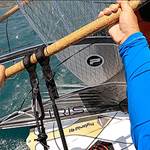
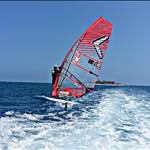
I just cant understand why all foil board manufacturers aren't making boards with noses that are more resiliant to the inevitable impacts that eventuate during foiling. I have smashed the nose of all my boards, (various manufacturers), several times. Why are we spending hours making nose protectors for $3 to 4-5K boards? It happens even to the Pro's. Why not cater to the needs of the bulk of your market?
I realise that the boards I have purchased are mostly designed for racing. As light as possible, as fast as possible. Like all high end boards. But surely there must be a more durable version of these that we all can use!?
Select to expand quoteBoston! said..
I just cant understand why all foil board manufacturers aren't making boards with noses that are more resiliant to the inevitable impacts that eventuate during foiling. I have smashed the nose of all my boards, (various manufacturers), several times. Why are we spending hours making nose protectors for $3 to 4-5K boards? It happens even to the Pro's. Why not cater to the needs of the bulk of your market?
I realise that the boards I have purchased are mostly designed for racing. As light as possible, as fast as possible. Like all high end boards. But surely there must be a more durable version of these that we all can use!?
What's the problem buy an inflatable board. Any catapult inflatable board is not afraid. Manta foil 150L Inflatable SUP/Windfoil board - with Tuttle only/
I couldn't agree more with Boston!. At this point I just watch in fascination as the windsurfing industry continues to make bad decisions that shrink an already dwindling market.
It is possible to prevent nose damage. I was able to accomplish it on my first ever board build. I used a handful of layers of Innegra patches in the nose. I broke three masts catapulting but never punched through the nose in two years of hard use. Masts are another way the industry has shot itself in the foot.
Select to expand quoteutcminusfour said..
I broke three masts catapulting but never punched through the nose in two years of hard use. Masts are another way the industry has shot itself in the foot.
There's your reason. Catapult bad enough, and something has to give. A broken nose is a quick and easy repair. I've had nose repairs done by pros, with perfect color matching, in a day for about $50. For quick and dirty repairs on vacation when I have no material, the cost for epoxy + fiberglass is about $20 and takes less than an hour. I usually plan to do a "proper" repair when getting back home, but usually don't bother.
A new mast in a catapult would be $500+, and would take days to get shipped .. assuming I could find a store that has the right mast.
Select to expand quoteboardsurfr said..utcminusfour said..
I broke three masts catapulting but never punched through the nose in two years of hard use. Masts are another way the industry has shot itself in the foot.
There's your reason. Catapult bad enough, and something has to give. A broken nose is a quick and easy repair. I've had nose repairs done by pros, with perfect color matching, in a day for about $50. For quick and dirty repairs on vacation when I have no material, the cost for epoxy + fiberglass is about $20 and takes less than an hour. I usually plan to do a "proper" repair when getting back home, but usually don't bother.
A new mast in a catapult would be $500+, and would take days to get shipped .. assuming I could find a store that has the right mast.
You could use Solarez for repair that is very easy fix for quick solution. After applying in damaged area expose to sun that is cured quickly. For vacation, you may also use ding repair putty but I prefer Solarez. In general, I do not like the boards coming with extra weight on the nose put for protection. In our area, professional repair is also expensive.
I don't know. Choice between a carbon mast or nose repair? I sure wouldn't want to replace my mast. They are well above $500 each. Phantom doesn't even have RDM. All mast are SDM and more fragile. Think about how costly that would be.
boardsurfr, I hear and understand your point. Designing in a fuse is a good thing and masts get replaced not fixed. That's why I feel strongly that the masts are not built tough enough, at least for me. The thing is I know it's possible for both the mast and board to survive a heavy catapult. I would not have believed it until I got hands on experience solving nose damage. The load on the board in a catapult is really not that large because the board can sink underneath it. Sure, the load per area is high but this can be solved with energy absorbing and dispersing materials like Innegra. Innegra can easily be used to provide damage tolerance to masts but sadly it is not. The masts I broke were from hooked in catapults where my body keeps moving as it enters the water but the sail stops suddenly. The masts did not break from colliding with the boards nose, they all broke at the clamp not the lower mast where they would hit the board.
These issues can be solved. The manufacturers don't want to probably because most won't buy it if they do. If it's not smaller and lighter most won't bite.
That's why you get custom boards.
Patching in the right places.
Factory won't use difficult materials but customs guys will.
Or, get a nose protector laminated up for your new board and affix with silicone.
As previousky said, something has got to give. So patching in the right places is great but from a safety stand point id rather be able to sail back to shore with a busted nose than a folded mast in pieces and shredded sail...
Wondering if the car industry is designing for drivers that have head on crashes 


Select to expand quoteMark _australia said..
That's why you get custom boards.
Patching in the right places.
Factory won't use difficult materials but customs guys will.
Or, get a nose protector laminated up for your new board and affix with silicone.
Took the words right out of my mouth. Custom boards are the way to go. I have been sailing Roberts boards since 88. And been catapulted many a time  . Never had an issue. I can't land a jump softly and still no heel dents. His custom boards are plenty light and the quality it second to none. He reinforces them were they need it.
I switched after going through too many production boards to count. Many replaced on warranty. I remember I was sceptical that his boards were any tougher; so he handed me a ball pin hammer and told me to hit the deck of a board. So I gave it a few taps without a dent. Rob grabbed the hammer from me and proceed to hammer on it using his 6' 6" 250lb frame - no dents just scuff marks!
Can of worms.
Try to solve one problem but creating many more.
So a company advertises "stronger" reinforcement.
You can still break it, at it's weaker spot. So you claim warrantee or sue...since you were inconvenienced and got cold.
What about trying harder NOT to get launched, and when you and I do, take rider responsibility by calling it an accident....like.....ooopps.
Actually, yes, car companies do indeed design cars for head-on crashes. That is what all the airbag and seatbelt and crumple zone and impact bar technology is for. It's never perfect, but it's a lot better than what we had in the 60s. Yes, I used to drive a '65 Corvair. Wish I still had it.
Do you guys want the companies to raise their prices to account for YOUR warrantee claims due to YOUR pilot errors?
Select to expand quoteutcminusfour said..
The load on the board in a catapult is really not that large because the board can sink underneath it.
I think this is a faulty argument. The mast is moving at very high velocity when it hits the board. Pushing the board under water would have to be near instantaneous .. which, according to Newton's second law, would require the transfer of rather large forces onto the board, especially since the board has to displace water to sink.
A somewhat comparable situation is breaking a board, which can be done even if the board is not being held at all:
 .
.
Select to expand quoteboardsurfr said.. which, according to Newton's second law, would require the transfer of rather large forces onto the board, especially since the board has to displace water to sink.
I bet he would be able to work out the correct length of harness line to use as well
Select to expand quotePhilUK said..boardsurfr said.. which, according to Newton's second law, would require the transfer of rather large forces onto the board, especially since the board has to displace water to sink.
I bet he would be able to work out the correct length of harness line to use as well
In that alternate universe, somebody here still would correct him.
The nose of the board cannot sink in a catapult.
1. Water needs time to displace.
2. Most catapults occur when the board is near or at planing speeds.
Select to expand quoteboardsurfr said..utcminusfour said..
The load on the board in a catapult is really not that large because the board can sink underneath it.
I think this is a faulty argument. The mast is moving at very high velocity when it hits the board. Pushing the board under water would have to be near instantaneous .. which, according to Newton's second law, would require the transfer of rather large forces onto the board, especially since the board has to displace water to sink.
A somewhat comparable situation is breaking a board, which can be done even if the board is not being held at all:utcminusfour said..
The masts I broke were from hooked in catapults where my body keeps moving as it enters the water but the sail stops suddenly. The masts did not break from colliding with the boards nose, they all broke at the clamp not the lower mast where they would hit the board.
I have had a few catapults, including some where I stayed hooked in, where I broke board noses and/or booms (or, best case scenario, just harness lines), but never had one where the mast broke. Something else was weaker .
In your case, where the board nose was reinforced, I would not necessarily expect the mast to break where it makes contact with the board. With the bottom of the mast stopping, the top will be subjected to a whiplash effect. That will be distributed over the top of the mast, but the boom clamp creates a sharp discontinuity, somewhat similar to the edge of the foot in the air break video above.
But let's say that you sail on gear that has been sufficiently reinforced somehow that nothing breaks even in a huge catapult. If something has to break and it's not your gear, it will probably be you. Personally, I'd rather fix or replace gear. I have had a few crashes where my body seemed to end up absorbing most of the forces, and I'd much rather fix a board nose, or even repair or replace a boom.
I'm not saying that board manufacturers could not perhaps do a better job at reinforcing. But that comes at an extra cost in money and/or weight, which some users who perhaps rarely crash may not want to pay.
The board damage I have caused is exclusively through hooked in catapaults. (Foiling "out" at speed with the board/foil stopping suddenly on re-entry to the water and my body continuing on and down) I have never broken a mast via mast to board nose contact. The nose protectors that most foilers have improvised all work to some extent. Almost all foilers I know use one. So why don't the manufacturers choose to have inbuilt protection from new or, at least offer to sell you a protector, built for that board, that they could sell you for say $200 that anyone who is spending 4K on a new board would be mad not to purchase? Of course no warranty regarding nose protectors would be offered as its would be impossible to cover all eventualities but, it would be something.
It just seems to me that none of the manufacturers have modified their builds to allow for the much more common catapaults that occur whilst foiling. They are still just using the same process they have been using for years with slalom and free ride boards.
I would love to buy a custom board but I don't see anyone offering any more durable, viable alternatives. (happy to be proven wrong)
Select to expand quoteBoston! said..
The board damage I have caused is exclusively through hooked in catapaults. (Foiling "out" at speed with the board/foil stopping suddenly on re-entry to the water and my body continuing on and down) I have never broken a mast via mast to board nose contact. The nose protectors that most foilers have improvised all work to some extent. Almost all foilers I know use one. So why don't the manufacturers choose to have inbuilt protection from new or, at least offer to sell you a protector, built for that board, that they could sell you for say $200 that anyone who is spending 4K on a new board would be mad not to purchase? Of course no warranty regarding nose protectors would be offered as its would be impossible to cover all eventualities but, it would be something.
It just seems to me that none of the manufacturers have modified their builds to allow for the much more common catapaults that occur whilst foiling. They are still just using the same process they have been using for years with slalom and free ride boards.
I would love to buy a custom board but I don't see anyone offering any more durable, viable alternatives. (happy to be proven wrong) sfer of rather large forces onto the board, especially since the board has to displace water to sink.
Even with fin windsurfing you can catapult through hitting something in the water. A lot of boards arent built to take that either. Competition boards you can say far enough, they have to be light. But boards like Starboard Futura are so thin in the nose I have seen 2 boards with 30cm long crack going around the deck to hull. I would never buy one.
Optional factory fitted nose protectors of the type a lot of foilers build themselves would be a good option.
This year I decided to first let the nose protector be made and than to go foiling second.
It's around 150 gr - very nice work by Kaktus protectors, germany.

I have the solution. Don't use a harness line. Problem solved.
When I catapult while off the harness line, the mast never contacts the nose of the board. Hasn't yet anyway (knock on wood, cross fingers, hold thumbs, depending on your native culture).
Select to expand quoteBoston! said..
I just cant understand why all foil board manufacturers aren't making boards with noses that are more resiliant to the inevitable impacts that eventuate during foiling. I have smashed the nose of all my boards, (various manufacturers), several times. Why are we spending hours making nose protectors for $3 to 4-5K boards? It happens even to the Pro's. Why not cater to the needs of the bulk of your market?
I realise that the boards I have purchased are mostly designed for racing. As light as possible, as fast as possible. Like all high end boards. But surely there must be a more durable version of these that we all can use!?
For the sake of the question, JP put innegra patches on the nose of their race foil boards (my 175 has it, i'm presuming they've continued to do it.)
The other change is a move towards much less to nil nose rocker (in race models at least) from a number of manufacturers. More to do with reducing windage coming into play with board speeds upwind/crosswind) but has the added benefit of reducing nose strike damage since the nose cops less/none of the impact.
Select to expand quotesegler said..
I have the solution. Don't use a harness line. Problem solved.
When I catapult while off the harness line, the mast never contacts the nose of the board. Hasn't yet anyway (knock on wood, cross fingers, hold thumbs, depending on your native culture).
I hope this was in jest. While there are some who never use a harness and some who don't use it on portions of downwinders (myself included), a harness, imho, is essential in extracting the full potential of windfoiling. A couple of years in, wingfoilers are discovering the same.
Touch wood, My solution has been short and ultra short boards (Naish Micro and Slingshot 103 (5ft long)). Its pretty hard to do nose damage on these but they definitly aren't for everyone. I've gone over the hangers a few times on the Micro hooked in and fully powered up doing about 20 knots, a very small paint crack is all I can see or feel. Stoked. 20 knots of board speed is still very doable plus the bonus of lots of carving fun.
Select to expand quotesegler said..
Actually, yes, car companies do indeed design cars for head-on crashes. That is what all the airbag and seatbelt and crumple zone and impact bar technology is for. It's never perfect, but it's a lot better than what we had in the 60s. Yes, I used to drive a '65 Corvair. Wish I still had it.
Totally agree, but the point has been missed. The car is designed to almost completely disintegrate on impact saving the driver. Here we are asking to keep the car intact at the cost of... the driver!!
I'm sure there are unfortunately too many stories of people doing ribs crashing on carbon booms vs aluminum.
Cant wait to watch Formula 1 with bullbars on
My comment about not using a harness is only partially in jest.
In 5 years now of foiling, I use my harness about 2% of the time. Really. Not 20%. 2.0%. Smaller sails (4.0-7.0) just don't need the harness. I will use the harness for cranking upwind. However, for beam reaching and downwind, a harness is just not necessary. I can foil for hours without tiring my arms. No, I don't have Popeye arms.
Select to expand quotesegler said..
My comment about not using a harness is only partially in jest.
In 5 years now of foiling, I use my harness about 2% of the time. Really. Not 20%. 2.0%. Smaller sails (4.0-7.0) just don't need the harness. I will use the harness for cranking upwind. However, for beam reaching and downwind, a harness is just not necessary. I can foil for hours without tiring my arms. No, I don't have Popeye arms.
think it depends on your kit, with big lower aspect wing and smaller sail you go slower with less pressure on sail, do not need to be hooked in. But with a smaller higher aspect wing with bigger sail you go faster with more pressure on sail, need to be hooked in for mile long runs for several hours.