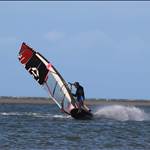
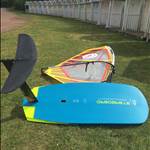
Recently repaired my old foilboard, kind of a ver. 1, which has held up well, and gets off the water pretty early. It's 219x86 130l. Sailed it yesterday and the narrowness of the rear deck vs new boards is apparent and widening it seems like a good project for the winter.
While I'm cutting, foaming, glassing, etc was wanting to revisit the bottom shape, too. It has a big V-shaped cut out reminiscent of the v.2 Exocet RF81, etc. Was wandering if any of you have messed with cut out shapes and their effect on early take off. I keep thinking that a more square release (think Phantom, Starboard, Severne, etc) seems more efficient.
Thoughts or experiences?
You can change it, but will it be better than stock in all conditions?
Stock is what designers think for all conditions, a compromise of characteristics for most everyone.
Select to expand quoteLeeD said..
You can change it, but will it be better than stock in all conditions?
Stock is what designers think for all conditions, a compromise of characteristics for most everyone.
Well, it's what the designer thought was best four years ago and only a couple of other designers have done the same since - thus my question. Designers aren't infallible - they, too, learn as time goes on. Otherwise, my OFO would have been wider*. 
* I have the same designer's next gen board, and, indeed, the OFO widened.
Select to expand quotePaducah said..
Recently repaired my old foilboard, kind of a ver. 1, which has held up well, and gets off the water pretty early. It's 219x86 130l. Sailed it yesterday and the narrowness of the rear deck vs new boards is apparent and widening it seems like a good project for the winter.
While I'm cutting, foaming, glassing, etc was wanting to revisit the bottom shape, too. It has a big V-shaped cut out reminiscent of the v.2 Exocet RF81, etc. Was wandering if any of you have messed with cut out shapes and their effect on early take off. I keep thinking that a more square release (think Phantom, Starboard, Severne, etc) seems more efficient.
Thoughts or experiences?
What style of foiling you're planning to do: racing, freestyle/jumping, or waves/ swell freeride. Cut out might help on wider board with tacking or if you not efficient with pumping on foil and need to relay on higher speed to get air. Flat to double concave with bevels on sides is my choice.
For early take-off I think the rockerline should be more in focus than the cutouts. A long flat section with sufficient nose lift for the chop should give an efficient glide. Cut-outs could be counterproductive for easy take-off by reducing the length of the flat section. For foiling I think of cut-outs more as a means of reducing drag when occasionally touching down during flight. At least for boards that are not super wide.
For early take-off I think the rockerline should be more in focus than the cutouts. A long flat section with sufficient nose lift for the chop should give an efficient glide. Cut-outs could be counterproductive for easy take-off by reducing the length of the flat section. For foiling I think of cut-outs more as a means of reducing drag when occasionally touching down during flight. At least for boards that are not super wide.
Select to expand quotemiamiwindsurfe said..Paducah said..
Recently repaired my old foilboard, kind of a ver. 1, which has held up well, and gets off the water pretty early. It's 219x86 130l. Sailed it yesterday and the narrowness of the rear deck vs new boards is apparent and widening it seems like a good project for the winter.
While I'm cutting, foaming, glassing, etc was wanting to revisit the bottom shape, too. It has a big V-shaped cut out reminiscent of the v.2 Exocet RF81, etc. Was wandering if any of you have messed with cut out shapes and their effect on early take off. I keep thinking that a more square release (think Phantom, Starboard, Severne, etc) seems more efficient.
Thoughts or experiences?
What style of foiling you're planning to do: racing, freestyle/jumping, or waves/ swell freeride. Cut out might help on wider board with tacking or if you not efficient with pumping on foil and need to relay on higher speed to get air. Flat to double concave with bevels on sides is my choice.
Flat water light air . max 20 kts wind speed. Sail sizes 6-8m2 "freerace" (ie sheeting in and making the most of the apparent wind in lightish conditions) thus the emphasis on early take off. I'm rather proficient in pumping but no sense wasting energy in our frequent marginal conditions if the bottom shape could be made more efficient.
I have a higher wind board that absolutely sticks to the water because of the tail shape (on my list of to-dos, as well). I love the way it rides but if I don't make it through a jibe when the wind slacks off, I'm having to wait for a hard gust. This experience has made more more conscious of the topic. There are some people in this forum that have sailed a number of boards and few that have made/modified their own. Just looking for some input on what their experiences are.
Select to expand quoteWatatait said..
For early take-off I think the rockerline should be more in focus than the cutouts. A long flat section with sufficient nose lift for the chop should give an efficient glide. Cut-outs could be counterproductive for easy take-off by reducing the length of the flat section. For foiling I think of cut-outs more as a means of reducing drag when occasionally touching down during flight. At least for boards that are not super wide.
This board already gets up pretty quickly almost to the point where the planing transition might only be a second or two. I think it's a bit more complex than that - no disrespect intended. The cutouts, even if they are intended just for touch downs, should still allow efficient release and my concern is that the V shape may inhibit that by not being inline with the water flow. Also, the cutouts allow for the tail to sink a bit to get a higher angle of attack on the foil in the lift off stage so I believe they help there, too. In my case, the V extends pretty well forward (again, consider the Exocet shape) and I'm thinking I'd rather have more flat on the water there and less back by the fin box.
Select to expand quotePaducah said..Watatait said..
For early take-off I think the rockerline should be more in focus than the cutouts. A long flat section with sufficient nose lift for the chop should give an efficient glide. Cut-outs could be counterproductive for easy take-off by reducing the length of the flat section. For foiling I think of cut-outs more as a means of reducing drag when occasionally touching down during flight. At least for boards that are not super wide.
This board already gets up pretty quickly almost to the point where the planing transition might only be a second or two. I think it's a bit more complex than that - no disrespect intended. The cutouts, even if they are intended just for touch downs, should still allow efficient release and my concern is that the V shape may inhibit that by not being inline with the water flow. Also, the cutouts allow for the tail to sink a bit to get a higher angle of attack on the foil in the lift off stage so I believe they help there, too. In my case, the V extends pretty well forward (again, consider the Exocet shape) and I'm thinking I'd rather have more flat on the water there and less back by the fin box.
Original cut out idea was for better top end speed, meaning once you are planning 20+kn, for taking off or touch down i don't see how it helps, my take off to air speed around 7-8kn, double concave was most used on formula for smoothest overall ride...
My first custom foil board has cutouts, 86 cm wide, when I switched to current 92 cm wide with no cutouts, no change in how early it takes off, very smooth touch downs do to larger bevels, better for upwind do to width and easier to use extra long fusilage in race mode. But I got bored with racing part of foiling, now into more wave foiling, waiting for Foilboard #3
The Fanatic Stingray has no cut outs. It gets up and flying faster than my Alien which has cut outs.
Hey Paducah!
I am recycling my big green homebrew board. I am cutting it down to something similar to the Wizard 130. I just cut the recesses, I copied the Wizard. After reading John340 comments I may fill them back in! Or perhaps I'll keep them and ride it a bunch then fill them in to see if I can notice the diff.
I sail an older Slingshot Wizard 150. It sticks to the water compared to others I foil with. Is it the cutouts? Is it the weight of the sail rig and board(24 lb board and 20 lb ring)? The shape of the rails? The shape of the bottom of the board? I have no idea.
One guy runs old freeride boards with redone tuttle boxes in the 130 to 140 liter range with widths of 70 to 72cm. He definately gets up sooner than me.
An other winger with a blow up board of about 140 liter with no cut outs really gets up really fast.
Its interesting that the Exocet gets up well because the board shape is similar to the Wizard 150.
In addtion I look at the Slingshot Shred Sled and the Goya Air Bolt and wonder if the bottom shape and the rail shape make it come off the water easier.
Select to expand quoteJohn340 said..
The Fanatic Stingray has no cut outs. It gets up and flying faster than my Alien which has cut outs.
What volume are your boards? (I heard that the Alien is small for the stated volume).
Since the foil exerts some lift, it helps to unwet the board, even at sub planing or sub foiling speeds. I'm not sure cutouts matter all that much. I think the rails play a big role.
My Stingray 140 has no cutouts, and it accelerates and lifts into flight very easily. My Exo FF 132 also has no cutouts, and it accelerates and lifts with more effort. The difference is the rails. The Stingray has fairly sharp rails, while the Exo rails are very rounded.
Select to expand quotesegler said..
Since the foil exerts some lift, it helps to unwet the board, even at sub planing or sub foiling speeds. I'm not sure cutouts matter all that much. I think the rails play a big role.
My Stingray 140 has no cutouts, and it accelerates and lifts into flight very easily. My Exo FF 132 also has no cutouts, and it accelerates and lifts with more effort. The difference is the rails. The Stingray has fairly sharp rails, while the Exo rails are very rounded.
Which version of the Stingray do you have? I have the cheaper (HRS) version, and the rails are not very sharp. Friends have the LTD version of the 125, which has sharper rails. But I have not looked at the 140 in LTD.
Keep talking guys/gals - some good nuggets in here. Thanks!
Whether or not cut outs contribute to early flight seems to be debatable - it does seem to me that improperly placed or size cut outs may take away from surface area helpful for early flight in some cases or reduce excess area in others e.g. Starboard Foil Slalom boards with much reduced bottom area compared to other foil boards. Looks like they decided not to do cut outs but cut aways - reduce the bottom completely.
"New waterdrop shape concept for maximum lift and stability, new back footstrap position for more control and higher reaching speeds, new extra-deep rail cutaways to take-off and get flying quickly. The Foil Slalom boards are also a new foil board category."
Select to expand quotePaducah said..
Keep talking guys/gals - some good nuggets in here. Thanks!
Whether or not cut outs contribute to early flight seems to be debatable - it does seem to me that improperly placed or size cut outs may take away from surface area helpful for early flight in some cases or reduce excess area in others e.g. Starboard Foil Slalom boards with much reduced bottom area compared to other foil boards. Looks like they decided not to do cut outs but cut aways - reduce the bottom completely.
"New waterdrop shape concept for maximum lift and stability, new back footstrap position for more control and higher reaching speeds, new extra-deep rail cutaways to take-off and get flying quickly. The Foil Slalom boards are also a new foil board category."
I wonder how those cutaways help with pumping on early take-off. I think it has less to do with water release than being able to get more motion when pumping larger boards but I may be wrong. The IQFoil board is 95cm and has huge cutaways, more severe than that. If I fly low and get the board wet I hear them sucking like a draining bathtub as the water hits them.
Select to expand quoteaeroegnr said..Paducah said..
Keep talking guys/gals - some good nuggets in here. Thanks!
Whether or not cut outs contribute to early flight seems to be debatable - it does seem to me that improperly placed or size cut outs may take away from surface area helpful for early flight in some cases or reduce excess area in others e.g. Starboard Foil Slalom boards with much reduced bottom area compared to other foil boards. Looks like they decided not to do cut outs but cut aways - reduce the bottom completely.
"New waterdrop shape concept for maximum lift and stability, new back footstrap position for more control and higher reaching speeds, new extra-deep rail cutaways to take-off and get flying quickly. The Foil Slalom boards are also a new foil board category."
I wonder how those cutaways help with pumping on early take-off. I think it has less to do with water release than being able to get more motion when pumping larger boards but I may be wrong. The IQFoil board is 95cm and has huge cutaways, more severe than that. If I fly low and get the board wet I hear them sucking like a draining bathtub as the water hits them.
iQ has to work in planning mode with fin, similar to formula. Don't look at it as an good example for foil board, it's a hybrid. Narrow tail a bit less drag on take off, but if you know how to pump foil well it doesn't matter. Those big wings on tail of the slalom foil to allow more leverage/control of foil at high speeds
Select to expand quotemiamiwindsurfe said..
iQ has to work in planning mode with fin, similar to formula. Don't look at it as an good example for foil board, it's a hybrid. Narrow tail a bit less drag on take off, but if you know how to pump foil well it doesn't matter. Those big wings on tail of the slalom foil to allow more leverage/control of foil at high speeds
Ahhh you're probably right. I forget about the 68cm Drake fin I have just laying around, haven't used it, it's not even been in the board. I think I've only seen 2 videos of people actually putting a fin in it.
Select to expand quotePaducah said..
... new extra-deep rail cutaways to take-off and get flying quickly. The Foil Slalom boards are also a new foil board category."
There's no doubt in my mind that this underwater shape is faster in a certain speed range than a shape that stays the full width, but has multiple cutouts. In semi-planing mode, where the "wings" are above the water, the water flow is simply a lot cleaner, with a lot less turbulence. That should help getting going on the smaller slalom front wings, which require a higher takeoff speed. The relevant speed range is somewhere around 10-18 knots. Once fully planing at 20+ knots board speed, regular cutouts should work just as well, and may even have some advantages. But that does not matter for a slalom foil board, because it will be flying by then.
While the tear drop shape definitely has benefits compared to regular cut-out from causing less turbulence, I would be cautious using this design on anything but big foil boards for race/slalom foils where bigger sails are used and there is plenty of board volume and width to sacrifice to achieve this shape. For smaller free-ride oriented foil boards used with smaller sails keeping the tail width will make it easier to achieve the relatively low speed needed for take-off because the wide tail will not tend to sink so much causing more water resistance. And regular cut-outs may make foot-pumping to assist lift-off easier ... maybe, but maybe at the expense of sacrificing a piece of good gliding surface which would make pumping less needed. Anyhow, I have also just made cut-outs on my retrofit of a 1999 Thommen Course Race board with 72,5 cm width. It has very boxy sharp rails so I expect it will have a slippery fast glide
Select to expand quoteWatatait said..
While the tear drop shape definitely has benefits compared to regular cut-out from causing less turbulence, I would be cautious using this design on anything but big foil boards for race/slalom foils where bigger sails are used and there is plenty of board volume and width to sacrifice to achieve this shape. For smaller free-ride oriented foil boards used with smaller sails keeping the tail width will make it easier to achieve the relatively low speed needed for take-off because the wide tail will not tend to sink so much causing more water resistance. And regular cut-outs may make foot-pumping to assist lift-off easier ... maybe, but maybe at the expense of sacrificing a piece of good gliding surface which would make pumping less needed. Anyhow, I have also just made cut-outs on my retrofit of a 1999 Thommen Course Race board with 72,5 cm width. It has very boxy sharp rails so I expect it will have a slippery fast glide
Maybe if I'm really really bored one day I'll make some cutout blocks for the IQ and filling in that volume to see what changes. I'm kind of curious.
Select to expand quoteaeroegnr said..Watatait said..
While the tear drop shape definitely has benefits compared to regular cut-out from causing less turbulence, I would be cautious using this design on anything but big foil boards for race/slalom foils where bigger sails are used and there is plenty of board volume and width to sacrifice to achieve this shape. For smaller free-ride oriented foil boards used with smaller sails keeping the tail width will make it easier to achieve the relatively low speed needed for take-off because the wide tail will not tend to sink so much causing more water resistance. And regular cut-outs may make foot-pumping to assist lift-off easier ... maybe, but maybe at the expense of sacrificing a piece of good gliding surface which would make pumping less needed. Anyhow, I have also just made cut-outs on my retrofit of a 1999 Thommen Course Race board with 72,5 cm width. It has very boxy sharp rails so I expect it will have a slippery fast glide
Maybe if I'm really really bored one day I'll make some cutout blocks for the IQ and filling in that volume to see what changes. I'm kind of curious.
Somebody with a Patrik Formula 4 board (Patrik has another few with plates) should chime in. I know that board has adjustable cut outs. Would be interesting to see how the adjustments change the performance.
1. Gotta identify the boatspeed you need to get up on your foil size.
2. Factor in weight and pumping skills.
3. Factor in sail size and it's power.
4. Consider cutouts size, shape, or if needed at all.
Remember, anything that helps ONE end of the spectrum will hurt at the OTHER end.
Select to expand quoteZeroVix said..
Somebody with a Patrik Formula 4 board (Patrik has another few with plates) should chime in. I know that board has adjustable cut outs. Would be interesting to see how the adjustments change the performance.
Yeah that would be good to hear info on.
I know, for instance, that if the wind is strong enough to get me close to 4knots boardspeed on the IQFoil, then I have enough power to push the board over the hump and accelerate to flying speed on the 900 wing if I pump in earnest. I haven't been successful if it's less than 3.8knots as judged by my gps watch. I think my minimum is about 8knots wind speed. If they have a big effect on pumping effort on the lower end I'd be really interested.
The 650 takes more board speed but I don't much notice the pumping effort difference, I just seem to need more wind and more initial board speed to get flying, which seems to come at some quasi planing state.
Slingshot gear is quite a bit different, and I haven't used it yet on a board with cutouts nor a proper foil board, but it gets going at a noticeably slower speed, and different pumping feel, but I don't know how much of that is board vs. foil feel. At least playing around with cutouts the feel difference should be more obvious.
Select to expand quoteWatatait said..
While the tear drop shape definitely has benefits compared to regular cut-out from causing less turbulence, I would be cautious using this design on anything but big foil boards for race/slalom foils where bigger sails are used and there is plenty of board volume and width to sacrifice to achieve this shape. For smaller free-ride oriented foil boards used with smaller sails keeping the tail width will make it easier to achieve the relatively low speed needed for take-off because the wide tail will not tend to sink so much causing more water resistance. And regular cut-outs may make foot-pumping to assist lift-off easier ... maybe, but maybe at the expense of sacrificing a piece of good gliding surface which would make pumping less needed. Anyhow, I have also just made cut-outs on my retrofit of a 1999 Thommen Course Race board with 72,5 cm width. It has very boxy sharp rails so I expect it will have a slippery fast glide
 Small 125 FoilX on top
Big 150 free foil on the bottom
Similar tear drop bottom shapes, although the FoilX has the extra tail cut outs
Select to expand quoteRuddeBos said..Watatait said..
While the tear drop shape definitely has benefits compared to regular cut-out from causing less turbulence, I would be cautious using this design on anything but big foil boards for race/slalom foils where bigger sails are used and there is plenty of board volume and width to sacrifice to achieve this shape. For smaller free-ride oriented foil boards used with smaller sails keeping the tail width will make it easier to achieve the relatively low speed needed for take-off because the wide tail will not tend to sink so much causing more water resistance. And regular cut-outs may make foot-pumping to assist lift-off easier ... maybe, but maybe at the expense of sacrificing a piece of good gliding surface which would make pumping less needed. Anyhow, I have also just made cut-outs on my retrofit of a 1999 Thommen Course Race board with 72,5 cm width. It has very boxy sharp rails so I expect it will have a slippery fast glide
Small 125 FoilX on top
Big 150 free foil on the bottom
Similar tear drop bottom shapes, although the FoilX has the extra tail cut outs
Sure, but the free foil 150 has a massive thickness for extra float to compensate for the narrower surface to glide on. High volume is another effective contributor to achieve acceleration for lift-off. It's all about finding a good balance and there are many ways to achieve this.
I have made 2 foil boards and have almost finished building #3.
#1 had no cut outs, #2 has cutouts modelled on Severne Alien but no noticeable difference in take off or touch down so #3 doesn't have cut outs.
I reckon don't bother with cutouts if you're on flat water.
I can see that in swells they probably help.
I guess they may also help with very wide tails.
There was a mention of rocker effect on take off/touch down.
I checked rocker lines of 6 or 8 prominent foiler brands and they are absolutely all over the place dimensionally.
At the same point, rocker varied from 65 to 150mm.
No agreement there.
I kept rocker low to help the aero wing leading edge.