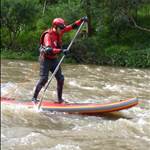
from what I have seen recently I personally think Jake has looked more stable on the 21 strike than Connor and Trev on sprints.
could it be that a flat deck board is letting you stand wider than the dug out when it comes to such narrow widths?
Danny Ching's time for the 200m sprint at Lost mills was 47.6sec. Considering that the times of these Olympic C1 paddlers in that race ranged from just over 44 sec to just over 47 sec., Danny's time is truly amazing. I know Danny had a rolling start, but even if you add a second or two (at most), his time is not that far off these Olympic C1 paddlers. The C1 boat is about 17 feet long and about 16 inches wide. The whole setup is designed to maximize straight line speed in flat water with no compromises. That Danny is even in the same ballpark as these guys is incredible. To me that suggests that Danny's technique can't be that far off the ideal technique for SUP sprinting.
I've spoken to Larry Cain many times and he says that there is a huge amount of relevance in the C1 stroke for SUP - especially the concept of power transfer from the hips - this works for both kneeling on one leg as well as standing up.
In my opinion this is not the direction SUP racing should take. Racing short distances in lanes in flat water migth be entertaining for the spectators, but not so much for the compettitors.
I think we should ,very much, try and stay connected to surfing and outrigger paddeling. A lot more people have succesfully come from outrigger than from flatwater canoes. Thats were to look in my opinion.
Talk all you want about 200 meter sprints on lakes in Germany hopefully thats not were the sport is heading
Select to expand quoteSurfNiels said...
In my opinion this is not the direction SUP racing should take. Racing short distances in lanes in flat water migth be entertaining for the spectators, but not so much for the compettitors.
I think we should ,very much, try and stay connected to surfing and outrigger paddeling. A lot more people have succesfully come from outrigger than from flatwater canoes. Thats were to look in my opinion.
Talk all you want about 200 meter sprints on lakes in Germany hopefully thats not were the sport is heading
I'd agree , but it's just another dimension for racing , the more variations the better. Bop and downwinding are fine, but a lot of Europe don't have a coastline. And everyone wants to know who the fastest is As far as flat water goes, sprints are farbbetter to watch than a 2hr flat water grind.
Select to expand quoteteatrea said..
SurfNiels said...
In my opinion this is not the direction SUP racing should take. Racing short distances in lanes in flat water migth be entertaining for the spectators, but not so much for the compettitors.
I think we should ,very much, try and stay connected to surfing and outrigger paddeling. A lot more people have succesfully come from outrigger than from flatwater canoes. Thats were to look in my opinion.
Talk all you want about 200 meter sprints on lakes in Germany hopefully thats not were the sport is heading
I'd agree , but it's just another dimension for racing , the more variations the better. Bop and downwinding are fine, but a lot of Europe don't have a coastline. And everyone wants to know who the fastest is As far as flat water goes, sprints are farbbetter to watch than a 2hr flat water grind.
Surfniels' acknowledgement that short distance sprints in lanes on flat water might be more entertaining for spectators whereas the competitors want something else altogether is one of the biggest problems that blocks SUP Racing becoming fully professional. Crowds love 20/20 cricket whereas purists and players prefer Tests. The big money is where the crowds and the TV audience resides and that's 20/20. I don't think 200 metre sprint racing is an obvious TV sport capable of drawing big sponsor dollars, but a 2hr flat water grind most certainly is not. The closest anyone has come to presenting a valid format for a commercial TV audience is the Turtle Bay surf race event. But a majority of the top competitors give that one a miss.
It comes down to what competitors want. At the elite level, they can have the 'purist' events that aren't necessarily TV/media friendly (like test cricket above), or you have compromised for TV events (the 20 Twenty version) in a tight stadium setting that appeals to the masses and TV producers. The money will always be with the compromised TV events, just as it is for cricket.
SUP is far from the only sport that has had to make significant compromises to appeal to TV producers and the general public.