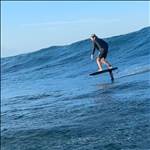
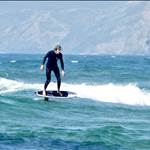
Brains trust - help is needed!
I'm just getting into riding the waves and I've stopped progressing. I'm not sure if it's a me-thing, a gear-thing, or a conditions thing.
Out in Bass Straight. Decent swell (head high+) with period of about 12 seconds. Superimposed sea. 20 knot easterlies, same direction as the swell and the sea.
Whenever I got on a wave, (bearing away to a broad reach) I would crash. Three different stacks, more or less equally spread between the types.
Stack one - high speed down the face. Foil vents (I'm assuming I'm too high), resulting in a high speed nose dive
Stack two. High speed nose dive into the wave in front. Just without the porpoise/vent/pop-up first.
Stack three. I know I'm a bit out of control, and cut across the wave, angling up slightly to windward from my existing track to let the wave pass underneath me - but then fall to windward.
I'm 80kg. 111 litre board, unstrapped. Mast 70cm Cabrinha foil front wing 1200. Riding North Nova 4.2m (I was a bit overpowered).
I've been going OK on other sessions when the swell and sea were not as big, but still a bit of a tendency to the same stacks.
Realistically these are the wave/wind/sea conditions I'll be getting into most often for wave riding. So working out what to change is really important.
My first thought is I just need a longer mast - with the sea superimposed on the swell, there is very little room for error in my height. But I'm open to any other explanation
Select to expand quotebrady said..
Brains trust - help is needed!
I'm just getting into riding the waves and I've stopped progressing. I'm not sure if it's a me-thing, a gear-thing, or a conditions thing.
Out in Bass Straight. Decent swell (head high+) with period of about 12 seconds. Superimposed sea. 20 knot easterlies, same direction as the swell and the sea.
Whenever I got on a wave, (bearing away to a broad reach) I would crash. Three different stacks, more or less equally spread between the types.
Stack one - high speed down the face. Foil vents (I'm assuming I'm too high), resulting in a high speed nose dive
Stack two. High speed nose dive into the wave in front. Just without the porpoise/vent/pop-up first.
Stack three. I know I'm a bit out of control, and cut across the wave, angling up slightly to windward from my existing track to let the wave pass underneath me - but then fall to windward.
I'm 80kg. 111 litre board, unstrapped. Mast 70cm Cabrinha foil front wing 1200. Riding North Nova 4.2m (I was a bit overpowered).
I've been going OK on other sessions when the swell and sea were not as big, but still a bit of a tendency to the same stacks.
Realistically these are the wave/wind/sea conditions I'll be getting into most often for wave riding. So working out what to change is really important.
My first thought is I just need a longer mast - with the sea superimposed on the swell, there is very little room for error in my height. But I'm open to any other explanation
Longer mast, smaller board and a smaller front wing will help but experience is the most important. Get out and do it again and again.
Hey Brady,
I had the same issues in the surf. I did swap my 70 mast for an 85 but the one thing that made the most difference for me was putting on the front straps. I went from falling in about 50 times a session to about 4. It allowed me to enjoy time on the water without punishing myself too much falling in all the time. 6 months down the track I pulled them off and haven't looked back.
Same weight also on cab. Agreed with the above, mast should be 85cm minimum if choppy/overhead, that's the most important. On the cab even the H800 is too much foil at overhead size.. scale down to H800 or H700 or H650. Board can be 70L while still being able to go super light wind, need to be long and narrow, 5' long or more and 20"wide or less.
In bigger waves having the right gear is extremely important, with the wrong gear it will be punishing and hard to progress and have fun.
Select to expand quotehilly said..brady said..
Brains trust - help is needed!
I'm just getting into riding the waves and I've stopped progressing. I'm not sure if it's a me-thing, a gear-thing, or a conditions thing.
Out in Bass Straight. Decent swell (head high+) with period of about 12 seconds. Superimposed sea. 20 knot easterlies, same direction as the swell and the sea.
Whenever I got on a wave, (bearing away to a broad reach) I would crash. Three different stacks, more or less equally spread between the types.
Stack one - high speed down the face. Foil vents (I'm assuming I'm too high), resulting in a high speed nose dive
Stack two. High speed nose dive into the wave in front. Just without the porpoise/vent/pop-up first.
Stack three. I know I'm a bit out of control, and cut across the wave, angling up slightly to windward from my existing track to let the wave pass underneath me - but then fall to windward.
I'm 80kg. 111 litre board, unstrapped. Mast 70cm Cabrinha foil front wing 1200. Riding North Nova 4.2m (I was a bit overpowered).
I've been going OK on other sessions when the swell and sea were not as big, but still a bit of a tendency to the same stacks.
Realistically these are the wave/wind/sea conditions I'll be getting into most often for wave riding. So working out what to change is really important.
My first thought is I just need a longer mast - with the sea superimposed on the swell, there is very little room for error in my height. But I'm open to any other explanation
Longer mast, smaller board and a smaller front wing will help but experience is the most important. Get out and do it again and again.
Yeah agree but I would add as speed increase when you on the wave you really need to add more and more front foot pressure you be amazed by give it a lot of front foot pressure leaning forward that you can hold down a big foil.
Select to expand quoteAUS126 said..
Hey Brady,
I had the same issues in the surf. I did swap my 70 mast for an 85 but the one thing that made the most difference for me was putting on the front straps. I went from falling in about 50 times a session to about 4. It allowed me to enjoy time on the water without punishing myself too much falling in all the time. 6 months down the track I pulled them off and haven't looked back.
What was it about the straps that helped on waves? Better board control? Better focus so you wouldn't crash and bust your ankles? :-)
Select to expand quotekiwiupover said..AUS126 said..
Hey Brady,
I had the same issues in the surf. I did swap my 70 mast for an 85 but the one thing that made the most difference for me was putting on the front straps. I went from falling in about 50 times a session to about 4. It allowed me to enjoy time on the water without punishing myself too much falling in all the time. 6 months down the track I pulled them off and haven't looked back.
What was it about the straps that helped on waves? Better board control? Better focus so you wouldn't crash and bust your ankles? :-)
Yes, foot straps gives you better control. But lots of good riders without. Coming from wave sailing feels more natural.
I weight 88kg and my larger foil in the surf is a chopped 1250, normally with 925 or 725. I also move the foil 1cm back if the surf is overhead, with a 70L board.
Select to expand quotekiwiupover said..AUS126 said..
Hey Brady,
I had the same issues in the surf. I did swap my 70 mast for an 85 but the one thing that made the most difference for me was putting on the front straps. I went from falling in about 50 times a session to about 4. It allowed me to enjoy time on the water without punishing myself too much falling in all the time. 6 months down the track I pulled them off and haven't looked back.
What was it about the straps that helped on waves? Better board control? Better focus so you wouldn't crash and bust your ankles? :-)
I was at a stage where I felt I was never going to get there in surf. I put straps on and all of a sudden felt attached to the foil. I could control it with minimal hours practice. I was apprehensive about injuring knees or ankles but felt the risk of cutting myself on foil was less with straps which sort of outweighed strap injuries. Whenever I crashed my feet slipped out of straps no dramas. There is a risk though. For me it was definately an easier learning experience with front straps.
Select to expand quotebrady said..
Brains trust - help is needed!
I'm just getting into riding the waves and I've stopped progressing. I'm not sure if it's a me-thing, a gear-thing, or a conditions thing.
Out in Bass Straight. Decent swell (head high+) with period of about 12 seconds. Superimposed sea. 20 knot easterlies, same direction as the swell and the sea.
Whenever I got on a wave, (bearing away to a broad reach) I would crash. Three different stacks, more or less equally spread between the types.
Stack one - high speed down the face. Foil vents (I'm assuming I'm too high), resulting in a high speed nose dive
Stack two. High speed nose dive into the wave in front. Just without the porpoise/vent/pop-up first.
Stack three. I know I'm a bit out of control, and cut across the wave, angling up slightly to windward from my existing track to let the wave pass underneath me - but then fall to windward.
I'm 80kg. 111 litre board, unstrapped. Mast 70cm Cabrinha foil front wing 1200. Riding North Nova 4.2m (I was a bit overpowered).
I've been going OK on other sessions when the swell and sea were not as big, but still a bit of a tendency to the same stacks.
Realistically these are the wave/wind/sea conditions I'll be getting into most often for wave riding. So working out what to change is really important.
My first thought is I just need a longer mast - with the sea superimposed on the swell, there is very little room for error in my height. But I'm open to any other explanation
Agree with those comments on mast length, personally I wing with 92cm, even at around 80cm I feel I don't have enough margin for error, I'm sure this depends on local conditions. I have shorter masts I prefer to prone (-80cm)
When you bear off on a swell you can release wing to back hand, position yourself close to the crest and just cruise for a bit, at that moment you are transitioning from being propelled by wind to being propelled by wave. I like to do a little check pump then roll into some turns, no rush, no need to power up and overtake waves, in fact if it's a confused swell / chop combo you might even pop back to the wave behind you at times ..
On the other hand if your goal is to 'full send it', just sheet in and go for it, but for that you probably need a metre long mast..
I will add stabilizer tuning to this discussion. Either shim your tail to a lower angle of attack or go to a smaller tail, can do wonders for the type 1 crashes without changing to a smaller and twitchier main foil.
Type 2 is about line choice, both on the wave (not bombing straight into the trough) and even more so about picking your wave in the first place, open ocean waves can stack up into some really steep and gnarly troughs even at waist high and avoiding the worst of these just comes with experience.
Type 3 is mostly about preparation and stance. Cutting across a steep wave puts your foil in different phases of the wave with one side lifting and the other dropping, which induces this roll moment that is pitching you off. More offset in your stance can help tame this roll moment, but first and foremost just anticipating it will make a big difference. Gearwise, a smaller span foil has less moment arm and also covers less differential in the wave phase so the roll moment is significantly less. Lower aspect foils have a gentler lift slope on the lift curve so the wave induced loads are less abrupt.
Totally agree w Svendson, especially about picking the right wave to learn (not too steep) and to not go straight down the face but ride the wave diagonally across the face coming in. Start with the shoulder and get a feel for the power of the wave pushing the foil. I found that bending my knees aggressively as I go down the face makes a big difference. If I don't absorb the energy this way I get ejected/breach by the wave. For me the shape of the foil made a bigger difference than size. I went from a 1100sqcm MA to a HA surf foil of the same size. It made all the difference. I also agree on mast length, with 85cm I have no issues. I haven't tried straps, I'm afraid for my ankles.
Keep at it Brady,
I'm definitely not good on waves, but my experience has me loving the Axis 1020 mast. The long length lets you get away with blue murder. Significantly better than the 86cm I had previously. Not to say you can't make it work on a shorter mast, but when it's longer you can bomb down wave faces and have a much greater margin for error.
I've also been trying to match foil speed with wave speed. I find the oceanic waves run pretty quick so you need to get a faster foil to keep up with them. Not familiar with Cab foils. Is your foil a bit on the slow side? You'll work hard to keep a slower foil up at pace and it often has a tendency to blow up when it's being pushed to it's max. The faster (and smaller area) foils are easier to control on a wave. And it trades off a bit of speed, but I'm often riding with a slower more stable rear foil than a faster less stable one.
I've also found winging in surf is much more difficult when you have windwaves on top of swell. Things get more confusing and the foil feels less stable underfoot. Just keep at it. If you hook down the face of a wave, and some windswell ends up being caught by the oceanic swell and "running up the face", then as you come down the face of the wave, you get the 2 waves interacting which causes a less than predictable experience. I find the foil will pogo under your feet a lot.
This probably says a lot about my ability, but I don't ride with straps as I like to move my feet around a bit depending on where I am on the wave and whether I'm going in on a wave or back out.
Bass Strait has some chunky waves mate. If you can cut it there, you're doing well.
I ride also the cabrinha,s and even for my 95kg and 56l board the 1200 is simply too big in serious waves and will get you foil out all the time. The 1000 can be good depeding on wavespeed and line choice, but for your weight: get an 800 (and a longer mast). It is a relative easy foil to het going but ads more control AND speed.
I'd second trying a smaller rear wing as a first step. I had the same problems like you and couldn't keep my Slingshot PTM 926 down in a relaxed manner, despite being 93 kg and positioning the foil quite rearwar in the boxes.
90% of my attention were on the foil to avoid breaching down a waveface.
When i switched from the stock 400 rear to the 325 things changed. With the reduced lift keeping control is much easier, requiring only about 20% of my attention on breaching and 80% on finding a good line on the wave.
Awesome advice everyone. Glad to hear I'm not alone. Not surprised I need to but more gear. The challenge is always how best to focus the $$$
now that I can tell my wife It'sa safety issue, I'm all good.
i like the idea of staying all within one brand to improve cross compatibility of the gear. So probably a whole lot more cabrina stuff. Yes or no?
A smaller tail and shimming for mast rake helped me keep the foil down on larger swell.
If your front foil is too big changing the stab to a smaller size just masks the main issue. Look at guys foiling massive waves and their stabs are quite large, but they have tiny front wings. I much prefer the feel of a balanced set up compared to a big front foil with a tiny stab.

Select to expand quotehilly said..
If your front foil is too big changing the stab to a smaller size just masks the main issue. Look at guys foiling massive waves and their stabs are quite large, but they have tiny front wings. I much prefer the feel of a balanced set up compared to a big front foil with a tiny stab.
Interesting comment. Doesn't the large stab add drag, or as speed pick up add too much front foot pressure. I'm not riding waves yet.
Select to expand quotepatronus said..hilly said..
If your front foil is too big changing the stab to a smaller size just masks the main issue. Look at guys foiling massive waves and their stabs are quite large, but they have tiny front wings. I much prefer the feel of a balanced set up compared to a big front foil with a tiny stab.
Interesting comment. Doesn't the large stab add drag, or as speed pick up add too much front foot pressure. I'm not riding waves yet.
If you go too fast you out run the wave. Very fine balance to be fast enough to stay with a swell, be able to turn and have pitch control. No easy answer it is what works for you.
Select to expand quotehilly said..
If your front foil is too big changing the stab to a smaller size just masks the main issue. Look at guys foiling massive waves and their stabs are quite large, but they have tiny front wings. I much prefer the feel of a balanced set up compared to a big front foil with a tiny stab.
Stab is probably 150-160 but looks big as front wing is 5-600 so stab is small but also small front wing.
as you say balance is key so need small front and rear wing to go fast on big waves 
Select to expand quotehilly said..Select to expand quoteIf your front foil is too big changing the stab to a smaller size just masks the main issue. Look at guys foiling massive waves and their stabs are quite large, but they have tiny front wings. I much prefer the feel of a balanced set up compared to a big front foil with a tiny stab.
Getting a more balanced setup is exactly the point of the stab tuning. If you are foiling out, you setup is not balanced for that application.
A too large foil on its own can't cause a breach or foiling out - the pitch moment on the main foil is nose down. So the excessive front foot pressure and eventual breach is entirely due the the stab overcompensating for the main foil nose down pitch moment. If the setup is balanced, it will be twitchiness and not breaching that will be the limit to rideability. And this is a simple percentages thing - if you are riding a given foil fast enough that it is lifting you at say 0.25 degrees angle of attack, a tiny 0.05 degree change in angle of attack is a 20% change in lift and you foil out or touch down. Going to a smaller foil increases the angle of attack it runs at (because drag never drops enough with the smaller foil to increase speed enough to get back to the same aoa and all the forms of foiling we discuss here are power limited) and so that same tiny 0.05 degree change in aoa becomes maybe only a 5% change in lift and you can correct before you crash.
Incidentally, this increased angle of attack that the smaller main foil operates leaves the stabilizer operating at a reduced angle of attack, reducing front foot pressure. Something you can also achieve by just shimming the stabilizer to a lower angle of attack with the larger main foil. So which gear change is actually masking the problem? Neither, since the problem in this case is failure to balance the pitch moment and coming at that from either side of the equation (main foil or stab) is not masking anything else.
Higher speeds can indicate a smaller main foil for stability related reasons, not just drag. In my opinion, if foiling out is the only issue (turning, keeping up with the wave, etc, are all satisfactory), this is a stab tuning issue and not a main foil size issue.
Stab tuning factors include fuse length, stab size, stab aspect ratio, and stab angle of attack w.r.t the main foil. The pitching moment from the main foil can be balanced out across a large speed range via a hugely diverse combination of these factors. And every one of these combos trades off other factors - turning, drag, dynamic pitch stability, yaw stability, roll stiffness, and more I can't think of right now. It is not possible to point at a setup for one application, especially a setup for extreme big wave surfing, and assert that this is a generally ideal tuning philosophy.
LIFT is proportional to FOIL SIZE, LIFT COEFFICIENT (varied by changing ANGLE OF ATTACK), and SPEED squared
When the speed increases, two things happen:
1. The Rider reduces the Angle of Attack on the front foil, to make up for the extra lift due to increased speed
2. This in turn increases the Angle of Attack on the stabiliser (it is an upside down foil), meaning the rider has to move their weight forward.
(The extra speed of water over the stabiliser also induces even more nose-up pitch, although the extra drag on the whole foil induces some nose-down pressure as well. Normally this is net nose-up, but if you have a very draggy foil (e.g. weed on the foil) it can overpower the stab at lower speeds)
So foiling out is a problem caused by either, or both of the following factors that the rider is struggling to control:
1. The nose of the board pitching upward, meaning the foil trajectory is up and out of the water
2. The foil is producing too much upward lift
The first can be helped with a smaller stabiliser, positive shim or a shorter fuselage.
However the second is more difficult, as if we double the speed we're going at, lift will be 4 times greater. So we reduce Angle of Attack. However, the big issue is that AoA accuracy has to become 4 times better! Too little AoA and we rapidly hit the water, too much and we foil out. You've described both of these events. E.g. at 10kts, you can be 0.4 degrees wrong, and have time to correct it before you hit the water/foil out, but at 20kts you need to be within 0.1degrees. So 4 times better at foil control. This can be helped with a smaller front foil, but bearing in mind the following:
Much of this also depends on the type of wave/swell you are riding. If you're blasting around comfortably and balanced on a small foil setup going at 25kts, and then catch a soft groundswell also going at 25kts you'll encounter no issues. In lighter winds this is difficult, as you need plenty of wind to go that fast on the flat and get a smaller foil going.
If however you're on steeper/breaking waves, sometimes going 15kts, then accelerating to 25kts down the steep bits, this is where the difficulty lies. My solution now is to use the Sabfoil dedicated surf-foil (w730 - 1050cm2), which helps calm down the acceleration, reduces high-speed lift and turns really well at higher speeds, all at the expense of a bit of glide. A bit like when windsurfing using a highly rockered wave-board, rather than FSW shape. You could say "well, I'll just use a tiny foil", and that can help. The issue can be however that it will just accelerate even more on the steep bits, say to 35kts rather than 25kts, especially if it's low-drag high-AR, which means you end up in the same AoA finesse situation (and also needing your weight really far forward to counteract the stab).
Briefly, it sounds like in your conditions you need a smaller front foil (get an easy-to-use Mid-Aspect), plus smaller stabiliser and/or fuselage.
Select to expand quoteSvendson said..hilly said..If your front foil is too big changing the stab to a smaller size just masks the main issue. Look at guys foiling massive waves and their stabs are quite large, but they have tiny front wings. I much prefer the feel of a balanced set up compared to a big front foil with a tiny stab.
Getting a more balanced setup is exactly the point of the stab tuning. If you are foiling out, you setup is not balanced for that application.
A too large foil on its own can't cause a breach or foiling out - the pitch moment on the main foil is nose down. So the excessive front foot pressure and eventual breach is entirely due the the stab overcompensating for the main foil nose down pitch moment. If the setup is balanced, it will be twitchiness and not breaching that will be the limit to rideability. And this is a simple percentages thing - if you are riding a given foil fast enough that it is lifting you at say 0.25 degrees angle of attack, a tiny 0.05 degree change in angle of attack is a 20% change in lift and you foil out or touch down. Going to a smaller foil increases the angle of attack it runs at (because drag never drops enough with the smaller foil to increase speed enough to get back to the same aoa and all the forms of foiling we discuss here are power limited) and so that same tiny 0.05 degree change in aoa becomes maybe only a 5% change in lift and you can correct before you crash.
Incidentally, this increased angle of attack that the smaller main foil operates leaves the stabilizer operating at a reduced angle of attack, reducing front foot pressure. Something you can also achieve by just shimming the stabilizer to a lower angle of attack with the larger main foil. So which gear change is actually masking the problem? Neither, since the problem in this case is failure to balance the pitch moment and coming at that from either side of the equation (main foil or stab) is not masking anything else.
Higher speeds can indicate a smaller main foil for stability related reasons, not just drag. In my opinion, if foiling out is the only issue (turning, keeping up with the wave, etc, are all satisfactory), this is a stab tuning issue and not a main foil size issue.
Stab tuning factors include fuse length, stab size, stab aspect ratio, and stab angle of attack w.r.t the main foil. The pitching moment from the main foil can be balanced out across a large speed range via a hugely diverse combination of these factors. And every one of these combos trades off other factors - turning, drag, dynamic pitch stability, yaw stability, roll stiffness, and more I can't think of right now. It is not possible to point at a setup for one application, especially a setup for extreme big wave surfing, and assert that this is a generally ideal tuning philosophy.
Not heard the term before, what does 'foiling out' mean?
For me, I think dropping from H1200 down to H1000 and H650 helped with staying on the swell. Installing footstraps and biasing for more front foot pressure helped with breaching/foiling out.
Select to expand quotepatronus said..Svendson said..hilly said..If your front foil is too big changing the stab to a smaller size just masks the main issue. Look at guys foiling massive waves and their stabs are quite large, but they have tiny front wings. I much prefer the feel of a balanced set up compared to a big front foil with a tiny stab.
Getting a more balanced setup is exactly the point of the stab tuning. If you are foiling out, you setup is not balanced for that application.
A too large foil on its own can't cause a breach or foiling out - the pitch moment on the main foil is nose down. So the excessive front foot pressure and eventual breach is entirely due the the stab overcompensating for the main foil nose down pitch moment. If the setup is balanced, it will be twitchiness and not breaching that will be the limit to rideability. And this is a simple percentages thing - if you are riding a given foil fast enough that it is lifting you at say 0.25 degrees angle of attack, a tiny 0.05 degree change in angle of attack is a 20% change in lift and you foil out or touch down. Going to a smaller foil increases the angle of attack it runs at (because drag never drops enough with the smaller foil to increase speed enough to get back to the same aoa and all the forms of foiling we discuss here are power limited) and so that same tiny 0.05 degree change in aoa becomes maybe only a 5% change in lift and you can correct before you crash.
Incidentally, this increased angle of attack that the smaller main foil operates leaves the stabilizer operating at a reduced angle of attack, reducing front foot pressure. Something you can also achieve by just shimming the stabilizer to a lower angle of attack with the larger main foil. So which gear change is actually masking the problem? Neither, since the problem in this case is failure to balance the pitch moment and coming at that from either side of the equation (main foil or stab) is not masking anything else.
Higher speeds can indicate a smaller main foil for stability related reasons, not just drag. In my opinion, if foiling out is the only issue (turning, keeping up with the wave, etc, are all satisfactory), this is a stab tuning issue and not a main foil size issue.
Stab tuning factors include fuse length, stab size, stab aspect ratio, and stab angle of attack w.r.t the main foil. The pitching moment from the main foil can be balanced out across a large speed range via a hugely diverse combination of these factors. And every one of these combos trades off other factors - turning, drag, dynamic pitch stability, yaw stability, roll stiffness, and more I can't think of right now. It is not possible to point at a setup for one application, especially a setup for extreme big wave surfing, and assert that this is a generally ideal tuning philosophy.
Not heard the term before, what does 'foiling out' mean?
Breaching
Loads of good information and explanations here.
One comment said stab choice can affect yaw, how does that work please?
If you stay in cab, concrete limits (for me at 80kg with a 5m wing) are :
H1000+kd13r no shim+medium fuse : Overfoiled around chest high. Comfortable above 12kts.
H800+kd13r no shim+medium fuse : Overfoiled around head high. Comfortable above 13-14kts.
H650+kd13r no shim+long fuse : Overfoiled probably well overhead (yet to find out). Comfortable above 15kts. Banking angles are unreal due to reduced span, true surfing feel.
Overfoiled means surviving instead of striving, you are going straight managing the foil instead of looking at the wave and banging big carves up the face. Long fuse is a huge benefit in pitch stability, highly recommended for small foils.
When it comes to wave riding I start to believe that one should be underfoiled in between waves so that it's the correct size foil when in the wave, especially in light wind and big wave conditions. Above 20kts almost any size of foil works so it makes things easier.
I would also add, the foil has to be faster than the wave you ride if you want to make a far out bottom turn and back on the face top turn. You can use a bigger/slower foil but then you are constrained in the trajectories you make, usually more straight line along the section and cutback.
Foilstate -- thank you for that excellent breakdown. I'm on F-ONE but find I'm going straight on anything overhead with 790HA or 840, and doing only slow gentle turns on head high. I knew that the smaller the wave was, the more I could turn but you have refined that observation in a much more meaningful and helpful way.
Select to expand quotewindtruck said..
Foilstate -- thank you for that excellent breakdown. I'm on F-ONE but find I'm going straight on anything overhead with 790HA or 840, and doing only slow gentle turns on head high. I knew that the smaller the wave was, the more I could turn but you have refined that observation in a much more meaningful and helpful way.
I actually discovered most of this recently when going down on foil sizes, and I wish someone had told me this so I write it here and hopefully it helps other wingers.
In overhead waves I was mostly going straight and I thought it was the only way, with 1000sqcm and above really surviving, then H800 doing better, but the H650 with long fuse was a revelation. This thing is fast and smooth, pitch stable, and very free in roll with 72cm of span. So you end up going faster than the waves, no front foot pressure build up problem on the way down, bottom turn far out, and fast tight top turn. Honestly I am doing exactly the same trajectory as on a shortboard, as a long time surfer it feels amazing to have foiling finally catching up with the surf lines in those waves. The foil also starts stalling when the wave is too small or fat, so it really feels like a surfboard that needs juice to come alive.
Titouan Galea has been riding the fone escape 530 for a long time now in big surf winging, I think there is a lot to be learnt from him and other guys on the forefront of wave winging.
Select to expand quotepatronus said..
Loads of good information and explanations here.
One comment said stab choice can affect yaw, how does that work please?
The obvious thing is lateral projected area of the stab - when you look at it from the side how much area do you see. Stabs with winglets or curvature increase lateral projected area and this increases yaw stability compared to flat stabs.
The less obvious thing is that anything that increases stabilizer drag increases yaw stability. Looking down on the foil from the top, any time the system is running at a nonzero yaw angle, the drag from the stab is out of line with the mast and thus creates a yaw moment trying to bring the stab back in line with the mast. So, things like more stab area, more stab thickness, or more stab angle of attack will increase drag and thus yaw stability.
Increasing fuse length also increases yaw stability by giving all the above factors a larger lever arm, as well as increasing the lateral projected area aft of the mast of the fuse itself.