Select to expand quoteoliverp said..Steven F said..
I think the ART 799 really needs the 300p rear wing to go fast and control lift at speed. I have used the 300p on rough water and felt very nice. Looking forward to speed testing on flat water.
I think 10sec average gps speeds should be used. I've seen peak speeds of inxs of 25knots due to gps positioning errors.
I've been hoping to test the 300p as I've heard such good reviews about it, will be interesting to compare it to the flat tails which one would assume to be faster.
Which length fuse do you use paired with the 300p?
I use the short fuse.
I sold my 400 flat after testing the 350p. 350p turns very well, felt fast and not as pitch sensitive.
Select to expand quoteAlysum said..oliverp said..
I've gotten 28.9 on with art 799 + short fuse, 400 flat tail. With 3.8m ppc surge wing. Flat water around 25 knots of wind.
It's the fastest foil I've tried, I've gotten 25kn+ many time with art 999, HP's 930, 1050. All with the same tail.
Breaking 30kn will be my next goal just need the right conditions.
Sorry I don't believe those speeds for a second. What gps watch did you use? It's easy to get a high speed blip.
Can you share the gpx for analysis on ka72?
Cheers
The app used also makes a big difference. Stava (which a lot of guys around here use for the 'segments' function) massively overstates speeds (in my opinion). Below are screenshots from Waterspeed and Stava *of the same session* (exported from Waterspeed to Strava) that shows the same sesssion as 5.6 knots or 27% faster (21 knots vs 26.6knots).
I was always wondering how the Stava guys were going so fast... I don't believe for a second I got anywhere near 26.6 knots in that session, even for an instant.


Select to expand quoteJonesey32 said..Alysum said..oliverp said..
I've gotten 28.9 on with art 799 + short fuse, 400 flat tail. With 3.8m ppc surge wing. Flat water around 25 knots of wind.
It's the fastest foil I've tried, I've gotten 25kn+ many time with art 999, HP's 930, 1050. All with the same tail.
Breaking 30kn will be my next goal just need the right conditions.
Sorry I don't believe those speeds for a second. What gps watch did you use? It's easy to get a high speed blip.
Can you share the gpx for analysis on ka72?
Cheers
The app used also makes a big difference. Stava (which a lot of guys around here use for the 'segments' function) massively overstates speeds (in my opinion). Below are screenshots from Waterspeed and Stava *of the same session* (exported from Waterspeed to Strava) that shows the same sesssion as 5.6 knots or 27% faster (21 knots vs 26.6knots).
I was always wondering how the Stava guys were going so fast... I don't believe for a second I got anywhere near 26.6 knots in that session, even for an instant.
Apple Watch is also pretty rubbish for tracking speed. If people are interested in dedicated speed runs, you need to marry it with a speed watch. Note at the GWA they're all using Sailmon's. Interesting enough, their peak speeds in slalom is max 22 knots (get the app and you can see for yourself). Hard to believe claims of fame without verifiable proof.
Select to expand quoteJonesey32 said..Alysum said..oliverp said..
I've gotten 28.9 on with art 799 + short fuse, 400 flat tail. With 3.8m ppc surge wing. Flat water around 25 knots of wind.
It's the fastest foil I've tried, I've gotten 25kn+ many time with art 999, HP's 930, 1050. All with the same tail.
Breaking 30kn will be my next goal just need the right conditions.
Sorry I don't believe those speeds for a second. What gps watch did you use? It's easy to get a high speed blip.
Can you share the gpx for analysis on ka72?
Cheers
The app used also makes a big difference. Stava (which a lot of guys around here use for the 'segments' function) massively overstates speeds (in my opinion). Below are screenshots from Waterspeed and Stava *of the same session* (exported from Waterspeed to Strava) that shows the same sesssion as 5.6 knots or 27% faster (21 knots vs 26.6knots).
I was always wondering how the Stava guys were going so fast... I don't believe for a second I got anywhere near 26.6 knots in that session, even for an instant.
I am definitely getting the Strava app now.
Select to expand quotecapster said..
I max out at 18 knots, Armstrong HA1125, HA195 one red ship (1deg), gong hipe 85l, foil just forward of center in rails, 85 kg plus wetsuit, takoon 5/7m wing.... I got 16 knots on the gong fluid T xl (approx 1500 cm) and 1m carbon mast...the Armstrong felt alot faster, but only 2 knot difference...hmm
Think the ha1125 would be faster...probably a few knots above 20 possible, but gong now quotes over 30 knots for their new ypra.
Typo, not fluid h, but the t version.expect h to be much faster
I wonder if there is much drag coming from the big fat leading edge on the blow-up wings. Most attack aircraft have thin leading edge wings. Is anyone working on a luff-pocket like sail/wing similar to windsurfing speedsails? Where the leading edge bladder is profiled instead of round?
Select to expand quoteberowne said..
I wonder if there is much drag coming from the big fat leading edge on the blow-up wings. Most attack aircraft have thin leading edge wings. Is anyone working on a luff-pocket like sail/wing similar to windsurfing speedsails? Where the leading edge bladder is profiled instead of round?
Yes have had them for years for ice sailing kitewing.com
Here is Kai using one
I've always thought that the inflatable style sail/wing/kite makes tons of sense for kiting as they really benefit from the relaunchability. While winging needs some buoyancy, I predict we will see hybrid wings in the future where there is some aspect of a bladder but that the shape of the sail is dictated and supported by some sort of carbon frame like the ice/snow wings. If this does turn out to be the case, wing prices will go even higher.
I brought this question up when I met Alex Aguera down in Florida last fall and he suspected that folks like Robby Naish were already working on this concept.
Pretty cool to watch the evolution.
New Takuma wing has tip battens and a grid trailing edge. Quite a bit of windsurf influence there.
I have had a session yesterday in which I focussed on going fast. Very much doubting if my GPS is accurate enough though and not overstating results.
I was on a 5.5 A-wing with a HA725 and HA195 tail. Wind was 12-16 knots. 
Select to expand quoteHubDekkers said..
I have had a session yesterday in which I focussed on going fast. Very much doubting if my GPS is accurate enough though and not overstating results.
I was on a 5.5 A-wing with a HA725 and HA195 tail. Wind was 12-16 knots.
Awesome alpha dude and great speeds 
Played around with shimming the stabiliser for less lift recently to see if it reduced drag and increased speed. Short answer is yes it can increase speed/reduce drag but if you go to far you lose too much pitch stability and control and start to go backwards.
I tried a whole heap of shims that reduced lift in 0.2 degree increments. Every time I reduced lift by 0.2 deg, I had to move the mast forward to bring back the front foot pressure. Was surprised at what a big difference 0.2 degrees made, especially around the sweet spot. Tried a couple of 0.1 variations and you could notice that too.
I'm 70kg so a relative light weight. As Adrian Roper said in his podcast, his kit is setup for riders around 80kg so reducing lift and as a result, drag buy shimming is probably more relevant to Lighter riders.
Measured heaps of these sessions using Waterspeed and it seems consistent at least. Fastest 2Sec I've managed is 22.8 knots on a 650 Cabrinha. That felt very sketchy so no idea how people hitting 30
Select to expand quoteHubDekkers said..
I have had a session yesterday in which I focussed on going fast. Very much doubting if my GPS is accurate enough though and not overstating results.
I was on a 5.5 A-wing with a HA725 and HA195 tail. Wind was 12-16 knots.
May I ask what fuselage you used?
Thanks
Select to expand quoteHubDekkers said..
I have had a session yesterday in which I focussed on going fast. Very much doubting if my GPS is accurate enough though and not overstating results.
I was on a 5.5 A-wing with a HA725 and HA195 tail. Wind was 12-16 knots.
Curious what the water conditions were?
My fastest with the 725 and 195 combo is 22kts and that felt crazy fast. This was in knee to waist high chop.
I was using the 60cm fuselage. I prefer that one with the 195 tail.
The water was flat, little chop of max 20-30 cm. Could not imagine going this fast on rough water, especially not with the 72cm mast that I am using.
Hey Speed Freaks
Would anyone be interested in formal racing... either Slalom style (typically Figure 8) or upwind/downwind box/course racing?
Thanks
25.98 knots vmax
24.66 knots 100m.
24.31 knots 250m
24.12 knots 500m
- 5.5m Unit Dlab and Mikes Lab 600 cm2 in 20mph average wind in open water (swell/chop).
Speed sailing in windsurfing approves devices, and also software that eliminates spikes. I had a device and my Garmin watch gave very similar results through the software.
Started winging and my Garmin watch max was 16.7knot max, whereas same run on Strava showed 24 knots. Friends are also reporting spuriously high speeds from Strava.
Waterspeed on my Apple Watch SE is irritatingly consistent. Heaps of sessions trying to go fast but always seem to top out at 22-23knots 2s. I tried both watch and phone simultaneously a couple of sessions back and there was a difference, gave my 2 second max to different runs and 21.8 vs 21.1 knots
Select to expand quoteRelapse said..
Waterspeed on my Apple Watch SE is irritatingly consistent. Heaps of sessions trying to go fast but always seem to top out at 22-23knots 2s. I tried both watch and phone simultaneously a couple of sessions back and there was a difference, gave my 2 second max to different runs and 21.8 vs 21.1 knots
I also get a consistent top 2 second interval speed with Waterspeed on my Apple Watch SE. Being a conservative old guy with my smallest front foil at 1250 sq cm/0.94 liter (Gong Fluid LT), my max 2 sec # is a wimpy ~19 knots.
The number set I would really like to see is a top 20 sec interval speed AND the "LOWEST" 20 sec straight line interval speed (just above stall) on the same gear. That would make for a really interesting story and perhaps more in tune with the typical type of riding for most people. I think I'll make that a project for my different foils .
.
FWIW, Waterspeed shows that I go into to most of my harder (for me) transitions at 10 to 14 kts and can get as slow as 3.5 to 5.5 kts while remaining on foil during the transition, depending on the foil combination
As a recovering speed addict (windsurfing) it has been refreshing to get into dingin for the pure joy of the flight and glide. However every now and then the need to see how fast i'm going pulls me back into the speed thing. I always track my session using my Garmin Fenix 5 mostly to keep an eye on my session : distance, time etc. I run an app developed for windsurfing speedsailing which reports the 6 categories of the 'competition' which could be a good basis for how we claim speed sessions. I was stoked a few weeks ago to see 28knt in the 2 second category whilst running a Naish HA foil that has never gone over 18knts previously. I obviously didn't claim the PB. The point is my Fenix 5 is not accurate and I would suggest that other non-accurate gps devices are similarly flawed. If you are interested in accurately measuring your speed then here's the forum thread from the windsurfing speedsailing gurus on gps accuracy :
www.seabreeze.com.au/forums/Windsurfing/Gps/Speed-Accuracy
As a novelty and those looking for an accurate DIY gps device here's a link to a forum by speed addicts :
www.seabreeze.com.au/forums/Windsurfing/Gps/Another-DIY-GPS-logger-approach?page=1
For anyone interested in running a datafield on their smart watch with the 6 'speedsailing' categories, here's another link :
www.seabreeze.com.au/forums/Windsurfing/Gps/Garmin-GPSTC-Datafield-to-complement-the-Motion-Simple-Logger?page=1
Select to expand quoteflatchat said..
The point is my Fenix 5 is not accurate and I would suggest that other non-accurate gps devices are similarly flawed.
Perhaps some software in the worn device (watch etc) finds a peak speed using just two GPS sample points. That's always going to show crazy spikes when the GPS position occasionally jumps around. Some software might try to filter these spikes out. Averages over 10+ secs or 100m should be valid. Some ways around it are to ensure the GPS has a clear "view" of the sky, set it to record points frequently (1 sample per second), download the raw track data file, use an app to find the high speed segments, ignore speed peaks and only consider speed averages over periods with sensible speeds on both sides of the interval.
I've got an old Garmin eTrex, and with a USB cable I can quickly download the GPX files in to the Garmin BaseCamp (free) app on my Mac, then it easily lets you see a graph of the speeds vs time, and I can zoom into interesting moments, and select some points to lety it calc averages for me. Using this method with my GPS it seems like I need to average a speed for at least 5 secs for it to be kinda reliable, and 10 secs (sample points) seems legit.
In this screenshot it shows a 31 kts peak. But with 14 kts just 1 sec before it. Obviously impossible. But if I take an average including the 14kts point, and 10 more points after, I get a speed value of 26 kts over 144m that seems reasonable. Maybe did 28.5 kts if avg from point 5351 to 5356. This was on my Naish 914 with a 6m Slick in about 15 kts of wind. The BaseCamp s/w also lets you quickly delete bogus points.
In the second screenshot, it shows how BaseCamp graphs help you to quickly find speed segments of interest.


Maybe the best way to look at this is to ask yourself, " what speeds are even possible given the foil that I'm using"?
With consumer grade foils in the 800-1200cm2 range you're doing really well to hit a 22 knot peak speed (crashes already spectacular), while a Mikes Lab 600... look at Cnski's numbers above.
Select to expand quoteEmmett said..
In this screenshot it shows a 31 kts peak. But with 14 kts just 1 sec before it. Obviously impossible. But if I take an average including the 14kts point, and 10 more points after, I get a speed value of 26 kts over 144m that seems reasonable. Maybe did 28.5 kts if avg from point 5351 to 5356.
From the graphs, your top speed for the rest of your track is just 24 knots. Your 31 knot point came after the GPS missed 2 points, which indicates that it has some problems. The next point is still 30 knots, so it's also likely to be at quite a few knots too high.
If you assume that your real speed for the 31 and 30 knot points was 25 knots, and leave the 27 knot speed, you get an average 10 second speed of 24.5 knots. That's a more realistic estimate. It shows that even a 10-second estimate may be off by 1.5 knots (and perhaps more) if a couple of the points are bad.
If you want to get a more reliable estimate of your top speed, use the average of your 5 best 10 second runs. That's usually called "5x10", and often used for the ranking on speed surfing sites. It reduces the error from a single "artifact" run by a factor of 5 - in your case, from 1.5 knots to 0.3 knots.
Select to expand quoteboardsurfr said..
From the graphs, your top speed for the rest of your track is just 24 knots. Your 31 knot point came after the GPS missed 2 points, which indicates that it has some problems. The next point is still 30 knots, so it's also likely to be at quite a few knots too high.
Yep the GPS had problems. Like most do at times. No raw GPS data points record any speed. They are time and location points. The viewing software is what calcs the speed. What I did when looking at the points of interest was to iterate, deleting various points that appeared invalid, attempting to "fair or straighten" the track and then let it calc the dist/time and show avg speeds. It seemed to work quite well. It was a while ago and I don't remember exactly what other point deletions I tried other than in the above screenshot, but I'd always got an average around 26 or 27 kts. Precise? No. Reasonable? Maybe.
I agree we need to go fast many times to get good confidence in validity. On that day the wind was highly variable. Steady wind is often rare here. My foil was well prepped. I got one chance. I knew from experience I'd done over 25 so at home I went looking in the data for that one. Thought maybe I did a bit more.
It's fun to find our limits. More fun to try get some data for it. My previous suggestion was to beware of trusting calculated numbers (on displays in devices or post processing software) without looking at the raw data points. Doing this with a map and an edit/view tool like Garmin's BaseCamp makes it pretty easy.
Select to expand quoteThatspec said..
Maybe the best way to look at this is to ask yourself, " what speeds are even possible given the foil that I'm using"?
With consumer grade foils in the 800-1200cm2 range you're doing really well to hit a 22 knot peak speed (crashes already spectacular), while a Mikes Lab 600... look at Cnski's numbers above.
Yeah, i agree, the foil performance capability is key. Big thick foils are slow and all they want to do is slow down. I've wondered why we don't see specs for foil frontal area, since that'd be easy for them to print off. But to spec the drag coefficient is I guess complicated by many variables, such as the load/weight, water density, how close the foil is operating to the surface and (for fast foils) the surface condition of the foil.
There is also the control factor. Foils rip when close to the surface. But how well can we keep one in that envelope without a crash? eg. How stable to make the rear foil, to get the most out of the front foil, without the rear foil being too draggy?
The front foils really find their boost mode when near the surface, and having a foil shape that re-grabs cleanly on a flat breech helps a lot with confidence to keep it near the surface. That is, if wing-sailing on a downwind angle without much heel/lean.
Crashing is interesting too. The kiters have that up-pull of the kite lines which are like an ejection tool. Wingers, without strings are I guess much more vulnerable. With a longish board leash it's pretty rare for the board to get anywhere near us, but occasionally it comes in gliding real fast and you have to beware and try control the type of crash and don't go rag-doll early. The sail-wing is a really useful shield when you suspect the board is coming in hot, but a few times when holding onto the wing, as the wing stops and body keeps going I've found it's easy to hyper extend an elbow around the front tube. Tough choice to either hurt the arm or risk your board/foils collecting you. I'd love to learn what the guys winging (no strings and sail) frequently above 30 kts can advise on crash theory.
Select to expand quoteEmmett said..
In this screenshot it shows a 31 kts peak. But with 14 kts just 1 sec before it. Obviously impossible. Select to expand quoteEmmett said..
I tried other than in the above screenshot, but I'd always got an average around 26 or 27 kts. Precise? No. Reasonable? Maybe.
You know that the speed for this point is obviously "impossible", but then you include it when building averages. Even in very gusty winds, it's extremely unlikely that one run is many knots faster than all other runs.
If you calculate averages with the "impossible" point includes, all the averages do is reduce by how much your speed is overstated. You cannot know by how much, but you know that the actual speed was less than whatever average you calculate.
i have been doing lots of research on winging but not yet tried short of for a few minutes without success.
Speed is their downfall no question.
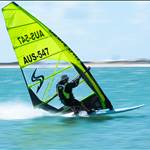
Reaching 30 knots on a windsurfer is not that hard with the right equipment.
Today i was going past the wingers like they were sailing in reverse gear. Made me think its not really for me.
I feel the majority of them are only averaging 17 to 18 knots with the fast wingers maybe doing 21 to 22 knots at a push.
Using much smaller foils and harness lines should help increase the top speed a few knots no doubt at a compromise of low end.
Winging simply will never be a fast form of sailing for the majority, a bit like foiling a windsurfer.
Doing 20 knots winging probably feels a lot more on the edge than on a windsurfer.
Hoping in a few years there will be a few keeping up with windsurfers but i doubt it.
Select to expand quotePcdefender said..
i have been doing lots of research on winging but not yet tried short of for a few minutes without success.
Speed is their downfall no question.
Reaching 30 knots on a windsurfer is not that hard with the right equipment.
Today i was going past the wingers like they were sailing in reverse gear. Made me think its not really for me.
I feel the majority of them are only averaging 17 to 18 knots with the fast wingers maybe doing 21 to 22 knots at a push.
Using much smaller foils and harness lines should help increase the top speed a few knots no doubt at a compromise of low end.
Winging simply will never be a fast form of sailing for the majority, a bit like foiling a windsurfer.
Doing 20 knots winging probably feels a lot more on the edge than on a windsurfer.
Hoping in a few years there will be a few keeping up with windsurfers but i doubt it.
So a primary goal on a windsurfer is to go fast (?). Guess that makes sense. Here on the east coast of the US we have a well known windsurfing spot called the Canadian Hole on the Outer Banks (NC). The typical windsurfer here screams in one direction for about 2km, makes a jibe (usually finishing off plane), then screams the other direction for 2 km. This is repeated for hours on end. Many of them have been doing this for 30+ years. They have never kiteboarded, kitefoiled or wingfoiled, but they seem content . It's all good!
Select to expand quotePcdefender said..
i have been doing lots of research on winging but not yet tried short of for a few minutes without success.
Speed is their downfall no question.
Reaching 30 knots on a windsurfer is not that hard with the right equipment.
Today i was going past the wingers like they were sailing in reverse gear. Made me think its not really for me.
I feel the majority of them are only averaging 17 to 18 knots with the fast wingers maybe doing 21 to 22 knots at a push.
Using much smaller foils and harness lines should help increase the top speed a few knots no doubt at a compromise of low end.
Winging simply will never be a fast form of sailing for the majority, a bit like foiling a windsurfer.
Doing 20 knots winging probably feels a lot more on the edge than on a windsurfer.
Hoping in a few years there will be a few keeping up with windsurfers but i doubt it.
You are right about the speed thing 18knots is flat out. But the more I foil the more I realise wing foiling is not about speed, its about carving turns, surfing waves, gybes, smooth gliding, pumping the foil between wind gusts. Or just playing doing things like seeing how slow I can sail on foil, tight zig zags breaching each wing tip, triple gybing, ..
Dont think I go straight for more than 30seconds without finding a wave or chop to surf or to gybe.
I also wing foil where I could never windsurf in areas that are small or gusty winds.
I think course racing wing foils will be great much better than windsurfers as they tack and gybe much faster allowing for better racing more like laser racing. Pumping foil and wings will add a new dimension. Once wing foilers get bored sailing they will start racing but that could take years..?