Select to expand quoteBWalnut said..Jeroensurf said..
No its not.I,m 95kg on a very good day/when we runned out of cookies and chocolate, now with 5mm hooded suit etc 100/103kg and really like my KT Wingdrifter 5.4x22x56l in solid 20knots and gusts above with AFS 850 and 1050 foils. I tried smaaler and that made it for me harder to start...imo mainly due the lack of length but that comes with lower volume (the 5.4 is allready pretty thin).That said, when its short period chaos, onshorish I rather grab my 6.5x22x92l SuperK just because its soo much easier to slog on, push through acouple of waves and then get on the foil instead of sinking the seccond I lose sped on the 56l.btw, I ride always strapless
Running out of cookies and chocolate is the worst!
What wing would you use with the 56l and 850 when it's solid 20 knots? I have't explored sinkers of that ratio too much but ride those foils so I'd love to hear what wing you need!
:)Its even worse when you think you got some left hidden but the Missus found my secret stash  .
.
Regarding to wings, its very much depending on the conditions: Our wind is most of the time depression driven and onshore to sideshore. True side off days with waves are rare here but our wind is rather constant/less variables compared to most places I have been. We have wind generated wind and when that is sideshore and the tide (slow) isnt against the wind you can easily drift away 7-8km p/h. So we need some power to get on foil. Even when wind against tide we still drift away 5km p/h.The wind meters are at the sea aprox 1km from the coast, so when I say 20knots its less, probably 16 at the beach, but I can, t check that.
I just go with what is measured 1km out.
Anyway these conditions making us needing more power as at places where the tide isnt a factor or an current runs against the wind like the Gorge or Brandon Bay-Ireland where we spend a lot of holidays.
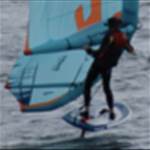
Not me, but some local wingfoil and windsurf action so you get an idea of the conditions.
Select to expand quoteBoardMaverick said..
Responding to the initial question:
In my experience, a "sinker" board of 0.8 (L-volume to kg-weight) is much easier to start than 0.54. Being closer to the surface results in a more corky experience, however accelerating requires much less effort; less awkward balancing and less pumping. Minimizing struggle = longer sessions.
I started with a 0.54 sinker 2 years ago, and due to the lighter-winds in my area, I could only realistically ride this sinker 2-3 times a year. Now, with my 0.8 board, I ride it about 50% of the time. The difference is that I am closer to the surface and better able to gain the momentum that is necessary to launch. To be clear, I only use my 0.8 board when I have decent wind and power in my wing. I need about 15 kts for this board to be feasible and am able to launch in about 20 seconds. If wind is marginal, I ride a big-ol' SUP board.
After trying several methods for launching, the rodeo method has worked best for me. I'm posting this video to show you what works for me in the hope that it will help a few of you folks out there. Of course, we are all different people, have different skills, body types, and flexibilities. So, I am not suggesting that other methods won't work better for other people. Watch the video to see how I launch after a fall. I have included pointers on the technique I use in the description of the vide. Let me know what you think.
Board dimensions: 4'8 x 20 1/2 x 4" x 58L
Enjoy the learning journey!
- Stuart
Sorry don't understand what u mean by saying 0.8 Board? 80% of kg in liter?
That's more an Semisinker!? More floating than sinking.
Select to expand quoteDriks said..BoardMaverick said..
Responding to the initial question:
In my experience, a "sinker" board of 0.8 (L-volume to kg-weight) is much easier to start than 0.54. Being closer to the surface results in a more corky experience, however accelerating requires much less effort; less awkward balancing and less pumping. Minimizing struggle = longer sessions.
I started with a 0.54 sinker 2 years ago, and due to the lighter-winds in my area, I could only realistically ride this sinker 2-3 times a year. Now, with my 0.8 board, I ride it about 50% of the time. The difference is that I am closer to the surface and better able to gain the momentum that is necessary to launch. To be clear, I only use my 0.8 board when I have decent wind and power in my wing. I need about 15 kts for this board to be feasible and am able to launch in about 20 seconds. If wind is marginal, I ride a big-ol' SUP board.
After trying several methods for launching, the rodeo method has worked best for me. I'm posting this video to show you what works for me in the hope that it will help a few of you folks out there. Of course, we are all different people, have different skills, body types, and flexibilities. So, I am not suggesting that other methods won't work better for other people. Watch the video to see how I launch after a fall. I have included pointers on the technique I use in the description of the vide. Let me know what you think.
Board dimensions: 4'8 x 20 1/2 x 4" x 58L
Enjoy the learning journey!
- Stuart
Sorry don't understand what u mean by saying 0.8 Board? 80% of kg in liter?
That's more an Semisinker!? More floating than sinking.
Yup: 58 liters divided by ~73 kg is about 0.8. This ratio has been quoted in several threads and I assumed that it was a sort of standard metric. However, honestly, I don't know what threshold qualifies as a true "sinker". I mean, no board is actually going to sink. Intuitively, I thought anything below 1.0 was categorized as a sinker, but I see your "semi-sinker" point.
The main point that I wanted to make was that you maybe don't want to get a 0.6 board just because that's the advice of certain experts. If you practice a bit, corkiness can be managed and you might end up saving yourself a lot of energy and having longer sessions.
Best,
-S.
In case people don't know where that ratio comes from, it's called the Guild Factor:
lostsurfboards.net/whats-your-guild-factor-surfboard-volumes-explained/#:~:text=GF%20measures%20the%20ratio%20between,in%20mind%20skill%20and%20fitness).
It's the same thing I use for the BARG Factor equation:
www.wouzel.com/post/calculating-your-barg-factor
Using that ratio gives you a bit better of a relationship than simply saying -30 or whatever liter drop you are considering. -30 for a 100kg rider (.7gf) is different than -30 for a 60kg rider (.5gf).
Jo!
Another question... If u are also looking for an board for freestyle/jumping the board should not be to small because of stable landings and faster recovery!? So maybe it's better to choose an 65l board instead of 55l!? How is ur perspective on this?
Select to expand quote
Sorry don't understand what u mean by saying 0.8 Board? 80% of kg in liter?
That's more an Semisinker!? More floating than sinking.
Yup: 58 liters divided by ~73 kg is about 0.8. This ratio has been quoted in several threads and I assumed that it was a sort of standard metric. However, honestly, I don't know what threshold qualifies as a true "sinker". I mean, no board is actually going to sink. Intuitively, I thought anything below 1.0 was categorized as a sinker, but I see your "semi-sinker" point.
The main point that I wanted to make was that you maybe don't want to get a 0.6 board just because that's the advice of certain experts. If you practice a bit, corkiness can be managed and you might end up saving yourself a lot of energy and having longer sessions.
Best,
-S.
Totally! In the short compact models, we tested the same model, for .60, .80, 1.25 my weigth and a big difference from the .6 to .8
From .8 to over 1 almost no difference in take off unless there is not enough wind to pop on foil ans you need to pump for 10 sec and use all the speed you can create.but almost the same take off.
however a dw 1.25 vs a compact is no match. I did not test the same concept in ML world.
Select to expand quoteBWalnut said..
In case people don't know where that ratio comes from, it's called the Guild Factor:
lostsurfboards.net/whats-your-guild-factor-surfboard-volumes-explained/#:~:text=GF%20measures%20the%20ratio%20between,in%20mind%20skill%20and%20fitness).
It's the same thing I use for the BARG Factor equation:
www.wouzel.com/post/calculating-your-barg-factor
Using that ratio gives you a bit better of a relationship than simply saying -30 or whatever liter drop you are considering. -30 for a 100kg rider (.7gf) is different than -30 for a 60kg rider (.5gf).
Please don't propagate marketing bulls**t...  .. Guild factor is pretty annoying to those of us who have been using volume fraction as a rule of thumb for a decade or two before those guys came along and claimed to invent it. Yet another case of surf industry guys taking old ideas from windsurfing and claiming they "innovated"
Select to expand quoteBoardMaverick said..Driks said..BoardMaverick said..
Responding to the initial question:
In my experience, a "sinker" board of 0.8 (L-volume to kg-weight) is much easier to start than 0.54. Being closer to the surface results in a more corky experience, however accelerating requires much less effort; less awkward balancing and less pumping. Minimizing struggle = longer sessions.
I started with a 0.54 sinker 2 years ago, and due to the lighter-winds in my area, I could only realistically ride this sinker 2-3 times a year. Now, with my 0.8 board, I ride it about 50% of the time. The difference is that I am closer to the surface and better able to gain the momentum that is necessary to launch. To be clear, I only use my 0.8 board when I have decent wind and power in my wing. I need about 15 kts for this board to be feasible and am able to launch in about 20 seconds. If wind is marginal, I ride a big-ol' SUP board.
After trying several methods for launching, the rodeo method has worked best for me. I'm posting this video to show you what works for me in the hope that it will help a few of you folks out there. Of course, we are all different people, have different skills, body types, and flexibilities. So, I am not suggesting that other methods won't work better for other people. Watch the video to see how I launch after a fall. I have included pointers on the technique I use in the description of the vide. Let me know what you think.
Board dimensions: 4'8 x 20 1/2 x 4" x 58L
Enjoy the learning journey!
- Stuart
Sorry don't understand what u mean by saying 0.8 Board? 80% of kg in liter?
That's more an Semisinker!? More floating than sinking.
Yup: 58 liters divided by ~73 kg is about 0.8. This ratio has been quoted in several threads and I assumed that it was a sort of standard metric. However, honestly, I don't know what threshold qualifies as a true "sinker". I mean, no board is actually going to sink. Intuitively, I thought anything below 1.0 was categorized as a sinker, but I see your "semi-sinker" point.
The main point that I wanted to make was that you maybe don't want to get a 0.6 board just because that's the advice of certain experts. If you practice a bit, corkiness can be managed and you might end up saving yourself a lot of energy and having longer sessions.
Best,
-S.
I have two ML boards, one is .85 volume fraction and the other .68 volume fraction (80L and 65L). Both take off easily once to the surface, but the .85 board will stay on the surface when the wind is well below the take off threshold. I consider .8 - 1.0 to be semi-sinker and below .8 or so to be a full sinker.
If you have short sharp gusts, a semi-sinker is much better but a sinker might be fine if you are in steady wind or rolling long period gusts. Where I ride I'm downwind of a big cliff a lot of the time so it's an advantage to be able to pop up on foil in a 5 second gust.
Shape has a roll to play as well, more surface area and a planing bottom shape will rise to the surface better than a really skinny displacement hull.
Select to expand quoteJonahL said..BWalnut said..
In case people don't know where that ratio comes from, it's called the Guild Factor:
lostsurfboards.net/whats-your-guild-factor-surfboard-volumes-explained/#:~:text=GF%20measures%20the%20ratio%20between,in%20mind%20skill%20and%20fitness).
It's the same thing I use for the BARG Factor equation:
www.wouzel.com/post/calculating-your-barg-factor
Using that ratio gives you a bit better of a relationship than simply saying -30 or whatever liter drop you are considering. -30 for a 100kg rider (.7gf) is different than -30 for a 60kg rider (.5gf).
Please don't propagate marketing bulls**t... .. Guild factor is pretty annoying to those of us who have been using volume fraction as a rule of thumb for a decade or two before those guys came along and claimed to invent it. Yet another case of surf industry guys taking old ideas from windsurfing and claiming they "innovated"
lol, well it's just what it's called across the industry. I don't see how it's marketing bs, it's just the name of the ratio that's been adopted and it's known and understood by shapers pretty much everywhere. I don't have any interest in any beef between any windsurfers and surfers. I'm just out there to have fun and simply use that ratio for every single board I have in every single activity. Cheers.
Select to expand quoteJonahL said..
I have two ML boards, one is .85 volume fraction and the other .68 volume fraction (80L and 65L). Both take off easily once to the surface, but the .85 board will stay on the surface when the wind is well below the take off threshold. I consider .8 - 1.0 to be semi-sinker and below .8 or so to be a full sinker.
If you have short sharp gusts, a semi-sinker is much better but a sinker might be fine if you are in steady wind or rolling long period gusts. Where I ride I'm downwind of a big cliff a lot of the time so it's an advantage to be able to pop up on foil in a 5 second gust.
Shape has a roll to play as well, more surface area and a planing bottom shape will rise to the surface better than a really skinny displacement hull.
I have a bundle of ML boards as well. 1 is easiest for me to slog. .9 feels like a significant decrease in slogging but still close to the same takeoff. .75 I only take out in solid winds, never under 20 knots as it really does struggle with the short period gusts.
I never thought of sinkers for anything but freestyle/ jumping and therefore only considered short boards with flat planing surfaces. However, I am not surprised to learn that displacement-type sinker boards <= 0.8 can be more difficult to launch, as Jonah and BWalnut both suggest.
This is good to know. This confirms my gut feeling and corroborates what I see as common practice - that a volume-weight ratio closer to 1.0 is small enough for an ML board. But now I'm off topic.
-S.
Select to expand quoteDriks said..
Jo!
Another question... If u are also looking for a board for freestyle/jumping the board should not be to small because of stable landings and faster recovery!? So maybe it's better to choose an 65l board instead of 55l!? How is ur perspective on this?
There's some truth to this, in my (beginner freestyle/jumping) experience.
But, on the other hand, the smaller the board the easier it becomes to jump/rotate/flip, or so it seems when I watch the pros. -S.
I have an Omen Flux 84L and 60L. I'm 100kg with gear. So 0.84 and 0.6 respectively. The 84 is a great board. It gets up on foil very quickly (like a few seconds) and feels better to ride than a larger volume board. Larger volume boards are thicker, wider, and perhaps longer. I have a hard time controlling bigger boards now. When the wind dies, I can slog around on my legs or my knees for if it's really light. Or I just straddle the thinner board like a surfer and wait a couple minutes for a gust. Once up, the board is easier to pump with my feet or my wing, so I can usually get home without coming back down. The 60 is great too but it requires more wind and more physicality. It also rides better than anything and I'm less likely to wipe out on it because of the increased control and ability to pump through the lulls.
After very very long research i went for the Armstrong ML55. Only because i found it second hand, hopefully i will make it work. that thing is narrow
Select to expand quoteBWalnut said..
Filmed it instead of trying to explain it. I get asked for this often so I needed to do it anyways. Works with all wings, foils, boards, in all sea conditions and wind speeds.
www.instagram.com/reel/DEanJd9yzdP/?utm_source=ig_web_copy_link&igsh=MzRlODBiNWFlZA==
Great video. Gonna try this tomorrow in 5 degrees air temp.
But 'Guild' wtf is that. Something from Dune? The board is -X L under your weight or +X L above. Clear. Concise. Obvious.
Hey, i have spent some time on my new sinker board and was thinking about sharing my experience. In the end I decided to go for Armstrong Midlenght 55L [iam 80kg] and must say that going from 24' board to 18' is a big jump. First couple of sessions were very frustrating. Constant falling and could not even get up on foil. Slowly I was trying different techniques and slowly was getting used to it. I must say that the second the board starts moving it suddenly locks in and becomes fairly stable. I need similar power to get up as my 5'2 85L board i was using before. Once you are up this board is just amazing. You dont feel the extra length at all. Its hard to describe what different but it just feels amazing. I dont think i would need to go any bigger and this is really do it all board. Great for wing, foildrive and prone.
For freestyle those low volume boards are no more then a pain in the *** . I go -10L under my weight and thats it. I tried 62L but it only makes life more difficult. For freestyle you want something thats floats, thats not too long and pretty wide. If you are trying to stick a new move and need to start that low volume board every time you crash, you get tired very quickly. Yes a small board has less swing weight and feels lighter. But imo its not worth the struggle. Sold my 62L and with 85 kilo (ex wetsuit) im back on the 78L as a one board solution.
If you have the wind, once you develop the get up, the sinker board is so much easier to get going in choppy wind. No bobbing around on the surface. very controllable using the wing for balance. You must have wind though or go a size up in your wing selection. I'm 80 kgs and use from 36 - 45l for wave boards. 73l for light wind board. Much rather the small boards in choppy conditions. But remember. No wind No Bueno.
Select to expand quoteJeroensurf said..Driks said..NordRoi said..
Sinker needs to be 50% of your weight in volume or even less volume. A full sinker with feet in the straps and board under water is less affected by super big chop but still something to learn and you need to be at least in mid range of your wing and +. It's more physical if wind is gusty.
a semi-sinker is coarky and if also short, it's less stable than a longer semi-sinker. The diff?rence is you need to keep the board stable on 2 axes instead of just one for a longer board.
That means 55l is to much for me with 95kg? Are there any recommendations for length? What is to short?
No its not.I,m 95kg on a very good day/when we runned out of cookies and chocolate, now with 5mm hooded suit etc 100/103kg and really like my KT Wingdrifter 5.4x22x56l in solid 20knots and gusts above with AFS 850 and 1050 foils. I tried smaaler and that made it for me harder to start...imo mainly due the lack of length but that comes with lower volume (the 5.4 is allready pretty thin).That said, when its short period chaos, onshorish I rather grab my 6.5x22x92l SuperK just because its soo much easier to slog on, push through acouple of waves and then get on the foil instead of sinking the seccond I lose sped on the 56l.btw, I ride always strapless
Thinking take a super K as first and only board, untill now was on borrowed stuff. (Takoon K?ster pro 85ltr) Perfect in the air, hated it for having to less volume in the nose, always wanted to go through chop instead of planing.
Tried a lot different boards, but not the super K. But tried the skybrid in 70ltr being 81kg (Boardshorts), was suprised how easy that was.
But being back in NL, gonna be wetsuit heavier. Should I take the 70ltr or should I go bit bigger? What's your input on that?
Select to expand quote1adsy said..
If you have the wind, once you develop the get up, the sinker board is so much easier to get going in choppy wind. No bobbing around on the surface. very controllable using the wing for balance. You must have wind though or go a size up in your wing selection. I'm 80 kgs and use from 36 - 45l for wave boards. 73l for light wind board. Much rather the small boards in choppy conditions. But remember. No wind No Bueno.
Hmmm I think about a fullsinker that is also usable for prone. I can start sky style with 75l in moderate conditions with 95kg. Now I thought about a 55l style instead get a crush. So winging in stronger winds and Surffoil without straps. What are you thinking?
Select to expand quotewsurfn said..
Jake, what % of the time do you ride your 0.6 board, and in what conditions?
About 10% of the time in 20 plus. If I were on a flat lake, I would use it 50% of the time because it's easy to get up if I have wind. But I'm often out on Lake Michigan which is choppy and rolly and gusty. In any case, 10% of the time is worth it because it's so much better. Plus I use it for my Foil Drive board so if I include Foil Drive, I use the board every week.
Select to expand quotePolderWing said..Jeroensurf said..Driks said..NordRoi said..
Sinker needs to be 50% of your weight in volume or even less volume. A full sinker with feet in the straps and board under water is less affected by super big chop but still something to learn and you need to be at least in mid range of your wing and +. It's more physical if wind is gusty.
a semi-sinker is coarky and if also short, it's less stable than a longer semi-sinker. The diff?rence is you need to keep the board stable on 2 axes instead of just one for a longer board.
That means 55l is to much for me with 95kg? Are there any recommendations for length? What is to short?
No its not.I,m 95kg on a very good day/when we runned out of cookies and chocolate, now with 5mm hooded suit etc 100/103kg and really like my KT Wingdrifter 5.4x22x56l in solid 20knots and gusts above with AFS 850 and 1050 foils. I tried smaaler and that made it for me harder to start...imo mainly due the lack of length but that comes with lower volume (the 5.4 is allready pretty thin).That said, when its short period chaos, onshorish I rather grab my 6.5x22x92l SuperK just because its soo much easier to slog on, push through acouple of waves and then get on the foil instead of sinking the seccond I lose sped on the 56l.btw, I ride always strapless
Thinking take a super K as first and only board, untill now was on borrowed stuff. (Takoon K?ster pro 85ltr) Perfect in the air, hated it for having to less volume in the nose, always wanted to go through chop instead of planing.
Tried a lot different boards, but not the super K. But tried the skybrid in 70ltr being 81kg (Boardshorts), was suprised how easy that was.
But being back in NL, gonna be wetsuit heavier. Should I take the 70ltr or should I go bit bigger? What's your input on that?
FWIW I'm about 87kg and the 70" Skybrid is my everyday board. I was very interested in the 70 KT Super K. It's much more technical to setup to get going than the Skybrid. Much less nose volume and tippier overall in water. I'm experienced enough where it wasn't that big a deal but my wife strongly preferred the Skybrid. She's a decent part time foiler. can jibe, switch feet, ride swell flagged. but she doesn't want things to be a struggle.
Select to expand quoteBWalnut said..
Filmed it instead of trying to explain it. I get asked for this often so I needed to do it anyways. Works with all wings, foils, boards, in all sea conditions and wind speeds.
www.instagram.com/reel/DEanJd9yzdP/?utm_source=ig_web_copy_link&igsh=MzRlODBiNWFlZA==
Nice video explanation, will have to give it a try ??
Select to expand quoteDriks said..1adsy said..
If you have the wind, once you develop the get up, the sinker board is so much easier to get going in choppy wind. No bobbing around on the surface. very controllable using the wing for balance. You must have wind though or go a size up in your wing selection. I'm 80 kgs and use from 36 - 45l for wave boards. 73l for light wind board. Much rather the small boards in choppy conditions. But remember. No wind No Bueno.
Hmmm I think about a fullsinker that is also usable for prone. I can start sky style with 75l in moderate conditions with 95kg. Now I thought about a 55l style instead get a crush. So winging in stronger winds and Surffoil without straps. What are you thinking?
Exactly. Just me, but I found with straps, it restricted my movements on the deck to keep things moving on the waves and in between gusts, so no straps for me. My 40 l 5'0 I can use for pretty well everything except under 12knots. Needs a 6.1 to get going though in 12 and there has to be couple of power gusts.
Its also my goto foil drive board and if I could paddle, it would be my prone board as well.
the 73 has its place when its light ****ty winds that needs a bit of float.
Select to expand quote1adsy said..Driks said..1adsy said..
If you have the wind, once you develop the get up, the sinker board is so much easier to get going in choppy wind. No bobbing around on the surface. very controllable using the wing for balance. You must have wind though or go a size up in your wing selection. I'm 80 kgs and use from 36 - 45l for wave boards. 73l for light wind board. Much rather the small boards in choppy conditions. But remember. No wind No Bueno.
Hmmm I think about a fullsinker that is also usable for prone. I can start sky style with 75l in moderate conditions with 95kg. Now I thought about a 55l style instead get a crush. So winging in stronger winds and Surffoil without straps. What are you thinking?
Exactly. Just me, but I found with straps, it restricted my movements on the deck to keep things moving on the waves and in between gusts, so no straps for me. My 40 l 5'0 I can use for pretty well everything except under 12knots. Needs a 6.1 to get going though in 12 and there has to be couple of power gusts.
Its also my goto foil drive board and if I could paddle, it would be my prone board as well.
the 73 has its place when its light ****ty winds that needs a bit of float.
Thanx... U helped me alot. Greetings
Select to expand quotesunsetsailboards said..PolderWing said..Jeroensurf said..Driks said..NordRoi said..
Sinker needs to be 50% of your weight in volume or even less volume. A full sinker with feet in the straps and board under water is less affected by super big chop but still something to learn and you need to be at least in mid range of your wing and +. It's more physical if wind is gusty.
a semi-sinker is coarky and if also short, it's less stable than a longer semi-sinker. The diff?rence is you need to keep the board stable on 2 axes instead of just one for a longer board.
That means 55l is to much for me with 95kg? Are there any recommendations for length? What is to short?
No its not.I,m 95kg on a very good day/when we runned out of cookies and chocolate, now with 5mm hooded suit etc 100/103kg and really like my KT Wingdrifter 5.4x22x56l in solid 20knots and gusts above with AFS 850 and 1050 foils. I tried smaaler and that made it for me harder to start...imo mainly due the lack of length but that comes with lower volume (the 5.4 is allready pretty thin).That said, when its short period chaos, onshorish I rather grab my 6.5x22x92l SuperK just because its soo much easier to slog on, push through acouple of waves and then get on the foil instead of sinking the seccond I lose sped on the 56l.btw, I ride always strapless
Thinking take a super K as first and only board, untill now was on borrowed stuff. (Takoon K?ster pro 85ltr) Perfect in the air, hated it for having to less volume in the nose, always wanted to go through chop instead of planing.
Tried a lot different boards, but not the super K. But tried the skybrid in 70ltr being 81kg (Boardshorts), was suprised how easy that was.
But being back in NL, gonna be wetsuit heavier. Should I take the 70ltr or should I go bit bigger? What's your input on that?
FWIW I'm about 87kg and the 70" Skybrid is my everyday board. I was very interested in the 70 KT Super K. It's much more technical to setup to get going than the Skybrid. Much less nose volume and tippier overall in water. I'm experienced enough where it wasn't that big a deal but my wife strongly preferred the Skybrid. She's a decent part time foiler. can jibe, switch feet, ride swell flagged. but she doesn't want things to be a struggle.
Thanks for the input, trying to demo.the super K somewhere to reconsider it. Hated a 4'11 85ltr Takoon K?ster pro with to less nose volume, so something I might find annoying, but the super K should be easier with bit more length. But interesting to know it's not as easy as the Skybrid.
Does anyone have experience with smik tokr middy: www.kiterepublic.com.au/product/smik-stokr-middy-pvc-carbon/
I am tempted to get a sinker and looking at different options.