This sport is evolving at hyper speed -- it has a number of mature sports like windsurfing, kiting, surfing and to some extend foiling from which to "steal" or borrow. The changes in winging over the last year in both technique and equipment took windsurfing five times as long or more to happen and become part of that sport. It's almost information overload! Where will be be a year from now?
Yes, these new boards look great but then again there seems to be a lineup of new and interesting equipment being introduced every day to a growing market.
May be I'm missing something, but they look like the boards that's been out already.
Select to expand quoteGoofcat said..
May be I'm missing something, but they look like the boards that's been out already.
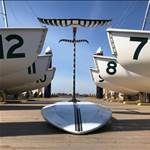
There are some of both, look at the squarer outline rather than pointy nose.
It could be this board, which has been around for awhile.
www.realwatersports.com/products/armstrong-wing-sup-foilboard?variant=31452750676055
Select to expand quotedejavu said..
It could be this board, which has been around for awhile.
www.realwatersports.com/products/armstrong-wing-sup-foilboard?variant=31452750676055
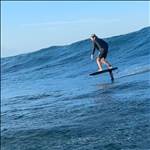
Different board, look how far forward the front strap is:

Cool design,probably the foil boxes are very far forward too.
I think centering like this allows to ride bigger volume/lenght boards minimizing the pitch inertia so they feel like a smaller one on foil.
Modern HA foils do not take that well to big angles of attack on takeoff so the ability to wheelie the board,the huge tail bevels etc... become a bit useless imho.
It kind of looks like the tail is beveled on top and flattish release on the bottom,maybe it is just the pic.
I'd say the box position is designed around the Armstrong foil characteristics. These foils don't push up hard against you like some others and a lot of boards mast track positions out there are way too far back for these foils. Also maybe that rider is a gun, we seem to creep more forward as we get better.
Notice the Y front straps, the current boards do not offer this. The squared nose ones are definitely new designs. The pointy nose looks like a smaller updated version of what currently is offered. Looks to be under 5'
I think the reverse tail bevel is there,never seen that on a foil shape.
Also big channelling on the first third of the board.
His feet seem to be straddling the middle of the board.
But it is true that Armstrong foils do not require front foot pressure like most others.And that the rider probably rips :)
I'm keen on this design for my next board. My tracks in my current board are woefully too far back, especially in relation to the footstrap inserts. I've got my mast slammed full forward with bolts reversed and still get back leg burn more than I'd like.
I'm keen on this design for my next board. My tracks in my current board are woefully too far back, especially in relation to the footstrap inserts. I've got my mast slammed full forward with bolts reversed and still get back leg burn more than I'd like.
That's interesting, played with this for a couple of sessions last week.
My GF usually sits right back in very rearward boxes on a similar board to the one pictured, and I have drilled extra holes in the plate to move it even further. I generally use all the rearward movement I can get and use a single washer to shim it up.
This time I moved it fully forward and shimmed down with 2 washers. It's a very big adjustment forward. I found it made a very major difference in swing weight, to the point it felt nervous...like when I get back on the prone after a long break. I got used to it and it was a big plus in the end. Your back foot is always in a position of authority so there is much more pivot in the turn.
Downside was that the mast was between my feet when slogging between gusts and the board would tend to swing into wind. Nothing a fin or some time on the setup wouldn't fix.
Looks great. Most boards have the tracks too far back for most foils. Look where he's standing, evenly centred over the middle of the board, where you want to be.
Maybe because many or most surf and sup foilers are originally surfers, sup surfers etc, they find the optics of this a little awkward, and have tended to design for what looks right rather than what works best.
Also first generation foils like the original gofoils had a lot more front foot pressure than the latest generation, and board designers have maybe been a bit slow to adjust to this too.
We Can see the new board here www.instagram.com/p/CMd1LxCD7bV/?utm_source=ig_web_copy_link
Anyone has infos ?
Launch has moved to July 7th I believe. I got to test the 60L yesterday. Extremely fast onto foil. Only tested in flat water but I was impressed.enough to buy one.
Select to expand quoteMidAtlanticFoil said..
Launch has moved to July 7th I believe. I got to test the 60L yesterday. Extremely fast onto foil. Only tested in flat water but I was impressed.enough to buy one.
Can you at least tell us the dimensions?
Select to expand quoteemmafoils said..MidAtlanticFoil said..
Launch has moved to July 7th I believe. I got to test the 60L yesterday. Extremely fast onto foil. Only tested in flat water but I was impressed.enough to buy one.
Can you at least tell us the dimensions?
60L is 4'11" x 23.5"x 4.25"
Forward Geometry extra long foil boxes have me setting the foil forward compared to my 5'1" previous board, so the amount of nose is vastly reduced. Feels smaller than a 4'11".
Riding my 1125 in 14-18mph and 4M BRM, I was getting up in between gusts and it only took a 3-4 pumps of the wing and bam, flying.
I proned it this afternoon for the added paddle speed in some chest high south swell. Definitely needed to move the mast back from the winging position by 3-4cm with the HA1125.
Wing Surf. 4'0"(27l) 4'5"(34l) 4'10"(39l)
Wing Sup. 4'8"(50l) 4'11"(60l) 5'2.5"(75l) 5'5"(88l) 5'8"(99l) 5'11"(115l) 6'4"(132l)
7 new sizes for wing sup.
Select to expand quotebaldy123 said..
Wing Surf. 4'0"(27l) 4'5"(34l) 4'10"(39l)
Wing Sup. 4'8"(50l) 4'11"(60l) 5'2.5"(75l) 5'5"(88l) 5'8"(99l) 5'11"(115l) 6'4"(132l)
7 new sizes for wing sup.
Any online sources for more info? Would be interested in full dimensions, including weights
From Armstrong:
"The logic behind Forward Geometry is all about the mast track position in relation to the center of the board. The further forward the mast can go the better, it improves maneuverability, response and dramatically reduces the rotational swing weight effect."
This concept is undisputed when on foil. BUT - I have experimented with mast position on my board, and if I shift it too far in front of the volume of the board, starting gets really awkward. In a happy medium of foil positioning in relation to board volume, you go from kneeling to planting your front foot right where it should be standing, in a natural and dynamic movement. if the foil is too far forward you need to be starting closer to the volume of the board (rearward) and when you go to standing you need to shift forward more dramatically to stay on top of the foil and control the lift. With enough power you might even wheelie on your knees or while shifting to standing. Maybe Armstrong has some special sauce that I can't figure out, in which case I would be curious what the difference is.
Can anybody comment on how these boards (or others with a similar theory) balance the forward foil position with rearward volume?
Also kind of surprised at the volume / length specs on these.
The "Forward Geometry" Wing Surf and Wing Sup are available in the following sizes.
Wing Surf
4' x 18" x 2 1/2". 27L
4'5" x 20" x 2 3/4". 34L
4'10" x 21" x 3". 39L
___________________________________
Wing Sup
4'8" x 22 1/2" x 3 3/4". 50L
4'11" x 23 1/2" x 4 1/4". 60L
5'2" x 26" x 4 1/2". 75L
5'5" x 27" x 4 3/4". 88L
5'8" x 28" x 4 7/8". 99L
5'11" x 29 1/4" x 5". 115L
6'4" x 31 1/4" x 5 1/4". 132L
___________________________________
Select to expand quoteVelocicraptor said..
From Armstrong:
"The logic behind Forward Geometry is all about the mast track position in relation to the center of the board. The further forward the mast can go the better, it improves maneuverability, response and dramatically reduces the rotational swing weight effect."
This concept is undisputed when on foil. BUT - I have experimented with mast position on my board, and if I shift it too far in front of the volume of the board, starting gets really awkward. In a happy medium of foil positioning in relation to board volume, you go from kneeling to planting your front foot right where it should be standing, in a natural and dynamic movement. if the foil is too far forward you need to be starting closer to the volume of the board (rearward) and when you go to standing you need to shift forward more dramatically to stay on top of the foil and control the lift. With enough power you might even wheelie on your knees or while shifting to standing. Maybe Armstrong has some special sauce that I can't figure out, in which case I would be curious what the difference is.
Can anybody comment on how these boards (or others with a similar theory) balance the forward foil position with rearward volume?
Also kind of surprised at the volume / length specs on these.
From the images i have seen the Wing boards have a reverse tail bevel,they slope down from the top instead of the bottom.
This takes away volume from the tail just like a typical bottom tail bevel and should let you stand more forward in float mode.
Select to expand quotemcrt said..Velocicraptor said..
From Armstrong:
"The logic behind Forward Geometry is all about the mast track position in relation to the center of the board. The further forward the mast can go the better, it improves maneuverability, response and dramatically reduces the rotational swing weight effect."
This concept is undisputed when on foil. BUT - I have experimented with mast position on my board, and if I shift it too far in front of the volume of the board, starting gets really awkward. In a happy medium of foil positioning in relation to board volume, you go from kneeling to planting your front foot right where it should be standing, in a natural and dynamic movement. if the foil is too far forward you need to be starting closer to the volume of the board (rearward) and when you go to standing you need to shift forward more dramatically to stay on top of the foil and control the lift. With enough power you might even wheelie on your knees or while shifting to standing. Maybe Armstrong has some special sauce that I can't figure out, in which case I would be curious what the difference is.
Can anybody comment on how these boards (or others with a similar theory) balance the forward foil position with rearward volume?
Also kind of surprised at the volume / length specs on these.
From the images i have seen the Wing boards have a reverse tail bevel,they slope down from the top instead of the bottom.
This takes away volume from the tail just like a typical bottom tail bevel and should let you stand more forward in float mode.
So I gather the theory is more about running length distribution than volume distribution. Interesting...
I guess that also addresses my comment around volume/length specs (stretch out the length a bit, keep volume the same - but distribute to the center not rear, shift tracks forward)
The option to move the mast far forward helps with running smaller and more efficient foils. On my other board with standard track placement and smaller or HA wings, on take-off, the board would gain altitude then stall and repeat. All the while trying to find the balance point before stall to gain speed. Finding that balance is much easier on this board.
Here's a video of my test run on the 60L:
www.instagram.com/tv/CRB1CjkjGXU/?utm_medium=copy_link