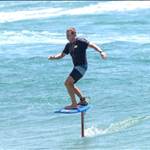
Hi, I'm brand new here and would love to tap into the community wisdom. I've been winging for a year and have lots to learn. The current nut I'm trying to crack is getting up in low wind. Wind near where I live is frequently in the 12-15 kts range and I just cannot consistently get on foil. 17-20 kts and I'm golden but if I'm going to enjoy this sport more, I need to improve my low end.
I'm 88kgs, using a 120L Wingcraft board, 1850 Armstrong HS foil, and 7M Duotone echo wing (overinflated 1 PSI).
I've watched all the pumping videos. I'm in reasonable shape (but could stand to lose a few kilos). I wait for gusts, pump like mad, and usually...nothing...just energy spent and very little momentum gained.
I figure I should probably get a larger foil (I own an infinity 84 but haven't yet tried it in light conditions) but I'm not certain about a larger wing (they just seem to get more difficult to handle). I've seen the posts about the 8M CWC and it's tempting but do I really need to buy something to fix this?
Maybe I need to focus on training and heading out on these light days until I get it. I just don't know.
Thanks much in advance
I'm 100kg wet and can get going in 11-12kn puffs. 7m Takoon V1 wing, 105L Sky Wing TE, Gong Fluid XLT (1500cm2 but super duper thin so needs speed to get up). 1yr in like you. Aside from patience and some fitness which it sounds like you are cultivating already, I think there are three things:
1)can you build speed across multiple waves (even teeny tiny bumps matter) and ideally across multiple wind puffs? This was primarily about the board for me, my huge 140l gong beginner board with tail kick was absolutely impossible to build speed over time with so takeoff wasn't possible in lighter winds unless the gusts were very powerful and long enough to get up and go in a single one. I don't know Wingcraft, but shape and total wetted surface are what you want to look at.
2) Can you pump through waves and gusts keeping the board flat and level? This is just practice. I still start building speed nicely only to have one bad moment see the board roll or pitch a little too much and the speed bleeds off and I I to start over again.
3) can you hold the right angle to the wind through the whole takeoff speed build process? The right angle varies a function of wind speed and sea state. Falling off too much in light wind can drop the apparent wind too low as speed builds to successfully get flying. Rounding up can rotate the force vectors in all the wrong directions to fly. Waves that aren't exactly from the wind direction can help or hinder depending on what tack you are on and finding the right balance of wave push vs apparent wind is an ongoing trial and error process for me on the day.
Agree a bigger wing may very likely be diminishing returns. As soon as gusts regularly hit 13 or 14kn I am on my 6m wing as I can pump it much more effectively than the 7 and cruise through lulls much better once up.
So, 1 part gear, 2 parts practice. Still very much a work in progress for me but the lower limit has come down a lot in just the last couple of months so hopefully you'll have a break through or two there soon as well.
As you have said yourself, head out on lightwind days and practice practice practice.
I am just in from a session on my HS1850 with 5m Duotone Slick on a 115 litre Patrik AIO. Confused sea state, swell and gusty winds with peaks of 13 - 15 knots. And I am 93kg.
Last year for a fact I could not have got going in the same conditions but had a good session today.
previous post is spot on advice on what to focus on.
Pumping on is hard work physically. Something that made a difference to me is not giving up after few seconds pumping, sometimes it takes a while to get the board speed up, then leg pumping is key to unstick the board.
Stick at it and it will click soon
Sorry for the length of this post, hope it helps.
CW, with that gear you should easily be able to get up in 12-15 with some small technique tweaks. A windsurfing background is really helpful for low end efficiency. The 1850 thankfully is a powerful foil that responds well to active pumping early rather than needing lots of forward speed to start to lift. The Echo, from memory, has a slightly different pumping technique than newer wings but still should offer plenty of low end. For reference I'm 90kgs and ride a 5m and 1850 in 12-15knots comfortably.
To get that gear combo going quickly, find the sweet spot and angle of where the Echo likes to sit to generate the most lift throughout the pump. You can practice this on the beach. The trick is to keep tension/power in the canopy throughout the pump, not allowing the wing to stall by oversheeting or forcing it too quickly or slowly through the power or recovery phase of the pump. Having your arm/hand spread a little narrower to give more amplitude/sensitivity in the pump may be helpful. You really want to feel where the centre of effort is in the wing and use it to your advantage through the pump. I find the initial 2 or three pumps with the wing tend to be comparitively slower, bigger ellipses with the leading edge initiating the movement followed by the trailing edge through the pump and as you build speed/apparent wind, you tighten up/speed up the pump making smaller ellipses. Lots of riders simply yank the wing frenetically back and forth with disjointed leg pressure hoping something will happen, but it's a feeling you get both from the wing and foil giving you info on centre of effort/lift.
As you pump the wing and deliver some thrust, your legs should be simultaneously driving the foil down and forward through the water. Imagine sitting on a rowing machine where you would be holding the handle straight out in front of you with extended arms and bent legs, but instead of extending the legs on the drive followed by the arms, you do both movements at the same time. The wing has a natural recoil/recovery that you need to time with your legs. This is key. You can kind of give a few quick pumps/thrusts of the wing/foil and then give the tail some quick pressure to release the board when you feel the foil engage. If the movements are uncoordinated your efficiency gets killed.
these are all great insights. I agree that the lightwind game doesn't come easy. Here's something you probably don't want to hear: Your 120L board is a giant wet sticky log that doesn't easily release. If you are going to be dealing with light wind often, then its time to invest in a proper lightwind wingboard like a Kalama E3 downwind board. Something skinny and longer will release waaaay earlier and carry more boardspeed to engage the foil. Senditbro
Select to expand quotechoosywinger said..
Hi, I'm brand new here and would love to tap into the community wisdom. I've been winging for a year and have lots to learn. The current nut I'm trying to crack is getting up in low wind. Wind near where I live is frequently in the 12-15 kts range and I just cannot consistently get on foil. 17-20 kts and I'm golden but if I'm going to enjoy this sport more, I need to improve my low end.
I'm 88kgs, using a 120L Wingcraft board, 1850 Armstrong HS foil, and 7M Duotone echo wing (overinflated 1 PSI).
I've watched all the pumping videos. I'm in reasonable shape (but could stand to lose a few kilos). I wait for gusts, pump like mad, and usually...nothing...just energy spent and very little momentum gained.
I figure I should probably get a larger foil (I own an infinity 84 but haven't yet tried it in light conditions) but I'm not certain about a larger wing (they just seem to get more difficult to handle). I've seen the posts about the 8M CWC and it's tempting but do I really need to buy something to fix this?
Maybe I need to focus on training and heading out on these light days until I get it. I just don't know.
Thanks much in advance
Hi
try to place central mast. See with this solutio.
It takes a while for all this to become muscle memory. Basically head upwind and get pressure in the wing, apparent wind, and speed. Don't lean back, and try and keep the board flat. Wait for the puff. Start heading downwind and do the apparent wind pump where you pump in a small clockwise motion while accelerating your wing forward after each pump to get air moving over the wing. Reach out and get that sail in front of you with each pump. When the board is flat and the wing tip is somewhat in line with the front of the board, stop going further downwind, start taking long, hard, fast pumps to get on foil. Bending the knees slightly while doing this helps engage the foil. Shoving the board forward with your feet while doing all this can help engage the foil. Once coming up on foil, move your back foot up a little (or put more weight on the front) to keep the foil from coming up too fast and stalling. Once up, turn upwind to get pressure back in the wing. You might need to do another wing or foot pump to get higher than the waves or chop. If you moved your back foot, you might need to push it back a little.
I've seen slingshot newbs put the stabilizer on upside down before and if thats the case it will never fly. So make sure that's right a mast position is optimal
I'm nowhere close to being good at light wind winging yet, but I am on the water quite often, and noticed a couple of things that might help. I have seen two different types of pumping from the wingers that get going early. The first one is a super-energetic, whole body pump that sometimes goes on long enough that I get exhausted just watching it. The second one is much more subtle, with typically just a few pumps that don't look anywhere nearly as energetic. Interestingly, the foiler using second type is at least as efficient in light winds (after adjusting wing sizes for body weight). Basically, this illustrates that technique is at least as important as effort.
At your stage, I'd take a break from the "pumping like mad", and instead experiment a little with the techniques to develop a feeling of what works. Others have mentioned important key points above, like controlling roll and pitch. Your goal is to drop your wind requirement by 5 knots. That's entirely possible, but it will come in smaller steps. Trying to get going in 12 knots is right now is just a recipe for frustration. But in 15-16 knots, you can develop the technique, and then push the boundary further down. Go back to "pumping like mad" only after you've made significant progress, and developed the muscle memory about exactly how to pump.Select to expand quotebroVan said..
Your 120L board is a giant wet sticky log that doesn't easily release. If you are going to be dealing with light wind often, then its time to invest in a proper lightwind wingboard
+1. Skinny and longer may help, but less volume and sharp rails in the back (perhaps with no tail kick or cutouts instead of the tail kick) may also do the trick. Both of the efficient wingers I mentioned above are on smaller boards (body weight in kg = volume or less), and I hear a lot of complaints whenever one of them tries a bigger board ("that board is so sticky and hard to get going").
Select to expand quoteJakeDawg69 said..
It takes a while for all this to become muscle memory. Basically head upwind and get pressure in the wing, apparent wind, and speed. Don't lean back, and try and keep the board flat. Wait for the puff. Start heading downwind and do the apparent wind pump where you pump in a small clockwise motion while accelerating your wing forward after each pump to get air moving over the wing. Reach out and get that sail in front of you with each pump. When the board is flat and the wing tip is somewhat in line with the front of the board, stop going further downwind, start taking long, hard, fast pumps to get on foil. Bending the knees slightly while doing this helps engage the foil. Shoving the board forward with your feet while doing all this can help engage the foil. Once coming up on foil, move your back foot up a little (or put more weight on the front) to keep the foil from coming up too fast and stalling. Once up, turn upwind to get pressure back in the wing. You might need to do another wing or foot pump to get higher than the waves or chop. If you moved your back foot, you might need to push it back a little.
Good advice. First, you will learn by trial and error how much wind you need (how strong of a gust and what it looks like on the water) to get on foil. Don't waste your time and exhaust yourself with useless little gusts and inefficient pumping-- develop an efficient pump and employ it for the gusts that count.
I would add to the advice above that you should try and get the front strut of the wing out and up in front of you to grab the wind and then pull down and back in a clockwise rotation to help gain speed (works especially well with MA and HA foils), As noted above, when you pull back with the wing push forward with your front foot to help slide (and pump) the board forward with each pump of the wing to gain speed -- increase the cadence of your pumping as you gain speed. When you pull back and down be careful about how close to the the water the tip of your strut comes to it (size of wing matters so pay more attention to this if you use a really big light wind wing) -- you obviously want to avoid hitting the water with it. I find that I start with longer pumps that become shorter and faster as I come up to speed and hit the ready to lift stage. There's a certain speed you will attain that you will retain in your memory as the speed (or feel) at which you can shift your weight slightly back and lift. As you come up in really light winds you may need to pump the wing a few more times to level the board out and set your cruising speed as you head closer to the wind -- especially true if you're at the end of the gust. The more you do it the better you'll get and at some point it will come naturally without thinking about it.
With a 5' 4" 95 litre board, Kijura 1440 foil and the F-One 8 metre CWC I'm up and going in very little wind using the above technique -- ripples on the water, maybe 6 to 8 knot gusts with huge holes that I have to pump both board and wing through). If the wind is less than that then I've got an e-foil for those conditions. 
The board is the most important, long narrow flat bottom and tail. With a CWC 8m you should be able to get going at 7-8 knots with your weight, 6 knots is expert level. With a 5m wing its more around 10 knots. The foil does not have to be more than 1500sq cm with the right technique. Practice yes but with the right gear!
Are you doing full body pumps or weak arm pumps? Most people do the latter. Are you pumping the board as well? Big powerful pumps or weak calf lifts?
It's a coordination thing at first to go full body. I find if there is enough wind to fill my wing between pumps I can get going.
Wait for a puff to come down. Do slow weak wing pumps until you feel the puff hit and a little pressure, then go hog wild full body wing and board. Keep your angle proper and adjust it while you are pumping. Catch a wing tip and recover and keep going.
If you are 75% up to speed and just can't seem to get the rest don't stop, keep pumping, adjust the angle. Sometimes the foil need to fly straight a bit and you keep pumping the wing three more times for high aspect foils once you are airborn. The highest aspect foil will still want to be aggressively pumped to get going, just slightly differently than others. I ride 500-800cm 10+AR wings. It may also be the initial board suction you need to get over by pumping the board. This is an issue with straight tailed boards who love to plane but the initial bit needs some love to get going. Conversely tail kick boards will start faster but struggle at the last 50% of the process. I'm talking at the bottom end of the wind speed for your gear of course.
Pump until your lungs hurt and you can barely stand. On the other hand, if you misjudged the puff and you pump out of it, stop immediately.
You will burn 200% more calories on a light wind day! Then master the pumping gybes and you will never stop flying in sub-liftoff winds once you get going.
Best advice I can give is while slogging along waiting for a gust do the cyclic wing pump in a slow low energy way. This will allow you the opportunity to learn the technique with feel for the wind. At low wind speed the cadence of the wing pump must be slow to maintain wind in the wing but as the wind speed increases the cadence can naturally increase without loosing rhythm and momentum. This slow wing pump also helps by adding slightly higher board speed with stability in preparation for the gust. Soon you can add the timely unweighting of the legs coordinated with the wing pump and magic happens.
I am the same. No go in under 15 knots! But still learning & not enough winging time.
In my experience I have found I can get up on foil easier when I first get on the water. But then it got harder & harder. I found I was trying to head upwind more & not keeping my board flat & turning downwind for more speed to lift.
I definitely know my pump technique isn't right and the advice the guys have given is awesome. So I know I will keep it in mind for my next session.
Pointing the leading edge up more & pulling hard down & towards me with the tail of the wing makes more sense. Just need to get the timing right.
Sticky boards? Yes. More wetted surface WIDTH area equals more drag.
I found this out comparing my SUPs in the surf. 29 inch wide was faster than the 32 inch wide.
One thing I have done to speed up a board was to polish the planing surface with car wax. I first did this years ago when I first started surfing after a mate told me about it. My first wave I was out of control! It was so fast & slippery that I flew off backwards! I have done the same to some of my SUPs & felt the difference. But I found that the wax does wash off after about half an hour.
Also I have read that CAR WAX MAY NOT BE APPROPRIATE FOR A BOARD AS IT COULD DAMAGE IT. But I haven't found this the case with my polyester resin & epoxy boards yet. But polishes can have different compounds. And I would never use any cutting compound polishes on a good board either.
There are polishes that are recommended for surf craft but I have forgotten the names of them. Again, I hope they haven't got cutting compounds in them either.
As you know there is a fine line like less than 1 knot of wind on the day that can be the difference in getting up on foil or not.
As for board size & weight. I agree the smaller is easier to control & handle with much less effort. But I also think that we can get accustomed to a lighter weight board so much in fact our muscle memory sticks with it & will never go back.
But some riders with heavier boards can equal or better some riders on lighter boards.
It's all about technique & strength. Just my view?
Thanks all for the advice. Lots to try. It was blowing 12-15 again yesterday after work so I went out. I was on the same setup I described in the original post except I traded out the 120L board for an Armstrong 88L.
I'd love to say between the advice and the smaller board I was getting on foil like a pro but I guess it will take a bit more time and practice. Thanks again.
Select to expand quotechoosywinger said..
Thanks all for the advice. Lots to try. It was blowing 12-15 again yesterday after work so I went out. I was on the same setup I described in the original post except I traded out the 120L board for an Armstrong 88L.
I'd love to say between the advice and the smaller board I was getting on foil like a pro but I guess it will take a bit more time and practice. Thanks again.
Get someone to shoot a short clip of you so you can see what you're doing. Have someone who's efficient critique it with you.
Question: seems that part of the wing pump is for forward momentum and part for lift. Can you comment on the "angle" you're pumping? Is it something like 45 degrees (a 50:50 split between forward drive and lifting)? Does it vary with wing size? My experience is that it's impossible to pump my 7M wing holding it vertically. Does it change as one gains forward speed
Select to expand quoteWindoc said..choosywinger said..
Thanks all for the advice. Lots to try. It was blowing 12-15 again yesterday after work so I went out. I was on the same setup I described in the original post except I traded out the 120L board for an Armstrong 88L.
I'd love to say between the advice and the smaller board I was getting on foil like a pro but I guess it will take a bit more time and practice. Thanks again.
Get someone to shoot a short clip of you so you can see what you're doing. Have someone who's efficient critique it with you.
Thats a great suggestion
Select to expand quotechoosywinger said..
Question: seems that part of the wing pump is for forward momentum and part for lift. Can you comment on the "angle" you're pumping? Is it something like 45 degrees (a 50:50 split between forward drive and lifting)? Does it vary with wing size? My experience is that it's impossible to pump my 7M wing holding it vertically. Does it change as one gains forward speed
Yes, pumping big wings like a 7m is often harder than smaller wings just because it's easier to catch the wing tip on the surface and I have sometimes almost run the wing tip over trying to wring the most out of it.
You will get it with practice. I have a 7m Duotone Slick and there is very little difference in wind speed between not getting up and it feeling like it's rock solid. I can now tell pretty much just by looking at the water surface what will and what won't work so it's possible to get a heads up and prepare to pump.
again it will come with practice, keep a look out upwind.
I recently put front straps on my smaller (-20L) board as it's barely 24" wide and I didn't feel I was getting the leverage necessary for steeper bank angles. The 93cm adds to the issue.
A side benefit has been that the board is also much easier to pump up onto foil as you can sort of lift it and drive it forward with more force.
Select to expand quotechoosywinger said..
Question: seems that part of the wing pump is for forward momentum and part for lift. Can you comment on the "angle" you're pumping? Is it something like 45 degrees (a 50:50 split between forward drive and lifting)? Does it vary with wing size? My experience is that it's impossible to pump my 7M wing holding it vertically. Does it change as one gains forward speed
I am always trying to hold the wing as vertical as possible - I want forward drive and acceleration, not lift, from the hand wing. Keeping the tip clear of the water is the limiting factor - my 7m wing I have to hold at much more of an angle to avoid dragging and blowing the takeoff than my 5m.
If you push board with 1850 and no one on it foil lifts it out of water at walking speed. When you stand on the board you use wing to make yourself weightless and drive board forward. On 88l I angle wing to get walking pace and rest of power into lifting my 88kg. If I go faster I just plough through water faster and my 88kg keeps board down.
The lift to drag ratio of your hydrofoil is several times to an order of magnitude better than the lift to drag ratio of your hand wing. Thus, lifting off by getting the hydrofoil up to takeoff speed is significantly more efficient than trying to reduce takeoff speed by increasing the load on the hand wing. And so, within constraints of tip clearance and biomechanical efficiency, this is why I try to keep my wing force vector pulling as forward as possible during takeoff.
Select to expand quoteSvendson said..
The lift to drag ratio of your hydrofoil is several times to an order of magnitude better than the lift to drag ratio of your hand wing. Thus, lifting off by getting the hydrofoil up to takeoff speed is significantly more efficient than trying to reduce takeoff speed by increasing the load on the hand wing. And so, within constraints of tip clearance and biomechanical efficiency, this is why I try to keep my wing force vector pulling as forward as possible during takeoff.
If I use wing for forward motion at 6knots I reckon board lift 100kg (me+board etc). If hold wing more overhead I may get up at 3knots. I read lift increases as velocity squared so foil only giving 25kg lift at 3knots so my wing would need to support 75kg upwards lift which sounds unlikely in light winds when pumping
Happy to report I had some success. I was able to easily foil in 12-15. (Gusts to 20). All the advice was superb. What made the biggest difference was pushing forward and down with my front foot as I pulled down the wing. Initially, I was doing this 180 degrees out of phase. How I settled on that approach, I know not.
For lite winds, my set up is a big sail (6.5 m A wing), 1850 cm2 foil, 75L board, and weigh 90 kgs. For lite conditions bigger guys need grunty wings because it's all about the pump of the board and wing. It has to be performed such you get both speed and lift off. One without the other leads to a false start, which can be quite annoying in lite winds. Personally, I use the first few pumps to break the board off the water. I pump quickly to lift the board even for a brief second. After feeling the board getting lite to the feet, I change the placement of the wing from a 90 degree position (parallel to shoulders) to a 45 degree position (in front of body), then pump to build board speed. After board speeds up and starts to lift off, it might splash down. Sometimes I may pump 6X if each liftoff achieves a longer and longer hop. Then feel for the gust to fill up the sail before bearing slightly upwind. If you turn upwind too fast, the angle of attack will be too sharp and the foil will stall. So don't turn to quickly !
Here's a good exercise for learning to pump the foil and pump the wing at the same time.. 
Best advice I was given:-
1/ Point more downwind on the start
2/ Reverse top hand grip
3/ The pump of the wing is more like a Sup paddle stroke , bring the bottom of the wing in first , lay out the leading edge to keep the wind in the sail. Biggest mistake on this one is when people pump the wing the pull they leading edge in first pulling it out of the breeze.
Disclaimer I am still pretty bad at it, but I find this video very useful, it doesn't just explain the 'how' but also the 'why'
I could use some advice as well. I was out in about 10 knots with 12-14 gusts. I was able to get up on the gusts, but as soon as the wind went back down I would stall out. I suspect the foil I'm using has too much drag but I'm interested in hearing what people think. The foil is f-one gravity 2200, board fanatic 103l sky air inflatable, 7m f-one cwc wing and I weigh 80kg. I have an f-one seven seas 1200 as well, but I've never rigged it in low wind. Should I maybe use that one instead of the gravity?