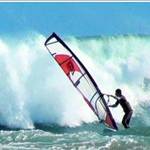
I've spent quite a bit of time on my Dyno 95 now and I have a few notes to add to the stuff already said.
Firstly, it's a lovely board and I'm getting even more out of it the more I use it. and it seems very happy in a big range of wind conditions.
But there are some odd things too:
The board planes early but it slogs best when you are out of the straps and standing well forwards, because of the volume distribution and rocker line. In that position the board will start to come up onto the plane as the wind increases, but you get there a lot quicker by popping the board and getting your front foot in the front strap asap. If you stay too far forwards you actually slow up the early planing release.
I find the board sets up best for me if I set my mast foot well back in the track, and a single bolt deckplate allows you to do that. I find this to be the case with all the 4m, 4.4, 4.8 and 5.0m sails used so far.
I had a suspicion that the 95 was overfinned for some of my size (75kgs) and I was right. I replaced the supplied 20cms centre fin with a 17cms K4 one and the improvement was immediate. The board seemed quicker to plane, and it loosened up on the wave face - whilst still having plenty of 'push' for the back foot.
I may yet try smaller thruster fins as well. I write this as someone who always likes to use small fins.
With the supplied fin set up I did find that the board will start to tail walk in windy weather - but only when I'm using the 95 with a 4m sail, and that's a sail size where you'd expect to be on a smaller board anyway.
As it is, I like the Dyno 95 so much that if I had the money I'd be keen to get an 85litre version too.
I'm adding a bit more to the above, simply because other views are available. To be honest, I was a bit shocked when I read the following on another forum elsewhere - and I won't quote who wrote it, because that's not fair if he can't respond.
"My dyno 95 comes with 20 + 2x12 which is great for well powered sailing with sails from 5.0 and down but whenever I need to use a bigger sail or it's gusty or there's an adverse current I change the central fin for a 22 k4 3sw. It still turns well enough for wave riding in slow conditions. I've also experimented with a 25 cm g10 freewave fin which gives good early planing without making the board slow or particularly hard to turn. I've even tried it in waves with some success. Clearly better than having to pass or do the walk of shame. For just burning and turning I wouldn't worry about trying with a fin as big as 27. I'm actually going to try just that with my 6.2 in the hope that I can leave my 120 freeride at home even on marginal days. I guesstimate that the 12 cm thrusters add a sail carrying capacity equal to about 4 cm extra single fin length if you get my meaning. So for example 27 + 2x12 will get you planing and upwind about as well as a 31 single while having the advantage of better turning and letting you sail comfortably in the inner strap positions."
My response to those words would be to point out that this is a board that can be sailed with a single fin. So if you feel you need more early planing, and better speed in marginal conditions, then fit a single fin - and take out the thrusters and replace them with the blanking plates supplied. The board will then ride better on its tail.
A single fin will also get you going earlier and will turn just as easily in marginal conditions - and a centre fin of 27cms in length should never be paired with thrusters. Adding a long single fin in addition to the thrusters just adds more drag. It won't get you going earlier, and won't help upwind.
There is a threshold with any board, where you either want to blast across flat water or else you want to wave ride, and that threshold is when or not there are waves. A tri fin for flat water can be OK but makes you lazy when gybing, in terms of your technique. (Sadly, most people try to cover up their stance issues, by adding too much fins area to their boards)
The fin choice should really relate to sail size used. For a 6m+ rig on any board I'd be on single fin. For sails of 5.7 or less on the Dyno I'd use the supplied tri fin set up if there were waves. For sails of 4.5 or less the tri fin set up is best but you may find you need less centre fin length and area, if well powered.
Anyone else want to comment on this?
Dyno 115 L - I use the stock fins for 6.1 and 6.7 in small waves. I'd use the same set up in bigger waves but we only get small waves in Florida. ??
38 cm freerace fin and 7.5 on flat water.
Just to add to the many words I've written about the Dyno 95, today I took delivery of a Dyno 85, and i got to sail it straight away.
The 85 is just like its bigger brother and I bonded with it from the get-go in what were 4m onshore conditions.
I sailed it as the standard tri-fin, but using a shorter (17cms K4 stubby) centre fin.
I'll keep the bigger fin supplied (20cms) for 5m+ winds.
We get a lot of white water and currents when we get waves, so the Dyno may have a 'freewave' tag but it's no slouch on the wave face and the early planing is so helpful in getting you out through lulls and breaking surf, and for jumping.
So I now have a matching pair that will easily float my 75kgs in all onshore conditions, and for 'float and ride' on the less-windy days.
Basher - did you not go for a Nano 2 in the end? Keen to understand thought process as I am also a South Coast UK sailor looking at these boards. Thanks!
Select to expand quoteWaveMuppet said..
Basher - did you not go for a Nano 2 in the end? Keen to understand thought process as I am also a South Coast UK sailor looking at these boards. Thanks!
Yes, I have a Nano 82 litres on order. But it doesn't arrive until late November or early December.
Basher
would be great to understand your thinking on usage of Dyno85 vs Nano82. I have a dyno105 and thinking about adding Dyno85 as a "fast wave board" for uk conditions. I am not an experienced wave sailor and am 80kg
Select to expand quoteWaveMuppet said..
Basher
would be great to understand your thinking on usage of Dyno85 vs Nano82. I have a dyno105 and thinking about adding Dyno85 as a "fast wave board" for uk conditions. I am not an experienced wave sailor and am 80kg
I won't be able to do a proper review of the Nano 82 until I have sailed one - and mine hasn't arrived yet. But I have seen a few already and other sized Nanos, plus the differences between the Nano, Dyno and Mako are pretty clear on the Severne site. All three are proper wave boards, but suited to different conditions.
The Dyno has a freewave tag but it's definitely a proper wave board, especially in the smaller sizes. It's Severne's onshore board in that it planes early, goes fast and so jumps well, keeps good speed in lulls, and still cranks a good turn on the wave face.
You can make the Dyno an even better wave-riding board by reducing the fin sizes used, and I also recommend shifting the mast foot well back in the mast track.
The Nano is 10cms shorter than the Dyno and usually a bit narrower in similar litre sizes - and again you can compare the dimensions on the Severne site.
People have already asked me why I'm getting a Nano 82 when I already have a Dyno 85 and the answer is that they are very different boards and I expect the Nano to be a step down, size-wise, from the Dyno 85. The Nano 82 will still carry sails up to 5.2 but I expect it will not plane quite as early as the Dyno because the Nano has more tail kick.
As a stubby, I'm thinking the Nano will also need to be more powered up than the Dyno, but then it will come into its now on the wave face.
The Nano 82 will be the board I take to Cape Town for the better waves and stronger wind expected there.
If for some reason it doesn't arrive in time, then I'll take the Dyno.
If you already like your Dyno 105 then I think you'll enjoy having a Dyno 85 to match the bigger board, and for use in stronger wind conditions.
Christened my new Dyno 95 in fat 3 foot waves last weekend. Board is supposed to be the same shape as last year's but with new fins. They look a bit thinner and like G10s to me.
Pretty sure it's just the fins but feels like it gets on the plane quicker and it's a bit faster now. Also seems to point higher. Previous comment about the new Nano being very different to the Dyno is right. I tried the 85L Dyno back to back with my old 83L Nano and felt there was a lot of cross over but new Nano is far more wavier.
the 2020 severne boards now made by cobra ...not china anymore...still made in the same construction ?
thanks in advance
Select to expand quoteRelapse said..
Christened my new Dyno 95 in fat 3 foot waves last weekend. Board is supposed to be the same shape as last year's but with new fins. They look a bit thinner and like G10s to me.
I was a late-comer to the Dyno party but my 2019 95 litre board came with G10 fins - rather than the blue or black polyester fins that earlier versions came with.
My 2020 Dyno also has G10 fins.
Does the fin material affect the board's early planing or speed? I'm not sure, but G10 is certainly more durable for launching and landing on our shingle beaches here on the south coast of the UK.
(Nice fins, but try using a smaller one in the middle, for the tri-fin set up. The shorter fin may not be so good with big sails, but dropping the 20/21cms centre fin in favour of a 16/17cms means you have a proper wave board for 5m sails and smaller. )
Select to expand quoteuweh said..
the 2020 severne boards now made by cobra ...not china anymore...still made in the same construction ?
thanks in advance
I am not sure what happened but there are two stories: One that, allegedly, Cobra bought the Chinese factory, and the other that Severne went back to the Cobra factory in Thailand to iron out early production issues they had.
As I understand it, the Dynos ares still made in concrete molds, which helps guarantee the consistent shapes.
This construction detail generally remains a mystery, but I can tell you that the Dynos I have are pretty light, strong, and are down to the published weights.
I sail on pebble/shingle beaches which tend to be harsher on boards than sand, but the paint finish on the Severne boards seems to chip less easily than the Starboard paintwork I also have.
Select to expand quoteBasher said..Relapse said..
Christened my new Dyno 95 in fat 3 foot waves last weekend. Board is supposed to be the same shape as last year's but with new fins. They look a bit thinner and like G10s to me.
I was a late-comer to the Dyno party but my 2019 95 litre board came with G10 fins - rather than the blue or black polyester fins that earlier versions came with.
My 2020 Dyno also has G10 fins.
Does the fin material affect the board's early planing or speed? I'm not sure, but G10 is certainly more durable for launching and landing on our shingle beaches here on the south coast of the UK.
(Nice fins, but try using a smaller one in the middle, for the tri-fin set up. The shorter fin may not be so good with big sails, but dropping the 20/21cms centre fin in favour of a 16/17cms means you have a proper wave board for 5m sails and smaller. )
Which fin yousmaller rear using Basher?
Select to expand quoteRelapse said..Basher said..Relapse said..
Christened my new Dyno 95 in fat 3 foot waves last weekend. Board is supposed to be the same shape as last year's but with new fins. They look a bit thinner and like G10s to me.
I was a late-comer to the Dyno party but my 2019 95 litre board came with G10 fins - rather than the blue or black polyester fins that earlier versions came with.
My 2020 Dyno also has G10 fins.
Does the fin material affect the board's early planing or speed? I'm not sure, but G10 is certainly more durable for launching and landing on our shingle beaches here on the south coast of the UK.
(Nice fins, but try using a smaller one in the middle, for the tri-fin set up. The shorter fin may not be so good with big sails, but dropping the 20/21cms centre fin in favour of a 16/17cms means you have a proper wave board for 5m sails and smaller. )
Which fin yousmaller rear using Basher?
17cms K4 stubby rear.
Select to expand quoteBasher said..uweh said..
the 2020 severne boards now made by cobra ...not china anymore...still made in the same construction ?
thanks in advance
I am not sure what happened but there are two stories: One that, allegedly, Cobra bought the Chinese factory, and the other that Severne went back to the Cobra factory in Thailand to iron out early production issues they had.
As I understand it, the Dynos ares still made in concrete molds, which helps guarantee the consistent shapes.
This construction detail generally remains a mystery, but I can tell you that the Dynos I have are pretty light, strong, and are down to the published weights.
I sail on pebble/shingle beaches which tend to be harsher on boards than sand, but the paint finish on the Severne boards seems to chip less easily than the Starboard paintwork I also have.
thanks...
Fin tuning.
I ordered a 16cms fin yesterday. It's a K4, stubby rear, 16cms long and with a powerbox head.
This will be similar to the 17cms version I already use all the time in my Dyno 95, but the 16cms is for the Dyno 85 I just bought.
I already tried the 17cms in the Dyno 85 on the three times I have sailed that board, and realise I could go smaller.
This may seem odd to some of you, when Severne themselves have actually increased their centre fin lengths for the 2020 Dynos.
So here's my reasoning:
1) Firstly, the fin area and fin lengths you want in any board depend on what you want to do with the board. The Dyno is a freewave and a crossover board in that it can take very big sails, for blasting use or even wave slalom. The fins supplied by Severne are very good and they allow you to do just that. You can easily use a 6m rig in tri fin mode with these fins.
2) But the Dyno is actually a very good wave board, especially in the 95 and 85 sizes. You can tune it to be an even better wave board and for better turning, simply by matching the fins to sail sizes used. Wave sailing usually happens with sails of 5m or less. I find with smaller fins there is no loss of early planing or upwind ability, and even when using a 5.3 rig I've had no issues with spinout.
3) Changing the centre fin is the simplest and cheapest way to reduce fin area, because you only buy one new fin - and changing a powerbox fin is pretty quick if you later want to change back. The two thruster fins that come with the Dyno boards are good, if a little big at 12.5cms.
4) When changing a single fin, we usually just talk about fin length but of course the fin width also adds to the area underfoot. With multi fin boards we should really compare total area when considering a change, but few manufacturers give that fin area. What I tend to do with a tri fin set up is to add up the centre fin length and the thruster fin length and see how that compares with a single fin length. So the Dyno 85 and 95 come with a 21cms fin and 12.5cms thrusters for 2020 and those two figures add up to 33.5cms. A 33cms fin is something I might use with a 7m+ sail, so my argument is that that's way too much for wave sailing on a 4.8m rig. My science is a bit dodgy here, but I hope you get my point - namely that it's easy to over-fin a multi fin board and you might not notice until really overpowered.
5) The 17cms fin worked straight away when I fitted it to the Dyno 95. 17 + 12.5 = 29.5 so that's still plenty of area, and the biggest sail I use on that board is a 5.3m. For the Dyno 85, I will soon be using it with 16cms centre fin, so that's 16 + 12.5 = 28.5cms.
6) I'll probably use my Dyno 85 with sails from 5.0 down to 3.6m and the smaller fins are almost essential for the smaller rig sizes. If you stuck with the big 20cms+ centre fin then the board would start to tail walk in 4m or even 4.4m weather - just like single fin boards do.
7) By reducing the centre fin only, you also change the cluster area, with less area at the back - so the tuning effect is also to make the board much looser because, in addition to less fin area, you've also shifted the cluster area forwards. If there's a downside, it's that the board will be less 'drivey' and that might not suit you if you are heavy on the back foot.
8) As I see it, this simple change takes the Dyno out of 'freewave' territory and makes it a proper waveboard, capable of waveriding, almost as good as a dedicated down the line board. For onshore conditions, this board is as good as it gets.
9) My further tuning tip - for those wanting better wave performance - is to shift the mast foot well back in the track when using any sails of 5m or less. This brings the mast foot back closer to the fins and makes the board much more lively for early planing etc. With a single bolt deck plate I'm using both my Dynos with the mast foot right at the back of the track for all sails. Only when I'm overpowered do I think about moving the deckplate forwards and maybe nearer the centre placing - for a bit more control. The front half of the track is completely redundant on my boards.
10) All the above points cover tuning issues - and tuning is always about personal preferences. So the experimentation is really down to you. I'm just telling you what I'm doing, and why. The Dynos are very plug and play, as supplied, so no reason to change the board if you are happy with yours already.
Maybe Severne can release a set of thruster specifically for wave for it? Fins of a Nano should do nicely
You weren't wrong about the 17cm rear fin for the Dyno Basher. Made a 3D printed powerbox adapter for the 17cm rear fin out of my Nano to see if it worked for me and holy moley what a difference. I think for larger guys on 5+m sails the stock fin is still a great option but at 70 kg the smaller fin made the Dyno faster and smoother and to my surprise planes earlier and points higher. The bit of extra speed helps with jumps too, best forwards so far on it. Can't wait to try it in the waves.
3D printed adapter isn't very strong so going to mold a permanent Powerbox head on it since I only use my Nano as a quad anyway.
Hello, I have a question about this board : For a template of 75 kg average level in bump and jump sail from 5.7 to 4.5, it is better the 105 or the 95 ? Thank you in advance. Philippe
Select to expand quotephilnath said..
Hello, I have a question about this board : For a template of 75 kg average level in bump and jump sail from 5.7 to 4.5, it is better the 105 or the 95 ? Thank you in advance. Philippe
Get the 95.
Hello guys I've a question for one of my friends: for a man of 72-75 kg, good level in on-shore bump and jump conditions, (speed loop, fast, and strong in overpowered conditions) sail from 3.6 to 5.2 it is better the 85 or 95? He also use a new Nano 82 for nice days.
Thank a lot
Select to expand quoteManawa said..
Hello guys I've a question for one of my friends: for a man of 72-75 kg, good level in on-shore bump and jump conditions, (speed loop, fast, and strong in overpowered conditions) sail from 3.6 to 5.2 it is better the 85 or 95? He also use a new Nano 82 for nice days.
Thank a lot
I have the Dyno 95, Dyno 85, and the Nano 82. I'm 72-75kgs. (76kgs after the recent lockdown!)
The Nano is great on the wave but the Dynos are no slouch on the wave face either, especially if conditions are onshore.
I'd say the Nano requires more skill and more energy to sail, whereas the Dynos are plug-and-play fun and most people seem to enjoy sailing them, pros or weekend sailors.
For bump and jump conditions and the best early planing you also want the Dyno.
I spent a lot of time on my 95 when I first got it, but since I got the 85 as well I find I now rarely use the 95. Both Dynos are better for jumping than the Nano with the latter needing to be more powered.
Talking about Dynos only, for sails of 3.6 you certainly want the smaller board, but the 85 is very happy with a 5.2 as well. For 5.8 sails or in rippy/whitewater/marginal conditions I'd go to the 95 for the extra float. My biggest sail is actually a 5.2m so I now pick the 95 when conditions are difficult, but I'll put the same sail on the 85 in steady wind. In truth, my 95 is now fulfils the role I originally bought it for - namely for float and ride. If I didn't have my 85 I'd still be using the 95 very happily in 4.2 to 5.2 wind as well.
You'd think from the volume measurement that the Dyno 85 and Nano 82 might be too close but, actually they pair up very well as a two board quiver. I'd say the big design difference is in the tail kick.
I use my Nano 82 with the fins as supplied, in quad mode.
I use both my Dynos in the tri fin set up, but both with a much shorter centre fin, which then brings out the true wave abilities of this all-round design.
Sounds about right.
Applies to other company FSW trips also.
My 92 fsw comes with 10's in front, so needs 20-22 small area rear single.
Needs more as a single fin board.
Select to expand quoteBasher said..Manawa said..
Hello guys I've a question for one of my friends: for a man of 72-75 kg, good level in on-shore bump and jump conditions, (speed loop, fast, and strong in overpowered conditions) sail from 3.6 to 5.2 it is better the 85 or 95? He also use a new Nano 82 for nice days.
Thank a lot
I have the Dyno 95, Dyno 85, and the Nano 82. I'm 72-75kgs. (76kgs after the recent lockdown!)
The Nano is great on the wave but the Dynos are no slouch on the wave face either, especially if conditions are onshore.
I'd say the Nano requires more skill and more energy to sail, whereas the Dynos are plug-and-play fun and most people seem to enjoy sailing them, pros or weekend sailors.
For bump and jump conditions and the best early planing you also want the Dyno.
I spent a lot of time on my 95 when I first got it, but since I got the 85 as well I find I now rarely use the 95. Both Dynos are better for jumping than the Nano with the latter needing to be more powered.
Talking about Dynos only, for sails of 3.6 you certainly want the smaller board, but the 85 is very happy with a 5.2 as well. For 5.8 sails or in rippy/whitewater/marginal conditions I'd go to the 95 for the extra float. My biggest sail is actually a 5.2m so I now pick the 95 when conditions are difficult, but I'll put the same sail on the 85 in steady wind. In truth, my 95 is now fulfils the role I originally bought it for - namely for float and ride. If I didn't have my 85 I'd still be using the 95 very happily in 4.2 to 5.2 wind as well.
You'd think from the volume measurement that the Dyno 85 and Nano 82 might be too close but, actually they pair up very well as a two board quiver. I'd say the big design difference is in the tail kick.
I use my Nano 82 with the fins as supplied, in quad mode.
I use both my Dynos in the tri fin set up, but both with a much shorter centre fin, which then brings out the true wave abilities of this all-round design.
Thank a lot Basher
Oooh.
The Severne Dyno new versions just arrived in the UK, with the red livery.
I'm not in a hurry to replace my existing Dyno 85 (favourite all round board) or my Dyno 95 (light wind wave board), but I see the new Dyno has a tweaked shape with a pointy nose.
But the big news for me, which I've only just noticed, is that they are doing a new, smaller size, at 75litres.
Tempting.
ive done some tweaking on my 2021 dyno 95 but no sign of wind here for a little while so ill have to hope it feels different next time or hope i can convert myself onto the safe/ smooth/sits IN the water (sort of dull ride feeling) compared to the lively playfull feeling of the fanatic freewave stby 95 2017 (but odly i thought the new 2020 fanatic freewave felt dull in el medano last sept) but the later fanatic and the dyno 95 gybe much easier so maybe thats the trade off hmm i need to do more sailing to get used to it , i have also decided to do back to back testing of my stby 95 and 2021 dyno 95 when conditions are conducive , i also realised when trying to use it recently there has been a lot of current so that really has made assessment more difficult and im hoping that was the reason i seem to keep coming off the plane which my stby 95 dosent really seem to suffer from thanks basher for your insight on your dyno i just hope they havent made it more safe feeling and dull in the new version
I'm itching to try the 125 out! Who needs wind with that much floatation!!?? I appreciate it's only 5cm wider than my much- loved 115 but hey that's 10l of extra float limping out to the windline, in the big lulls the SE throws up here and for uphauling when there is a nagging suspicion you're in croc country! 115 great, let's see what the 125'll do!!
Select to expand quoteBasher said..
I'm adding a bit more to the above, simply because other views are available. To be honest, I was a bit shocked when I read the following on another forum elsewhere - and I won't quote who wrote it, because that's not fair if he can't respond.
"My dyno 95 comes with 20 + 2x12 which is great for well powered sailing with sails from 5.0 and down but whenever I need to use a bigger sail or it's gusty or there's an adverse current I change the central fin for a 22 k4 3sw. It still turns well enough for wave riding in slow conditions. I've also experimented with a 25 cm g10 freewave fin which gives good early planing without making the board slow or particularly hard to turn. I've even tried it in waves with some success. Clearly better than having to pass or do the walk of shame. For just burning and turning I wouldn't worry about trying with a fin as big as 27. I'm actually going to try just that with my 6.2 in the hope that I can leave my 120 freeride at home even on marginal days. I guesstimate that the 12 cm thrusters add a sail carrying capacity equal to about 4 cm extra single fin length if you get my meaning. So for example 27 + 2x12 will get you planing and upwind about as well as a 31 single while having the advantage of better turning and letting you sail comfortably in the inner strap positions."
My response to those words would be to point out that this is a board that can be sailed with a single fin. So if you feel you need more early planing, and better speed in marginal conditions, then fit a single fin - and take out the thrusters and replace them with the blanking plates supplied. The board will then ride better on its tail.
A single fin will also get you going earlier and will turn just as easily in marginal conditions - and a centre fin of 27cms in length should never be paired with thrusters. Adding a long single fin in addition to the thrusters just adds more drag. It won't get you going earlier, and won't help upwind.
There is a threshold with any board, where you either want to blast across flat water or else you want to wave ride, and that threshold is when or not there are waves. A tri fin for flat water can be OK but makes you lazy when gybing, in terms of your technique. (Sadly, most people try to cover up their stance issues, by adding too much fins area to their boards)
The fin choice should really relate to sail size used. For a 6m+ rig on any board I'd be on single fin. For sails of 5.7 or less on the Dyno I'd use the supplied tri fin set up if there were waves. For sails of 4.5 or less the tri fin set up is best but you may find you need less centre fin length and area, if well powered.
Anyone else want to comment on this?
I did spend some time pondering the equivalent single fin length that will match the thruster set-up. This is what I did.
Firstly -> measured the actual fin areas of the Severne 210 & 230 fins. They no longer print these on the fin. Got 183cm2 and 206cm2 respectively. I also found a picture of an older 125 thruster fin with the fin area stated as 77cm2 

Second ->
Plotted all of the know fin lenth and areas in my collection - Blue = wave , orange = slalom.
Fitted a curve through the blue ones (y = 22.967 exp(0.0973x)). R2 = 0.9965 so not too shabby.

Three ->
Added the total surface area for the thruster setup.
Dyno 85 (2x125 +210) = 337cm2
Dyno 105 (2x125 + 230) = 360cm2
That is quite a bit of fin area.
next
back calculated the equivalent single fin length using the above relationship, got
Dyno 85 = 27.6 cm so the two side thrusters add ~ 6.5 cm
Dyno 105 = 28.3 cm so the two side thrusters add ~5 cm
So quite close to the guesstimate of 4cm.
Interested if this matched what people experience on the water.