Select to expand quoteZYX said..
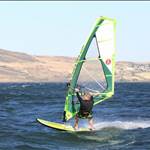
I just had max gps speed 30 km/h on 40cm fin and 40km/h on a foil. 5 m sail, same time, same board. Wind was just enough to get on plane on 5m sail but just right for the foil. 1 out of 10 days wind is strong enough for fin to win vs foil in speed.
Wow! congratulations!!!!! Doing 16 knots (30 kmh) on a windsurf takes a real lot of skill, I can never really go much below 22-25 knots on my FSW board and wave sail (I am doomed on my slalom stuff). Bravo!
Doing 21.5 knots (40 kmh) on a foil seems much more average: please slow down. ... which you did in the following post that describes "another method to improve foil speed from Russia". Yes! 18 knots is much more like it! Thank you!!!
We were missing you, and your surreal posts! Keep it up!
The limitations of single foiling is the issue with windsurfers.
Sailrocket uses multiple angled foils to deal with gravity and thereby far exceeds the drag limitations imposed by gravity and surface drag. The problem with windsurfer foils as designed is that they provide far too much fulcrum and insufficient power to drag ratios because so much of their effort is wasted on directly holding a sailor and windsurfer clean out of the water.
They are also reliant on direct trim from the sailor. In traditional windsurfing this is an advantage because the levelling function is performed by the board so happy days. That's why windsurfing is ace.
The fasted foil craft seem to use multiple angled foils or bent plane foils in conjunction with designs that provide significant self levelling/trimming control.
Watch on 1:30 what happens when your foil wing catches air:
Select to expand quoteZYX said..
Watch on 1:30 what happens when your foil wing catches air:
Because of this problem, you have to ride your foil deep resulting in more drag from the long mast. You can fly higher with less drag, but the risk of catapult increases. When you go high speed on your foul you need deeper mast because variation of altitude happens faster so you need more room for controlling your altitude. You definitely do not want your wings catching air on high speed when you are on a harness.
The Russian video is not about speed. The Russian video shows a safe riding foil with continuously ventilated wing that non of you even thought possible. The speed of the Russian foiler on the video is slower in comparison to slalom on the background, which is normal. Non of you can foil faster then slalom at the wind speed shown.
Russian foiler indeed looks a little rough skimming on the surface. I assume he is so focused because he trying to force the foil into a catapult but the foil does not let him.
The practical application of this is that you can fly higher without risk of catapult. And more people would want to get into foiling because of safer foils.
Where are you guys foiling? I may be able to ask someone to foil with you to compare. Or we could exchange gps.
There's nothing special about the foil in the russian video, its the riders technique that saves him from a catapult. Catapulting after ventilation is simple physics, there is no such thing as a foil design that can "stop" a catapult. Theres a foiler here that practices the same technique, so he can save himself from catapulting when he knows the foil is about to ventilate.
if you like the idea of not catapulting then use a shorter dinosaur bone on your foil. Your board won't get the height to go nose in then. Just accept that your foil will breach a lot more like the dude in the video.
Select to expand quotegroucho said..
The limitations of single foiling is the issue with windsurfers.
Sailrocket uses multiple angled foils to deal with gravity and thereby far exceeds the drag limitations imposed by gravity and surface drag. The problem with windsurfer foils as designed is that they provide far too much fulcrum and insufficient power to drag ratios because so much of their effort is wasted on directly holding a sailor and windsurfer clean out of the water.
They are also reliant on direct trim from the sailor. In traditional windsurfing this is an advantage because the levelling function is performed by the board so happy days. That's why windsurfing is ace.
The fasted foil craft seem to use multiple angled foils or bent plane foils in conjunction with designs that provide significant self levelling/trimming control.
I think you are 1/2 right. IMHO gravity is not really an issue - it is hard enough to keep a speedboard & fin on the water @ 50kts let alone a foil. The lift need to clear a board/rig sailor at 40+kts boardspeed is easy to achieve. Control is a real issue. I have talked to an engineer who used to be involved in windsurfing in the early days & now he is involved in UAV's he is convinced that "fly by wire" foil control is the future & the technology already exists. He has tried numerous times to get industry support with various manufacturers but no one is interested. Why? ... It is because this is a sport! People only want it easier to a point. They welcome the challenge. In fact this is why so many windsurfers have taken up foiling - it's a new challenge not just a new sensation.
Select to expand quotegorgesailor said..
convinced that "fly by wire" foil control is the future & the technology already exists.
Could be there's a fundamental limit to the speed at which a foil can be controlled by weight shift alone. In which case windfoilers are at an evolutionary deadend. Active articulation of underwater components is a too huge an evolutionary hurdle to overcome. We need a bunch of Moth sailers to get into the speed side of things. Come at it from a different starting point. Convergent evolution would probably home in on something that, at least from the top side, didn't look too different from a windfoiler.
Select to expand quotegorgesailor said..groucho said..
The limitations of single foiling is the issue with windsurfers.
Sailrocket uses multiple angled foils to deal with gravity and thereby far exceeds the drag limitations imposed by gravity and surface drag. The problem with windsurfer foils as designed is that they provide far too much fulcrum and insufficient power to drag ratios because so much of their effort is wasted on directly holding a sailor and windsurfer clean out of the water.
They are also reliant on direct trim from the sailor. In traditional windsurfing this is an advantage because the levelling function is performed by the board so happy days. That's why windsurfing is ace.
The fasted foil craft seem to use multiple angled foils or bent plane foils in conjunction with designs that provide significant self levelling/trimming control.
I think you are 1/2 right. IMHO gravity is not really an issue - it is hard enough to keep a speedboard & fin on the water @ 50kts let alone a foil. The lift need to clear a board/rig sailor at 40+kts boardspeed is easy to achieve. Control is a real issue. I have talked to an engineer who used to be involved in windsurfing in the early days & now he is involved in UAV's he is convinced that "fly by wire" foil control is the future & the technology already exists. He has tried numerous times to get industry support with various manufacturers but no one is interested. Why? ... It is because this is a sport! People only want it easier to a point. They welcome the challenge. In fact this is why so many windsurfers have taken up foiling - it's a new challenge not just a new sensation.
Yeah I agree. I'm not saying gravity should be an issue but it is with current designs. If gravity and drag were not an issue at present, foilers would be faster. It's a logical elimination.
Select to expand quoteIan K said..
Could be there's a fundamental limit to the speed at which a foil can be controlled by weight shift alone. In which case windfoilers are at an evolutionary deadend.
Could be. If so, that would be a very fast evolution to a dead end.
But there are still plenty of mutations happening to allow for further evolution. Maybe foil races will change over time from a triangle or upwind-downwind format to include more slalom-type races, where maximum speed is more important. Maybe what feels plenty fast now will feel slow after foiling a hundred or two hundred times, and foilers will demand faster foils. Either way: new selection pressure => new adaptations => higher speeds.
Or maybe races stick to course similar to what longboards use; the sensation of speed when flying on a foil remains higher than on a slapper, even after many sessions, and nobody really wants to go much faster; the majority of foilers learns to draw squiggly lines even in small swell and love it; and foils won't get much faster.
Select to expand quoteazymuth said..Swindy said..
The silence is deafening 
I'll bite
How is 18 knots demonstrating "a method to improve foil speed"?
Maybe the rider is super-skilled - but based on that ride what does that say about the foil? 
Your message implies that there is no merit to determine if foils are capable of achieving speeds which exceed the existing speed-records. Since it is a young field of expertise, Macro's question is valid - what top-speeds or average-course-racing-speed are possible ?
Smaller foils make a huge difference in board speed.
Kitefoilers use small foils.
Here, everyone using 1200 sq cm and bigger gets passed by the one foiler on his 550 sq cm foil.
Course speeds are similar to Formula, but foil is easier and less strain on the body.
Yes, a slight edge to foil, but very slight.
Question becomes, do you want to practice with a 9.2 or a 6.2?
Select to expand quoteVAILIYATBEN said..azymuth said..Swindy said..
The silence is deafening
I'll bite
How is 18 knots demonstrating "a method to improve foil speed"?
Maybe the rider is super-skilled - but based on that ride what does that say about the foil?
Your message implies that there is no merit to determine if foils are capable of achieving speeds which exceed the existing speed-records. Since it is a young field of expertise, Macro's question is valid - what top-speeds or average-course-racing-speed are possible ?
I think you'll find azymuths post was aimed at ZYXs post, not Macros
The AC50 cat's are heavier than a foil board and have no trouble doing 50 knots!
Then there is the AC75 monohull....
Select to expand quoteSubsonic said..boardsurfr said..Subsonic said..
Im pretty sure those early reports of foils beating slalom gear around a slalom course were either misrepresented or wildly embelished.
I must have missed those. I've seen reports about foils beating formula and slalom gear in courses that include upwind legs, like triangle courses and "around the island" races. I've seen a couple of such races where both formula and foils were out, and it was no contest. Of course, formula boards have a lower top speed than slalom boards, but upwind and downwind angles tend to be more important than top speed in the races.
Of course a foil is going to beat slalom kit around a course with upwind legs. Hence why i said it must have been misrepresented. I've heard slalom gear has been beaten down a slalom course with some degree of regularity, which must be chinese whispers. Maybe the racing being talked about took place in marginal slalom conditions, dunno.
There are also limits due to water conditions with a slalom (or otherwise) board. You will not goo that much more than 30-33 knots of max speed if there is significant chop/swell. And in those conditions a foil might hold an advantage.
Anyway ... the thread was about the max foil speed, and right now it is about 20 knots slower ...