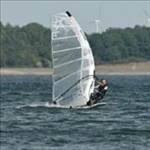
Describe foiling? I had a peak of speed of 27knts but I was only just out of the water, not flying high, so my question is was I foiling or riding the foil like a fin.
The difference between 27knots flying on a fin to 27knots flying on a foil is the amount of freckle twitching you get on the foil at speed
Select to expand quoteelmo said..
The difference between 27knots flying on a fin to 27knots flying on a foil is the amount of freckle twitching you get on the foil at speed
Bloody oath, i get seriously twitchy at 22 knots on a foil, feels like im not even moving at that speed on a fin.
Select to expand quotetbwonder said..
Here is my fastest 26.77
www.ka72.com/Track/t/459115
Not close to Boston but still north of 26.
But that is a 2" top speed. You are doing 24 knots, not 26 and change, over 10". It might flatter our egos but it really makes no sense to quote 2" top speeds. 10" is about 120 meters at 24 knots, and it seems a reasonable minimum to quote speeds. Speed records over 20 meters seem a bit silly.
Just to put things in perspective, yesterday I GPS-ed my RRD 90 FSW, open ocean with small swell, with Point-7 Spy 4.7 powered up. Best 5x10" was 24 and change. Same spot and conditions a day earlier and a friend of mine did 32 5x10" with a AV-slalom 88 and 6.2.
And that confirms a few years of observations. Going around the pond recreationally a foil tops out around the speed of a free style wave board, while a slalom board gains 8-10 knots. Perhaps a coincidence but the gap is similar to AA last year results over the nautical mile. Foil 30 knots and change, Windsurf 40 and change.
Select to expand quoteduzzi said..
But that is a 2" top speed. You are doing 24 knots, not 26 and change, over 10". It might flatter our egos but it really makes no sense to quote 2" top speeds. 10" is about 120 meters at 24 knots, and it seems a reasonable minimum to quote speeds. Speed records over 20 meters seem a bit silly..........
On the contrary. A "speed record" over 2 seconds today, with modern technology is quite a legitimate concept.
The only reason really why the WSSRC decided on a 500m record way back in the technicalogically stone age of sailing, was this stone age speed measuring method limitations. In those days it was done between marked transits with a group of people sitting in boats at the start and finish holding stop watches. This is a VERY non precise way of measuring something. There is a well studied and documented large error factor in 'hand timing'. To make it better, multiple timers were used and some sort of discarding and averaging was usually employed. To obtain any sort of practical accuracy the distance between transits had to be quite large. Hence the minimum of 500 meters.
The requirement for that from a technical point of view decreased substantially with the advent of 'Video Timing' and disappeared completely with the use of accurate GPS timing (Introduced and approved by the WSSRC for the Maquarrie Innovation campaign.) The minimum requirement for those GPS devices was an accuracy of equal to, or better than 8cm for the 500m (and presumably, timing to the 100th of a second or better).
From about 2007 onwards, Consumer Doppler gps devices like the Locosys GT-31 have been able to measure 2 second speeds with a verifyable accuracy of under around 0.2 Knots. More recent 10Hz and 25Hz Doppler GNSS devices can measure 2 second speeds with a verifiable accuracy in the order of 0.05 Knots.
Compared with the original hand timing over 500 meters, this is absolutely of 'record' quality.
To put it another way. there is absolutely NO technical reason now, why we must have sailing speed 'records' over a 500m distance.
Of course, there are cultural/traditional reasons to retain that measure for historical comparison purposes.
But speed is speed however you do it. 

Select to expand quotepowersloshin said..
with 10 to 25hz devices 1sec. max speeds would be reliable then...
Hmmm, maybe a bit less than half as 'reliable' as 2 seconds.
The issue with short recording times @ high Hz is that they now show up a lot of micro movements or vibrations of the device. If you were on flat water with a very steady mounting of the GPS, 1 sec readings could be quite accurate, but they could also be badly affected by body movement, a bump or a wave, or you being catapulted etc.
2 seconds is much better but still could be influenced by the same things. I was simply pointing out that a 2 second top speed for a foiling comparison was a reasonably legitimate measure. I was not saying it was suitable for some sort of official record (roughly 18m @ 35 knots) or even a legitimate comparison, and certainly not suggesting that.
Fast foiling is when you can keep up with a good freeride windsurfer who also is powered up.
None of us are keeping up with good slalom racers. Talking US, not some pro.
Excellent video. Thanks for posting it.
He does leave a wake a lot, so wonder length and chord of his mast.
Obviously tiny foil, what size you think.
At slow windsurf speed, my 600 is easily twice the size I really need.
Since there are no secrets in the racing world, I wonder why there aren't more foilers in slalom?
What was the name of the tiny foil mounted on a G-10 mast? About 4 years ago?
See, old age already has me losing my memory.
Select to expand quoteLeeD said..
Oh, 350 foil.
Hey Lee, how do you know he was using the 350? I know one SB rider's PB was done with the 650 wing, not the 550. So drag is important but you also need some lift and stability.
I myself am just passing info from the foil section.
Main F4 guy suggested I use my 310 stab as a front foil. He showed me his 400 front wing...never ridden. It's finer than my Naish 310.
As you know, I use my 600 foil in 10-16 knots and 5.0 sail. And I'm very slow compared to rec windsurfing.
Select to expand quoteLeeD said..
I myself am just passing info from the foil section.
Main F4 guy suggested I use my 310 stab as a front foil. He showed me his 400 front wing...never ridden. It's finer than my Naish 310.
As you know, I use my 600 foil in 10-16 knots and 5.0 sail. And I'm very slow compared to rec windsurfing.
I don't think you are slow because you have a "big" wing. If you want to go fast in 10-16 knots with that wing you need a much bigger sail
Select to expand quotesailquik said..duzzi said..
But that is a 2" top speed. You are doing 24 knots, not 26 and change, over 10". It might flatter our egos but it really makes no sense to quote 2" top speeds. 10" is about 120 meters at 24 knots, and it seems a reasonable minimum to quote speeds. Speed records over 20 meters seem a bit silly..........
On the contrary. A "speed record" over 2 seconds today, with modern technology is quite a legitimate concept.
Sure, let's have a Olympic sprinter race over 20 meters instead of 100. Or a swimming race over 4 meters.
Select to expand quoteduzzi said.. Sure, let's have a Olympic sprinter race over 20 meters instead of 100. Or a swimming race over 4 meters.
And they would be both totally impractical. (A starting dive itself takes you more than 4 meters).
And you don't measure any windsurfing record or speed from standstill. Comparing running or swimming races with windsurfing or foiling speed is comparing chalk and cheese.
But it could be a legitimate comparison to see what the top 4 meter speed of a swimmer was if there were a practical and accurate way to measure it. I don't think there is a way for all practical purposes and I don't think there is much interest in it. But we are fortunate that in windsurfing and foiling there is a way with the best current high Hz Doppler devices.
As I said, comparing 2 second top speeds with a high Hz, best quality GNSS device is quite a legitimate concept.
Select to expand quoteLeeD said..
Nah, op'd with 5.0 in 12-20 already....600 foil, 79 fuze, 210 stab
Which 600 wing? Seems like a short fuse too. On my i76 I've been out in that range with a 6.6 and I felt a little overpowered but I just needed to go deeper up/downwind. On the 9.0 and 900 front (IQFoil) with 115+ that range is pretty comfortable now. Not sure what's going on and why you feel slow. on the i76 was over 20mph and IQ hitting 25mph in that wind and I'm not that fast.
Naish Kite 600, almost as thin as F4 slalom 750.
I'm slow because I'm comparing to slalom board windsurfers on Isonics, Airinsides, Bolts.
Also, I'm scared to push it on reaches due to pitch control problems. I Just head upwind...slowly.
Select to expand quotesailquik said..duzzi said.. Sure, let's have a Olympic sprinter race over 20 meters instead of 100. Or a swimming race over 4 meters.
And they would be both totally impractical. (A starting dive itself takes you more than 4 meters).
Of course, the comparison is intentionally silly. But according to your logic swimmers could be tracked with a gps device and a gold medal be given to the swimmer who had the fastest 4 meters run within a 100 meters. Which of course would be silly, the winner could be last over 100 and first over 4.
Speed is traditionally reported over 500 meters or 1 nautical mile because we want to know who is the fastest to go from point A to point B. The only reason traditionally we, recreational sailors, use speed over a a certain time interval is because we do not have gates regularly set up to go through. But now we have good GPS, we do not need gates, and the best way to report an average speed might not be over time but over distance.
Simple enough: report your best speed over 100, 200, 500 meters.
Non-surfing friend of mine just raised how locked and "non-flappy" Goyard's sail is around 1:22 compared to all the others.
Select to expand quoteduzzi said..sailquik said..duzzi said.. Sure, let's have a Olympic sprinter race over 20 meters instead of 100. Or a swimming race over 4 meters.
And they would be both totally impractical. (A starting dive itself takes you more than 4 meters).
Of course, the comparison is intentionally silly. But according to your logic swimmers could be tracked with a gps device and a gold medal be given to the swimmer who had the fastest 4 meters run within a 100 meters. Which of course would be silly, the winner could be last over 100 and first over 4.
Speed is traditionally reported over 500 meters or 1 nautical mile because we want to know who is the fastest to go from point A to point B. The only reason traditionally we, recreational sailors, use speed over a a certain time interval is because we do not have gates regularly set up to go through. But now we have good GPS, we do not need gates, and the best way to report an average speed might not be over time but over distance.
Simple enough: report your best speed over 100, 200, 500 meters.
Well, if you are going to be silly, you just degrade your credibility and point of view. 
Did you not read my explanation of why the original WSSRC speed records where done over 500m? It was all about trying to get a legitimate accuracy with stone age hand timing.
With GPS speed measuring, we went to a time interval because that is what a GPS measures accurately. measuring a 'distance' with GPS introduces more error based on interpolation between data points, especial for 1Hz devices. Co-founders of GPS-SS, Martin Van Muers and Roger Van Togeren, settled on 10 seconds for very good reasons, not the least of which was that the devices of the day could only really get a reasonably good reading every 2 seconds. Averaging those 5 readings over 10 seconds improved their legitimacy significantly. Then having a ranking based on 5 x 10 seconds added another dimension of consistency - and quite a nice challenge in most places.
You are quite correct that 500m has remained the default measure of the WSSRC records. To change it would make no sense from a historical and comparative point of view. That does not in any way mean that records over a shorter distance or a set time period would be any less valid now that we have the technology to measure them accurately.
It's also a fact that 10 seconds has become the default standard time measurement period for all practical purposes in the windsurfing speed sailing competition world. Both GPS-SS and GPS-TC, the two foremost databases for windsurfing speed emphasise this measure. (BTW, at 40 knots, one does around 250m in 10 seconds).
And despite you trying to dismiss the legitimacy of 2 second comparisons by comparing it with irrelevant 'records' and other irrelevant sports, the fact remains that with a high Hz, best quality GNSS device, 2 seconds is quite a legitimate concept for comparisons in foiling or windsurfing top speeds. I am not suggesting we make it a world record category at all, but it would not be a ridiculous concept. I believe there is actually a gps measured Landsailing world record that is claimed over only a few seconds. edit: Confirmed that one of the most recent records was set over 50m or less than half a second! I had some correspondence many years ago with the timing team for an earlier record and they were using 4 x GT-31 GPS's to measure the top speed over, (from memory) I think, either 1 or 2 seconds. The +/- 0.5 mph was deemed to be acceptable accuracy for that world record. Current GNSS consumer technology accuracy is almost and order of magnitude better than that.
Select to expand quoteJulienLe said..
Non-surfing friend of mine just raised how locked and "non-flappy" Goyard's sail is around 1:22 compared to all the others.
Did you explain to him the difference between a foil sail and a slalom sail?
A side note: Some years ago we did a sailing speed record attempt with a proa boat named WotRocket. The goal was 50knts. My role in support was making parts and caring for the foils between the on water tests. The foils were made from a high tensile steel. Very high attention to detail and extreme care required when handling them, they lived in a dedicated road case when not on the boat. At that time the design challenge with the foils was focussed on the problem of the water changing from liquid to gas as the pressure drops around the foil. A lot has since been learned in the past 10yrs especially through the AC program.
Select to expand quotesaltwaterwine said..
A side note: Some years ago we did a sailing speed record attempt with a proa boat named WotRocket. The goal was 50knts. My role in support was making parts and caring for the foils between the on water tests. The foils were made from a high tensile steel. Very high attention to detail and extreme care required when handling them, they lived in a dedicated road case when not on the boat. At that time the design challenge with the foils was focussed on the problem of the water changing from liquid to gas as the pressure drops around the foil. A lot has since been learned in the past 10yrs especially through the AC program.
What happened to Wotrocket? Did it ever successfully sail at speed? Lots of Hype and then disappeared completely!!!???
Select to expand quotesaltwaterwine said..
A lot has since been learned in the past 10yrs especially through the AC program.
I think that the difference is having a massive budget, which allows them to gather a bunch of clever engineers together with free reign to make the boats that quick. I think i admire those who came before them more. To have gotten to where they did with a comparatively limited budget is more of a feat imo.