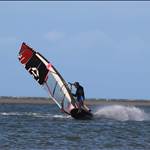
Robby sailed only 8 nautical miles in that video, which is a very short distance. It was made to look like an epic trip but really it was just a little snack of a sail. No-one who does decent distances would even think about sailing unhooked.
He was using a foiling sail with a slalom board. That doesn't really make sense either.
Also Robby used to sail with his harness hook facing up in the old days and kept at it long after everone had changed to facing the hook down. He marches to his own drum.
Select to expand quoteLeeD said..
So, NONE of you who replied ever raced.
Only a racer knows it's necessary to pump and oooch even after planing in in the straps.
Dirty air is the enemy if you're not in the top few spots.
I dont think you understood the context of the question. Any idiot can see racers unhook to turn and anyone slightly more cleverer will see they also unhook to get going through dirty air... the question was regarding unhooking to deal with being overpowered. To which the answer is definitely no - not at pwa level especially
Select to expand quoteNubie said..duzzi said..
For sure I dont sail in these condition,I survive...This happend only twice when wind pick up
Even with 5.5 I unhook when big gusts come,because I am scared of catapult.
So I wonder why best windusrfer ever do this...
Very few people can windsurf comfortably in real 35 knots of wind. I would need a 3.0 to try. But going back to your question, I would completely disregard what Naish says in the video. First, he is Naish, and second it is the worst advise to give to a beginner. You just pin pointed the problem: you are scared of a catapult. It is a sort of vicious circle, you get scared, maybe open the sail, upset your asset, as a result you bring your weight forward, get more scared because you start to feel a serious pull forward, and finally unhook to try to bring things sort of in control.
The trick is to commit. Keep your weight back, do not put too much pressure on the fin, do not open the sail, crouch down by bending your knees (no seven position if very overpowered), and things will stay in control. And keep those harness lines loaded: they are your friend!
Robby do this all the time,but I still dont understand why pro wsurfer(best ever) do this..
I never seen that pro wsurfer sail unhooked
Robby is unhooked because of the sea state not the strength of the wind. Notice that he hooks in closer to shore, where there is much less swell He unhookes as be goes through and over large swells, particularly when he jumps.
I would be hanging on with that gear in 25kt, and unhooking on a bear away tack whenever a big gust came or I got out of shape due to the swell. it's very easy to bury the nose when going full blast over back of chop/swell in the ocean on a deep beam reach. Easy to spin out. Need 100% concentration. These tacks produce the most spectacular stacks and damage.
@nubie: I totally agree with everybody here. Follow their advice. It will be a while before you do a downwinder anyway.
Select to expand quoteJohn340 said..Nubie said..duzzi said..
For sure I dont sail in these condition,I survive...This happend only twice when wind pick up
Even with 5.5 I unhook when big gusts come,because I am scared of catapult.
So I wonder why best windusrfer ever do this...
Very few people can windsurf comfortably in real 35 knots of wind. I would need a 3.0 to try. But going back to your question, I would completely disregard what Naish says in the video. First, he is Naish, and second it is the worst advise to give to a beginner. You just pin pointed the problem: you are scared of a catapult. It is a sort of vicious circle, you get scared, maybe open the sail, upset your asset, as a result you bring your weight forward, get more scared because you start to feel a serious pull forward, and finally unhook to try to bring things sort of in control.
The trick is to commit. Keep your weight back, do not put too much pressure on the fin, do not open the sail, crouch down by bending your knees (no seven position if very overpowered), and things will stay in control. And keep those harness lines loaded: they are your friend!
Robby do this all the time,but I still dont understand why pro wsurfer(best ever) do this..
I never seen that pro wsurfer sail unhooked
Robby is unhooked because of the sea state not the strength of the wind. Notice that he hooks in closer to shore, where there is much less swell He unhookes as be goes through and over large swells, particularly when he jumps.
Yep, and as Naish mentions at the beginning of his video nowadays PWA sailors sail (hooked in of course!) in much more wind and much bigger sails than he does.
'
Select to expand quoteBigsnut said..
STAY HOOKED iN you pussies.
My friends call me pussie every time they see me sailing unhook in "toilet survive mode""
But I admit I am pussy,I dont scare of catapult itself,I scare of shark when crash in deep water so I want stay at board as long as possible,that is real reason why I unhook,when you sail unhooked you cant crash,beause your hands feel every change in sail pressure better when unhooked,and you have more flexibiliy to absorb chop
Select to expand quoteNubie said..Bigsnut said..
STAY HOOKED iN you pussies.
My friends call me pussie every time they see me sailing unhook in "toilet survive mode""
But I admit I am pussy,I dont scare of catapult itself,I scare of shark when crash in deep water so I want stay at board as long as possible,that is real reason why I unhook,when you sail unhooked you cant crash,beause your hands feel every change in sail pressure better when unhooked,and you have more flexibiliy to absorb chop
So the purpose of your original post was to justify why you sail unhooked.
Your challenge, by heeding the advice of all the above respondents and the people you sail with, is to hook in and reap the benefits of this change in technique.
Select to expand quoteJohn340 said..
So the purpose of your original post was to justify why you sail unhooked.
Your challenge, by heeding the advice of all the above respondents and the people you sail with, is to hook in and reap the benefits of this change in technique.
I think John if you have been sailing for a while, all the above advice makes sense. To a beginner/intermediate, it may seem counterintuitive or even a bit piss taking (I remember a few wave sailors encouraging me to go out in 3 foot surf on my 160L beginner board. Extremely immature advice to give to a fellow sailor who is new to the sport). Note that most new sailors don't have the other half of the house in order - that being the rigging experience. So, the good techniques are hard to apply because you need the rigging skills and correct equipment to go with it. This all comes with time of course.
I went out in 5' Ocean Beach San Francisco, 3 days after my 1st lesson, 6.1 sail and 11'9" Alto, rode 7 waves toeside, but then got stuck on the old pier at Sloat.
Select to expand quotejn1 said..John340 said..
So the purpose of your original post was to justify why you sail unhooked.
Your challenge, by heeding the advice of all the above respondents and the people you sail with, is to hook in and reap the benefits of this change in technique.
I think John if you have been sailing for a while, all the above advice makes sense. To a beginner/intermediate, it may seem counterintuitive or even a bit piss taking (I remember a few wave sailors encouraging me to go out in 3 foot surf on my 160L beginner board. Extremely immature advice to give to a fellow sailor who is new to the sport). Note that most new sailors don't have the other half of the house in order - that being the rigging experience. So, the good techniques are hard to apply because you need the rigging skills and correct equipment to go with it. This all comes with time of course.
I remember how difficult it was to learn to windsurf. I also remember the exhilaration of first being hooked in the harness and in the foot straps. It's still thrilling after nearly 40 years of windsurfing, especially when really powered up.
Select to expand quoteolskool said..Nubie said..WillyWind said..Nubie said..duzzi said..Nubie said
For same body posture,righting moment and mfp are the same in both case(hooked unhooked.)
No MFP will not be same hooked n unhooked.
Hooked in,body weight is transferred thru harness lines to boom to mast to mastfoot to board. =MFP
Unhooked, body weight is on the board with very little MFP.
The nose of board will lift. To lessen this effect hang off boom n pull down as you unhook.
Try to overcome your fear. Rather than unhook as a gust approaches, bend at the knees n prepare for the gust n accelerate away. Yeeeww!
Good explanation of MFP for me, a beginner.
Do you use harness first or foot strap first in general please?
Select to expand quoteJohn340 said..jn1 said..John340 said..
So the purpose of your original post was to justify why you sail unhooked.
Your challenge, by heeding the advice of all the above respondents and the people you sail with, is to hook in and reap the benefits of this change in technique.
I think John if you have been sailing for a while, all the above advice makes sense. To a beginner/intermediate, it may seem counterintuitive or even a bit piss taking (I remember a few wave sailors encouraging me to go out in 3 foot surf on my 160L beginner board. Extremely immature advice to give to a fellow sailor who is new to the sport). Note that most new sailors don't have the other half of the house in order - that being the rigging experience. So, the good techniques are hard to apply because you need the rigging skills and correct equipment to go with it. This all comes with time of course.
I remember how difficult it was to learn to windsurf. I also remember the exhilaration of first being hooked in the harness and in the foot straps. It's still thrilling after nearly 40 years of windsurfing, especially when really powered up.
I am awaiting for that moment, hopefully not too long!
Harness usually before straps unless wind is Honking. Harness first puts some weight on board thru mastfoot(mfp)= flatter board trim which will plane up easier.
Front strap then harness then rear strap. Unless arms are worn out then harness first.
thinking of trying rear strap, front strap, harness
Select to expand quoteBen1973 said..
Front strap then harness then rear strap. Unless arms are worn out then harness first.
thinking of trying rear strap, front strap, harness
It was suggested to me (and then I tried) rear strap first when waterstarting and the wind is really strong. Keeps you from getting pulled onto the board to an immediate catapult, most of the time. Waterstart and GO. Can sometimes even get into both straps in the water and just harness in once up. Others have told me they will get in the harness and straps when really overpowered.
Select to expand quoteolskool said..
Harness usually before straps unless wind is Honking. Harness first puts some weight on board thru mastfoot(mfp)= flatter board trim which will plane up easier.
Value comments, will try and experience it. Thank you!
Select to expand quoteBen1973 said..
Front strap then harness then rear strap. Unless arms are worn out then harness first.
thinking of trying rear strap, front strap, harness
Will training with experience. Thank you!
Select to expand quoteaeroegnr said..Ben1973 said..
Front strap then harness then rear strap. Unless arms are worn out then harness first.
thinking of trying rear strap, front strap, harness
It was suggested to me (and then I tried) rear strap first when waterstarting and the wind is really strong. Keeps you from getting pulled onto the board to an immediate catapult, most of the time. Waterstart and GO. Can sometimes even get into both straps in the water and just harness in once up. Others have told me they will get in the harness and straps when really overpowered.
Rear first is super inefficient. If you have power to burn might as well waterstart in both straps.
I use rear strap on waterstarts when grossly overpowered, like 4.5 in gusts of 35 knots. That's 3.0 wind for me.
The extra wide stance getting up is safe and stable, taking a bit of time before rocketing to speed in that kind of chop.
Normal wind, like 15-25 and 5.0, I go front straps, then rear, still accelerating, to harness before top speed.
Select to expand quoteGrantmac said..
Rear first is super inefficient. If you have power to burn might as well waterstart in both straps.
Possibly. I've only been in that situation a couple of times.