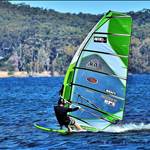
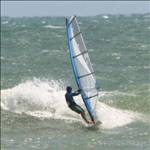
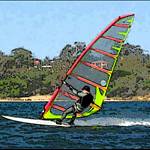
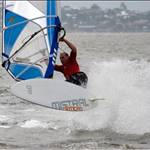
Decrepit and I have been talking about building a speed board for the "Ice Ramp", Mandurah's flattest but shallowest stretch of water. Elmo and I have sailed Ice Ramps with traditional weed fins and nearly killed ourselves with shallow water groundings and catapults.
Decrepits Idea is to build a twin fin board, using two parallel fins, anout 12cm in depth,to use at the Ive Ramp, I know a bit suicidal, but one must push the boundaries?. The ideas are maybe One board without a channell and fins placed outboard but how far?, and another board with a channell through the middle and fins on the 2 lateral hulls.
What are some of your ideas about how to make such a board work, and what to do with such small fins, how do we get them to work?
your biggest problem will be getting enough lift out of them without ventilating from the base. Also remember that unlike a kite, if you do hit something you will get DRILLED into the shallow water and break your neck.
quote:
Originally posted by slowboat
your biggest problem will be getting enough lift out of them without ventilating from the base. Also remember that unlike a kite, if you do hit something you will get DRILLED into the shallow water and break your neck.
 You have to spoil everything don't you
What about if you built a fin that was only 6 or 7 cm deep, but between 20 or 30cm long. Kind of like an old dagger board when they were folded up along the bottom of the board.
You would still have plenty to push against, but it would only be 7cm deep.
Probably wouldn't have great upwind ability, but who cares 
The concept reminds me of Wayne Lynch and nat Young's keel surfboards from back in the early seventies. They had no fin as such.
What about an even more extreme version of the hypersonic with really deep channels so to create three keels. One on each rail and in the middle.
I'm thinking off the cuff here!!
i reckon you're in hydrofoil territory, something like a u shape with the horizontal element providing lift. you could even use it to adjust AoA.
other than that. an upside down version of a fighter tail. ie. 2 fins joined at the base with each blade raked laterally at 45deg or so. that'll provide lift vertically.
Keep it simple, conventional shape and the 2 small fins. Would think you could make the tail wider then normal. Or why not a tri fin.
I run a 23cm home made speed weedy.
If that puppy hits the bottom then it's to shallow for me.
The prangs are bad enough in 18" of water
Seems like the obvious solution, so obvious I guess people have tried it before with out success, (for top end speed sailing anyway).
There'd be lots of R & D to get it right, if you did want to try, must admit it is tempting, hmmmmmm ---------
The foils great till it hits the copious quantities of weed we have, hence the preference for weed fins
No Elmo, you miss the point. with foils you don't need to sail in the weed! If you're high enough, open ocean is the go, get some real wind!!!
Drag is the real problem for the speed board after you have solved the chop problem. What about Single concave to double v and then small flats from about 15cm in front of each fin. sort of a mini catamaran.
hi fortyd,
the boards i use are similar to what you describe. you can also include stepped hulls and tunnel hulls into this category.
i am trying to get up some photos so you can all have a look.
if you want to get really serious about fins & speed, and relationship with sails & boards...
have a good read through the forum topic below (all 6 pages) at gps-speedsurfing.
It'll make your head spin, but it is the top speedsters from all countries having their say, including Mal Wright, Chris Lockwood & Andrew Daff
hagar quote
"If you want to have a read of full on tech fin discussion then check this out, this is a bit to techo for me
www.gps-speedsurfing.com/default.aspx?mnu=forum&forum=1&val=3165
can the "Mandurah Missile" or the "Nebs Snub-Nosed Banana" be competitive without a speed fin[}:)][}:)]
The consensus from the forum seems to be that they are hitting the wall in the mid-40knts, with fin performance & cavitation - with Sandy Pt getting special mention as 'the place' (Send in the missiles, Elmo)
i finally got the time to read through the posts on the gpsspeedsurfing forum.
fantastic stuff!!
was particularly interested in the stuff towards the end of the posts from boogie and co regards channel and stepped type hulls. here is a photo of my new 125lt slalom board from underneath. (hence the wide tail) www.seabreeze.com.au/gallery/gallery.asp?imageid=4583
i've been sailing these type of bottom shapes for about 12 years now and what you see in the photo is the latest outcome. pete who designs the boards has been researching them for over 25 years. my formula board is also a channel step (CS) design and now the new speed proto i have. the speed proto is very interesting with some new nose concepts. it is also a lot narrower than the board in the photo which also creates higher aspect pads.
personally i think that the stubby shapes really suit these designs. they have minimal wetted area for their width when sailed in flat water. like all new wider tail shapes you get a better drag aspect ratio, more control/stability and larger wind range. the channels do lose out a little compared to a flat bottom version when planing up. a few pumps deals with that though.
from my average sailor view these designs are unbelievably stable. are less prone to tail walking. gybe as tight as a traditional designs and leave everything for dead when going back upwind. they track very well and on a broad reach really get up and go. almost flying over the water and gliding through the lulls.
i might try some small low aspect fins and see what happens?
Wooooah Nellie!
I'm curious as to how this bottom shape stops spinout, when the root of the fin looks like it's not wetted?
Ah well when the data drops the bull**** stops [}:)]
Next Vikky point session we'll pit the Flow (old skool) against the NXS (nu school) and see what the outcome is 
quote:
Originally posted by nebbian
Wooooah Nellie!
I'm curious as to how this bottom shape stops spinout, when the root of the fin looks like it's not wetted?
quote:
[ Ah well when the data drops the bull**** stops [}:)]
Next Vikky point session we'll pit the Flow (old skool) against the NXS (nu school) and see what the outcome is
 but seriously, you should sail one of the boards too. otherwise how do you really know.?
Last session I was on a kn barn door that was a couple of meters wide, never sailed something that huge before and yes I certainly had trouble gybing!
But anyway I'm looking forward to meeting up with the SEQ again and spinning some sh**
"...the speed proto is very interesting with some new nose concepts. it is also a lot narrower than the board in the photo which also creates higher aspect pads."
Huh??
The aspect ratio is span/ave. cord. Long narrow hulls or sponsons have low aspect (less than one)ratios depending on the amount of hull in the water of course.
High aspect rato planning hulls are wide (eg formula type) with short longitudinal wetted surface. They have inherintally poor longitudinal stability and are poor for speed as tail walking becomes a prob.
To go REAL fast you need BIG wind. Any theoretical reduction in hull surface drag using high AR shapes is overwhelmingly outweighed by control issues.
But from what you describe the sponsons are not that. Slowboat made a board like that which he took to the canal a couple of years ago.
quote:
Originally posted by Gestalt
i might try some small low aspect fins and see what happens?
quote:
Originally posted by yoyo
"...the speed proto is very interesting with some new nose concepts. it is also a lot narrower than the board in the photo which also creates higher aspect pads."
Huh??
The aspect ratio is span/ave. cord. Long narrow hulls or sponsons have low aspect (less than one)ratios depending on the amount of hull in the water of course.
quote:
High aspect ratio planning hulls are wide (eg formula type) with short longitudinal wetted surface. They have inherintally poor longitudinal stability and are poor for speed as tail walking becomes a prob.
quote:
To go REAL fast you need BIG wind. Any theoretical reduction in hull surface drag using high AR shapes is overwhelmingly outweighed by control issues.
quote:
But from what you describe the sponsons are not that. Slowboat made a board like that which he took to the canal a couple of years ago.
yeah nebs.
looks like we got that 15-20 blow after all. i watched it from the mulligrubs playground. i am keen to hit VP again too.
hi decrepit.
i was thinking it would be iteresting to try something like a cut down freestyle fin? 10cm deep. would need to be a very broad run.
but i won't be hacking into the board. a centre fin works well.
good luck with your ideas. sometimes it's fun to try something different. raises the bar.
Hardie,
If your course is ripple smooth you're not going to have control problems. The only thing you will be concerned about is grip. My first guess at a solution would be for a flat rocker to a 1m or more flat with no v or channels or concaves - simplest possible shape with sharp rails of course at the back and through all the release edges.
Fins - you could try for a single with a tip treatment (wingletts or a bulb). Those things increase the effective span of foils. This is because the tip of your foil doesn't do anything but smooth out the turbulent flow. It can be horizontal and do this. Of course you have to know the aoa of your hull so you can orientate the things straight ahead. Maybe you could design the fin to rotate forwards and backwards a little so you can tune this angle. Nebs I think, knows something about this stuff. Two fins is theoretically less efficient because a) you have twice as many tips which means the the effective length/wetted surface ratio is poor and b) The pressure bulb from the upwind fin impinges in the low pressure zone of the downwind fin decreasing its lift. However its probably the easiest thing to do.
Having sounded off it behoves me to reveal I have no practical experience of board design or speed. No I just like to sit here with a beer and pretend I'm at the pub. Now what makes sails fast?
NotWal's on the money with the talk of winglets and bulbs. You could also try a fence if spinout is a problem.
What I'd do though, is make a couple of asymmetrical fins. I'd imagine that the gain in performance would be significant over the terribly inefficient fins we all seem to use. Pick a nice airfoil (not too thin, it needs to be strong), give it a bit of permanent tip twist, and off you go.
Also something that might be worth considering is trying out a gurney flap on your asymmetrical fin. They look horrible but work well.
quote:
Originally posted by NotWal
Having sounded off it behoves me to reveal I have no practical experience of board design or speed. No I just like to sit here with a beer and pretend I'm at the pub. Now what makes sails fast?
Ooooh... Guerny flap! Had to look that up. It would have to be pretty small I imagine. Its virtue seems to be that it can make a small foil provide the lift of a large foil very efficiently.
So just guessing... if you start out with a fin say 3/4 of the size you need, then grind the leeward face a bit flatter and refair it, then grind away and refair the trailing edge to put the wide spot near the middle of the cord, and then fix a guerney flap to the trailing edge (maybe 3 mm thick?) projecting windward, and shorten the fin 50 mm say and epoxy on a smick little winglet projecting maybe 15 mm on the windward side and projecting behind 40mm maybe, .... then.... would you end up with a bit more lift than the original fin with a lot less drag? huh? Or is that very wrong?
hmmmm ..... You could spend years getting that design right. What fun.
quote:
Originally posted by nebbian
Wooooah Nellie!
I'm curious as to how this bottom shape stops spinout, when the root of the fin looks like it's not wetted?
Ah well when the data drops the bull**** stops [}:)]
Next Vikky point session we'll pit the Flow (old skool) against the NXS (nu school) and see what the outcome is
quote:
Originally posted by NotWal
Ooooh... Guerny flap! Had to look that up. It would have to be pretty small I imagine. Its virtue seems to be that it can make a small foil provide the lift of a large foil very efficiently.
So just guessing... if you start out with a fin say 3/4 of the size you need, then grind the leeward face a bit flatter and refair it, then grind away and refair the trailing edge to put the wide spot near the middle of the cord, and then fix a guerney flap to the trailing edge (maybe 3 mm thick?) projecting windward, and shorten the fin 50 mm say and epoxy on a smick little winglet projecting maybe 15 mm on the windward side and projecting behind 40mm maybe, .... then.... would you end up with a bit more lift than the original fin with a lot less drag? huh? Or is that very wrong?
hmmmm ..... You could spend years getting that design right. What fun.