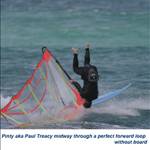
Possibly bit later. Didn't hurt anyone, just damaged gear. must be another person with exactly same name thats sails at the train. The other guys knew who you were by name.
I've had to stand a board up a few times on the tail to put the brakes on.
It's doable when blasting, but bloody hard to do on a full speed run.
Speed runs either crank it upwind (both hands in front of harness lines sometimes when overpowered) or hard gybe.
Been known to do enema's (bum drags) to try and wash of speed (always!!!! hang onto the boom).
Also been known to let out a steam of expletives when fully lit the shoreline rapidly approaching the sail just doesn't want to change direction and none of the above seems to work. I don't know if it works but it sure lets everybody know to watch my imminent disaster.
Hard to sink the tail in shallow water that's getting shallower! Pilots have the same problem overshooting runways - 3.50. (Never mind the presenter, it's the Botox)
Select to expand quoteelmo said..
I've had to stand a board up a few times on the tail to put the brakes on.
It's doable when blasting, but bloody hard to do on a full speed run.
Speed runs either crank it upwind (both hands in front of harness lines sometimes when overpowered) or hard gybe.
Been known to do enema's (bum drags) to try and wash of speed (always!!!! hang onto the boom).
Also been known to let out a steam of expletives when fully lit the shoreline rapidly approaching the sail just doesn't want to change direction and none of the above seems to work. I don't know if it works but it sure lets everybody know to watch my imminent disaster.
How do you do a bum drag still holding onto the boom bearing off the wind? Wouldn't you catapult as you tried to do it..?
It's amazing what you can do when your freckle is clenching rapidly.
Stand the board on the tail is not so much sinking the tail but lifting the front of the board as much as you can.
Bum Draging is generally last line of defense, body by that stage is not square with the board but heading towards the back, cause you are hanging onto the boom the sail is at the angle of a water start so less exposure into the wind, with it being so far down your body has a lot farther to travel before a catapult.
I can demonstrate a crash quite easily, just don't ask me to understand how I do what I do.
Select to expand quoteIan K said..
Hard to sink the tail in shallow water that's getting shallower! Pilots have the same problem overshooting runways - 3.50. (Never mind the presenter, it's the Botox)
Can you envision now the next big thing to be flying carpet, after foil madness pass out?
At what speed formula board becomes airborne , utilizing ground effect?
Definitely less resistance to fly over air cushion, then foil cutting thought the water.
All we need is to resolve some side force support for sail to be effective.If anything happen that Americas Cup 2030 may resolve the problem of flying/sailing on ground effect.
Then 50 knt is not the limit but just the beginning of new adventure.
Eventually we should able to do similar calculation what dimensions and speed is required for our speed board shape as airfoil wing, cross section.
The funny is the at Lauderits this board will fly over sand , when channel already finished  another future development could bring combination of airfoil board ( using ground effect) and wing sail - that do provide additional lift.At this moment it seems that winglers are the slowest on the water , but that could change dramatically when wings will become shaped for speed. More like carbon fiber molded wing not pumper rubber duck. Properly shaped wing could provide our speed boards the lifting force, not the fin or board.
Select to expand quoteIan K said..
Hard to sink the tail in shallow water that's getting shallower! Pilots have the same problem overshooting runways - 3.50. (Never mind the presenter, it's the Botox)
Yes, sinking the tail happens well after top speed is bled off from sheeting out, which snables normal drag to slow you down first.
I'm not convinced that the video airplane analogy is relevant to the planing hull in quite the same way. (And yes, I have ridden a Skiffle board - but they vertainly do not work very well in water that is anywhere near deeper than a small fraction of the hull width! Try one that is 1 meter wide in 50cm, or even 10cm of water depth!)
However, an effect on the fin is highly likely. But I say "so what?". It's just another parameter for going fast on water, like strong wind, perfect angle, flat water, cold/fresh/salty water, wearing weight, being in the right place at the right time, being able to afford attend and to run the canal, etc. I am not the only one who has noticed and commented that I suddenly accellerated just before I ran aground and crashed on an unseen sand bar. And if you can work out how to sail your windsurfer in a few cm of water, or with your fin just barely clearing the bottom (and actually want to try it!  ) then I say go for your life! (but please have your health insurance paid up!
 ) And if you go 70 knots, I for one will call you the fastest (and bravest) human sailor on water.
Select to expand quoteMacroscien said.
The funny is the at Lauderits this board will fly over sand , when channel already finished ......
If that ever happens, I would rather be over water! 
Select to expand quotesailquik said..
I'm not convinced that the video airplane analogy is relevant to the planing hull in quite the same way.
I thought it was analogous in that in both cases slowing down becomes unexpectedly delayed when a solid surface interferes with the freely flowing fluid dynamics. Any interference to the free flow will create back pressure - but creating back pressure is the name of the game in generating lift, the more the better.. How much is the question. It's quite noticeable in 25 cm of water, hero gybes, spocks and vulcans etc. Does it fade to less than half a knot on the GPS at 50 cm? Who knows, but I agree "so what" it's all part of the game. Just an interesting curiosity to think about.
(I'd asked if any foilers reckon they can feel it - No apparently. But I suppose while constantly correcting for the short uphill and downhill motions of a foil it's hard to filter out the straight and level component of drag that might come into the picture while skimming over a sandbar)

For a gtood air glider stalling speed is about thirty-something Knotts. Which means that glide comfortably about 40 ktn
. That is exactly where we start not to feel comfortable sailing on the water.I mean.
Watergliders do not exist in vocabulary as yet. But you could be on something here Ian. Ground ( water) effect is the key.
our typical watercraft have that upper limit. But for water glider 40 ktn is just beginning.Our future watercraft could sail on the air cushion, like hovercraft, but powered exclusively by wind!
Select to expand quoteMacroscien said..
For typical air glider stalling speed is about thirty something knotts. Which mean that glide comfortably about 40 ktn.That is exactly where we starts not feel comfortably sailing on the water.
For me it's around 46-47 knots!
I usually feel totally comforable at 40-44 Kts. I guess it is about lived experience. I have been fortunate enough to experience quite a lot of runs over 40, so that is not the unknown for me. 47+ is definitly unfamiliar territory! Its the unknown and unfamiliar that makes us uncomfortable and apprehensive.
Select to expand quoteIan K said..
I thought it was analogous in that in both cases slowing down becomes unexpectedly delayed when a solid surface interferes with the freely flowing fluid dynamics. Any interference to the free flow will create back pressure - but creating back pressure is the name of the game in generating lift, the more the better.. How much is the question. It's quite noticeable in 25 cm of water, hero gybes, spocks and vulcans etc. Does it fade to less than half a knot on the GPS at 50 cm? Who knows, but I agree "so what" it's all part of the game. Just an interesting curiosity to think about.
(I'd asked if any foilers reckon they can feel it - No apparently. But I suppose while constantly correcting for the short uphill and downhill motions of a foil it's hard to filter out the straight and level component of drag that might come into the picture while skimming over a sandbar)
Ahhh.... I see your point. Sowing down at Sandy Point is almost always in quite deep water. But at Lake George it is often is very shallow water. I can't say I have noticed the effect at Lake George, but then, the urgency is rarely there at that place. I will have to be more observant on that point from now on. 
Thats a fantastic picture by the way. I have seen it many times before and it still intrigues me.
Select to expand quotesailquik said..Macroscien said..
For typical air glider stalling speed is about thirty something knotts. Which mean that glide comfortably about 40 ktn.That is exactly where we starts not feel comfortably sailing on the water.
For me it's around 46-47 knots!
I usually feel totally comforable at 40-44 Kts. I guess it is about lived experience. I have been fortunate enough to experience quite a lot of runs over 40, so that is not the unknown for me. 47+ is definitly unfamiliar territory! Its the unknown and unfamiliar that makes us uncomfortable and apprehensive.
You are a lucky man. My lifetime goal is to get 40 ktn. Then I can go happily into grave fulfilled.
anyway
maybe our further speed board looks like a glider rather?
the thin body along, but side wing at the tail? Mounted on some swivel so you could make some smaller turns and adjustments?this wing should you provide all lift you may need but only over 40 ktn ( or near once ground effect come to play) .so next task is not to fin / board shapers but rather wing shapers for our boards !!

Select to expand quoteelmo said..
It's amazing what you can do when your freckle is clenching rapidly.
Stand the board on the tail is not so much sinking the tail but lifting the front of the board as much as you can.
Bum Draging is generally last line of defense, body by that stage is not square with the board but heading towards the back, cause you are hanging onto the boom the sail is at the angle of a water start so less exposure into the wind, with it being so far down your body has a lot farther to travel before a catapult.
I can demonstrate a crash quite easily, just don't ask me to understand how I do what I do.
Select to expand quoteMacroscien said..sailquik said..Macroscien said..
For typical air glider stalling speed is about thirty something knotts. Which mean that glide comfortably about 40 ktn.That is exactly where we starts not feel comfortably sailing on the water.
For me it's around 46-47 knots!
I usually feel totally comforable at 40-44 Kts. I guess it is about lived experience. I have been fortunate enough to experience quite a lot of runs over 40, so that is not the unknown for me. 47+ is definitly unfamiliar territory! Its the unknown and unfamiliar that makes us uncomfortable and apprehensive.
You are a lucky man. My lifetime goal is to get 40 ktn. Then I can go happily into grave fulfilled.
anyway
maybe our further speed board looks like a glider rather?
the thin body along, but side wing at the tail? Mounted on some swivel so you could make some smaller turns and adjustments?this wing should you provide all lift you may need but only over 40 ktn ( or near once ground effect come to play) .so next task is not to fin / board shapers but rather wing shapers for our boards !!
I recall the extra long nose of that board was designed with a bit of wing-in-ground aerodynamics in mind. For once your idea is not new Macro. It didn't go as far as being asymmetric for a starboard course though. It could have had the forward starboard/port rails shaped in a leading/trailing edge combination.
Select to expand quotesailquik said..
. I will have to be more observant on that point from now on.
And have a think about shallow water gybes? What do you reckon? I think we tend to congratulate our selves on maintaining perfect trim and coming out in fine style when in fact boards may self trim in shallow water and be slipperier to boot. I might be imagining it all though.
Sandy Point would be where the effect should be more obvious if it exists. You have deep and shallow bits of flat water to go back to back in,
I've been on a golf course at the end of a runway with landing planes going low overhead.
It was amazing how long after the plane had gone over head that the buffeting from the vortexes hit us.
As this pic shows, the turbulence extends a long way behind and I reckon it was the ones at the bottom of this pic that hit us. Great shot.
Ian, Here's your ground effect illustrated.
This run was all settled at 36kts and then felt that surge you can see up to 38.5 and then hit the bottom.
19cm fin.

Select to expand quoteTe Hau said..
Ian, Here's your ground effect illustrated.
This run was all settled at 36kts and then felt that surge you can see up to 38.5 and then hit the bottom.
19cm fin.
Ouch!
Select to expand quotePacey said..Te Hau said..
Ian, Here's your ground effect illustrated.
This run was all settled at 36kts and then felt that surge you can see up to 38.5 and then hit the bottom.
19cm fin.
Ouch!
You haven't come across any information on planing hull drag vs. depth in your travels have you Pacey? The only mis-labelled graph I can find on the internet is for wings. A 1 or 2% reduction in induced drag at 1 wingspan.

Select to expand quoteIan K said..
And have a think about shallow water gybes? What do you reckon? I think we tend to congratulate our selves on maintaining perfect trim and coming out in fine style when in fact boards may self trim in shallow water and be slipperier to boot. I might be imagining it all though.
Sandy Point would be where the effect should be more obvious if it exists. You have deep and shallow bits of flat water to go back to back in,
I cant say I have ever noticed it Ian, but I will definitely try to be more observant.
The effect, if it can be noticed, will certainly be more evident at LG.
Virtually all SP gybes are done in quite deep water, Almost all the banks we run drop off deep very steeply.
ok here is nice piece of advice how to loose the velocity safely on the chop, while at high speed - part 3 - deceleration
Select to expand quotesailquik said..
Thats pretty much exactly what I said but he used a LOT more words.
This is exactly what I did try on flat water at sandy point. Realeising completely sail wasn't working for me , because there was no chop to absorb energy and slow me down. Board was still going fast with sail neutral to wind.
Here is chop to slow down but I was following flat water along the bank.Simply sinking a tail of the boar at speeds above 30+ also isn't helping much to slow down.
Select to expand quoteMacroscien said..sailquik said..
Thats pretty much exactly what I said but he used a LOT more words.
This is exactly what I did try on flat water at sandy point. Realeising completely sail wasn't working for me , because there was no chop to absorb energy and slow me down. Board was still going fast with sail neutral to wind.
Here is chop to slow down but I was following flat water along the bank.Simply sinking a tail of the boar at speeds above 30+ also isn't helping much to slow down.
The only way there was not some chop to 'help slow you down' was because to didn't go far enough around the curve to get to the ideal angle off the wind, and the best possible top speed. (This is very common among Sandy Point speed Newbies by the way. )
But IMHO, it's not the chop that slows you down much anyhow. It sounds like you just didn't stand up and sheet out enough, and also that you probably did not turn away from the bank to go broader for a few moments. If you completely release the power, there is no way you won't slow down fairly quickly. On most runs in less than Epic conditions (Epic = 35-40+ knots - 40 knots speeds are common in 28-33 knots of wind)), you will be going very close to, or faster than the wind speed at the end of your run. It is then very easy to lose power as when you turn a little more downwind, there will be almost no power in the rig. But it will come back a bit as you slow down, which is why you must sheet right out as you slow.
Really, it is just not that hard to do and not really that much of an issue. I'm sure if you came here again and were luckly enough to strike a good day, you would very quickly learn it. 
Select to expand quotesailquik said..Macroscien said..sailquik said..
Thats pretty much exactly what I said but he used a LOT more words.
This is exactly what I did try on flat water at sandy point. Realeising completely sail wasn't working for me , because there was no chop to absorb energy and slow me down. Board was still going fast with sail neutral to wind.
Here is chop to slow down but I was following flat water along the bank.Simply sinking a tail of the boar at speeds above 30+ also isn't helping much to slow down.
The only way there was not some chop to 'help slow you down' was because to didn't go far enough around the curve to get to the ideal angle off the wind, and the best possible top speed. (This is very common among Sandy Point speed Newbies by the way. )
But IMHO, it's not the chop that slows you down much anyhow. It sounds like you just didn't stand up and sheet out enough, and also that you probably did not turn away from the bank to go broader for a few moments. If you completely release the power, there is no way you won't slow down fairly quickly. On most runs in less than Epic conditions (Epic = 35-40+ knots - 40 knots speeds are common in 28-33 knots of wind)), you will be going very close to, or faster than the wind speed at the end of your run. It is then very easy to lose power as when you turn a little more downwind, there will be almost no power in the rig. But it will come back a bit as you slow down, which is why you must sheet right out as you slow.
Really, it is just not that hard to do and not really that much of an issue. I'm sure if you came here again and were luckly enough to strike a good day, you would very quickly learn it.
You are absolutely right. At this speeds I didn't know completely where I am going to finish. could be open ocen or NZ even worse. Then sheeting out- make sense. All I did was rather neutral, free flapping -which did not slow board too much. You are right again. I am simply not used to such good conditions, everything was new. Need more practice. The closest comparison we have here is Burrum Heads, but so far never even close to SP.Maybe need to Europe one day for practice ? Look like those guys there don't need L?deritz to get nice 2s , ,miles and distance in comfortable civilized conditions. Cost wise Europe could be also much cheaper...
What do you think? Are you going to chase Hans Kreisel at La Franqui... or Kirby?

Sailing the West Kirby marine lake has been a dream of mine for nearly 40 years! 
More rencently I have been intrigued with the pictures and reports from la Franqui.
I would love to sail both places in great conditions, but it is a very long and expensive trip with no guarantees. . They are on my bucket list though, (its a BIG list)
For now, I will have to make do with Sandy Point, Lake George, Bugiewoi, Primbee, Goodwinsands, Frenchies Albany, Liptions, Fangy's, Shark Bay, Burrum Heads etc. And I know there are a few others to satisfy the speed itch on this big Island
Hoping for a run down that west Kirby wall one day too, just need to watch out for the dogs


Select to expand quotesailquik said..
It's a bit deceptive. Notice how the sailor has to bear away from the wall into the chop to get top speed near the end of the run. The wind angle was too tight for top speed against the wall and that is why it is so lovely and flat.
It can be the same at Sandy Point when the wind is a bit too SW. lovely and flat but not so fast without a bit of a bearaway from the bank at the end into a bit of fun 'rattle chop'.
EG:
Yep,. that wall wasn't engineered properly. Should be build to allow proper bear off like at L?deritz.When we build our own here is Australia, we may avoid such mistakes! But otherwise the wall looks lovely. Flat , not rocks like our Yambe. then with nice asphalt path way. Wind quality perfect - coming all the way from the sea, unobstructed. Looks like a depth is also reasonable. Ideally if water level is not tide related, so we cold do 24h distance on such smooth pathway.Lets imagine 10 km stretch like that !!