Boogies post from that 2008 thread is still very relevant I think:
"first of all thnx a lot for pointing out that there is a difference between cavitation and ventilation.
lot of confusion out there and a lot people talking about cavitation actually mean ventilation..
i don't quite get the last bit of your quote above... air injection on a fin and sailing it that way is exactly the same as sailing a fin in spin-out mode. so of course you can't inject air and not sail in spin-out mode.
of course it won't work best with a standard fin. to make a superventilated fin work at all on a windsurfer you would have to about double to triple the size and ride it at very high angles of attack. so a symmetrical configuration is basically ruled out.
on a traditional fin only about one third of the power comes from the compression side.
you can optimise the shape the of the pressure side quite a bit on a ventilated fin and surely have to adjust the angle it's being sailed at for best L/D ratio, but if my research is pointing in the right direction then you would still struggle to get up to a L/D ratio of around 10 more likely around 6-8.
fully submerged fins with no cavitation can be better by a factor of 10... for a power limited craft like a windsurfer, which needs to play the efficiency game to go fast, this will be very hard to make work for achieving new speed records.
kitesurfers have a lot more power available and can use the low efficiency ventilated surface system, which an edged kiteboard represents. ventilated surfaces are great in respect of the power being very dependable as there can't be any spin-outs and there is no cavitation problem no matter how fast you go. it's just not very efficient...
that is also the biggest potential improvement in kitesurfing speed designs. they have the potential to increase their efficiency by a large amount. given the speeds they are doing now i think we will see 60kn peaks within a year.
Boogie
Select to expand quotehardie said..
Hmm only an addicted speed junkie could be focussing on this xmas morning and only an equally addicted speed junkie bothering to read it
Xmas, what's that?
And a bit presumptive to assume all speed sailors are Xstian
Select to expand quotesailquik said..
I have read it in numerous places.
e.g.: chevaliertaglang.blogspot.com/2012/12/clearing-50-knot-gate-hydrofoil.html
From the official Sailrocket website: "The super powerful and efficient craft was designed with the sole purpose of breaking through sailings "sound barrier". With conventional hydro-foils, at speeds around the low to mid 50 knot range, the pressures involved cause water to boil on contact in a phenomenon called cavitation. This offers a brick wall of drag. Sailrocket 2 was developed to have the power to test radical new foil shapes to overcome this phenomena and prove that sail powered boats could go way beyond conventional limits. She remains the only sailing boat in history to have done this."
And this: "Conditions were building so considering we hadn't discovered the magic to make that foil work I decided to do the ol' switcharoo over to the new ventilated 'wedge' foil. The guys had to go back to the container to collect it..."
And this indicates that the forward mounted rudder is ventilating as well. which is very interesting to say the least!: "So we will digest all this new info. I already have a few things I want to querie. It appears from the masthead camera that the foil is running very close to the ditch created by the ventilating forward mounted rudder. "
Ventilation and cavitation are two different things. As per the wave-piercing props, super-ventilation is useful - it reduces drag significantly.
Back in that 2008 thread I wrote: "I cant think of a way of air-injection on a fin, which wont cause spin-out". I had not read that link before now - very interesting to read they were able to air-feed the trailing edge of the foil.
I also wrote that windsurfing is power-limited, so making use of cavitation, would be unlikely. If a windsurfing-fin ( and possibly even the bottom surface of the board ) could make use of trailing-edge air injection, then it might be possible to go faster than we do today.
So that little trail of bubbles behind the fin may not be as bad as I thought? It could be reducing drag more than it's reducing lift?
Boogies point, that I have also seen elsewhere, is that a cavitating foil needs to run at a much larger AoA and would need a lot of area is very relevant. As pointed out, it would feel a bit like a spun out ventilated fin with the board going sideways a lot.
Should be a lot of fun to experiment with. 
We need a couple of young experienced and tough 'crashers' to test it. Maybe 'Crasher', 'Kato', Mat

Select to expand quotedecrepit said..
So that little trail of bubbles behind the fin may not be as bad as I thought? It could be reducing drag more than it's reducing lift?
It would depend on whether the bubbles where as a result of energy being sapped away from board, or coming from some other source.
The reality is, WTFK (who the f*** knows) - if there is one thing this project does do is to get a modern sail into a wind-tunnel, then we are all likely to be better off in the longer term.
Select to expand quotemathew said.. if there is one thing this project does do is to get a modern sail into a wind-tunnel, then we are all likely to be better off in the longer term.
Could be, but only if they actually analyse the sail aero, and especially if they make that info Public, which is highly doubtful.
Putting a sail in a wind tunnel would be interesting but they will be keeping in mind that a windsurfing sail has evolved to work in a turbulent boundary layer. Wind tunnels are designed with a contraction just upstream of the testing chamber to accelerate the airflow to take out ~95% of the turbulence, and the boundary layer. If you've got a formula one car speeding through relatively still air that's fine.
With enough length a natural boundary layer would build up in a wind tunnel but it would take tens of metres of length to get a boundary layer a metre high. And then you've got boundary layers coming down from the ceiling and walls as well. How big do you want to make it? Wind tunnels specifically designed to study stuff in the planetary boundary layer get around this by tripping a boundary layer just after the contraction. They fiddle around with obstacles until they reckon they've got it right.
And then there's the twist in the apparent wind as you go up the mast. Not going to replicate that in a tunnel.
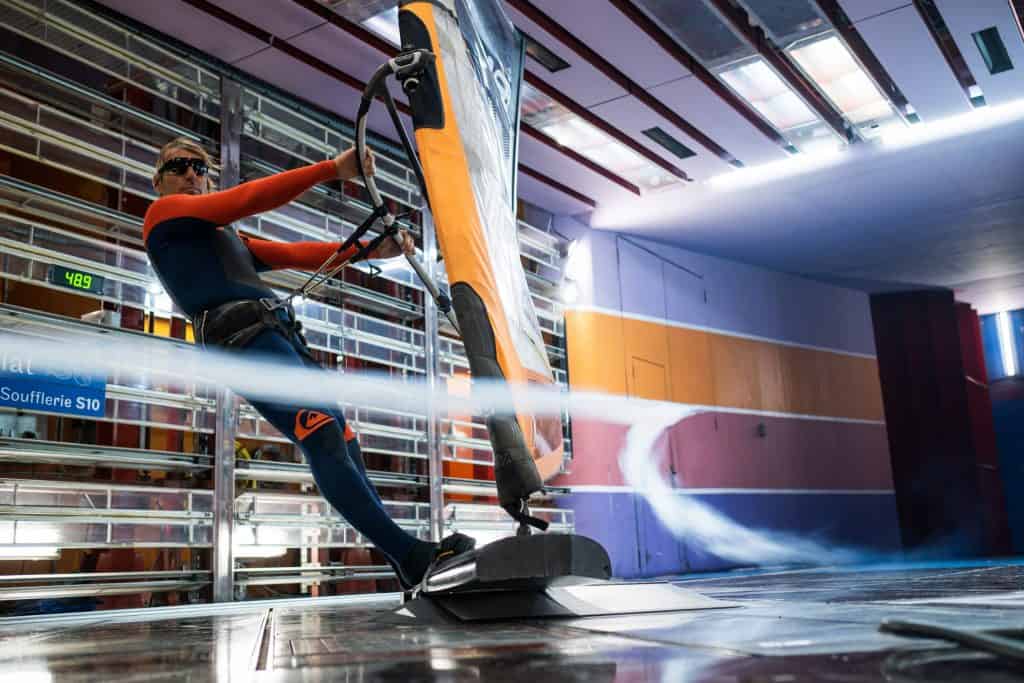
I think they're using the tunnel to design a special drag-reducing suit for AA. The sail is just there to accelerate air over the suit and to ensure AA is holding the correct pose.

Select to expand quoteIan K said..
And then there's the twist in the apparent wind as you go up the mast. Not going to replicate that in a tunnel.
I think they're using the tunnel to design a special drag-reducing suit for AA. The sail is just there to accelerate air over the suit and to ensure AA is holding the correct pose.
Yep. But isn't the change in apparent wind as you go up the sail more to do with the surface induced boundary layer anyhow?
I recon you are spot on about the testing of body aero being the main aim.
I would be very chuffed if we could just see pictures or videos of evenly spaced smoke lines from bottom to top flowing over the sail under full load. 
Select to expand quotesailquik said..Ian K said..
And then there's the twist in the apparent wind as you go up the mast. Not going to replicate that in a tunnel.
I think they're using the tunnel to design a special drag-reducing suit for AA. The sail is just there to accelerate air over the suit and to ensure AA is holding the correct pose.
Yep. But isn't the change in apparent wind as you go up the sail more to do with the surface induced boundary layer anyhow?
I recon you are spot on about the testing of body aero being the main aim.
I would be very chuffed if we could just see pictures or videos of evenly spaced smoke lines from bottom to top flowing over the sail under full load.
If you scan the videos from the windtunnel close enough you'll find it. They don't focus on it but it's there Daffy...even for your old eyes!
Select to expand quotesailquik said..
Yep. But isn't the change in apparent wind as you go up the sail more to do with the surface induced boundary layer anyhow?
The changing apparent wind angle with height is the combination of board velocity and variation of true wind strength with height. Unless you build a very wide wind tunnel you can't have board velocity. Like flying the sail on the beach with the mast foot in the sand. ( though I had a go at the apparent wind geometry once, the variation in apparent wind with height is there but not enough to explain the amount of twist in sails. )
A wind tunnel would be good for looking at completely new formats, but in the long run you can't beat trial and error. The small soft sails used on wind surfers evolve pretty quickly, get the pro to try something, send it back to the loft, try again an hour later, don't even have to wait for the glue to dry.
The F1 guys don't spare the expense when building windtunnels, to get around the boundary layer build up that would play havoc with low down aerodynamics they put a conveyer belt on the floor!
Select to expand quoteRoo said..
If you scan the videos from the windtunnel close enough you'll find it. They don't focus on it but it's there Daffy...even for your old eyes!
If you mean the single smoke line, I saw that, even through my bad eye. Not much info there......
OK. So boundary layer is directly responsible for increase of wind velocity with height from surface. Thats what I said.
But I hadn't thought so much about board speed and the reltionship with the surface boundary layer. That F1 wind tunnel explanation is quite an eye opener. Thanks Ian. 
I have posted before about observing Lindsay Cunningham doing a wind shear measurement at Sandy Point many years ago, before they built Yellow Pages, using a very tall pole with pitot tubes at different heights. YP and MI's wings has only a subtle twist.
Select to expand quotesailquik said..Roo said..
If you scan the videos from the windtunnel close enough you'll find it. They don't focus on it but it's there Daffy...even for your old eyes!
If you mean the single smoke line, I saw that, even through my bad eye. Not much info there......
There's multiple videos online from the different windtunnels, both with a cutdown sail and full sized one. You'll have to search around to find them.
Select to expand quoteRoo said..
There's multiple videos online from the different windtunnels, both with a cutdown sail and full sized one. You'll have to search around to find them.
Ahhh, thanks.... I think.......
Select to expand quotesailquik said..Ian K said..
And then there's the twist in the apparent wind as you go up the mast. Not going to replicate that in a tunnel.
I think they're using the tunnel to design a special drag-reducing suit for AA. The sail is just there to accelerate air over the suit and to ensure AA is holding the correct pose.
I recon you are spot on about the testing of body aero being the main aim.
If he tried an underhand front grip it might help
Had a bit of time over the holidays to analyse the video and reports coming out of the Zephir project, got some feedback from their foil designer as well. If you look closely at all the data they have released it slowly becomes obvious the direction they are heading. They will be running in fairly flat water with a targeted wind in the 20 to 30 knot range, with a tight course around 120 degrees. Pretty much the same parameters Sailrocket was optimised for.
It won't be foiling craft along the lines of the current windfoil setup, as the foil designer said foils won't work for speed records. Cavitation and stability limit speeds to well under the 65 knots. Also the current system isn't inherently stable, the faster you go the less reaction time you have for pitch control. Also cavitation effects aren't consistent and are unstable.
To get stability and control you have to enlarge the platform of the vessel. What this allows is greater leverage and increased loading of foil/fin setup. If you look at Sailrocket you can see how far the rig/wing is away from the supercav fin. That's what they will be trying to do with the Zephir. To still use a conventional style windsurfing rig you need a semi rigid sail/wing for smooth constant power and a longer board/sled to mount it on. The sailor can still operate it in the conventional way but will have to be a bit lighter than Antoine's current poundage to rise up out of the water, hence testing a smaller/lighter sailor in the windtunnel. Also the angle they canted over the rig and sailor give you an indication they are looking at a similar physics model to what Sailrocket used. Will be interesting to see how it all develops.

Select to expand quoteRoo said..
Had a bit of time over the holidays to analyse the video and reports coming out of the Zephir project, got some feedback from their foil designer as well. If you look closely at all the data they have released it slowly becomes obvious the direction they are heading. They will be running in fairly flat water with a targeted wind in the 20 to 30 knot range, with a tight course around 120 degrees. Pretty much the same parameters Sailrocket was optimised for.
It won't be foiling craft along the lines of the current windfoil setup, as the foil designer said foils won't work for speed records. Cavitation and stability limit speeds to well under the 65 knots. Also the current system isn't inherently stable, the faster you go the less reaction time you have for pitch control. Also cavitation effects aren't consistent and are unstable.
To get stability and control you have to enlarge the platform of the vessel. What this allows is greater leverage and increased loading of foil/fin setup. If you look at Sailrocket you can see how far the rig/wing is away from the supercav fin. That's what they will be trying to do with the Zephir. To still use a conventional style windsurfing rig you need a semi rigid sail/wing for smooth constant power and a longer board/sled to mount it on. The sailor can still operate it in the conventional way but will have to be a bit lighter than Antoine's current poundage to rise up out of the water, hence testing a smaller/lighter sailor in the windtunnel. Also the angle they canted over the rig and sailor give you an indication they are looking at a similar physics model to what Sailrocket used. Will be interesting to see how it all develops.
Do you have idea how "board" will looks like?
Only way to increase righting moment,is place sailor more outward ,but then boom must be wider as well.

Unless the mast was fixed in the upright position moving your body away from it on a wider platform really wouldn't help. And even if it was fixed it would need to be a very wide platform to make any significant gain.
Roo said: "......Also the angle they canted over the rig and sailor give you an indication they are looking at a similar physics model to what Sailrocket used. Will be interesting to see how it all develops."
It should be the logical starting point. After sailrocket's record smashing run I wondered whether a more human/windsurfer sized craft along the same principles may be better. It took sailrocket years, 2 versions and no doubt hundreds of thousands of dollars to go from struggling to get to 30knots to 65knots. With size came logistical problems. A smaller version with a skilled human using reflexes for control may allow for quicker optimization and more opportunity for record speeds. But stacking at those speeds on water will be quite hazardous.
Select to expand quoteBen1973 said..
Unless the mast was fixed in the upright position moving your body away from it on a wider platform really wouldn't help. And even if it was fixed it would need to be a very wide platform to make any significant gain.
It is proportional,if you move your body out for double ,then righting moment is double as well.Then you can hold double sail power..
Select to expand quoteUSA46 said..Ben1973 said..
Unless the mast was fixed in the upright position moving your body away from it on a wider platform really wouldn't help. And even if it was fixed it would need to be a very wide platform to make any significant gain.
It is proportional,if you move your body out for double ,then righting moment is double as well.Then you can hold double sail power..
Yes but,
if your using the board for leverage the mast would have to be fixed to the board with no UJ. On a wide board now if it was fixed your level is only about a foot long working against a mast that's 5m long, not much advantage there, even going out a meter is not going to make much difference and your going to need a really wide boom.
has he actually said he's going to use something that could be concidered a windsurfer
Select to expand quoteBen1973 said..
Yes but,
if your using the board for leverage the mast would have to be fixed to the board with no UJ. On a wide board now if it was fixed your level is only about a foot long working against a mast that's 5m long, not much advantage there, even going out a meter is not going to make much difference and your going to need a really wide boom.
has he actually said he's going to use something that could be concidered a windsurfer
You dont leverage mast/sail with board, because UJ cant transfer moment.You leverage through boom...
(assumption : if you transfer all your weight to harness lines)
roughly calc.
If you are 1m out ,then Fsail=50kg
if you are 0.3m out,then Fsail=15kg
etc