Select to expand quoteelmo said..
Simple rule of thumb
Might has the right.
However, there's an "if" to be wary of. If you have the "right of way" (or are "Stand on vessel" according to Colregs) and then dodge to avoid a bigger vessel, sometimes you can get the issue we all encounter on the footpath; where each person dodges the same way trying to avoid the other, then they each dodge back the same way, and so on. There was recently a yacht racing incident in QLD where a starboard tacker tried to avoid a port tacker by bearing away, just when the port tacker was bearing away to avoid the starboard tacker. The ensuing collision wrote off a 40 foot yacht.
The law says* that in such cases, the boat that is most in the wrong is the one that had "right of way" and altered course in a way that stopped the other boat from keeping clear. The rule that says that a "right of way" vessel must behave predictably (by pretty much going in the same speed and course as much as they can) is just as important as the rule that says the other boat must give way.
So if we dodge someone in a cruiser, and he dodges while we dodge so that we both crash into each other, we may be responsible for paying for repairs to his scratched anchor and he may get away without paying for all the damage to our board or body.
* don't rely on this post in court, but it's an accepted principle of maritime law.
Select to expand quoteChris249 said..elmo said..
Simple rule of thumb
Might has the right.
The rule that says that a "right of way" vessel must
Where does the rule say anything about "right of way"? Where in any of the COLREGs is there mention of "right of way"?
Select to expand quoteMikeyS said..Chris249 said..elmo said..
Simple rule of thumb
Might has the right.
The rule that says that a "right of way" vessel must
Where does the rule say anything about "right of way"? Where in any of the COLREGs is there mention of "right of way"?
Nowhere, Mikey. That's exactly why in the previous post I said "they don't even refer to "right of way" any more because that term implied that one vessel was in the right", why I said in my first sentence that the rules refer to "stand on vessel", and why I used quote marks when referring to "right of way" which is the common (but incorrect) term that other people were using.
Unfortunately, even the authorities misuse the term "right of way". It's a pet peeve of mine, because it wrongly makes people believe "I have right of way, therefore I can do what ever I want. It's the other guy who has to give way." It doesn't work like that. The sailing racing rules do use the term "right of way", but of course we ain't talking about that here.
Select to expand quoteSparky said..
I think we have two blind spots. One behind the sail and one behind us. So our view is roughly 100 degrees forward and 100degrees backwards. (depending on the level of osteoarthritis in the neck, and the construction of the sail)
Of course, blind spots won't reduce anyone's overarching responsibility under Rule 5 to keep a proper lookout;
"Every vessel shall at all times maintain a proper look-out by sight and hearing as well as by all available means appropriate in the prevailing circumstances and conditions so as to make a full appraisal of the situation and or the risk of collision."
I didn't see them because of my salty window, or my osteoarthritis, or that I'm still recovering from whiplash after the last catapult, counts for squat.
I think that I'll leave what happened and how with the guys doing the investigation to the incidents rather than make assumptions, probably would be good to understand why the boat skippers did or did not see the guys.
Last few days been sailing Melville and have noticed how much of a blind spot we actually do have. Sailing Port tack as was another sailor with us being about 100m apart, we came 1 metre from colliding as we were converging with me sailing slightly off the wind and the other tight to the wind. We spoke about it afterwards and both of us scanned in front and as much as we could and around before we set of on the run, even after what my fellow windsurfer and I thought was a comprehensive scan it didn't help and was a close shave.
Close to the same happened a couple days ago but this time I was far enough out on a starboard tack to notice another sailor going for a speed run upwind from me on starboard, scared poor old P Dann as he did not see me but all was safe as I slowed right down letting him pass through.
We all talk in knts on how fast we go but for every sec at 28knts we travel 14m, collisions can happen real fast, for me personally I really don't care if I am the stand on vessel when there are boats in the vicinity, I let them pass, last thing I want is to have gear failure or a wind shadow in front of a large boat.
Like Hards has said it's the ones we don't see, so how do we address our issue first of not being able to see is the million dollar question, as it's not just the boats we have to worry about but also ourselves when sailing in close quarters.
Just stay safe guys watch out for each other watch out for boat/windsurfer traffic whether you are stand on vessel or not, lets hope the boaties have there eyes out for us as well, but to be perfectly honest they probably do the same as what we do focused on whats in front when the waves and wind are up.
Select to expand quoteChris249 said.. The rule that says that a "right of way" vessel must behave predictably (by pretty much going in the same speed and course as much as they can) is just as important as the rule that says the other boat must give way.
Well put.
That is my issue with the people saying "just give way to everyone". NO it creates confusion.
These incidents in Perth with sail crossing a channel perpendicular and the motor boat hitting them is the clearest case of a simple rule violation, and the fact its not uncommon now is very concerning. The answer is not for us to try and give way to everything, then nobody has a clue what will happen next - and it gets worse.
The boat driver has a more clear view, has no excuse for not seeing a sail approaching from left or right at 500m away, no excuse to not see it will cross his path and no excuse to not vary his speed to avoid conflict.
If we all behave randomly - we give him an excuse for hitting PM33 or Neil and ****ing up their day. Month.... year......
Then all the idiot boat drives say windsurfers always turn before the channel or always stop or mostly umm errr I though maybe he would too....
If you are crossing the channel, the power needs to yield. Hold your line.
Obviously keep a lookout for the ones that won't.... but don't give way to everyone as you are doing us all a disservice.
Select to expand quoteMark _australia said..
If you are crossing the channel, the power needs to yield. Hold your line.
Do you know that for a fact, I think the opposite but I don't know for sure and this discussion is creating doubts about things I thought I knew, it would be good to have some expert clarification.
Select to expand quotecammd said..Mark _australia said..
If you are crossing the channel, the power needs to yield. Hold your line.
Do you know that for a fact, I think the opposite but I don't know for sure and this discussion is creating doubts about things I thought I knew, it would be good to have some expert clarification.
I think if in WA in traversing narrow channels, then under the law this will apply, so read this and follow the rules:
Rule 9 - Narrow channels
(a) A vessel proceeding along the course of a narrow channel or fairway shall keep as near to the outer limit of the channel or fairway which lies on her starboard side as is safe and practicable.
(b) A vessel of less than 20 metres in length or a sailing vessel shall not impede the passage of a vessel which can safely navigate only within a narrow channel or fairway.
(c) A vessel engaged in fishing shall not impede the passage of any other vessel navigating within a narrow channel or fairway.
(d) A vessel shall not cross a narrow channel or fairway if such crossing impedes the passage of a vessel which can safely navigate only within such channel or fairway. The latter vessel may use the sound signal prescribed in Rule 34(d) if in doubt as to the intention of the crossing vessel.
(e) (i) In a narrow channel or fairway when overtaking can take place only if the vessel to be overtaken has to take action to permit safe passing, the vessel intending to overtake shall indicate her intention by sounding the appropriate signal prescribed in Rule 34(c)(i). The vessel to be overtaken shall, if in agreement, sound the appropriate signal prescribed in Rule 34(c)(ii) and take steps to permit safe passing. If in doubt she may sound the signals prescribed in Rule 34(d).
(ii) This Rule does not relieve the overtaking vessel of her obligation under Rule 13.
(f) A vessel nearing a bend or an area of a narrow channel or fairway where other vessels may be obscured by an intervening obstruction shall navigate with particular alertness and caution and shall sound the appropriate signal prescribed in Rule 34(e).
(g) Any vessel shall, if the circumstances of the case admit, avoid anchoring in a narrow channel.
The refer to:
Rule 18 - Responsibilities between vessels
Except where Rules 9, 10 and 13 otherwise require:
(a) A power driven vessel underway shall keep out of the way of:
(i) a vessel not under command;
(ii) a vessel restricted in her ability to manoeuvre;
(iii) a vessel engaged in fishing;
(iv) a sailing vessel.
(b) A sailing vessel underway shall keep out of the way of:
(i) a vessel not under command;
(ii) a vessel restricted in her ability to manoeuvre;
(iii) a vessel engaged in fishing.
(c) A vessel engaged in fishing when underway shall, so far as possible, keep out of the way of:
(i) a vessel not under command;
(ii) a vessel restricted in her ability to manoeuvre.
(d) (i) Any vessel other than a vessel not under command or a vessel restricted in her ability to manoeuvre shall, if the circumstances of the case admit, avoid impeding the safe passage of a vessel constrained by her draught, exhibiting the signals in Rule 28.
(ii) A vessel constrained by her draught shall navigate with particular caution having full regard to her special condition.
(e) A seaplane on the water shall, in general, keep well clear of all vessels and avoid impeding their navigation. In circumstances, however, where risk of collision exists, she shall comply with the Rules of this Part.
(f) (i) A WIG craft shall, when taking off, landing and in flight near the surface, keep well clear of all other vessels and avoid impeding their navigation.
(ii) A WIG craft operating on the water surface shall comply with the Rules of this Part as if it were a power driven vessel.
[Rule 18 amended: Gazette 27 May 2005 p. 2297.]
I don't believe Mark is correct unless of course he is referring to a wide channel outside Rule 9.
I believe, unless I missed it, that similar rules exist in Qld and other states.
I think the rules that you cited are general rules that apply world-wide, even if they may be formulated differently. The interesting on is rule 9b:Select to expand quoteRichardG said..
Rule 9 - Narrow channels
(b) A vessel of less than 20 metres in length or a sailing vessel shall not impede the passage of a vessel which can safely navigate only within a narrow channel or fairway.
At a location that is known to have shallow sand bars, a responsible boater should assume that he can safely navigate only in the channel. Even if he has a depth map, sand bars move. We see boats who left a shipping channel ending up stranded on a sand bar near our launch on a somewhat regular basis.
Maybe I am playing devil's advocate here, but it seems the situation is not quite as obvious as it seemed at first glance. The boater may have had good reason to think he was the "Stand-On" vehicle when he was hit by a windsurfer. The Stand-On vessel "must maintain current course and speed". Even if the boater saw the windsurfer, he may have correctly thought that he should hold his course and speed.
As soon as the situation becomes dangerous, both vessels have the obligation to change course and/or speed to avoid an accident. A windsurfer can change both course and speed faster than a 15-foot boat, especially a boat is in a channel. This means that if a collision becomes likely when crossing a channel, the windsurfer may be the only one who can avoid it.
Another complication is that windsurfers never travel at constant speed. Even when just cruising on a constant course, our speed varies much more than the speed of motor boats. At gusty places like Melville, this is especially true. If a boater sees a windsurfer on a collision course while the windsurfer is in a lull, he may come to the conclusion that the windsurfer will pass behind him. But if the windsurfer then accelerates in a gust, this can easily move the intersection of the paths by 10 or 20 meters, and lead to a collision. Even if the boater would notice the speed-up, there is nothing he can do to avoid it. If he would get off the gas and the boat would slow down, that would only increase the chance that the boat would run over the windsurfer, instead of the windsurfer hitting the boat from the side.
In the end, it does not matter is the boater is an idiot, or if he has the right of way and acts as he thinks he should - the end result is the same. You can't change what the other guys do (unless the speed limits are lowered and adhered to!), so only the windsurfers can avoid such accidents. Being aware of blind spots when crossing boating channels is critical.
At traffic lights ALL turning vehicles must give way to pedestrians.
But
If you see someone who isn't about to stop, will you righteously step out on the road knowing the law is on your side? Yes or no?
It doesn't matter if you have the right of way or not, if you get hit by a boat, you may scratch the boat, but the boat is gunna FLICK you up.
A mate of mine still carries the gouges up one side from a propeller he got hit with in the 70's.
Be observant, don't take for granted that they have seen you or that they will do the right thing
It's just common sense (but then again that's not all that common)
In the right of way...rules...a vessel, is a sailboard or paddle board actually considered a vessel ?
this thread is rather like preaching to the choir.
the gentleman who pointed out , that in a Auto it's your responsibility to avoid a collision, real world thinking, this isn't always a option to avoid a crash , and at times going off the road to avoid a crash isn't always the best option.
First is avoid, the right of way rule, at your funeral could then be discussed.
first safety rule for me is a helmet.
Select to expand quoteforceten said..
In the right of way...rules...a vessel, is a sailboard or paddle board actually considered a vessel ?.......
In Western Australia it is clear that a vessel includes a windsurfer and it seems a paddle board. Clearly a paddle board is not a sailing vessel however whereas a sailing vessel includes as I read the definitions a windsurfer. What are the rules in your state/jurisdiction ? Where is that ?
Rule 3 - General definitions
For the purpose of these Rules, except where the context otherwise requires: -
(a) The word "vessel" includes every description of water craft, including non-displacement craft, WIG craft and seaplanes, used or capable of being used as a means of transportation on water.
(b) The term "power driven vessel" means any vessel propelled by machinery.
(c) The term "sailing vessel" means any vessel under sail provided that propelling machinery, if fitted, is not being used.
(d) The term "vessel engaged in fishing" means any vessel fishing with nets, lines, trawls or other fishing apparatus which restrict the manoeuvrability, but does not include a vessel fishing with trolling lines or other fishing apparatus which do not restrict manoeuvrability.
(e) The word "seaplane" includes any aircraft designed to manoeuvre on the water.
(f) The term "vessel not under command" means a vessel which through some exceptional circumstance is unable to manoeuvre as required by these Rules and is therefore unable to keep out of the way of another vessel.
(g) The term "vessel restricted in her ability to manoeuvre" means a vessel which from the nature of her work is restricted in her ability to manoeuvre as required by these Rules and is therefore unable to keep out of the way of another vessel. The term shall include but not be limited to:
(i) a vessel engaged in laying, servicing or picking up a navigation mark, submarine cable or pipeline;
(ii) a vessel engaged in dredging, surveying or underwater operations;
(iii) a vessel engaged in replenishment or transferring persons, provisions or cargo while underway;
(iv) a vessel engaged in the launching or recovery of aircraft;
(v) a vessel engaged in mine clearance operations;
(vi) a vessel engaged in a towing operation such as severely restricts the towing vessel and her tow in their ability to deviate from their course.
(h) The term "vessel constrained by her draught" means a power driven vessel which because of her draught in relation to the available depth and width of navigable water is severely restricted in her ability to deviate from the course she is following.
(i) The word "underway" means that a vessel is not at anchor, or made fast to the shore, or aground.
(j) The words "length" and "breadth" of a vessel means her length overall and greatest breadth.
(k) Vessels shall be deemed to be in sight of one another only when one can be observed visually from the other.
(l) The term "restricted visibility" means any condition in which visibility is restricted by fog, mist, falling snow, heavy rainstorms, sandstorms or any other similar causes.
(m) The term WIG craft means a multimodal craft which, in its main operational mode, flies in close operational proximity to the surface by utilising surface effect action.
[Rule 3 amended: Gazette 27 May 2005 p. 2296.]
I'm going off what is on the DPI website here in WA and they make the rules.
Also going off what has existed for 100 years that power gives way to sail.
The exceptions are only for narrow channel or otherwise limited manouverability for the power boat - which does not apply here. Its a big big channel where we are sailing.
The DPI link was posted in the other thread someplace.
Now I'm just confused by Richard 
Select to expand quoteMark _australia said..
I'm going off what is on the DPI website here in WA and they make the rules.
Also going off what has existed for 100 years that power gives way to sail.
The exceptions are only for narrow channel or otherwise limited manouverability for the power boat - which does not apply here. Its a big big channel where we are sailing.
The DPI link was posted in the other thread someplace.
Now I'm just confused by Richard
Mark it is correct to say, in simple terms:
"In general, powered vessels should give way to sail.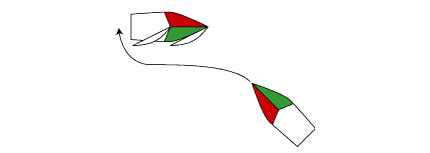
However, everyone has a responsibility to avoid collisions so, even if the rules require another vessel to keep out of your way, you must be ready to take action yourself to avoid a collision."
see: www.transport.wa.gov.au/imarine/rules-of-the-road.asp
The above is a summary but not a full substitute for the law of WA which is as found at:
classic.austlii.edu.au/au/legis/wa/consol_reg/pocasr1983435/index.html#s5
It is not correct to say, that power always gives way to sail although that is generally true. There are exceptions to the general rule for power giving way to sail eg narrow channels, commercial vessels etc. I express no view on where a narrow channel is or is not in any particular case. However, everyone has a responsibility to avoid collisions so, even if the rules require another vessel to keep out of your way, you must be ready to take action yourself to avoid a collision. In practice I prefer to sail on the ocean where I see few powerboats. I do race on the river on a Windsurfer LT and there are many powerboats that annoyingly get in the way and sail into the start line and in the course when we are racing, but many times I have to avoid them as they are generally idiots. Also they seem to delight in interfering with the course progress of a race and viewing the racers thinking it is fun to make waves on the course for us. I take evasive action and don't want to get injured, lose more time in the race than necessary nor be a fatality. It is easier for a longboard to keep out of the way of a power boat however.
Seems to be the majority on here tend to give way to boats, might has right, style of thinking when crossing boating channels in rivers around Aust.
I think its the safest attitude to have over holding your line to try and enforce or prove the rules.
Especially with all the clauses in the rules to try and consider in a few seconds......is it a commercial boat? Is it a fishing boat and if it is do they have lines out? I think this is a wide channel but does the boatie think its narrow?
A lot to consider if the boats in the glare of the sun or you can only see it when quickly checking your blind spots etc
It only takes a second to slow down and let the boat through and then at least you know you are safe.
It might not be what the rules say, but seems the safest option so you get to go home to your wife and kids and sail again the next day.
Especially when most boaties in a channel drive it like a highway in their car, looking straight ahead.
I don't windsurf on the river, but i've done a lot of sailing on it.
I still get out occasionally on the yachts and bigger stink boats and i will say that the visibilty of windsurfers is very poor.
Picking them up near the shorelines is easier but once out in the middle of the river our footprint is tiny.
You cant make out the boards due to line of sight in the chop and usually the only think marking us out there is the Luff fabric .
When bigger boats are looking out for other bigger boats or boats "racing" id presume that a windsurfer blasting back and forth are of less concern.
^^ Anita, both didn't see the boat so they could not give way to it even if they wanted to.
There is a reason way back in the day they decided power should give way - they have better visibility of at least 180deg, and a throttle. (except for a few circumstances where they simply can't give way, as pointed out)
A powerboat skipper has a far better chance of seeing a windsurfer than the other way around.
Great Discussion.
The issues are around what we can control and what we can't.
What stands out for me, is our Blind Spot/s. That's our big vulnerability.
We've got such a large wise, and clever community, this is our challenge.
WE need a Blind Spot Solution , c'morrn you great minds, get cracking
If we can resolve this, we give ourselves much more control over avoiding collisions.
I think your right hardie,
I think there is only 3 solutions in these now well over crowded metro spots that have reached capacity saturation of water uses.
1) Like you have said, fix the blind spot issue.
2) A segregation of power and sail. A buoyed off area ie. boat no go zone, like what has worked at a spot separating kite and boardsailors .
or, the saddest one
3) What WILL eventually happen, because its only going to get busier, a 3knt restriction on ALL vessels that the local councils etc. end up enforcing on us for the safety of all general public water uses in these over populated spots.
Time for a solution instead of blame throwing and rule quoting as it will not fix the problem.
My two solutions of being a vunurable windsurfer are ,
1 , look out as much as you can especially when jybing or tacking ,
2 , If your getting close , give obvious way first and grump later ,
Unfortunately accidents happen and everyone goofs off from time to time. ( some kiters more than others, hey lotto )?This is an out of controll situation that does happen .
Because it is such a complex , who gets right of way thing , and there is no way of teaching and implementing everyone of these rules , I go to my second rule.
lol
Your rule number 2 works the best. Better to grump later than be dead.
And you last sentence show great intellectual intelligence, for a cheeky pussy. purrrrrr
to my mind the blind spot is already resolved.
The rules take it into account - hence why power gives way most of the time .... due to our blind spot and no throttle, same as yachts.
Analogy - blind spot in your car is mitigated by rules for merging and changing lanes etc. The idiot who chooses to ignore needs to be charged by authorities and/or civilly liable. In the latter they can apportion blame so its not like its 100% the boaties' fault it might be 70/30 or 50/50. But in the PM33 and Neil examples it will surely be far far weighted against the powerboat skipper.
On the Swan, go to Melville where you are not crossing a channel every run. Or choose to go to Pelican Pt as its less gusty and so on -but partly accept the boat risk.
A bit like if you want flat water, accept the idiot kiter factor at the pond.... or if not go elsewhere.
Still find it ironic that when kiter/windsurfer segregation was mentioned a certain troll was all full of vitriol. Now segregation is a good thing...?
When ROW was mentioned its all "old slow windsurfer haha we boost over youse"
ROW in these threads a couple of years later "we don't know the rules so we ignore them lol" But now he knows all the rules.
Now he's an expert. Wow.
This thread has taught me a lot. No I don't know all the rules lol, but have learnt there is a lot of different interpretations of them going on.
Surely you would agree that, if what you say about me is true, that Im a dangerous, reckless no good kiter, than surely its good Im here learning and offering solutions ?
Seems your unhappy if I joke and muck around, or be serious . I don't understand why you are so angry that Im trying to be more responsible ?
Anyway PM me if you want to chat, once again,this thread is not about our banter.
Select to expand quoteMark _australia said..
to my mind the blind spot is already resolved.
The rules take it into account - hence why power gives way most of the time .... due to our blind spot and no throttle, same as yachts.
Analogy - blind spot in your car is mitigated by rules for merging and changing lanes etc. The idiot who chooses to ignore needs to be charged by authorities and/or civilly liable. In the latter they can apportion blame so its not like its 100% the boaties' fault it might be 70/30 or 50/50. But in the PM33 and Neil examples it will surely be far far weighted against the powerboat skipper.
On the Swan, go to Melville where you are not crossing a channel every run. Or choose to go to Pelican Pt as its less gusty and so on -but partly accept the boat risk.
A bit like if you want flat water, accept the idiot kiter factor at the pond.... or if not go elsewhere.
Still find it ironic that when kiter/windsurfer segregation was mentioned a certain troll was all full of vitriol. Now segregation is a good thing...?
When ROW was mentioned its all "old slow windsurfer haha we boost over youse"
ROW in these threads a couple of years later "we don't know the rules so we ignore them lol" But now he knows all the rules.
Now he's an expert. Wow.
Mark I actually tried to look up why power gives way to sail, considering the rule has been in play let's say 50yrs I don't think windsurfers were part of the equation. Could it be that the rule was due to the the sail boats being slow and having to tack etc or they might have blind spots, I wouldn't be too sure that because we have blind spots that the rules take this into account and would expect that we sail to the conditions I.e if you cannot see slow down or whatever it takes.
It's not just Peli that there is an issue, Point Walter easterlies or just cruising most of the swan, the 90 deg travel yes happens on reaching but when going upwind or broad runs we can go through the whole 180 deg of sailing.
I see on a constant basis near misses between sailors and to say the regs cover our blind spots will not help the poor souls who collide at 35knts, it's an issue.
Melville in particular as the two speed runs intersect one from Port side the other from Starboard (yes starboard has right of way but when you can't see them is when this whole conversation comes into play)
i do sail the river but dutchies is my preferred location even for slalom, only issue there is those bloody speed humps late in the day hard to see when travelling into the sun, don't worry a few have had a few choice words to say, probably scared the bejeusus while they are meditating while paddling.??
Neil is a good mate and I sail with him often and will do again when he gets better, Incedents like this one should bring us all together and come up with what is safe for all of us rather than debate ColRegs as I think we all know what they are but they are not keeping us safe from idiots out there.
Select to expand quoteMark _australia said..
There is a reason way back in the day they decided power should give way - they have better visibility of at least 180deg, and a throttle. (except for a few circumstances where they simply can't give way, as pointed out)
A powerboat skipper has a far better chance of seeing a windsurfer than the other way around.
Exactly,they have uninterrupted vision,whilst windsurfers can see in front of us uninterrupted 180 degrees.
Sailors at Pelican Point sail around 90 degrees to the boats heading towards Fremantle or coming back the other way.
The danger factor is therefore great,not just of collision but were a accident to happen the damage is very likely going to be severe.
I think both the boats that contacted us did so a little forward of the centre of our boards.
My accident the damage to the side of my board was around a few feet forward of the mast track.
The boat must then have then passed the nose of my board and I was catapulted in the harness lines at supersonic speed
When I got flung forward my left knee has left a large indentation mark where it contacted the board. My kneecap shattered instantly and my fema snapped too. Certain my body made no contact at all with the boat.
Any boat that makes contact with the middle of the board - the injuries are going to be a lot more severe than ours.
Between the tail and the middle I'm afraid instant death at best.
I just don't see how you could possibly survive a full contact with a boat travelling 90 degrees or thereabouts to you and making flush contact.
Impossible I'll ever sail there again after the second accident.
With the increasing flow of boat traffic there and windsurfers travelling 90 degrees to them a fatal is more likely than not.
I do not want to sail with fear constantly on my mind so I'll stick to Melville where the shallow depth means there are no boats.
Select to expand quoteAus501 Boz said..
Could it be that the rule was due to the the sail boats being slow and having to tack etc or they might have blind spots, I wouldn't be too sure that because we have blind spots that the rules take this into account and would expect that we sail to the conditions I.e if you cannot see slow down or whatever it takes.
The basic principle behind many of the rules is that the more maneuverable boat gives way to the less maneuverable boat. That's way "vessels not under command" are on top of the list - they cannot change course and direction. Similarly, large boats, fishing boats actively fishing, and boats in channels are restricted in how much or how fast they can maneuver, and thus get a spot higher on the list. It seems like a safe bet that blind spots did not factor into the rules.
All this does make me think of how many kms I have done at Pelican point over the past year, all the way out and back. And after all that time I did notice a medium sized boat on Saturday (for the first time ever?) it eased off its throttle and let me go past. Maybe they have talked about the windsurfer incidents as we are here.