Gestalt asked : got me thinking whether brass screws for the brass inserts would be strong enough.
By experience, answer is no.
One of the local sailors who knew absolutely nothing about the technical aspects of windsurf boards (but could sell pastries as his normal job), used brass screws on one of his boards after a SS screw failure and they failed under load almost immediately.
Select to expand quoteWindmanV said..
Gestalt asked : got me thinking whether brass screws for the brass inserts would be strong enough.
By experience, answer is no.
One of the local sailors who knew absolutely nothing about the technical aspects of windsurf boards (but could sell pastries as his normal job), used brass screws on one of his boards after a SS screw failure and they failed under load almost immediately.
Thx
Good to know..
Select to expand quotelemat said..Gestalt said..AI.Dave said..
corrosion and stuck/broken screws with the finer threads and metal to metal contact?
It depends on the type of stainless steel screw being used with the brass. both brass (sanded) and titanium (Flikka) are excellent in saltwater environments. I specify lights for coastal architecture and use a local company that specialises in brass fittings which offer good warranty.everything else just falls off the buildings.
titanium is even better..
the issue is galvanic corrosion between the stainless steel and brass insert.. marine grade 316 is ok but the brass will corrode over time. I think Flikka uses all titanium so that's not going to experience galvanic corrosion. You don't want to use titanium with brass. Flikka also use titanium because it's light.
got me thinking whether brass screws for the brass inserts would be strong enough.
Edit..looks like m6 brass screws are available with hex head. Maybe with deox r81 anti seize.
I done some insert with A4 (marine grade) stainless claw nuts set in forex plate and laminate both side. With A4 screws no problems. Brass insert should work too, it work with fins. With a little neutral grease on screw before set even better. Galvanic corrosion is a far bigger problem with aluminium.
I wouldn't mind trying something like this or the big head fittings but the cost is steep compared to the sanded inserts. FWIW the sanded type inserts are also available eBay for about $3 per plug.
Select to expand quoteGestalt said..lemat said..Gestalt said..AI.Dave said..
corrosion and stuck/broken screws with the finer threads and metal to metal contact?
It depends on the type of stainless steel screw being used with the brass. both brass (sanded) and titanium (Flikka) are excellent in saltwater environments. I specify lights for coastal architecture and use a local company that specialises in brass fittings which offer good warranty.everything else just falls off the buildings.
titanium is even better..
the issue is galvanic corrosion between the stainless steel and brass insert.. marine grade 316 is ok but the brass will corrode over time. I think Flikka uses all titanium so that's not going to experience galvanic corrosion. You don't want to use titanium with brass. Flikka also use titanium because it's light.
got me thinking whether brass screws for the brass inserts would be strong enough.
Edit..looks like m6 brass screws are available with hex head. Maybe with deox r81 anti seize.
I done some insert with A4 (marine grade) stainless claw nuts set in forex plate and laminate both side. With A4 screws no problems. Brass insert should work too, it work with fins. With a little neutral grease on screw before set even better. Galvanic corrosion is a far bigger problem with aluminium.
I wouldn't mid trying something like this or the big head fittings but the cost is steep compared to the sanded inserts. FWIW the sanded type inserts are also available eBay for about $3 per plug.
For me those plugs looks good. At least better than chinook plastic one's.
Whether the footstrap plug is metal or plastic or something else, isn't the main question -> what matters is how well the plug bonds to the substrate.
- If there is a significant difference in stiffness between two adjacent materials, it will have a natural-fracture-boundary.
- If the surface preparation of the plug is not suitable for structural-adhesion, then it will have a likely-fracture-boundary.
- _all metals_ have some form of rust - if there is any water or air contact to that surface, will cause it to rust to some degree. Rust increases the thickness of the surface which creates a stress point, which results in possible-fracture-boundary. **
** Aluminium and other metals are said to not-rust because the surface layers create a natural ceramic. That ceramic is still an oxidation of the Al metal. Same for Zinc, titanium, etc. It is still rust, just labelled differently.
Big boats have marine-grade stainless steel cleats and fittings. Generally speaking those dont fail, while still being bonded into fibreglass/carbon hulls. So it is possible to do the bonding/embedding with sufficient strength. But big boats aren't weight-constrained so they can use suitable construction techniques.
Windsurf gear is extremely weight-constrained, which limits what we can do to have effective bonding.
I'm not saying it would be the lightest but I've often thought about using something like a US box track for footstraps. Very fine adjustment and you can replace the threaded component easily.
Select to expand quoteGrantmac said..
I'm not saying it would be the lightest but I've often thought about using something like a US box track for footstraps. Very fine adjustment and you can replace the threaded component easily.
I see a DIY wingfoil board with something like that, small US box like plugs so the guy can adjust straps, a problem for wingfoiler when they start using strap for jump after long time strapless. If i remenber well he build is plug with 3D printer.
Keeping with foot strap inserts and interesting using tracks 
Specifically metal inserts, Agree use stainless 316 grade.
A long time ago, I built a couple of wave boards (with offset back inserts).
Used furniture inserts into H80 foam then glassed over, a bit of mucking around to stop resin into threads but worked well and so easy to change compared to conventional inserts.
No problem with jumping but 3 years later the corrosion issue!
I like the furniture insert idea and the track concept.. fwiw I use silicon to fill boxes and plugs to prevent resin getting in.. front straps specifically on a track is really interesting.. as with all this stuff every decision comes with weight penalties.
stainless is not the best for marine environments. best is titanium, by a long shot. then brass.. i get stainless is stronger than brass but it's also heavier and it rusts.. if you do a deep dive into stainless in marine environments you will see it has a very hectic cleaning schedule or it rusts, tea stains etc. titanium unfortunately is very expensive..
I'm going to try brass inserts direct into hd blocks on my next build.. super light and cheap
psmfasteners.com/product/inserts-for-plastics-m6-x-16-sonic-lok-brass-0-size-16mm-psm8600060x16-slbm6-os-16mm/
www.wkooa.com/product/brass-insert-nuts-for-plastic-blind-knurled/?srsltid=AfmBOordZFQjHGXd-fR_vpBuAIr9v0c5DaSJSQhL-tzPlZS8eZG7AHlW
Select to expand quoteGestalt said..
I like the furniture insert idea and the track concept.. fwiw I use silicon to fill boxes and plugs to prevent resin getting in.. front straps specifically on a track is really interesting.. as with all this stuff every decision comes with weight penalties.
stainless is not the best for marine environments. best is titanium, by a long shot. then brass.. i get stainless is stronger than brass but it's also heavier and it rusts.. if you do a deep dive into stainless in marine environments you will see it has a very hectic cleaning schedule or it rusts, tea stains etc. titanium unfortunately is very expensive..
I'm going to try brass inserts direct into hd blocks on my next build.. super light and cheap
psmfasteners.com/product/inserts-for-plastics-m6-x-16-sonic-lok-brass-0-size-16mm-psm8600060x16-slbm6-os-16mm/
www.wkooa.com/product/brass-insert-nuts-for-plastic-blind-knurled/?srsltid=AfmBOordZFQjHGXd-fR_vpBuAIr9v0c5DaSJSQhL-tzPlZS8eZG7AHlW
Brass work well it's easy to find and to work with hand tools. For no rust problems stainless steel must be 316L grade, A4 for screws and must be work with dedicated tools. I see corrosion problems came from use of same tools for working stainless steel and standard steel. Using protective grease for screws is a good habit, even simple vaseline work for that.
Select to expand quotemathew said..
But big boats aren't weight-constrained so they can use suitable construction techniques.
Windsurf gear is extremely weight-constrained, which limits what we can do to have effective bonding.
Umm, sorry, what? Some big racing boats are arguably more weight-restrained than windsurfers. Supermaxis, for example, have no weight controls and huge budgets so the lighter the construction, the better. Many other classes of big boats arguably have more weight constraints and high tech than boards.
Even where the actual weight is restricted by weight limits, the big boat guys can still spend huge sums in reducing hull weight. More than 30 years ago I was standing on a set of carbon fibre Nomex core pre-preg floorboards that sat over the top of a ton or so of internal ballast, When you put that sort of tech into something sitting 10cm above lead, you're clearly optimising weight distribution.
Would any serious big racing boat be built of thick soft foam and the layups we use in boards? They've been into pre-preg Nomex for decades now.
Select to expand quoteGestalt said..
stainless is not the best for marine environments. best is titanium, by a long shot. then brass.. i get stainless is stronger than brass but it's also heavier and it rusts.. if you do a deep dive into stainless in marine environments you will see it has a very hectic cleaning schedule or it rusts, tea stains etc. titanium unfortunately is very expensive..
Titanium was banned for some uses in big boats decades ago because in practise, it fractures easily with no warning. It's been dropped for most uses, AFAIK, because it doesn't do much that isn't better done with carbon or ss.
There's thousands of boats from the '60s and '70s out there with stainless steel bolts holding multi-ton ballast keels with no problems, normally zero cleaning, and years of living in bilge water. I had the keel bolts from one of my yachts pulled when it was 40 years old and most of them were perfectly fine and the other had other issues. I used to work in the industry and never heard of anyone even considering ti bolts for keels, and can't recall them ever being used for critical rigging areas.
I'm no boatbuilder but looking at the areas where people spend vastly much more cash on building lightweight sailing craft (ie $35,000 for the bare hull of a 17 foot singlehander, or $70,000 for a foiling Moth) it's normally a case of using thin cores of Nomex or high density foam with carbon over the top. High-load areas like the rigging attachments are made up very easily and lightly by using carbon tows (strands) epoxied to the carbon skin. I think my brother's 37 foot catamaran has its rigging loads taken by simple carbon tows, which would weigh a few grammes and take far more load than anything any windsurfer ever felt.
I'm not up on windsurfer sailcloth, but I still find it odd that a 5.7m dacron sail from the original Windsurfer is less than 2kg and therefore dramatically lighter than most modern sails. I've noted before here that I've weighed by yacht, dinghy, cat and windsurfer sails and the latter are far heavier for their area and the claims that windsurfer sails are tougher seems to be complete BS - I don't know anyone who both wavesailed and done a tough Sydney-Hobart would claim that. or anyone who would have wound the tension into an F18 cat rig and then stacked it big time in a blow. There may be very good reasons for the extra weight in windsurfer sails but I do wonder whether the board sails are more driven by marketing than boat sails. Certainly windsurfer sail makers keep on claiming that sails have ever-wider ranges but they also keep on writing catalogues that say you need the same number of sails to cover the wind range as they did decades ago, whereas the yachts that have gone to 3DI or modern laminates are showing that using different modern approaches really can increase sail range.
Select to expand quoteChris 249 said..Gestalt said..
stainless is not the best for marine environments. best is titanium, by a long shot. then brass.. i get stainless is stronger than brass but it's also heavier and it rusts.. if you do a deep dive into stainless in marine environments you will see it has a very hectic cleaning schedule or it rusts, tea stains etc. titanium unfortunately is very expensive..
Titanium was banned for some uses in big boats decades ago because in practise, it fractures easily with no warning. It's been dropped for most uses, AFAIK, because it doesn't do much that isn't better done with carbon or ss.
There's thousands of boats from the '60s and '70s out there with stainless steel bolts holding multi-ton ballast keels with no problems, normally zero cleaning, and years of living in bilge water. I had the keel bolts from one of my yachts pulled when it was 40 years old and most of them were perfectly fine and the other had other issues. I used to work in the industry and never heard of anyone even considering ti bolts for keels, and can't recall them ever being used for critical rigging areas.
I'm no boatbuilder but looking at the areas where people spend vastly much more cash on building lightweight sailing craft (ie $35,000 for the bare hull of a 17 foot singlehander, or $70,000 for a foiling Moth) it's normally a case of using thin cores of Nomex or high density foam with carbon over the top. High-load areas like the rigging attachments are made up very easily and lightly by using carbon tows (strands) epoxied to the carbon skin. I think my brother's 37 foot catamaran has its rigging loads taken by simple carbon tows, which would weigh a few grammes and take far more load than anything any windsurfer ever felt.
I'm not up on windsurfer sailcloth, but I still find it odd that a 5.7m dacron sail from the original Windsurfer is less than 2kg and therefore dramatically lighter than most modern sails. I've noted before here that I've weighed by yacht, dinghy, cat and windsurfer sails and the latter are far heavier for their area and the claims that windsurfer sails are tougher seems to be complete BS - I don't know anyone who both wavesailed and done a tough Sydney-Hobart would claim that. or anyone who would have wound the tension into an F18 cat rig and then stacked it big time in a blow. There may be very good reasons for the extra weight in windsurfer sails but I do wonder whether the board sails are more driven by marketing than boat sails. Certainly windsurfer sail makers keep on claiming that sails have ever-wider ranges but they also keep on writing catalogues that say you need the same number of sails to cover the wind range as they did decades ago, whereas the yachts that have gone to 3DI or modern laminates are showing that using different modern approaches really can increase sail range.
Not sure if you noticed but we are talking about windsurfers and not boats. How it makes sense to compare an Lt sail to modern sails I leave to you because that analogy to me makes zero sense.
anyways I'm calling bull **** on your post..
www.samaterials.com/blog/how-is-titanium-used-in-marine.html
www.sail-world.com/news/236027/The-Tech-Inside-AC75-Soft-Wings
some science
www.alekvs.com/stainless-steel-vs-titanium-a-comprehensive-comparison/
Select to expand quoteChris 249 said..mathew said..
But big boats aren't weight-constrained so they can use suitable construction techniques.
Windsurf gear is extremely weight-constrained, which limits what we can do to have effective bonding.
Umm, sorry, what? Some big racing boats are arguably more weight-restrained than windsurfers. Supermaxis, for example, have no weight controls and huge budgets so the lighter the construction, the better. Many other classes of big boats arguably have more weight constraints and high tech than boards.
Even where the actual weight is restricted by weight limits, the big boat guys can still spend huge sums in reducing hull weight. More than 30 years ago I was standing on a set of carbon fibre Nomex core pre-preg floorboards that sat over the top of a ton or so of internal ballast, When you put that sort of tech into something sitting 10cm above lead, you're clearly optimising weight distribution.
Would any serious big racing boat be built of thick soft foam and the layups we use in boards? They've been into pre-preg Nomex for decades now.
As an ex-AC builder and having built plenty of other racing/aerospace parts, I can confirm the level of paranoia around weight saving is very real and borderline absurd at times. But you can't deny the results when you get it right, weight savings = top line performance.
Durability and cost of course are very different conversations. Then there's the human factors involved in getting the most out of nice lightweight kit without destroying it with brute force and ignorance.
Select to expand quoteChris 249 said..
Umm, sorry, what? Some big racing boats are arguably more weight-restrained than
Hell no. Context matters.
You took this mass discussion completely out of context. This discussion is specifically about boards that weight less than 10kg, that are available for us to build or purchase. We are discussing adding 50g to a 6kg hull vs adding 50 grams to a 10 tonne boat.
There are indeed some big-boats which are designed to absolutely minimise strength - that isn't in question. These boats are not available for a weekend-warrior to purchase, so any comparison is silly.
Select to expand quoteChris 249 said..
Would any serious big racing boat be built of thick soft foam and the layups we use in boards? They've been into pre-preg Nomex for decades now.
Yes. Fountaine-Pajot - as a handicap class.
Select to expand quoteBrent in Qld said..Chris 249 said..mathew said..
But big boats aren't weight-constrained so they can use suitable construction techniques.
Windsurf gear is extremely weight-constrained, which limits what we can do to have effective bonding.
Umm, sorry, what? Some big racing boats are arguably more weight-restrained than windsurfers. Supermaxis, for example, have no weight controls and huge budgets so the lighter the construction, the better. Many other classes of big boats arguably have more weight constraints and high tech than boards.
Even where the actual weight is restricted by weight limits, the big boat guys can still spend huge sums in reducing hull weight. More than 30 years ago I was standing on a set of carbon fibre Nomex core pre-preg floorboards that sat over the top of a ton or so of internal ballast, When you put that sort of tech into something sitting 10cm above lead, you're clearly optimising weight distribution.
Would any serious big racing boat be built of thick soft foam and the layups we use in boards? They've been into pre-preg Nomex for decades now.
As an ex-AC builder and having built plenty of other racing/aerospace parts, I can confirm the level of paranoia around weight saving is very real and borderline absurd at times. But you can't deny the results when you get it right, weight savings = top line performance.
Durability and cost of course are very different conversations. Then there's the human factors involved in getting the most out of nice lightweight kit without destroying it with brute force and ignorance.
Exactly, i worked for high tech composits (racing boat, car, plane) guys are able to spend so much money for so little weight reduction... We near only used carbon prepeg and nomex with autoclave.
Each parts cost so much.
Airinside boards are build like that. Even Patrick team don't seem to use them so much for racing. I repair a light slalom board, no name, guys say me that it was a proto for a pro rider from an italian builder. Bottom, rails and nose deck was carbon monolithic build over light foam !
Select to expand quote515 said..
I would like to boards go away from EPS which sucks water to closed cell foam.
Hollow boards have a place for race boards.
Been more into winging and a few companies have closed cell foam such as Appletree and PPC.
Talking to a PPC board rider that their hollow race wing boards have a bulkhead, so they don't sink!
Also seen some home builds using Extruded polystyrene, and on the topic of "gassing" reply comment is that pin holes are your friend.
To your point 515 regards hollow boards.. Naish have released hollow foil boards too.. I wonder how much cost reduction is available if the tech can be up scaled
Select to expand quoteGestalt said..515 said..
I would like to boards go away from EPS which sucks water to closed cell foam.
Hollow boards have a place for race boards.
Been more into winging and a few companies have closed cell foam such as Appletree and PPC.
Talking to a PPC board rider that their hollow race wing boards have a bulkhead, so they don't sink!
Also seen some home builds using Extruded polystyrene, and on the topic of "gassing" reply comment is that pin holes are your friend.
To your point 515 regards hollow boards.. Naish have released hollow foil boards too.. I wonder how much cost reduction is available if the tech can be up scaled
?si=_j2e3xRWeFYxBV_K'
article.
www.surf-magazin.de/en/wingsurfing/wing-boards/board-building-hollow-shell-naish-launches-hollow-boards-on-the-market/
And at the other, more pointy end, there are experiments with stainless steel/cf composite masts. Not light at all but competitive. I've heard about similar in Moths. Not all edges of the envelope involve small reductions in weight .
3d printing in Ti is a thing now in bespoke bikes. It might be interesting what additive construction techniques might bring our sport.
Select to expand quotePaducah said..Gestalt said..515 said..
I would like to boards go away from EPS which sucks water to closed cell foam.
Hollow boards have a place for race boards.
Been more into winging and a few companies have closed cell foam such as Appletree and PPC.
Talking to a PPC board rider that their hollow race wing boards have a bulkhead, so they don't sink!
Also seen some home builds using Extruded polystyrene, and on the topic of "gassing" reply comment is that pin holes are your friend.
To your point 515 regards hollow boards.. Naish have released hollow foil boards too.. I wonder how much cost reduction is available if the tech can be up scaled
?si=_j2e3xRWeFYxBV_K'
article.
www.surf-magazin.de/en/wingsurfing/wing-boards/board-building-hollow-shell-naish-launches-hollow-boards-on-the-market/
And at the other, more pointy end, there are experiments with stainless steel/cf composite masts. Not light at all but competitive. I've heard about similar in Moths. Not all edges of the envelope involve small reductions in weight .
3d printing in Ti is a thing now in bespoke bikes. It might be interesting what additive construction techniques might bring our sport.
I built my own mast extensions once from stainless. Was very happy with how it all turned out until I realised it weighed a kilo.
put it in the bin
Select to expand quoteGestalt said..515 said..
I would like to boards go away from EPS which sucks water to closed cell foam.
Hollow boards have a place for race boards.
Been more into winging and a few companies have closed cell foam such as Appletree and PPC.
Talking to a PPC board rider that their hollow race wing boards have a bulkhead, so they don't sink!
Also seen some home builds using Extruded polystyrene, and on the topic of "gassing" reply comment is that pin holes are your friend.
To your point 515 regards hollow boards.. Naish have released hollow foil boards too.. I wonder how much cost reduction is available if the tech can be up scaled
?si=_j2e3xRWeFYxBV_K'
article.
www.surf-magazin.de/en/wingsurfing/wing-boards/board-building-hollow-shell-naish-launches-hollow-boards-on-the-market/
Yeah I think for winging hollow boards will slowly come in but the price is high!
KT also making hollow downwind boards and they have videos of the Cobra factory building them. Likewise with Naish, Kane their foil designer and top rider also mentioned the lightness and stiffness.
Interesting when I was talking to PPC employee/rider he was saying that there hollow wing race boards weren't built for longevity.
I was thinking of how I could build my own (former EPS vacuum sandwich windsurf board builder years ago)?
Kinda using ideas from hollow wood boards for framing but not the faffing with the rails and strip deck. Maybe frames thin ply/hd foam/glass, with the ply computer cut from drawing program. Using existing board bottom with plastic and peel ply to get bottom skin and rocker jig. It's sounding like more work than foam core!
Would never try a hollow windsurf wave board, unless float and ride only
I guess the issue is stiffness and cost for windsurfers.
im keen to try it too. Interesting but does seem like a lot of work. My next build is a freemove/style board and I'm going to drill the core like tw custom but more like holes in acoustic treatment ie. smaller dia holes spread at equal centres. I saw a similar idea for a strip plank build. Will avoid certain areas and not fully drill trough so bottom has some shape.
Now Cobra offer hollow build tech so all "big" brands add hollow board in their range and claim r?volution.
Lol, most D2 were build hollow like boat, DIY wood hollow board is as old as surfing, salomon surfboards were hollow, etc... I have a 2000 wind magazine that expose airinside hollow boards
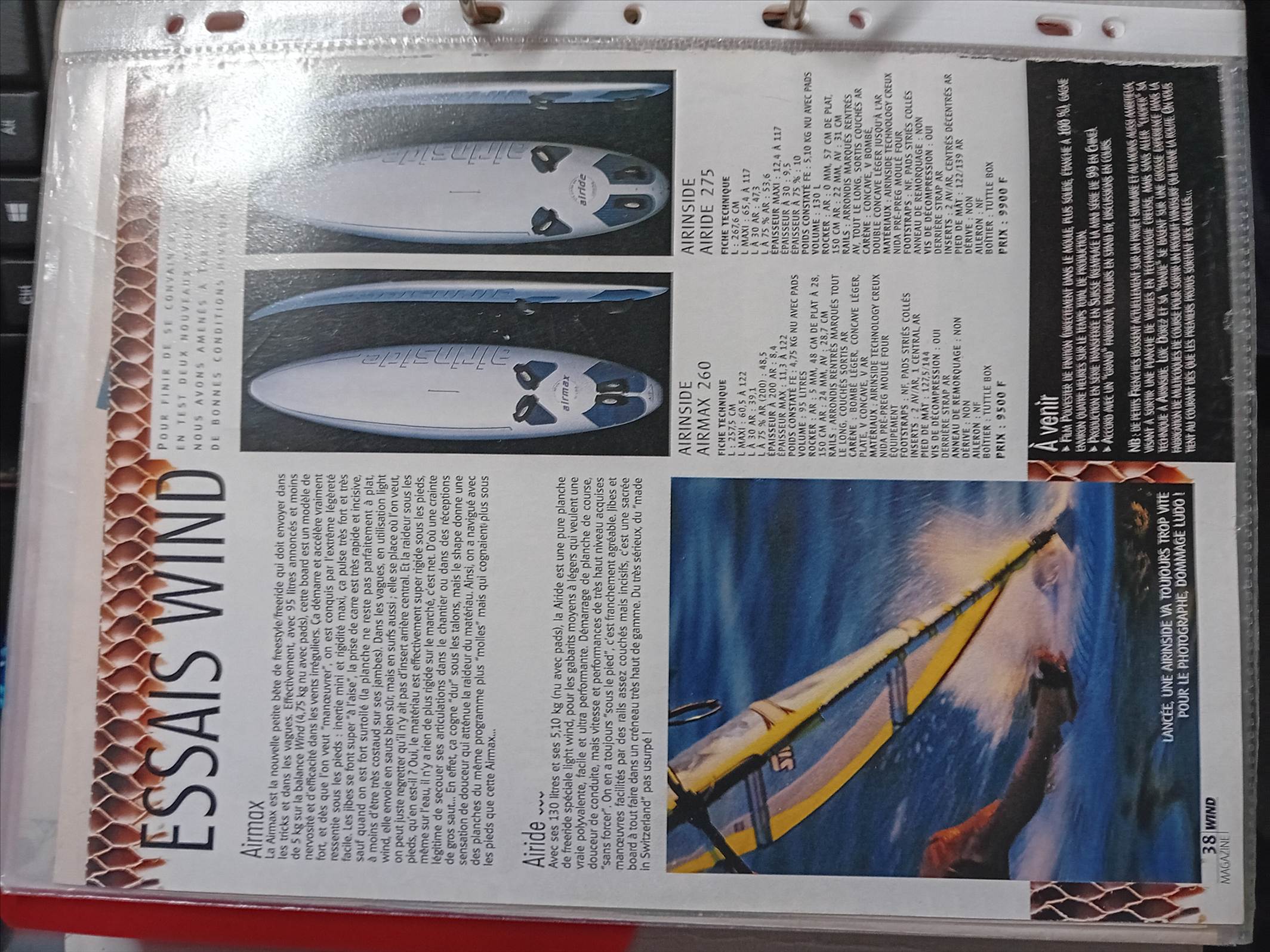
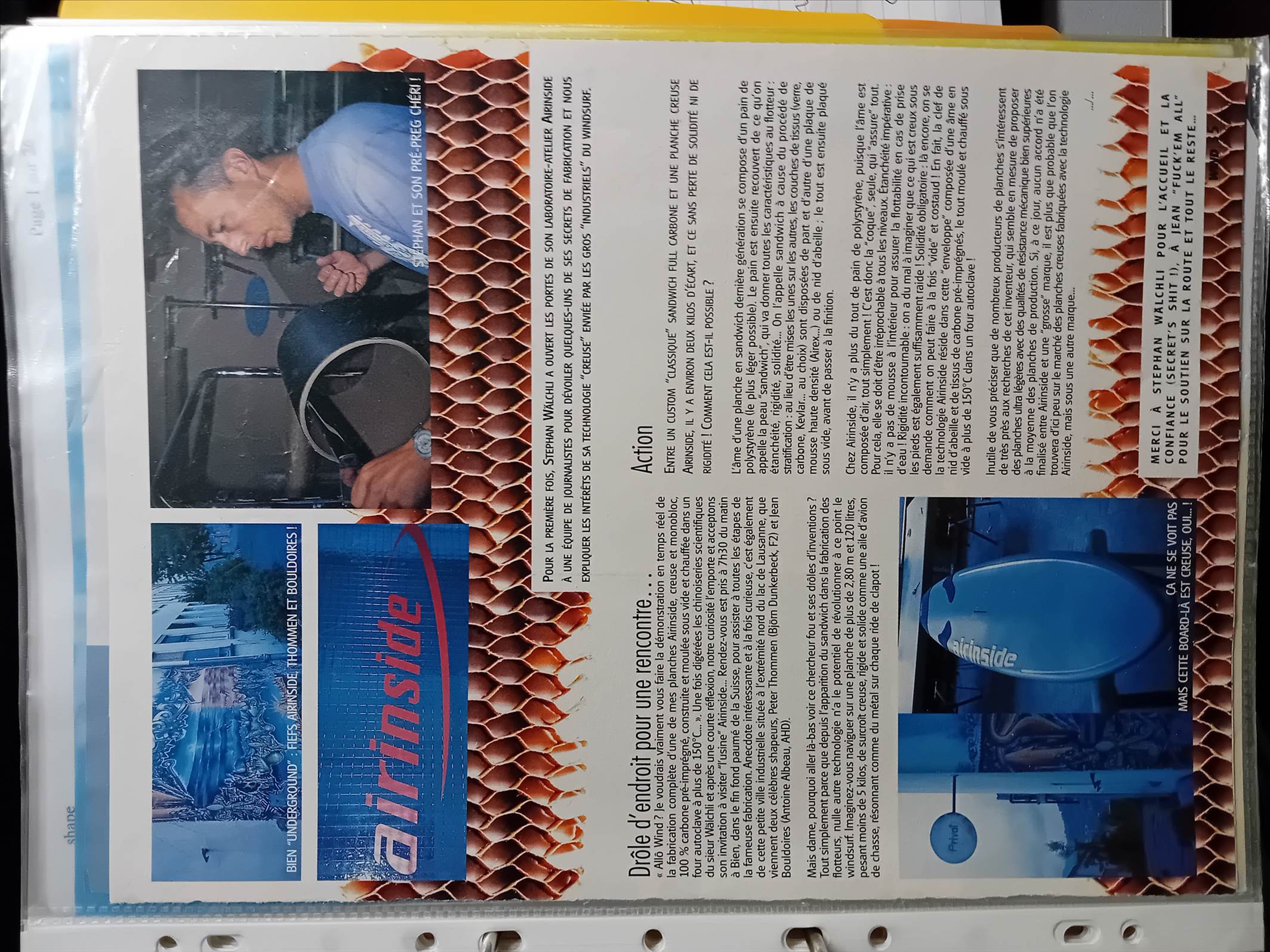
Why we use foam core: easier and faster to build with good strengh/weight ratio. Even if eps take water board float when open skin dinged. Can be a real nightmare with hollow boards.
That was about 10 years after we did them in California using nomex honeycomb with Carbon Fiber pre preg in an autoclave. Two piece mold and everything precut for layup. Still have one in my garage.
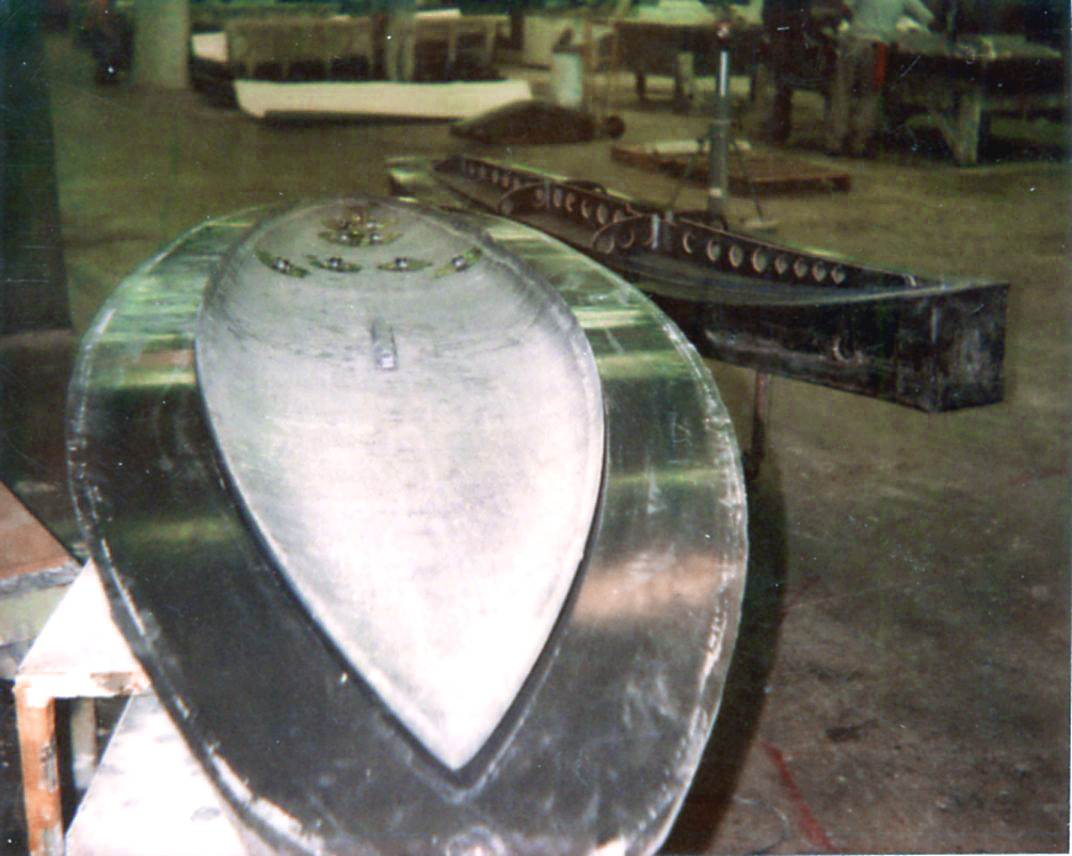
why do we think they haven't taken off. There has been a few goes over the years but buyers seem to prefer foam core
Cost. Foam makes new models easy to produce .. but slight tweaks for costly mould changes made it hard to have a range of hollow boards.
then labour cost maybe for more complex layup, trimming halves and then bonding halves properly.
I think foam sandwich is the best blend of cost vs durability vs ability to change shape if needed and that's why it's prevailed.
I've seen some great DIY hollow boards but I think the current mass production of them is a response to the trendiness of wing / DW and wanting to have something new that the other companies don't have. I hope it doesn't translate to $5000 windsurf boards soon.
Select to expand quoteMark _australia said..
Cost. Foam makes new models easy to produce .. but slight tweaks for costly mould changes made it hard to have a range of hollow boards.
then labour cost maybe for more complex layup, trimming halves and then bonding halves properly.
I think foam sandwich is the best blend of cost vs durability vs ability to change shape if needed and that's why it's prevailed.
I've seen some great DIY hollow boards but I think the current mass production of them is a response to the trendiness of wing / DW and wanting to have something new that the other companies don't have. I hope it doesn't translate to $5000 windsurf boards soon.
That's here, hollow windfoil board 5599 eur = 9157 aud

8
Select to expand quoteGestalt said..
I guess the issue is stiffness and cost for windsurfers.
im keen to try it too. Interesting but does seem like a lot of work. My next build is a freemove/style board and I'm going to drill the core like tw custom but more like holes in acoustic treatment ie. smaller dia holes spread at equal centres. I saw a similar idea for a strip plank build. Will avoid certain areas and not fully drill trough so bottom has some shape.
I'm getting drillium vibes - a big thing in the 70s and early 80s when it was "cutting edge" to drill out components to save weight. Then we dropped a couple of kilos off the frame and it didn't seem so important any more. 
Select to expand quoteMark _australia said..
Cost. Foam makes new models easy to produce .. but slight tweaks for costly mould changes made it hard to have a range of hollow boards.
then labour cost maybe for more complex layup, trimming halves and then bonding halves properly.
I think foam sandwich is the best blend of cost vs durability vs ability to change shape if needed and that's why it's prevailed.
I've seen some great DIY hollow boards but I think the current mass production of them is a response to the trendiness of wing / DW and wanting to have something new that the other companies don't have. I hope it doesn't translate to $5000 windsurf boards soon.
Yes it was all about price. They were going to retail for USD$4000 back in 1991 (about $10000 today), the Japanese were snapping them up. They were too expensive to make. The best shaper and best windsurfer in the world were involved.
If I was too make a hollow board today it would be 3D printed and easily modified. I have plans for a basic monocoque that a number of different shapes can be fitted to. You could easily have 3 different slalom/speed boards using one monocoque.
Select to expand quotelemat said..Mark _australia said..
Cost. Foam makes new models easy to produce .. but slight tweaks for costly mould changes made it hard to have a range of hollow boards.
then labour cost maybe for more complex layup, trimming halves and then bonding halves properly.
I think foam sandwich is the best blend of cost vs durability vs ability to change shape if needed and that's why it's prevailed.
I've seen some great DIY hollow boards but I think the current mass production of them is a response to the trendiness of wing / DW and wanting to have something new that the other companies don't have. I hope it doesn't translate to $5000 windsurf boards soon.
That's here, hollow windfoil board 5599 eur = 9157 aud
8
I'd figured the starboard one was going to be expensive, but thats outta control.
formula foil boards are one of those situations where hollow makes sense. They can weigh in quite heavy at the size they are when foam construction is used, and they're hardly in the water.