Specs for the tech nerds ,
30 cm long . 30 deg rake . 19 cm chord max . Thickness 9.5% of chord one third back . Flanged out at base Fangy style.
Material is 25 mm thick PVC. I chose this because it is quite stiff and tough as nails and will bend before breaking . Much harder than Ultra HD PE . Flexier than G10.
The idea is to get some flex from a short thick fin to create more lift than stiff shallow water fins.
Will it work ? , probably not .

Making 2 , PB and Tuttle.
Got to start square.

EXCELLENT, a new fin thread, I am as keen as Berlusconi in front of a coffee table with the finest Columbian sherbet.!
Q's: CNC or Hand foiled or something else?
Vertical lift or lateral lift, or both? I have been pondering materials to make cheap and quick prototypes - CNC of various plastics included, but I don't recall looking at PVC. I am guessing a block of PVC is competitively priced compared to the alternatives?
Very interested to see how you do this Imax, of course how well it performs/lasts.
Just keep in mind, as rake increases vertical lift, due to flex, lift decreases to a point where it becomes just drag. That's why flexy 45s are crap. 30deg may just be on the edge depending on how much flex and how much twist.
But experiments are allways worth doing, we could all learn something
Hand machined Fangy.
In the first pic I calculated how deep I have to machine max thickness in stages . Have to leave some ribs to be able to clamp flat to table . Tilt milling head for front and rear foil . Finish by hand . This is for light winds , big sails. I know that long fins that flex create lift and make the board go across the water lighter . I know I can go a few kts faster in 12 to 15 kts wind with a long flexing fin. Short fins sits the board lower in the water . Trying to get some of this lifting action happening . I'm positive this plastic is more than strong enough with a short wide fat fin . I've done testing on thin offcuts. It's got good spring back qualities. When bent too far it stays bent and doesn't snap. Good for safety . How it flexes in the real world ??? A problem I can foresee is the fact it is plastic and will be used in shallow water and therefore scraped a lot in sand . It will blunten easily but is easy to reshape with a file and sandpaper.
I managed to get a second hand sheet on Buy Sell Swap , 1220 mm x 1220 mm x 25 mm thick for $80. Normally new $700 So I get to experiment for free.
One potential issue is twist - something that Fangy fins do not have thanks to their stiffness. Twist will kill lift, and the cutout at the back would allow more twist. Not sure how big a deal this is with a 30 degree fin, though. You could keep the cutout smaller. I don't doubt the cutout is important for high rake fins, but not so sure about designs like yours where the back edge is almost vertical.
Looks like a great experiment. Keep us posted!
The shape of the fin is the same as one I made from G10 . It is solid as a rock with no flex . I am always using it and very happy . The difference with this one is the leading edge is 10 deg more upright creating a longer chord at the tip and set 30 mm more back on the box. I did this to compensate it's centre of effort and to make it a stronger connection to the box . The cutout makes a huge difference . On a earlier model it didn't have a cutout and it tended to spin out . Then I added the cutout . What a massive difference . Now on the rare occasion it spins out , it just drifts a little and pulls straight back in . I can be as sloppy as I want with a 9.4 m sail on a 84 cm wide board . I also made a smaller 27 cm version that I use with a 7.2 m sail and smaller . It amazes me how much grip you can get from a Fangy style short fat fin . There are guys here using Fangy fins on super lightwind boards , 95 cm wide with no problems . One uses a 24 cm with a 8 m sail.
I don't think twist will happen , I don't even think I'll get much flex , ( the fins too short and fat ). If I make it thinner to get a lot of flex , it will defy the fat grippy concept and just end up a spinning out Delta.
So if I can improve what I use with some flex .................... well that's the idea.
All good in theory, it will probably be a dog . I've assed a few ideas lately , my luck has got to run out.
For perspective,
The left two are 30 and 27 cm G10 . Bottom right big Fangy 28. Top right is the experiment . Not a lot different from my 30 cm.

Always interested in "IMAX1" project.
Question for Imax1, since you build your own boards why not put your boxes further forward?
Just a little hijack whilst waiting for the next instalment from Imax. Cutouts - IF I understand the theory correctly, with a surface piercing strut/fin, there is always potential for ventilation along the trailing edge. By increasing the momentum of the surface layer of water, this starts to create a barrier to the atmospheric air and makes it harder to penetrate. You can increase the momentum by increasing the velocity and or the mass of the water. A fillet compresses the flow and, in turn, increases the velocity of the surface water layer. The cutout reduces the low pressure region near the surface and provides more momentum to the surface water layer. The penalty is drag from the fillet, and loss of potential lift from the fin. That is, the overall Coefficient of lift versus Coefficient of drag of the fin is reduced.
Select to expand quote515 said..
Always interested in "IMAX1" project.
Question for Imax1, since you build your own boards why not put your boxes further forward?
Cos then it's too far forward for a normal fin.
. Select to expand quotefangman said..
Just a little hijack whilst waiting for the next instalment from Imax. Cutouts - IF I understand the theory correctly, with a surface piercing strut/fin, there is always potential for ventilation along the trailing edge. By increasing the momentum of the surface layer of water, this starts to create a barrier to the atmospheric air and makes it harder to penetrate. You can increase the momentum by increasing the velocity and or the mass of the water. A fillet compresses the flow and, in turn, increases the velocity of the surface water layer. The cutout reduces the low pressure region near the surface and provides more momentum to the surface water layer. The penalty is drag from the fillet, and loss of potential lift from the fin. That is, the overall Coefficient of lift versus Coefficient of drag of the fin is reduced.
I thought fillets reduced interference drag which is why they are used on fins and wings
Select to expand quoteGestalt said..
. fangman said..
Just a little hijack whilst waiting for the next instalment from Imax. Cutouts - IF I understand the theory correctly, with a surface piercing strut/fin, there is always potential for ventilation along the trailing edge. By increasing the momentum of the surface layer of water, this starts to create a barrier to the atmospheric air and makes it harder to penetrate. You can increase the momentum by increasing the velocity and or the mass of the water. A fillet compresses the flow and, in turn, increases the velocity of the surface water layer. The cutout reduces the low pressure region near the surface and provides more momentum to the surface water layer. The penalty is drag from the fillet, and loss of potential lift from the fin. That is, the overall Coefficient of lift versus Coefficient of drag of the fin is reduced.
I thought fillets reduced interference drag which is why they are used on fins and wings
I thought fillets increase the distance from the back of the board where the cavitating air sucks from and interupts it's flow up the fin.
Yeah, understand that it's too far forward for normal fin but if you predominately sail in shallow water why not build a specific board for these fins. There must be more load on the front of the box with those fins and big sails
I can understand a reduction in turbulent flow down the trailing edge from turbulence produced at the fin board connection but can't speak to turbulence from back of the board.
there has been a lot of research into fin fillets which is available online. Some conclude reduced drag and more lift.
Just wondering about foil. There are a bunch of thicker 12% high lift foils used on propellers and glider wings that may be worth looking into. Might not win on the speed course but if max lift is the goal than why not.
Select to expand quoteGestalt said..
I thought fillets reduced interference drag which is why they are used on fins and wings
Yes, agreed for fillets there is that too. Possibly rolling the turbulent flow into a vortex flow with greater angular momentum helps too.I haven't found any research concluding a cut-out creates more drag, or not. (very happy to be pointed in the right direction, tho) It does affect the lift noticeably as the cut-out size moves further forward. Intuitively, I think this would therefore mean less drag, but I have no proof of this yet.* However, during testing of large forward cut-out's on water, I think that the overall possible decrease in fin drag doesn't adequately compensate for the loss of lift. It does however make the fin almost impossible to spin out. * I am slowly learning CFD and associated software and how to apply it to my CAD models, so I hope to have some more rigorous analysis in the future.
Select to expand quote515 said..
Yeah, understand that it's too far forward for normal fin but if you predominately sail in shallow water why not build a specific board for these fins. There must be more load on the front of the box with those fins and big sails Select to expand quote515 said..
Yeah, understand that it's too far forward for normal fin but if you predominately sail in shallow water why not build a specific board for these fins. There must be more load on the front of the box with those fins and big sails
It's about 50/50
Select to expand quotefangman said..
Just a little hijack whilst waiting for the next instalment from Imax. Cutouts - IF I understand the theory correctly, with a surface piercing strut/fin, there is always potential for ventilation along the trailing edge. By increasing the momentum of the surface layer of water, this starts to create a barrier to the atmospheric air and makes it harder to penetrate. You can increase the momentum by increasing the velocity and or the mass of the water. A fillet compresses the flow and, in turn, increases the velocity of the surface water layer. The cutout reduces the low pressure region near the surface and provides more momentum to the surface water layer. The penalty is drag from the fillet, and loss of potential lift from the fin. That is, the overall Coefficient of lift versus Coefficient of drag of the fin is reduced.
Interesting. When I had looked at papers about fillets a few years back, I came away with the impression that turbulence reduction was the main effect. But the papers were mostly about turbines or airplane wings, not water-air boundary layers.
For the cutouts, I vaguely remember Lessacher's results from the glass bottom boards. What stuck to my memory was the idea that the air bubbles at the bottom of the fin drifted of to the side in the cutouts due to the sideways pressure on the fin, so they did not get a chance to move towards the tip along the trailing edge. He mentions this on his web site, although he says the water-air mix is "thrown out to the back" ("wirft das Wasser - Luftgemisch...direkt am Cutout nach hinten raus"). Interesting to see that his 50 knot fins have a relatively huge cutout: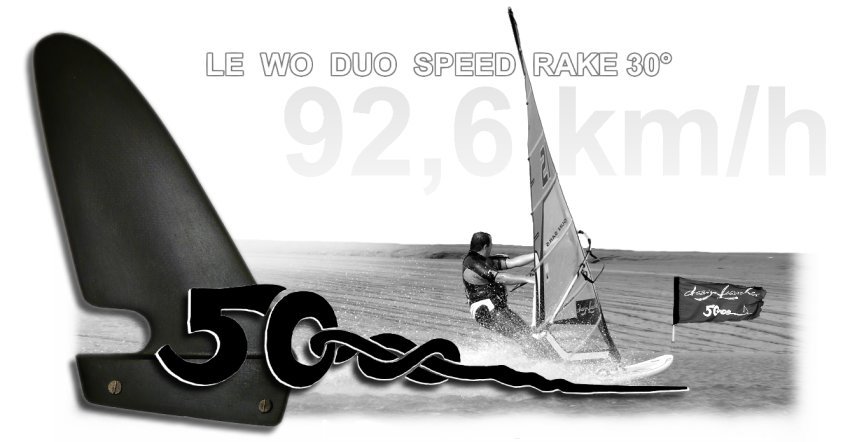
The way I understand it ;
If a fin spins out when it's underwater , it's not the handful of air that's stuck to the fin . That air would quickly be left behind . The spinning out fin must be sucking a stream of fresh air from somewhere . I thought it was from behind the fin , out the back of the board . Like a cavitating prop on a boat which can suck air from a metre behind the prop. So on a windsurfer , the air which comes from behind the fin , either from the side or back , gets sucked along the bottom of the board towards the rear of the fin . With a cutout the air has to do a U turn before it can go up the fin , interrupting or stopping the air flow. What is actually going on in that cutout , I have no idea , but it does break the airflow going up the fin.
Whats so good with cutouts is you can use a smaller fin and not worry about a sudden and total spinout. You just get little slides that pull back in . It's probably constantly happening and you don't even notice it . I'd say it's not the most efficient , but you can use a smaller fin with safety and that may make you go faster especially in rougher water .
I prefer to use a 55 cm pointer , when I can , with my 9.4 m sail because of the lift the fin produces . But when it lets go , it let's go. So the stream of air gets sucked from the edge of the board all the way along the fin. Would a cutout be useful in this situation if you could make a long fin strong enough with a cutout ? Remember in the old days they tried a mini fin directly in front of the main fin , what about a mini fin or lump or something behind the main fin to interrupt the airflow ? ???
I think the cutout is helping prevent the trailing edge vortex extending beyond the endplate (bottom of the board) and creating a path for ventilation.
Select to expand quoteImax1 said.. >>it's not the handful of air that's stuck to the fin . That air would quickly be left behind . >>>>?
I think you are wrong here, air can "stick" to a low pressure area. Just slide you hand across the top of the water. then submerge it from the wrist, when you get a sufficient angle slowly submerge your fingers, you'll find a pocket of air "stuck" to the tip of your fingers. This is a stall condition, and is what happens with a sudden massive spin out
I do believe air sticks to the fin , thats what were trying to fix. .Sometimes with a big fin and spinning out , I can hear a slurping noise . I'm presuming a lot of air is getting sucked towards the fin. A spinning out fin can't go sideways like it does through water . It has to be sliding through air . A huge amount of air must be feeding towards the fin to be no sideways resistance. Let's say I'm spinning out at 25kts with a 55cm pointer going totally sideways. It's a good way of strengthening anus muscles .By the time I've stopped the fin has displaced probably half a cubic metre of area. There is no way I've moved around half a cubic metre of water. Not with no effort . When in this position it seems there is absolutely no resistance , in fact it seems im speeding up for a second , ( that's probably because I'm crashing  ). Im presuming the fin has sucked half a cubic metre of air.
The slurping sound is air being sucked into the low pressure side of the fin. For whatever reason and there are number of them the trailing edge vortex has travelled beyond the tail of the board and opened up a path for air to feed into the low pressure side of the fin and whamo, spinout.
Select to expand quoteboardsurfr said..
Interesting. When I had looked at papers about fillets a few years back, I came away with the impression that turbulence reduction was the main effect. But the papers were mostly about turbines or airplane wings, not water-air boundary layers.
Same here. I was left wondering if a vortex flow is a higher energy 'organised' turbulent flow?
Interesting conversation  been thinking this through and thought of 2 additional things the cutout could be doing. firstly it would make the fin more manoeuvrable by reducing base width.
secondly, Would the cutout move the fin centre of effort towards the tip. which would provide more leverage for bigger sails and wider rear straps.? Could different foils along the fin length produce the same outcome
Select to expand quotefangman said..Gestalt said..
I thought fillets reduced interference drag which is why they are used on fins and wings
Yes, agreed for fillets there is that too. Possibly rolling the turbulent flow into a vortex flow with greater angular momentum helps too.I haven't found any research concluding a cut-out creates more drag, or not. (very happy to be pointed in the right direction, tho) It does affect the lift noticeably as the cut-out size moves further forward. Intuitively, I think this would therefore mean less drag, but I have no proof of this yet.* However, during testing of large forward cut-out's on water, I think that the overall possible decrease in fin drag doesn't adequately compensate for the loss of lift. It does however make the fin almost impossible to spin out. * I am slowly learning CFD and associated software and how to apply it to my CAD models, so I hope to have some more rigorous analysis in the future.
I was only talking fillets.
wasn't commenting on cutouts. But as everyone else has mentioned I can see how the cutout reduces turbulent flow down the trailing edge.
Select to expand quotemr love said..
I think the cutout is helping prevent the trailing edge vortex extending beyond the endplate (bottom of the board) and creating a path for ventilation.
similar to why F1 spoilers have endplate cutouts?
Select to expand quoteGestalt said..
Just wondering about foil. There are a bunch of thicker 12% high lift foils used on propellers and glider wings that may be worth looking into. Might not win on the speed course but if max lift is the goal than why not.
Pressure drag on fins exponentially increases with velocity. So ideally, keep the frontal area low and only move the water as much as you need to offset the sail pressure. However, short fins, especially raked low aspect ratio, are inefficient due to the relatively higher surface area and leakage of pressure gradients down the span. A fatter foil gives you fab lift at a certain velocity, once you exceed that velocity the drag monster throws out the anchor and fin becomes inefficient. If you then make the fin shorter, the inefficiencies of a short span overwhelm any gains. Over the years it appears that we have converged to the 7 - 10% foil thickness providing the best compromise between lift and drag for the various types of fins. Also water takes a lot of energy to move quickly, and if you do it too quickly, it changes phase on you to a gas, with a completely different set of physical properties again. Frankly, it's a bit of a PIA and a can of worms at the same time!
Select to expand quoteGestalt said..
Interesting conversation been thinking this through and thought of 2 additional things the cutout could be doing. firstly it would make the fin more manoeuvrable by reducing base width.
secondly, Would the cutout move the fin centre of effort towards the tip. which would provide more leverage for bigger sails and wider rear straps.? Could different foils along the fin length produce the same outcome
Manoeuvrability with a longer cut out - I think this was better, but given that I am generally sailing fairly straight courses on boards not suited to turning quickly, I am not sure whether I could say with any certainty there was a benefit.
The cut-out has the opposite effect of an end plate, so it leaks pressure, (lift) through from the high pressure side. This makes the fin more inefficient. Using a wider foil will help, but that can exponentially increase your drag. The cut-out is a balance between making the fin handle better, increasing your confidence to push the limits, versus the fin becoming more inefficient and draggy.
One of the experiments I want to do this summer is place an end plate at the cut out and see if that has as much of an effect as placing the bulb on the fin tip did.