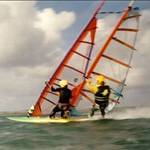
I love gybing and could watch gybe videos all day long. Does anyone else have any more good examples?
The ones above are epic!
Shifu, agreed. This is my favorite gybe video, especially the gybe-tack-gybe sequence starting at 2:50.
That's remarkably clean ice. Does someone clear the snow away and flood it?
I spent a winter in Ottawa and the local authority kept the Rideau canal clear for skating. They used to go out with pumps, drill a hole in the ice and pump up water to smooth out the ice. That was amazing - kilometres of ice with thousands of people skating at night. There's a small lake attached that would be suitable for wind skating.
Ex P.W.A sailor Jimmy Diaz, would have to be the best Jiber in Slalom l have ever seen. He wasn't the fastest but killed it in the jibes, in the old downwind Slalom.If you can get a old Utube of him back in the early 2000s, watch his flawless skill.Getting back to Jibes the more wind the better, Being a heavyweight, l struggle to come out of a jibe planing.
Bugs is good at duck gybes, ask him
Duck gybing a race sail may be different though.
Select to expand quoteIan K said..sailquik said..Ian K said............... Have you noticed how much easier it is to gybe in shallow water? Ground effect minimises hull drag. Also makes trim easier. Too much weight on the tail more ground effect at the tail end. Self trimming.
According to the WSSRC, ground effect does not help you until the depth of the water is less than half of the beam.
On almost any board and situation I can think of, that is very close to the fin depth which means you are in grave danger of running aground. 
I'm not entirely sure the WSSRC is correct on this, but I can't say I have actually noticed 'ground effect' in all my shallow water windsurfing, at least not except for the instant before a very bad crash!! 
What I can say with lots of experience it that extreme flat water (think glassy, weedy lakes and low wind speed), definitely minimises hull drag and makes flat trimming and retention of planing speed easier. 
Can't figure out how to drag images on a smart phone, but just google "ground effect height vs wingspan". The How to fly a plane manuals all seem to use the same graph which shows an asymptote to zero. At half wingspan the drag reduction is 8%. Maybe I'm imagining I can sense that.
Of course perceptions are known to be biased towards what you believe should be the case.
I think we are talking water depth and 'ground effect for a narrowish windsurfing or kite board? I'm not sure if aero 'ground effect' is exactly comparable?
As I said, I'm not sure if the WSSRC are correct, but I recon they would have had pretty good scientific advise on the matter to put it in their rules?
I wonder if the mass of weed (a la LG) in the water enhances this effect? if it does, it could make up for some of the drag the fin see's from dragging through the weed?
I also have a suspicion that the mass of weed around, and under the fin helps to reduce tip vortex drag. A sort of a ground effect which you might get if the tip of the fin is running almost touching the bottom which may act like a kind of endplate. ?? I have wondered if this reduces drag a bit tp counter the drag of parting the weed, and to possibly counter the theoretical poorer lift to drag ratio of our low aspect, highly raked weed fins?
No definitely not exactly comparable, but they both work on the same principle. Generate momentum in the downward direction to create lift in the upward direction. It's more efficient to throw it down with a fully immersed foil than a planing hull but pound for pound it's the same amount of fluid that has to be thrown down. You could argue that seeing a hull is say twice as draggy that 8 % turns into 4 % or maybe you could argue that because all the deflection is happening on the bottom surface the 8% turns into 16%? Too complex to make a guess but you can be pretty sure it asymptotes to zero rather than suddenly dropping off at half hull width.
Anyway for gybing the leeward rail is dipped even closer to the bottom. The wetted hull is now a bit narrower but that short wide based fin is now acting as fence! No wonder gybing in shallow water is so easy!
If the WSSC had scientific advice on this they would have referenced it.
Select to expand quoteBasher said..
On a speed board, you might have built up to going very fast - perhaps with an over-sized sail - but that speed is unlikely to be carried into a true for a fully planing gybe. That's because a speed board is very narrow and, similarly, your fastest slalom board will usually be your narrower one.
I have been tracking my jibes for almost 2000 windsurfing sessions, recording minimum jibe speed both in absolute terms (knots at the minimum) and relative terms (percent of entry speed kept at the minimum speed). I also often look at these numbers from better sailors, especially when someone posts a great alpha.
It's true that carrying is speed through jibes on speed boards is harder than on wider slalom or freestyle boards - but that is a matter of skill. My best jibe on flat water, measured by minimum speed and alpha, was done on a speed board. Sure, a relatively wide (55 cm) and big (95l) speed board, but it's still a few cm narrower than my small (~90 l) slalom boards. The main issue is that the foot movement needs to be very exact, both with respect to placement and to timing. If you put a foot a few cm too far to the outside when stepping, nothing happens on a big (100 l+) slalom or freestyle board. But on a speed board, the edge digs in, and you loose a lot of speed. Stepping too early, too late, or too far forward or backward gives similar results.
On flat water and when powered on 6.3 or smaller, I can usually plane through jibes on a large speed board, with typical minimum speeds above 12 knots. But my jibing skills on speed gear are quite mediocre when compared to the better speedsurfers, who often stay above 15 knots. Here is a screen shot from the jibe of a really good speedsurfer:

That's Slowboat's jibe when he set his 27.485 knot alpha PB a couple of months back in Albany, on a 53 cm speed board. He kept a speed of more than 20 knots (although that probably would be a knot lower if recorded at 5 or 10 Hz instead of a GT31), and more than 63% of his entry speed.
In my recorded sessions, which probably include about 50-100K jibes, I have only 6 sessions with jibes that kept at least 70% of the entry speed. The best ones (84% and 74%) we done when catching a wave at the right time, and going down the wave when flipping the sail. I still remember both sessions, since I rarely play in waves, and these jibes definitely stood out.