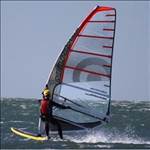
Right, need some info to help improve my gybes. Basically they feel ok and pretty smooth and controlled right up until the rig flip. About then it's a bit of struggle controlling the re-powering sail. No catapults or anything drastic (yet...) just feels like the weakest / non smooth link in my gybes. Any tips of how to control the power on rig flip to make the exits silky smooth? Such an amazing feeling powering in and out of a gybe, would love to find out the secrete to the fluidity the guns sailors achieve.
Get a hold of Peter Hart's latest DVD, 10 Steps to Gybing, very good. Speed seems to be an important factor when you see big Dave White gybe fluently on that video.
Most gybes that look ugly to me are when people don't flip soon enough. I usually tell people to lean into the turn and let go of the sail, then see if you can clean up the mess.
Watch The Master.
Flip early. Way earlier than you are used too. Figure out where directly downwind is and flip when you are pointing there. Use a landmark. Gybing doesn't work if you don't flip early.
Most important is to keep the board carving into and out of the gybe. I don't flip my sail until I'm just slightly "LEE" of the wind. I don't change my feet position until after the sail has flipped over to the new side. This allows for more stability through out your gybe and helps you keep you carving at the same angle. Gybing is an art of its own. You will find your sweet spot. Just make sure you're going into your gybe with plenty of speed, and keep your sail sheeted in until the flip. Depending on conditions, right before I gybe, I will I bear off on a broad reach then carve and flip the sail.
Just think, "CARVE-N-FLIP" and your feet will follow through with your motion.
Oh and another thing! As you're flipping the sail, keep the mast leaning into the carve, then bring the mast aft a little to compensate for the sail being powered up after the flip.
I got all the dvds and went to Guy Cribb clinics. I struggled the same as you with the exit, and still a lot of my jibes are not too good, but when I get it right I think it is because I have got speed, I leaned forward and flipped early. The rest comes easy if the work has been done earlier. In the exit I just remember myself to stay low, don't point too high, extend the arms and front leg and anticipate the pull of the sail. Months ago I did a good jibe and Berowne took photos, I was shocked to see how upright I was. Get someone to take a video of yourself and you will discover how to improve.
Select to expand quotepowersloshin said..
I got all the dvds and went to Guy Cribb clinics. I struggled the same as you with the exit, and still a lot of my jibes are not too good, but when I get it right I think it is because I have got speed, I leaned forward and flipped early. The rest comes easy if the work has been done earlier. In the exit I just remember myself to stay low, don't point too high, extend the arms and front leg and anticipate the pull of the sail. Months ago I did a good jibe and Berowne took photos, I was shocked to see how upright I was. Get someone to take a video of yourself and you will discover how to improve.
I only know what to do wrong! Standing tall when I think I am low, not placing my weight on the balls of my feet on entry, not carving with the front of the board. Where did all the speed go? I have also read that if it gets really bumpy half way through then it's because too much weight is on the back end of the board. Good luck with your exits... If you have a bit of cash and someone to video you, you can send the recording to Guy Cribb and he will analyse it and provide some coaching. Details are on his website.
I once read an article by Peter Hart where he said "planing gybes are about fooling the board into thinking nothing is going on on top of it". It really is great advice. If you've got all the pieces of the gybe worked out, it then becomes about minimising violent movements that'll exert back onto the board. Eg, if you flop the rig around through the flip you'll weight your foot trying to balance it and dump weight where the board doesnt want it. If you rotate the rig on the universal joint, and don't let it flop, the board won't get disturbed by foot movement. Foot changes have to be minimal and cat like rather than stomping...
Unless you're in completely flat water and powered, it's not an easy feat.
You have to minimise the time the rig has no power in it (the rig flip) as well.
Also take in consideration that some boards don't gybe well at all, and others gybe so easy.
The gybe needs to happen fast so the board doesn't slow down. Every one always looks way too deep into the gybe, even me at the time learned. But the easiest way to explain this, is CARVE n FLIP. Just 2 things to think about. Not the 10 step gybe process or anything that confusing. Just think about CARVING the board and FLIPPING the sail. The footwork will come together as soon as you get the timing down for the CARVE N FLIP.
You will have to practice where the correct spot will be on your board to perform the CARVE N FLIP. It might be more forward, more in the middle or more to the back of the board. At the time of my flip, my forward foot is in front of the forward foot strap and my back foot is between the forward and rear footstraps. This position for my feet are in marginal winds. In light winds I stand a little more forward, and in heavy wind, I stand a little more back towards the rear of the board. I'm talking maybe 3 to 4 inch difference in foot placement depending on the wind. But the footwork is the same every time, like clockwork.
Like I said, get the CARVE N FLIP down first, then the footwork will automatically follow.
Loads of good advice so far .
.
I think I ruin board trim on the exits by bracing for the re-powering on the sail, moving body weight back a fraction to compensate. Hope to get a run this arvo and try a few of the above tips. Will work on the "fooling the board" theory.
Cheers
If the board is bouncing around while entering the gybe, that means you are not carving the board into the gybe. Once you carve the board as you're gybing, you are basically using the rail to cut through the chop and when the rail is slicing through the water when gybing, you will not bounce or bounce very little through out your gybe.
Pro tip #1:
Face close to boom, elbows down.
Pro tip #2:
Do not take advice from people you have not seen sail. You may be "getting sex tips from a virgin or financial advice from a pauper".
Disclaimer: I only learnt 6 months ago and I plane out once in a blue moon. My instructor was very good. He also thought that at its core the carve gybe is very simple - "a surf move" and the clinic gurus overcomplicate it.
Mr Cranky,
Don't belittle anyone's tips here. They are all good suggestions and all slightly different. I really don't think anyone on a windsurfing site would waste their time making ridiculous suggestions. But now that you mentioned it, I bet you people are going to start putting crap suggestions here. But hopefully who ever puts crap suggestions will put an emogi of some kind at the end of their crap suggestion so that we know it's crap.
After the rig flip get down low, apply heaps of mast foot pressure and almost pump the sail as you stand back up and hook in.
You should still be facing down wind as opposed to side on once in the foot straps and harness lines.
Select to expand quoteMagic Ride said..
Most important is to keep the board carving into and out of the gybe. I don't flip my sail until I'm just slightly "LEE" of the wind. I don't change my feet position until after the sail has flipped over to the new side. This allows for more stability through out your gybe and helps you keep you carving at the same angle. Gybing is an art of its own. You will find your sweet spot. Just make sure you're going into your gybe with plenty of speed, and keep your sail sheeted in until the flip. Depending on conditions, right before I gybe, I will I bear off on a broad reach then carve and flip the sail.
Just think, "CARVE-N-FLIP" and your feet will follow through with your motion.
I find that works well powered up and with small sails but if its gusty doing the foot change first ( step gybe) has you in a better possy to keep the board going and for balance.
I'm no expert but I've found looking at the exit and flipping early important.
I still need to straighten my front arm on entry and let myself get pulled forward.
Select to expand quotepowersloshin said..
I got all the dvds and went to Guy Cribb clinics. I struggled the same as you with the exit, and still a lot of my jibes are not too good, but when I get it right I think it is because I have got speed, I leaned forward and flipped early. The rest comes easy if the work has been done earlier. In the exit I just remember myself to stay low, don't point too high, extend the arms and front leg and anticipate the pull of the sail. Months ago I did a good jibe and Berowne took photos, I was shocked to see how upright I was. Get someone to take a video of yourself and you will discover how to improve.
Yep..sailing in flat water has got me higher than I should be. When I was going ok I used to try and crouch below boom height as I entered..
Select to expand quoteMagic Ride said..
If the board is bouncing around while entering the gybe, that means you are not carving the board into the gybe. Once you carve the board as you're gybing, you are basically using the rail to cut through the chop and when the rail is slicing through the water when gybing, you will not bounce or bounce very little through out your gybe.
Board bouncing on entry - probably the best tip I got from Guy Cribbs clinic was to unhook the harness with a subtle hip movement while you are applying downforce..If you stand up to unhook the weight comes off the mast foot and the board starts bouncing and it's all downhill from there.. Now I just have to remember to do it!
We watched a video of me gybing ( 2012) and I could see how the board started bouncing in the chop on entry as I unhooked and stood up..
+ 1 re elbows down ( guy Cribb tip)..mm I'd forgotten that one. I'll have to check what I do next sail..

There is some critical info missing from your question.
What type of gybe are you trying to do:
A) strap to strap - ie flip sail, then switch feet - more commonly used for wave sailing
B) step gybe - ie switch feet, then flip sail - used by all PWA slalom racers.
Big difference. Let us know. Thanks
A lot of people try to combine (a) and (b) into a new method of gybing - which is why it usually isn't successful.
Select to expand quotewind012 said..
There is some critical info missing from your question.
What type of gybe are you trying to do:
A) strap to strap - ie flip sail, then switch feet - more commonly used for wave sailing
B) step gybe - ie switch feet, then flip sail - used by all PWA slalom racers.
Big difference. Let us know. Thanks
Exactly! Huge difference between a gentle flip at the end of a wave ride and then transferring feet soon after, compared to a PWA slalom step gybe.
I have no idea .
take your back foot out of the strap and put it on the inside rail.
Good suggestion about type of gybe. I'm talking wave / wave slalom, strap to strap, no-hand gybe. Bend knees (of course), push down on the boom to keep the board flat, switching feet early wobbles the board and slows you down, early release, push with your back hand speeds up the flip, sail with both feet in the front straps if you have to, hook in, move to rear strap.
Select to expand quotewind012 said..
There is some critical info missing from your question.
What type of gybe are you trying to do:
A) strap to strap - ie flip sail, then switch feet - more commonly used for wave sailing
B) step gybe - ie switch feet, then flip sail - used by all PWA slalom racers.
Big difference. Let us know. Thanks
A lot of people try to combine (a) and (b) into a new method of gybing - which is why it usually isn't successful.
Hey Wind012, Good point. I sail ocean and lake, and sorta found I need two different styles of gybe for either location. Was primarily referring to lake / river full planing gybes. Here's the main "flat water" location I sail, and here's what I'm doing now- well sorta...
Sailed the same spot again this arvo, using some of the advice given in this post. Stoked, 90 percent of gybes planed out of cleanly. Focused on a few key points. Keep board carving, don't up-set trim, point front foot forward on exit, bend zee knees, keep mast foot pressure through arc, flip early, kept body low etc. End result, waaaay more fluidity and a smile to rival Chad Morgan. Still buzzing and hanging to refine things even more.
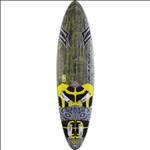
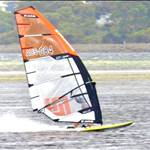
If of any interest, today's sesh. Board 93 Starboard S-Type, 6.4 KA Kult, wind 15-22 knots. Footage much the same.
I've looked through all the great tips here and one I think is missing is - slide your back hand down the boom before entry into the turn. In conjunction with (as already noted) a straight front arm. Peter Hart tip related to this - you should be able to see the opposite side of the nose of your board as you enter the turn (ie it shouldn't be obstructed from view by the sail). These tips give you speed into the turn and the straight front arm also gives you space to flip the rig.
Select to expand quoteSimonzee said..
I've looked through all the great tips here and one I think is missing is - slide your back hand down the boom before entry into the turn. In conjunction with (as already noted) a straight front arm. Peter Hart tip related to this - you should be able to see the opposite side of the nose of your board as you enter the turn (ie it shouldn't be obstructed from view by the sail). These tips give you speed into the turn and the straight front arm also gives you space to flip the rig.
I has a classic stack yesterday due to having the rig too close to me. I flew into a gybe and threw the rig for the flip but then hooked in as I did and threw myself into the sail I've accidently hooked in on gybes before but usually earlier in the gybe and they weren't as dramatic.
I find it really strenuos trying to extend the front arm especially on larger sails or powered up..I don't feel strong enough.. maybe I'm leaving it too late or doing something wrong?  I find I can do it when comfortably powered up in flat water and when I'm fresh but really powered up or when I get tired i revert to bent arms and having the rig too close..
Select to expand quotesboardcrazy said..Simonzee said..
I've looked through all the great tips here and one I think is missing is - slide your back hand down the boom before entry into the turn. In conjunction with (as already noted) a straight front arm. Peter Hart tip related to this - you should be able to see the opposite side of the nose of your board as you enter the turn (ie it shouldn't be obstructed from view by the sail). These tips give you speed into the turn and the straight front arm also gives you space to flip the rig.
I has a classic stack yesterday due to having the rig too close to me. I flew into a gybe and threw the rig for the flip but then hooked in as I did and threw myself into the sail I've accidently hooked in on gybes before but usually earlier in the gybe and they weren't as dramatic.
I find it really strenuos trying to extend the front arm especially on larger sails or powered up..I don't feel strong enough.. maybe I'm leaving it too late or doing something wrong? I find I can do it when comfortably powered up in flat water and when I'm fresh but really powered up or when I get tired i revert to bent arms and having the rig too close..
That is the worst. The harness hooks in mid-gybe and you just can't get it out. Cranked into a gybe on a smooth swell, all the time in the world, watch me and weep noobs, drag hand in the water for extra evidence of control and smoothness. Then the flailing begins, ending with a faceplant on the sail and writhing around trying to get unhooked.
Select to expand quotesboardcrazy said..Simonzee said..
I've looked through all the great tips here and one I think is missing is - slide your back hand down the boom before entry into the turn. In conjunction with (as already noted) a straight front arm. Peter Hart tip related to this - you should be able to see the opposite side of the nose of your board as you enter the turn (ie it shouldn't be obstructed from view by the sail). These tips give you speed into the turn and the straight front arm also gives you space to flip the rig.
I has a classic stack yesterday due to having the rig too close to me. I flew into a gybe and threw the rig for the flip but then hooked in as I did and threw myself into the sail I've accidently hooked in on gybes before but usually earlier in the gybe and they weren't as dramatic.
I find it really strenuos trying to extend the front arm especially on larger sails or powered up..I don't feel strong enough.. maybe I'm leaving it too late or doing something wrong? I find I can do it when comfortably powered up in flat water and when I'm fresh but really powered up or when I get tired i revert to bent arms and having the rig too close..
I hate the accidental hook-in! I think if you are travelling fast enough into the gybe then the rig is light and a straight front arm is not strenuous. Bearing away is key. Probably when we are over powered or tired, we sail more defensively and choke the board speed.
Select to expand quoteSimonzee said..sboardcrazy said..Simonzee said..
I've looked through all the great tips here and one I think is missing is - slide your back hand down the boom before entry into the turn. In conjunction with (as already noted) a straight front arm. Peter Hart tip related to this - you should be able to see the opposite side of the nose of your board as you enter the turn (ie it shouldn't be obstructed from view by the sail). These tips give you speed into the turn and the straight front arm also gives you space to flip the rig.
I has a classic stack yesterday due to having the rig too close to me. I flew into a gybe and threw the rig for the flip but then hooked in as I did and threw myself into the sail I've accidently hooked in on gybes before but usually earlier in the gybe and they weren't as dramatic.
I find it really strenuos trying to extend the front arm especially on larger sails or powered up..I don't feel strong enough.. maybe I'm leaving it too late or doing something wrong? I find I can do it when comfortably powered up in flat water and when I'm fresh but really powered up or when I get tired i revert to bent arms and having the rig too close..
I hate the accidental hook-in! I think if you are travelling fast enough into the gybe then the rig is light and a straight front arm is not strenuous. Bearing away is key. Probably when we are over powered or tired, we sail more defensively and choke the board speed.
Maybe.. I know when I'm fresh or sailing in flat water I can concentrate on stance more. If I'm overpowered or in chop I tend to cramp up and bend my arms and keep my front hand closer to the mast. A psychological thing - I feel I can depower or unhook if it gets too knarly...
Makes sense to go flatchat into the gybes but takes guts especially powered up on a slalom board in chop.. One day I'll be able to charge confidently into the gybes like the guys in chop..
I wish we still had the feature to bold type parts of someones quote then the replies would make more sense..
Select to expand quoteMartinF2 said..
What we all dream for 
that must have been a great alpha too.
Great gybe and would have been nice to see the feet too.