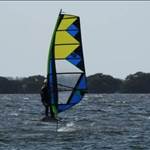
Hi All - first post!! I'm a relative windfoil newbie, about 15 sessions in.
Using original Naish Hover 142 and WS1 foil and Blades 4.7 - 5.7.
83kg - 182 lbs
I'm usually foiling on my own (or with a couple of kite foilers) so I don't have much reference point, but my issue is I'm having trouble with level flight.
Not really wild, but I find it really hard to stay dead level - especially if it's gusty.
I notice the kite guys are very stable. Also all the vids on here look stable ??
I'm sailing essentially flat/choppy water - no swell.
Is the early Naish foil prone to this or is it just TOW?
I do not have experience with your kit but I'm pretty sure its just Time On the Water mate. The classic advice of look straight ahead and at the horizon can help. Try and anticipate the gusts and lulls rather than react, they change mast base preasure so they affect pitch a lot. Look for the little victories in every session, you are progressing. Keep going!


Naish user also, but 122, and mostly on 600 kite front wing, after 100 days on the 1220.
Nobody stays level without constant weight shifts, adjustments, sail sheeting in or out, rig tilted fore or aft, harness and hand pressure, and board tilt and direction changes.
Unless you find steady wind.
Naish is offering an 80cm fuselage, up maybe 13 cm from yours...and mine. It hasn't sold particularly well, compared to the 2 other shorter fuses. Maybe wingers like short, maybe windfoilers are set as is, I don't know.
I plan to buy one, but winging seems easier to pump with the shorter fuses. Waiting till next year to decide whether wing or windfoil becomes my future.
Agree.
TOW. but longer fuse can help
Also wider stance than how you windsurf.
If you find you are going up and down a lot try to increased distance between sail mast and foil mast (will need to move front strap back). then gradually as you learn to control things better shorten this distance and move front strap forward.
I shift my hips fore and aft to modify altitude while I keep everything else stable. A waist harness helps with that too.
That's interesting. I foil with a much narrower stance than windsurfing and the mast base as far to the rear as possible I find reduces porpoising.
Different strokes for different folks?
The best jiber and freeride foiler here at EastBay SF uses narrow stance, forward sail mastbase, and no rear straps.
His closest rival uses no straps and front foot within 16" of his sail mastbase. Also narrow feet.
Im not sure but i think a lot of it is about having confidence to stay committed to the harness as wind changes, albeit in an upright foil stance, bent at waist rather than windsurfing "7" stance, with your shoulders moving forward as wind increases. As wind increases, board speed increases so foil lift increases- if you stay committed mast foot pressure also increases to compensate and keep you level. If you sheet out, or sheet in then your mast foot pressure is changing independently of board speed and foil lift so you porpoise.
Regardless, you do have to spend enough TOW that moving your shoulders forward and backwards along the board (not out like windsurfing) becomes second nature.
if foil wing is too far forward, or too far back, relative to footstraps it can also make porpoising worse. Imagine trying to stand straddling a seesaw - if your legs are equal distance either side of the pivot it is fairly easy - if one leg is very close to the pivot then its really hard to keep it level
Underdownhauled sails can also be a hindrance- i feel them powering up and then spilling the wind in an irritating rhythm- bit like an umbrella in the wind.
Yeah, the sail is another point to be examined.
I like max twist downhaul and deep draft outhaul, similar to ws.
Some like tight leech.
Some like very flat with outhaul.
Some choose small sails for the wind.
Some choose to rig almost ws size sails.
But when the wind changes or we guessed wrong..... we gotta change something.
Select to expand quoteSmidgeuk said..
Im not sure but i think a lot of it is about having confidence to stay committed to the harness as wind changes, albeit in an upright foil stance, bent at waist rather than windsurfing "7" stance, with your shoulders moving forward as wind increases. As wind increases, board speed increases so foil lift increases- if you stay committed mast foot pressure also increases to compensate and keep you level. If you sheet out, or sheet in then your mast foot pressure is changing independently of board speed and foil lift so you porpoise.
Regardless, you do have to spend enough TOW that moving your shoulders forward and backwards along the board (not out like windsurfing) becomes second nature.
if foil wing is too far forward, or too far back, relative to footstraps it can also make porpoising worse. Imagine trying to stand straddling a seesaw - if your legs are equal distance either side of the pivot it is fairly easy - if one leg is very close to the pivot then its really hard to keep it level
Underdownhauled sails can also be a hindrance- i feel them powering up and then spilling the wind in an irritating rhythm- bit like an umbrella in the wind.
Yep. Sheeting out and losing mast foot pressure without a compensatory increase in front foot pressure, will lead to breaching
I was just thinking about the seesaw too, to justify why a wider stance can help, at least for me. I think the wider stance gives us more opportunity to change leverage over the foil as we have a longer moment arm, but wider stance means shorter sail to foil mast position which can be too maneuverable for beginners.
The Naish 2020 has a longer fuse and is more stable, you can buy just the fuse and the rear stab, it will fit your mast and front wing.
i checked my records around the 15th session and I was falling a lot, it is still early stages, keep going and you will enjoy it.
I have a Hover122, I keep the foil mast about the middle of the channel, footstraps all the way back and also mast base most of the way back.
Interesting our setup differences. Mine is based on the constant shifty windspeed we deal with....most light days 5-17 with 21 knot peak gusts. Makes for interesting foiling conditions.
Naish Hover 122 also, 600 kitewing, foil mast 1" forward, rear straps fully back, sail mast foot 1/3rd forward. When I used the 1220 front wing, foil mast fully back.
The fuse is the main issue
Other suggestions will help yes
But the best fix is to go longer on the fuse
This will make the whole foiling experience better including stability in a straight line and in the gybe
Sounds like you are on a gen 1 foil, I think later model foils from most manufactures are a lot easier to learn on for a beginner
it's been a minute since I've foiled the 142 and used the Naish foil, it seemed pretty stable to me, nothing crazy radical
Think I had mast base way back from center and the foil mounted in the middle of the tracks.
keep practicing you'll get it
First, you need to make sure you are balanced on the board in flight, that means your front and rear foot pressure is equal when in level flight. Imagine you are straddling a seesaw with the left seat level with the right seat when you have equal pressure on both feet, that is being balanced. So once you have the board setup for that, which involves the sail mast base position, then all you do to maintain a level flight is to gently rock back and forth as needed while sheeting the sail in and out. It takes a lot of balance and coordination. Right now you are probably shifting your weight back and forth without realizing it, and that is causing you to porpoise. If you have access to an Indo Board, that will help train you to balance your foot pressure while in flight since it replicates half of what is needed, the other half is sheeting in and out rapidly while in flight, and responding to gusts by sheeting in/out takes practice. I have very gusty conditions, and I can maintain a level flight, but it does take a lot of focus and very quick reflexes, and I do that without looking for the gusts, I just respond to the pressure on the sail. Sometimes I cannot respond fast enough and either go airborne (rarely) if I am too high to begin with, or drop straight down and land on the water with a bang in the case of a negative gust (very hard to respond to).
The kite foilers are using wind that is 90 feet up, and that wind is more stable since it has an unobstructed path. You are on the whitewater rapids of a narrow river, they are on a broad river that does not have major whitewater or rapids "most of the time".
Thanks all - that's a lot of suggestions/thoughts to process!
I think more TOW and then maybe make some small adjustments - so far I've tried to keep the setup constant while I'm learning, but there are some good points in there.
I've just checked my last session and it was windy, min 7 knt max 27 knt so maybe I should expect to have a lively time in those conditions!!
Select to expand quoteSamkyo said..
Hello,
some good advice and explanation on those video
Yup, good points in here. I've had seen it before, but a re-visit is good. I definitely have to constantly remind myself to stand straighter over the board. Trying to undo years of old skool windsurfing is a challenge!
The winds are relatively very stable in that video, so easy to keep the flight level.
Select to expand quotespikefoil said..
Thanks all - that's a lot of suggestions/thoughts to process!
I think more TOW and then maybe make some small adjustments - so far I've tried to keep the setup constant while I'm learning, but there are some good points in there.
I've just checked my last session and it was windy, min 7 knt max 27 knt so maybe I should expect to have a lively time in those conditions!!
Yes, the gusts make it exciting, but once in the air you can keep a level flight in those gusts, just takes focus and quick reflexes. Notice in the video he is not sheeting in or out, that is because the wind is so stable, he can just use alternating front and back foot pressure to deal with the minor changes in wind speed, and you can not see the change in his foot pressure. In real gusty conditions you need to constantly sheet in and out, while also alternating front and back foot pressure, to keep a stable flight.
But is also fun to drop in and surf the waves, and then go back up in the air, keeping a level flight all the time can get boring. The exception for me is if I am out in the Gulf of Mexico flying across the 2-3 foot swells, then even though I am maintaining a level flight the distance between the board and water is constantly changing as I cross the peaks and troughs of the swell, that is a blast!
Sandman's comments about balance above are on the money. If you are a newbie and buy a foil from Sailworks, they spend a lot of time going over this with you.
Also mentioned further above is the effect of the harness. It is easy to windfoil without the harness, but the harness does indeed quiet the ride since it tends to even out the mast base pressure and make it less sensitive to sheet.
Yes, the longer fuse definitely stabilizes the pitch. The problem is, those are usually racing foils with the front wing much further forward of the mast. If you have balanced your gear for a freeride foil, it will probably be too front-foot heavy for a race foil. Something to note.
For example, when I have balanced my board for a LP or AFS freeride foil, if I mount the Moses Race 110-900 to it, I have to stand in front of the footstraps to balance it. This is when using my normal freeride sail quivers of 4.2 to 7.0. Moving the sail mast base fully forward does not do the job.
I think the racers will tell you that the mitigation of this is to always use a big heavy race sail over a race foil. The big sail adds enough extra mast base pressure to balance the more-forward front wing. In any case, the Moses Race with the 110 cm long fuse is a really sweet and stable ride.
Yeah, long fuze means rear wing is farther back, but ALSO, front wing has to be farther forward.
Not so much in Naish's 67 to 80 case.
Very noticeable in RRD 120 vs Naish 67.
Select to expand quotesegler said..
Yes, the longer fuse definitely stabilizes the pitch. The problem is, those are usually racing foils with the front wing much further forward of the mast. If you have balanced your gear for a freeride foil, it will probably be too front-foot heavy for a race foil. Something to note.
For example, when I have balanced my board for a LP or AFS freeride foil, if I mount the Moses Race 110-900 to it, I have to stand in front of the footstraps to balance it. This is when using my normal freeride sail quivers of 4.2 to 7.0. Moving the sail mast base fully forward does not do the job.
I think the racers will tell you that the mitigation of this is to always use a big heavy race sail over a race foil. The big sail adds enough extra mast base pressure to balance the more-forward front wing. In any case, the Moses Race with the 110 cm long fuse is a really sweet and stable ride.
interesting, was looking at the new 2020 model year AFS foil with 95 cm mast and 94.5 cm fuselage, never thought it would cause a problem on my existing board with the mast base all the way back for an AFS Wind95 foil, 95 cm mast 88 cm fuselage.
The whole point is the location of the front wing. Compared to my AFS-2 and LP FRS front wings, the front wing of my Moses Race is a good 4 inches further forward. That is enough to mess up the balance point between front and back footstraps, forcing me to stand in front of the straps IF I continue to use the same freeride-sized sails. On the other hand, if I use a big heavy race sail over the race foil, it balances out since the big sail adds a lot more mast base pressure than the smaller freeride sails. Racing foilers all know this.
Select to expand quotesegler said..
The whole point is the location of the front wing. Compared to my AFS-2 and LP FRS front wings, the front wing of my Moses Race is a good 4 inches further forward. That is enough to mess up the balance point between front and back footstraps, forcing me to stand in front of the straps IF I continue to use the same freeride-sized sails. On the other hand, if I use a big heavy race sail over the race foil, it balances out since the big sail adds a lot more mast base pressure than the smaller freeride sails. Racing foilers all know this.
good information, new to me, but then I only race the wind. So putting a 2-3 lb weight at the mast base could fix it, not that I would want to do that!
You can use shims to run negative stabilizer incidence which is what the racers do.
The Starboard 115, 115+ and 115++ fuselages all work on the same board with mostly the same sail sizes even though the wing is much further forward on the 115++, they balance out with stab angle.
The downside is the 115++ isn't comfortable at anywhere but maximum VMG and it's a less stable combination.
More than one way to balance a foil.
Select to expand quoteGrantmac said..
You can use shims to run negative stabilizer incidence which is what the racers do.
The Starboard 115, 115+ and 115++ fuselages all work on the same board with mostly the same sail sizes even though the wing is much further forward on the 115++, they balance out with stab angle.
The downside is the 115++ isn't comfortable at anywhere but maximum VMG and it's a less stable combination.
More than one way to balance a foil.
Grantmac, negative stab. incidence is when you put the shim under the leading edge screw of the stab.?
Depends on whether the stab is mounted on the top, or on the bottom, of the fuselage.
For my AFS-2, the stab is mounted on the bottom (viewed with the foil upright as in flight). Same side as the wing. To increase the down angle, you add shim to the front of the stab. Sailworks recommends a small amount of shim for the F800 wing.
Many foils mount the stab on the top of the foil (with upright foil). To increase the down angle, you add shim to the back of the stab.