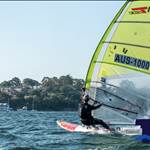
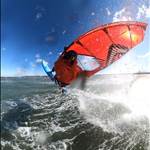
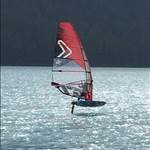
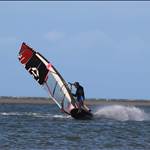
I was wondering what minimum board speed is required for a successful take-off and foiling after pumping, without stalling the foil, and what are your experiences?
Why board speed instead of wind speed: I found this metric interesting and useful, because when using a watch, board non-planning speed is for me a good indicator of when to start pumping. Also, reliable light wind readings on the water are hard to get and are notoriously under-reported/downplayed when discussing with other riders, so my guesstimate is 7-10 knots, which is a super wide range :)
In ideal conditions (flat sea water, steady thermal wind), I need about 6.8 km/h (~3.7 kt or 4.25 mph) of board speed before it makes sense to start pumping and eventually taking off foiling. If the water is choppy, the minimum board speed for my skill needs to be higher, above 7 km/h (3.8 kt or 4.34 mph), sometimes even 8+ km/h in case of nasty/high chop (4.3 kt or 5 mph). We won't get noticeable swell or current, so that's out of the equation.
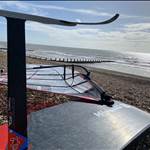
Equipment is Starboard race foil, 1000 wing, 115+ fuselage, 255 -2 stab, +1 or +0.5 spacer, 9 or 10 m2 foil race sail, and 1 m wide course-race foil board (mast rake 1.4?). I've tried with larger 330 stab, but it only stalled the foil due to inadequate speed and/or inadequate pumping technique. My skill is average, and I tend to pump first to gain some board speed before popping off the water (I've seen skilled IQ/race riders jump sooner to foil and gain speed with vigorous up & down motion).
It would be interesting to see how much sooner could one plane/foil with a displacement board, which seems to be gaining popularity with wings, but never really caught on with windfoiling (supposedly being too technical to ride).
When I started foiling, I often had a phone with speed announcements on my arm. I found that unless I heard 5 knots board speed, there was no point in pumping, since I would not get stable flight. I probably needed about 8 knots on large beginner wing, and I'm a lazy pumper.
With an SB 800 front wing, I found that I needed significantly more board speed. If I got up on a foil at 10 knots, I'd usually drop right back down. Around 12 knots was the minimum. The FR1100 is maybe 2-3 knots lower, although that's based on boom GPS units, not announcements.
With a displacement board, it will be almost impossible to get up to 10 knots in displacement mode, since the hull speed is typically around 6 or 7 knots. For winging, the narrow and "long" boards work because they are very narrow - 50 cm wide is typical. With a wing, you can take most of the weight off the board by putting it on the wing when pumping, which lets the small board pop up. The narrow width then reduces the drag while you still touch the water.
Maybe a gifted acrobat would have a chance to windfoil with a large sail on very narrow board - maybe. That said, I have seen someone with exceptional skills take off on a Slingshot flyer in "unfoilable" light wind. The Flyer is still around 70 cm wide, though, and the foiler in question can probably get in less wind that most others on any board.
I need around 4.5 knots of board speed. 76cm-wide board, starboard 1000, 115 plus, 255 -2 stab, +.5 shim, 8.5 Flyer FR. Rider weight 75 kg.
Mostly when I can't foil my gps says slog speed is 3 and a bit knots. GPS graphs below seem to suggest that around 4Knots is needed to get on foil....


For reference:
w720 ~ 750 sqcm on 900 cm fuse
w800 ~ 900 sqcm on 1010 cm fuse
W999 ~1750 sqcm on 899 cm fuse
My watch reads around 4 knots on iqfoil or on freeride gear when it's pumpable. Over 4 knots i usually just can lean back and give it a kick or just a few. I've been experimenting with largest shim and IQFoil around 3.5 knots boardspeed and sometimes I get it to work.
Thanks everyone, great info, especially the detailed charts @thedoor.
@boardsurfr: Maybe a gifted acrobat would have a chance to windfoil with a large sail on very narrow board
Yeah, exactly this  Balz Muller on Starboard Serenity displacement board and windfoil:
About 5,6 knots of board speed and like a 5-7 knot gust for pumping up,
91 wide patrik foil one, 900 front wing, 9.0 foil + patrik, im around 90kg
Select to expand quoteRoyalontheFoil said..
About 5,6 knots of board speed and like a 5-7 knot gust for pumping up,
91 wide patrik foil one, 900 front wing, 9.0 foil + patrik, im around 90kg
That's interesting, the board speed seems quite high for the given wind range. I don't recall a non-planing board speed exceeding 5-5.5 knots in such light wind, unless there are whitecaps...
I that in fin mode.it doesn't matter the size of board 150 or 76 liters. The. Oars will get up to plane a roughly the same speed. The difference is how much power it will take.
with foil I find the same thing . Board size irrevant. Wing size i think is a bit different. So far my 130 wizard bs my 114 .the 114 is a bit easier to get on foil. As far as wing size or shape. It comes down to speed and stall speed. So that I have not come to a conclusion on. My old 76 infinity vs the 926 phantasm. The 926 gets up at almost same speed.just less draggy and glides so much Better.
On my gps it seems aroun 7-8 mph but maybe a pro could get up on less ??
1350 Leviathan is my earliest flying frontwing i have tried, so far

Today I was watching my take off speed. At 200 lb with a 1150 cm2 wing, I have to have a minimum of 9mph to get flying.
Select to expand quotesegler said..
Today I was watching my take off speed. At 200 lb with a 1150 cm2 wing, I have to have a minimum of 9mph to get flying.
Is that speed needed with or without pumping?
Either way. If I pump to get to 9mph board speed, or if there is enough wind to power me to 9mph board speed, or if I can surf a wave to get 9mph board speed, that is the speed I need to lift it into flight. The underwater wing requires forward motion in order to generate enough lift. In my case that means about 250 pounds overall.
Yesterday at Arlington/Roosevelt that was with a SAB799 (1150 cm2) wing. My SAB950 (1350 cm2) will lift at about 8mph board speed. My i76 (~1550 cm2) wing will lift at about 7.5mph board speed.
Select to expand quotePatK said..
1350 Leviathan is my earliest flying frontwing i have tried, so far
Sorry for the wingding
This looks fantastic! Doesn't matter if it's windfoil, wingfoil or kitefoil, this is exactly the direction I'm looking for when it's too light for windfoiling :)
Kite obviously solves lots of light wind issues, but not everyone has enough launch space or a suitable spot for kiting.
Usual story, you get your light wind displacement board out and it hasn't stopped blowing 20plus knots for 10 days now.
Meanwhile, what's the thought on mast rake angle?. As the board does sit on its tail as the bow rises up onto the plane. As the board is narrow at 60cm wide, the larger span 1100 and 1000 SB front wings may be a little on the large size.
Tim


Select to expand quoteseafoodtim said..
Usual story, you get your light wind displacement board out and it hasn't stopped blowing 20plus knots for 10 days
LUCKY!!. hasn't blown over 7 knots here for weeks. Grrrrr..
Select to expand quotethedoor said..
Mostly when I can't foil my gps says slog speed is 3 and a bit knots. GPS graphs below seem to suggest that around 4Knots is needed to get on foil....
For reference:
w720 ~ 750 sqcm on 900 cm fuse
w800 ~ 900 sqcm on 1010 cm fuse
W999 ~1750 sqcm on 899 cm fuse
What the graphs actually show is that your hull speed is about 3 knots (assuming your y axis is in knots), and your typical foiling speeds are about 4-6 times higher. A 6 ft long board has a hull speed of about 3.2 knots.
The lowest graph is interesting because it has a bunch of very short foil runs at the start. You mostly stayed below 12 knots in the short runs, while the stable foiling later is above 12 knots. Based on that, it seems the foil needs about 10-12 knots to provide enough lift for stable foiling.
To get from the hull speed to the "stable foil speed", a bunch of things come into play. Lift from the foil is just one of these;others are a transition of the board into semiplaning and planing mode. Small race foils will pretty much require full planing to get to foiling speeds. Sailor skills and effort in pumping sail and board, and adjusting foil angle for and after take off, is what determines how much help you need from the gear (e.g. larger foils for beginners). All those nicely foiled through jibes indicated a substantial level of skill.Select to expand quoteFormuIa said..
I was wondering what minimum board speed is required for a successful take-off and foiling after pumping, without stalling the foil,
The board speed at take-off is tricky, since there is a very rapid transition from the hull speed (e.g. 3 knots) to the "typical" foil speed (e.g. 12 - 18 knots in thedoor's graphs). Typical foils speeds are generally at least a few knots above the minimum speed. To measure the minimum speed required to prevent stalling, you'd need to slowly slow down from typical foils speeds, and check the speed just before you drop off the foil. Typically, you can pop right back up onto the foil then, since the foil still generates enough lift that a small change in angle of attack is sufficient. You'd want to do this with minimal sail pressure - if you're well powered, you can foil at slower speed with a high angle of attack and a lot of sail power. Doable, but not much fun!
My numbers above do not agree with my 11 mph minimum hull speed shown in the youtube I made last year in Florida. There I needed at least 11 mph of planing to get foiling and then 11 mph minimum speed to keep foiling. Since I usually shim negative for more speed (no shim on the i76 system, however) I always get the board planing first before lifting it into flight.
Select to expand quotesegler said..
Since I usually shim negative for more speed ...
Unless ones speeds are in the mid 20s and above, imho, this is one of the worst pieces of advice that permeated early windfoiling and listening to it caused me tons of issues starting out.
Shim to get level flight with your set up and the desired angle of attack for your wing. Better yet, shim so the board flies level as you enter a jibe. A board that flies level and doesn't nose dive because of inadequate pressure under the front foot is the key for intermediates jibing. Any loss in speed is inconsequential and the added stab pressure makes the whole setup more longitudinally stable.
When I first started out, I had a Horue foil and the accepted wisdom is trim the stab flat to "go fast". On my kit, it was unrideable and demanded a ton of back foot pressure. I finally relented - added a washer to add some angle - and my life got so much easier. I could fly level and make my way up the learning curve.
I recently got a new lightwind/course board where the mast track is about 1.5-2cm forward of my previous preferred mast base position. Even with the mast base all the way back, I had an incredible amount of trouble getting through a light wind jibe (e.g maybe 8 kts of wind). I added a 1/2 degree of angle (changed from a 0.5 to 1.0 in Starboard parlance) moved the mast base a touch forward to soften the change and now I fly through them. Bonus - recently set a PBR for that wing, too, ie I'm just as fast if not faster than I was before.
Select to expand quotePaducah said..segler said..
Since I usually shim negative for more speed ...
Unless ones speeds are in the mid 20s and above, imho, this is one of the worst pieces of advice that permeated early windfoiling and listening to it caused me tons of issues starting out.
Shim to get level flight with your set up and the desired angle of attack for your wing. Better yet, shim so the board flies level as you enter a jibe. A board that flies level and doesn't nose dive because of inadequate pressure under the front foot is the key for intermediates jibing. Any loss in speed is inconsequential and the added stab pressure makes the whole setup more longitudinally stable.
When I first started out, I had a Horue foil and the accepted wisdom is trim the stab flat to "go fast". On my kit, it was unrideable and demanded a ton of back foot pressure. I finally relented - added a washer to add some angle - and my life got so much easier. I could fly level and make my way up the learning curve.
I recently got a new lightwind/course board where the mast track is about 1.5-2cm forward of my previous preferred mast base position. Even with the mast base all the way back, I had an incredible amount of trouble getting through a light wind jibe (e.g maybe 8 kts of wind). I added a 1/2 degree of angle (changed from a 0.5 to 1.0 in Starboard parlance) moved the mast base a touch forward to soften the change and now I fly through them. Bonus - recently set a PBR for that wing, too, ie I'm just as fast if not faster than I was before.
I will second this. Trimming the starboard by 1/2deg positive (or 1 full in very light wind) made a huge difference in rear leg fatigue as well as in jibes.
Pushing the ptm 926 quite a bit forward also made a big difference in jibing (although often higher wind strap vs. step jibes that I do on the starboard foil). That nose dive during jibes is very disheartening when you don't understand what is happening (which was where I was at, too).
I got my advice for negative shimming from no less than Bruce Peterson himself. For my LP and SAB foils (which I purchased at Sailworks), I shim negative to keep the foil from coming up and smacking me in the face whenever I get up to flying speed. Also, to keep from burning out my front leg.
I shim for straight and level flight (no porpoising) with equal foot pressure at 16-18 mph board speed. Faster than that requires a bit more front foot. Slower than that requires a slight bit more back foot.
Before I shimmed negative, it was ALL front foot ALL the time, no matter the speed, and it was a short day of constant porpoising with a burned out front leg. The learning curve was ugly.
After shimming negative, the learning curve was goldilocks.
People keep saying that a front-foot-heavy trim is better for jibing. The Sailworks guys say, big deal, just keep your back foot further back during the carve.
Some people shim the i76, but I run mine stock. It works fine.
FWIW this is very light wind. It was weedy as well. IQFoil with +1 shim/115+. Should have moved the mast base back more because it was so light but I thought it was going to pick up more. Classic.
You can see steady board speed of 3.8kts before I start pumping and get flying. I was burning a lot of calories and only made it happen a couple of times. And, not nearly enough speed to stay flying during the jibe as I hit about 12.5kts.
Also, segler, this is the spot you like. It's great when the tide is running out as you say. Was a little too West which causes it to be more gusty, wish it had a little bit more North or just more base wind. Had to clear weeds on every new tack.

Nice and methodical! I'm on the same boat, so to speak, in perfect conditions I can pump at ~3.8 kt board speed, but cannot or struggle to complete the jibe (more skill needed). Max. power setup (1000 wing, 115+ fuselage, +1 spacer).
The main takeaway was that this is a metric that's rather easy to measure and share/replicate with others, and allows to measure progress to an extent (when to start pumping and when it's futile). It eliminates the guesswork and notorious under-reporting of "I was foiling in 5 knots" :)
Select to expand quoteFormuIa said..
It eliminates the guesswork and notorious under-reporting of "I was foiling in 5 knots" :)
How so? "I was foiling in 5 knots" claims usually are about wind speed, not board speed. More often than not, the wind speed is just guessed, not even measured.
Select to expand quotesegler said..
My numbers above do not agree with my 11 mph minimum hull speed shown in the youtube I made last year in Florida.
You mean "board speed". The term hull speed has a pre-defined meaning in sailing: the maximum speed that a boat can reach in displacement mode (en.wikipedia.org/wiki/Hull_speed). At hull speed, the boat is climbing up the bow waves it generates, which makes any additional speed gains in displacement mode almost impossible. For windsurfing and foiling, you need to switch out of displacement mode by having the board climb out of the water - going into semi-planing or planing, and/or using push from the foil.
Select to expand quoteboardsurfr said..FormuIa said..
It eliminates the guesswork and notorious under-reporting of "I was foiling in 5 knots" :)
How so? "I was foiling in 5 knots" claims usually are about wind speed, not board speed. More often than not, the wind speed is just guessed, not even measured.
My point exactly. Minimum board speed before pumping and flying can easily be measured and proven with a GPS track, and thus comparable between riders and for personal reference.
The "I am able to foil in 5 knots" is most of the time just guessing, and is notoriously prone to stating ridiculously low numbers, because they're hard to prove (measure) without a wind station nearby or on the water. This phenomenon is reversed when the wind picks up and one becomes overpowered
Free foiling with medium large wing (1260mm2, 926mm) on a 125cm X 75cm board with 6m camless sail I need to pump up to about 8 to 9 kts to get flying.
Select to expand quoteWillyWind said..
I need around 4.5 knots of board speed. 76cm-wide board, starboard 1000, 115 plus, 255 -2 stab, +.5 shim, 8.5 Flyer FR. Rider weight 75 kg.
So my watch is set to mph so the 4.5 is in mph. 3.9 knots then my board speed. If I am slogging at around 4 knot of board speed I might get flying if I pump like a madman or I get a little gust, I which case I need to pump like partially madman.
I have a theory, goes like this..
When I get on foil it's not about planning speed or displacement speed but more about "sail pressure" ie once I can generate sufficient power from wind in the sail the board "pops" onto the foil

5.2 km/h or 3 knots waiting for a gust, then the board pops onto the foil. At 3 knots I think it's a combination of surface area of the foil (1100cmsq for my SAB 799) and angle of attack created by weight shift that lifts the board out of the water. Obviously both these things are only possible with power in the sail
Select to expand quote2keen said..
I have a theory, goes like this..
When I get on foil it's not about planning speed or displacement speed but more about "sail pressure" ie once I can generate sufficient power from wind in the sail the board "pops" onto the foil
5.2 km/h or 3 knots waiting for a gust, then the board pops onto the foil. At 3 knots I think it's a combination of surface area of the foil (1100cmsq for my SAB 799) and angle of attack created by weight shift that lifts the board out of the water. Obviously both these things are only possible with power in the sail
Well said
Thanks boardsurfr. I will try to use "board speed" from now on. I guess we don't ride on hulls. We ride on boards. What do DivII sailors ride on?
Hey aeroegnr, I wonder about the weeds you mentioned. Are they worse this time of year? When I foil there in November and March I don't notice much in the way of weeds. Yeah, when the wind has too much west component, this spot is not good and I go down to 75 cent beach.