Select to expand quoteutcminusfour said..
Segler, I appreciate your wealth of knowledge and history about fin windsurfing! The empirical knowledge of windsurfing design is a great resource that one should consider when designing new gear for foiling. No one doubts that flat is fast on planing fin boards, it has been proven over time.
Insisting that it is EXACTLY the same for foil boards holds the progression back!!!!!!!
The lift that a foil creates the second a board starts moving changes things....... What exactly it changes is still largely unknown but will be sorted out eventually. This is a brand new design space and if designers do not experiment, document and share the results it will take longer to learn what the new rules are.
If Kalama had stuck to the rules of non foiling stand up boards the new developments in SUP foil would have taken much longer to arrive.
My efforts here are NOT a failure! I experimented, learned, documented, shared, improved my deisgn/build skills and had FUN! I am working on the next one that will NOT look like something I can buy.
What are you thinking next - long, narrow'ish, flat bottom, sharp straight rails, medium tail width for semi-planing, forward geometry ?? 
I still think someone needs to try a much skinnier windfoil board. My kalama barracuda is 19.5" wide (50cm). Massive massive difference in ease of take off once you get down to these widths. Maybe I should try a strap-on mast base and do some experimenting over Xmas.
Select to expand quotebaldy123 said..
I still think someone needs to try a much skinnier windfoil board. My kalama barracuda is 19.5" wide (50cm). Massive massive difference in ease of take off once you get down to these widths. Maybe I should try a strap-on mast base and do some experimenting over Xmas.
Please Do! Multihull sailboats can perform without the brutal planing shapes but only if they are really narrow for their length.
Select to expand quoteazymuth said..utcminusfour said..
Segler, I appreciate your wealth of knowledge and history about fin windsurfing! The empirical knowledge of windsurfing design is a great resource that one should consider when designing new gear for foiling. No one doubts that flat is fast on planing fin boards, it has been proven over time.
Insisting that it is EXACTLY the same for foil boards holds the progression back!!!!!!!
The lift that a foil creates the second a board starts moving changes things....... What exactly it changes is still largely unknown but will be sorted out eventually. This is a brand new design space and if designers do not experiment, document and share the results it will take longer to learn what the new rules are.
If Kalama had stuck to the rules of non foiling stand up boards the new developments in SUP foil would have taken much longer to arrive.
My efforts here are NOT a failure! I experimented, learned, documented, shared, improved my deisgn/build skills and had FUN! I am working on the next one that will NOT look like something I can buy.
What are you thinking next - long, narrow'ish, flat bottom, sharp straight rails, medium tail width for semi-planing, forward geometry ??
Yes, that is the idea so far.
I have had more time sailing in wind above 15 knots on my recut super short board recently. I am getting better with it and I am noticing what I think is the overhanging tail dragging at take off. I need to recut the recut and play with a tail kick and step and then cut it off just aft of the foil. This will help me decide how I want to approach the tail design on my next one.
Remember one of my main goals is good manners in the water, looking to uphaul easy and sail not slog. Length is often the answer to that goal as well as early take off. If some of the length is behind the foil there is much less swing weight.
The other requirement I have is that the nose not be further than 59" forward of the foil. This way I can carry the board on my back with the foil mast on my shoulder and the nose won't drag on the ground (I don't carry anything on my head at any point now). That requirement makes for a pretty short board unless I hang the length behind the foil. This 59" requirement also rules out the Predator 125 or 145 and the Goya Airbolt 130, boards I was considering buying. God it would be so much easier to just buy something but I would not be satisfied spending all the money to then need to add a handle or a deck pad or tracks. I would also have to carry the gear to the water in two trips. My 145l Kalma copy weighs 3 pounds less than the Goya 130! All other productions board with enough float have the sail track way to far forward for my taste.
I am trying to figure out what the best shape for the overhanging tail is. From my tinkering with the shred sled I know there needs to be a step if there is a kick. I am also looking at less overhang but classic flat run aft and sharp rails but my recent experiences on my short board has me leaning toward something with a step or at least keeping the overhang shorter.
Input from the village is always welcome.
Select to expand quotesegler said..
Slalom boards with flat bottoms were well known to be scary fast.
It is true that any amount of V in the planing surface can reduce top speed compared to a flat bottom. However, if you look at the planing area of modern slalom and speed boards, you will see that the vast majority of them do have a V. I just checked on4 different slalom and speed boards in my garage from3 different brands, and all of them have a pronounced V (looks like around 5 mm or more in front of the fin, although I did not measure it).
Vs in slalom and speed boards give more control than flat bottoms, especially in chop, and make it easier to push down the leeward rail to ride the fin. Those factors are much more important than the slight loss in efficiency from the V. I had the pleasure to speed surf with many of the top speed surfers in Australia earlier this year. Perhaps the most important thing for top speed was control. I needed tips from a 50-knot surfer that went against the common "wisdom" to break 40 knots - in my case, moving the mast base far forward for more control. The one thing that separated the few guys who always went a few knots faster than everyone else was the amount of control they had in chop and strong gusts.
If you compare modern slalom boards to free ride and wave boards, you may find that some of the non-slalom boards have more V. But the bigger differences will be in the amount of rocker, and the sharpness of the rails, especially around the front foot straps. Slalom boards have zero rocker, or close to zero. Wave boards may have a couple of cm rocker, free ride boards in between. The rocker forces the water flow in an upward direction, effectively sucking the board down into the water. Rocker is great for radical turns in waves, but makes it hard to start planing. Kick tails, and a V-shape tail, act similar.
Round rails in the planing surface have a similar effect. With a sharp, rectangular rail, the water that's flowing to the outside squirts out to the side of the board. With a rounded rail, the water follows the shape of the rail and moves upward. That, again, creates downward suction. If you look at the central planing surface of the Elix board, you'll see sharp and rectangular rails. The same is true for some boards that have a pintail bottom shape and winglets.
Looking at downwind board shapes, you need to consider how they are used. For the original downwind use in waves (like on Maui), the board does not need to reach planing speed, since it can use the push of the wave and the foil. If you go to flat water, the wave component goes away, so you'll need a bit more of something. That can be a bigger front wing, or even the upward pull of the hand wing.
Now if you go to a narrow windfoil board shape, you have to allow the board to plane, at least if you want to use a smaller foil. That means your rail and rail shapes become much more important. It does not mean that every corner on the board needs to be sharp and rectangular - at the lower speed transition from displacement to semi-planing, round corners seem to work well enough.

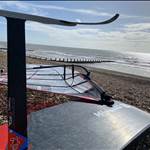
Friend of mine just received custom down winder board with mast track as you can see, we should be testing it soon on a light wind day. First time KT added mast track on this type of a board. Friend of my planning to pair of this board with 186 cm span front wing from Gong, but we planning to test smaller ones too
Friend of mine just received custom down winder board with mast track as you can see, we should be testing it soon on a light wind day. First time KT added mast track on this type of a board. Friend of my planning to pair of this board with 186 cm span front wing from Gong, but we planning to test smaller ones too

Select to expand quotemiamiwindsurfe said..
Friend of mine just received custom down winder board with mast track as you can see, we should be testing it soon on a light wind day. First time KT added mast track on this type of a board. Friend of my planning to pair of this board with 186 cm span front wing from Gong, but we planning to test smaller ones too
Keep us in the loop! What are the dims and volume of that one?
Select to expand quotebaldy123 said..
I still think someone needs to try a much skinnier windfoil board. My kalama barracuda is 19.5" wide (50cm). Massive massive difference in ease of take off once you get down to these widths. Maybe I should try a strap-on mast base and do some experimenting over Xmas.
Pete - I tried it back in August with Q Mike's first gen downwind board, I think 22 wide.
The straps made it tough to get up and it was cold and super windy so a short experiment before it came apart in the middle of the river 
Didn't feel any nice board glide but if it was there it was obscured by the straps drag.
In the brief moments in the air it felt really unbalanced even though the foil mast to mast base dimensions were correct.
Uphauling was ok.
Inconclusive - I hope your test goes better


Wow, I give you guys points for trying... But the whole point of displacement mode is to minimize drag through the water, those straps create crazy drag and mast foot not solidly attached to the board.... Also, you would need to use relatively small sail, max 6 to be comfortable on the narrow board. Will keep you posted, should have some testing done within 2 weeks.. long fusilage/mast I think also is a bad idea
Select to expand quoteutcminusfour said..azymuth said..utcminusfour said..
Segler, I appreciate your wealth of knowledge and history about fin windsurfing! The empirical knowledge of windsurfing design is a great resource that one should consider when designing new gear for foiling. No one doubts that flat is fast on planing fin boards, it has been proven over time.
Insisting that it is EXACTLY the same for foil boards holds the progression back!!!!!!!
The lift that a foil creates the second a board starts moving changes things....... What exactly it changes is still largely unknown but will be sorted out eventually. This is a brand new design space and if designers do not experiment, document and share the results it will take longer to learn what the new rules are.
If Kalama had stuck to the rules of non foiling stand up boards the new developments in SUP foil would have taken much longer to arrive.
My efforts here are NOT a failure! I experimented, learned, documented, shared, improved my deisgn/build skills and had FUN! I am working on the next one that will NOT look like something I can buy.
What are you thinking next - long, narrow'ish, flat bottom, sharp straight rails, medium tail width for semi-planing, forward geometry ??
Yes, that is the idea so far.
I have had more time sailing in wind above 15 knots on my recut super short board recently. I am getting better with it and I am noticing what I think is the overhanging tail dragging at take off. I need to recut the recut and play with a tail kick and step and then cut it off just aft of the foil. This will help me decide how I want to approach the tail design on my next one.
Remember one of my main goals is good manners in the water, looking to uphaul easy and sail not slog. Length is often the answer to that goal as well as early take off. If some of the length is behind the foil there is much less swing weight.
The other requirement I have is that the nose not be further than 59" forward of the foil. This way I can carry the board on my back with the foil mast on my shoulder and the nose won't drag on the ground (I don't carry anything on my head at any point now). That requirement makes for a pretty short board unless I hang the length behind the foil. This 59" requirement also rules out the Predator 125 or 145 and the Goya Airbolt 130, boards I was considering buying. God it would be so much easier to just buy something but I would not be satisfied spending all the money to then need to add a handle or a deck pad or tracks. I would also have to carry the gear to the water in two trips. My 145l Kalma copy weighs 3 pounds less than the Goya 130! All other productions board with enough float have the sail track way to far forward for my taste.
I am trying to figure out what the best shape for the overhanging tail is. From my tinkering with the shred sled I know there needs to be a step if there is a kick. I am also looking at less overhang but classic flat run aft and sharp rails but my recent experiences on my short board has me leaning toward something with a step or at least keeping the overhang shorter.
Input from the village is always welcome.
Check out (bluedog541) on instagram he rides a strapless 5'9x26 @100+lit. Made by Flying Dutchman on Maui.I've seen him ride this board and it seems to work well for him.Also he is on Axis foils and does not use the 899 windsurf fuse think he's on the black short at 703 by going strapless might be a lot easier to run a shorter fuse and result in tighter turns.
Select to expand quoteazymuth said..
Interesting info about Alan Cadiz's wing board starting at 11.33 mins
Tuttle box to eliminate deck plate drag
Board shape - wide tail but overall the board looks fairly narrow
Long straps to move your foot fwd and back
I am lucky enough to see Alan up close when in Maui, he is a great guy and very knowledgeable. He is also one of the best wingers I have ever seen so what he makes look easy is not necessarily easy. Just my 2 cents worth from what I have noticed about his kit
Like he said the Tuttle box is more efficient so I guess that why the racing folks stick with them and they should help with earlier take off. Personally I find them easier to use but don't have a problem with setting up the kit because I ride strapless. My board builder advised me that the Tuttle is a lighter, stronger build but he integrates the Tuttle to the very back of the board.
I would not say Alan's board is overly narrow, from what I remember, but it seemed thick to me. Especially given some of the the good wingfoilers are riding 30 to 40 L boards.
If the goal is to get on a foil in light winds I remember a story one of the wingfoil racers told me. He was at a race event and there was hardly any wind so folks were not racing and he could not get going on his winging kit but a friend lent him some big IQ gear and he said he was flying around no problem on it. And he is a better winger than windfoiler. Riding an 8m sail on a big board is not really for me but it beats sitting on the beach
Select to expand quotemiamiwindsurfe said..
Friend of mine just received custom down winder board with mast track as you can see, we should be testing it soon on a light wind day. First time KT added mast track on this type of a board. Friend of my planning to pair of this board with 186 cm span front wing from Gong, but we planning to test smaller ones too
First test yesterday, 3-8 kn, board is narrow..., mast foot position/ foil position changes???, was using 4.2 sail that was not a good counter balance, was using 2000 cm2 front wing / jumbo 186 cm wing span, definitely not plug and play, but eventually I think will work, for now lots swimming, few lifts but didn't feel stable/weather was also a bit cold for Miami
Select to expand quotemiamiwindsurfe said..miamiwindsurfe said..
Friend of mine just received custom down winder board with mast track as you can see, we should be testing it soon on a light wind day. First time KT added mast track on this type of a board. Friend of my planning to pair of this board with 186 cm span front wing from Gong, but we planning to test smaller ones too
First test yesterday, 3-8 kn, board is narrow..., mast foot position/ foil position changes???, was using 4.2 sail that was not a good counter balance, was using 2000 cm2 front wing / jumbo 186 cm wing span, definitely not plug and play, but eventually I think will work, for now lots swimming, few lifts but didn't feel stable/weather was also a bit cold for Miami
thanks for update
Here is an idea I have pondering for sometime now. It's a power boat chine with a spray deflecting flat. I think there should be one at the bottom planning surface to keep the flow from climbing up the vertical. This is something I can add to what I have and test.

Having nothing to lose I did this quick and dirty edit to see if it would help. This did improve take off. The massive suction was reduced to mild suction and it was easier to get free. It still yawed and rolled horribly as it approached take off speeds.


Select to expand quoteutcminusfour said..
Having nothing to lose I did this quick and dirty edit to see if it would help. This did improve take off. The massive suction was reduced to mild suction and it was easier to get free. It still yawed and rolled horribly as it approached take off speeds.
Interesting process - what's next?
For Winging this is next....... AFS Blackbird, more tail area, for windfoil, similar, more planing surface at rear, less depth on the chine.


Select to expand quoteutcminusfour said..baldy123 said..
I still think someone needs to try a much skinnier windfoil board. My kalama barracuda is 19.5" wide (50cm). Massive massive difference in ease of take off once you get down to these widths. Maybe I should try a strap-on mast base and do some experimenting over Xmas.
Please Do! Multihull sailboats can perform without the brutal planing shapes but only if they are really narrow for their length.
I guess a canoe body may get to foil lifting speed in theory, but would be very long and narrow (4m long, 50 cm wide, round rails, this would never get on planing but on waves in the flat bottom section. I guess somebody has already done that, I rememeber some pic & vid about a Slingshot one and some others too. Though the light wind performance come at a price of high swing weightand inertia on yaw axis which are difficult to overcome, and when on the water standing on this kind of vessel is very challenging and unstable.
I would rather get into the middle of the spectrum with a semy planning hull, that may have less resistance vs a full planning hull at sub planning speeds and less drag of a full displacement one when getting to relativerly higher speeds, but this space is the toughest, there is any kind of shape and is very difficult to make design choiches, but some direction may be taken: minimize wetted surface, minimize stern form drag by making the stern little narrower, though keeping the transom (hard kine) and some flat and large enough surface to get on the plane just before getting on the foil, decision would need to be taken on whether or not keeping rounded kine along the rails or make them sharp as a planning board, probably the best would be to have semi-round edges on the front and full sharp 90 degrees ones on the very stern. One of the triky elements of this design is the ones driven by the pumping technique, since this changes everything, requires adequate and specific skills and is making a full planing hull a nonsense...but only fotr the ones with the ability to take advantage of the board features. For instance flat hull, is good for planing and skimming, but not if you pump and want to rise vertically with minimal forward speed, since the flat section sticks to the water and planing occurs only with speed, some wing boards are rounded for that reason with narrow tail and bow, some inflatable even got very low flying speeds despite no hard kine at all. As you see I have no definitive answer, just some insight I got through observation and fluid dnamics experience. My board at the moment is hard kined and large at the stern, it flies early but I do not have comparison benchmarks with data to know relative performances...I will probably do some modification to the hull and see how it goes...I'll let you know in case.
Select to expand quoteazymuth said..utcminusfour said..
Having nothing to lose I did this quick and dirty edit to see if it would help. This did improve take off. The massive suction was reduced to mild suction and it was easier to get free. It still yawed and rolled horribly as it approached take off speeds.
Interesting process - what's next?
Greetings JJ!
I need a win so I am being more conservative this time. My modified Shred Sled is the closest yet to my goals so I have tried to improve on it, it's the orange outlines in plan and profile. The volume is nearly the same at 145 liters and the center of buoyancy is very close to the same location, just aft of the mast track. I shifted the COB forward a touch by thickening the board forward of the mast track because the sled was too easy to sink the nose when uphauling. The width is about 2" narrower and it's a 1/2" thicker. I had it narrower but I chickened out, we will see how this goes and maybe try that next time. It is slightly shorter so it won't drag behind me when I carry it over my shoulder. The foil and track location stayed roughly the same. The chined rails are gone and replaced with sharp edges. The bottom is flat with hard sharp rails from the tail forward to the sail track then it is a gentle convex arc rolling into tucked and rounded rails at the nose. The tail kick has a release edge or step similar to my mods on the sled. The outline is pulled in slightly in the ends. This has less wetted surface than the sled so that coupled with being narrower over all and narrower at the tail I am hopeful that it will take off easier in light air. I designed it and milled it on holiday between Xmass and New years. I am gonna try my hand at building a tuttle and tracks from scratch so the progress is slow but the weather is crap here so it's the perfect time to geek out and try and save some grams.


Select to expand quoteutcminusfour said..azymuth said..utcminusfour said..
Having nothing to lose I did this quick and dirty edit to see if it would help. This did improve take off. The massive suction was reduced to mild suction and it was easier to get free. It still yawed and rolled horribly as it approached take off speeds.
Interesting process - what's next?
Greetings JJ!
I need a win so I am being more conservative this time. My modified Shred Sled is the closest yet to my goals so I have tried to improve on it, it's the orange outlines in plan and profile. The volume is nearly the same at 145 liters and the center of buoyancy is very close to the same location, just aft of the mast track. I shifted the COB forward a touch by thickening the board forward of the mast track because the sled was too easy to sink the nose when uphauling. The width is about 2" narrower and it's a 1/2" thicker. I had it narrower but I chickened out, we will see how this goes and maybe try that next time. It is slightly shorter so it won't drag behind me when I carry it over my shoulder. The foil and track location stayed roughly the same. The chined rails are gone and replaced with sharp edges. The bottom is flat with hard sharp rails from the tail forward to the sail track then it is a gentle convex arc rolling into tucked and rounded rails at the nose. The tail kick has a release edge or step similar to my mods on the sled. The outline is pulled in slightly in the ends. This has less wetted surface than the sled so that coupled with being narrower over all and narrower at the tail I am hopeful that it will take off easier in light air. I designed it and milled it on holiday between Xmass and New years. I am gonna try my hand at building a tuttle and tracks from scratch so the progress is slow but the weather is crap here so it's the perfect time to geek out and try and save some grams.
Nice work - super interested to see how that turns out
The step tail is cool - seem to remember a few longboards had similar back in the day.
I think I would go similar to your design but 22-24 wide and no step tail (to optimise for light wind take-off) - I'm 80 kgs
Select to expand quoteazymuth said..utcminusfour said..azymuth said..utcminusfour said..
Having nothing to lose I did this quick and dirty edit to see if it would help. This did improve take off. The massive suction was reduced to mild suction and it was easier to get free. It still yawed and rolled horribly as it approached take off speeds.
Interesting process - what's next?
Greetings JJ!
I need a win so I am being more conservative this time. My modified Shred Sled is the closest yet to my goals so I have tried to improve on it, it's the orange outlines in plan and profile. The volume is nearly the same at 145 liters and the center of buoyancy is very close to the same location, just aft of the mast track. I shifted the COB forward a touch by thickening the board forward of the mast track because the sled was too easy to sink the nose when uphauling. The width is about 2" narrower and it's a 1/2" thicker. I had it narrower but I chickened out, we will see how this goes and maybe try that next time. It is slightly shorter so it won't drag behind me when I carry it over my shoulder. The foil and track location stayed roughly the same. The chined rails are gone and replaced with sharp edges. The bottom is flat with hard sharp rails from the tail forward to the sail track then it is a gentle convex arc rolling into tucked and rounded rails at the nose. The tail kick has a release edge or step similar to my mods on the sled. The outline is pulled in slightly in the ends. This has less wetted surface than the sled so that coupled with being narrower over all and narrower at the tail I am hopeful that it will take off easier in light air. I designed it and milled it on holiday between Xmass and New years. I am gonna try my hand at building a tuttle and tracks from scratch so the progress is slow but the weather is crap here so it's the perfect time to geek out and try and save some grams.
Nice work - super interested to see how that turns out
The step tail is cool - seem to remember a few longboards had similar back in the day.
I think I would go similar to your design but 22-24 wide and no step tail (to optimise for light wind take-off) - I'm 80 kgs
At the moment my intuition tends to agree with your comments. I was looking seriously at those widths before I took a more conservative route. I need more data in regards to manners in the water at these sizes. I am not willing to compromise much in the way of ease of uphauling and ease of displacement sailing, blame it on my background in boats and my passion for seamanship. I had a moment on my compact set up yesterday where I struggled to get home cause the wind got squirly and there have been others recently on that board. It strengthened my resolve to keep working towards my design goals. I want a rocket longboard, or maybe we can recycle the funboard term? Or maybe we should not..
Similarly l know how to reduce swing weight in longer lengths but don't have the data regarding the shape of the tail aft of the foil. Given my current experience on a board with a flat hull extension aft of the foil I have my doubts as I feel it dragging when I tell it to go UP.
Like I said, I need a usable board so I made subtle changes to what has worked for me. This will be a good data point along the way towards the next designs and I always learn something about making the boards lighter and better with each build.
I just want to get back to working on my technique rather than board building. Plus I am eager to switch my "maker" energy towards some custom sails.
Your recent vids have been epic! Looks like you are in the sweet spot of your summer! Thanks for sharing the stoke, the northern hemi appreciates it!
Your design is optimized for the transition to semi-planing and planing. Compared to the shred sled, it should work quite a bit better with small foils that require planing speeds to take off. In displacement mode, it's much closer to a traditional shape than to a downwind shape. But the length and width should make slogging home much easier than with a very short board. For me, that's a very important aspect of board design.
For taking off, the wetted area is largely irrelevant, since speeds are low. The effects of sharper rails on water release, and tail shape for enabling increasing the AoA of the foil, will be a lot larger than any effects from wetted area differences. Otherwise, narrow downwind shapes which have larger wetted areas than more square shapes simply would not work.
Select to expand quoteboardsurfr said..
Your design is optimized for the transition to semi-planing and planing. Compared to the shred sled, it should work quite a bit better with small foils that require planing speeds to take off. In displacement mode, it's much closer to a traditional shape than to a downwind shape. But the length and width should make slogging home much easier than with a very short board. For me, that's a very important aspect of board design.
For taking off, the wetted area is largely irrelevant, since speeds are low. The effects of sharper rails on water release, and tail shape for enabling increasing the AoA of the foil, will be a lot larger than any effects from wetted area differences. Otherwise, narrow downwind shapes which have larger wetted areas than more square shapes simply would not work.
Your comments a few weeks ago about optimizing for the semi-planing speed range resonated with me and sent me off looking at boats and longboard windsurfers designed for that regime. One of the details I noted in that drill down is that most of the good boats and boards in that realm were narrow for their length.
I am glad to hear I am not the only one who cares about having some sailing ability in sub foiling winds! The great thing about foiling is that even when it's windy and rough a little extra volume does not create the control problems it does on fin boards.
At take off speed I agree, it's all about the water release. Getting up to that speed is where reducing the wetted surface is important. One of the fundamental metrics of light air sailboat design is sail area to wetted surface ratio. Below hull speed, wetted surface is the primary source of drag and shapes that are circular in cross section excel. In and around hull speed the main source of drag is wave making and narrower shapes excel. Once planning the wetted surface becomes important again that's why we see steps on fast powerboats and cut outs on formula boards. These are basic principles of naval architecture and while things are different with foiling craft these basics still apply in some way. Our windfoil gear needs to address each of these realms to perform across a range of conditions. It is super fun exploring the subtle differences that this new design space offers!
My thought is that if there is less drag at displacement speeds then you accelerate quicker, build apparent wind sooner and increase the flow over the foil sooner. The key as I have learned from my experiments and experiences is that for windfoil you can not ignore the need for a good planning hull in pursuit of lowering the drag in displacement mode.
I did not necessarily change anything in this design to reduce wetted surface but I did note that it was lower. I did intentionally pull the width of the tail in and make it rounded with the goal of lowering drag at displacement speeds.
As always I appreciate your intelligent input, thanks for your reply!
Having spent some time before the hurricanes and ice age came this Autumn/Winter. I was fortunate to have a wide range of conditions to try out the foiling Serenity. With a lightweight 5.8 single cam NO foil sail, I was able to try out various combinations of masts, fuses and wings.
The work in progress so far has revealed their are 3 very distinct sailing modes:
"full displacement" (despite the drag of what is a shopping trolley underneath the board)
"foil assist", the lift can be felt with the bow displacement hull form out of the water
" full foil" both displacement ends of the board out of the water, full zombie mode
Wider HA wings help the stability issues below zooming mode with a downside of being a little uncomfortable and uncontrollable at speed. As the board doesn't have the width or leverage on the foil. My best efforts so far are with a chopped down HA 1050 to a MA 850 front wing ( chop saw to the skinny wing tips). The swing weight is crazy, but the board is in foil assist around 8 knots and will do wind speed plus easily at 10-12 knots of wind.
Bigger sails don't help drive the board with the foil, as all you're really trying to do is get to the board speed where the foils engage. There's a lot of fun to be had in displacement windfoiling, and with some mods and design input to a local 3D CAD blank builder, there's a fun board/concept waiting to happen . I've had a real blast in sub 10 knots. Not quite fully frothed, but more foam latte. Alas I fear with the decline of wind foilers locally to full WangLord, (the path of least resistance and staying in a comfort zone with lots of other free riders), it's a personal project that won't be released on the general foiling public


Select to expand quotemiamiwindsurfe said..
Friend of mine just received custom down winder board with mast track as you can see, we should be testing it soon on a light wind day. First time KT added mast track on this type of a board. Friend of my planning to pair of this board with 186 cm span front wing from Gong, but we planning to test smaller ones too
Another update, after few days of testing we agreed that mast track(for sail)was too far forward, so board went back to KT and they installed another track back. My friend just got it and had a chance to try it, very happy now, board and rig feel balanced now and even with smaller sail, but that huge front wing, it takes off on nothing, I should be able to try it in a month, will post photos and more details then

FYI: he accidently ordered 2 front wings 186cm Sirius? , so, if someone what a great deal on a new jumbo front wing from Gong, text me