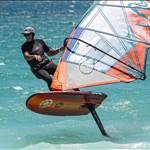
Long story short, Mark OZ is right about keeping things flat in the tail. This is the hardest design to get flying that I have ever ridden and it is really unstable in roll and yaw as it struggles to get free. Even with my big front wings did not help. It is fascinating how a little mast base preassure completely changes what hull shapes work! My winging and SUP buds will all get turns testing it to see how it goes in those modes.
I liked it in the air just fine but easy lift off is my primary goal so it's back to the drawing board. I will use all that learned on the next one. Real Data!


Select to expand quoteutcminusfour said..
Long story short, Mark OZ is right about keeping things flat in the tail. This is the hardest design to get flying that I have ever ridden and it is really unstable in roll and yaw as it struggles to get free. Even with my big front wings did not help. It is fascinating how a little mast base preassure completely changes what hull shapes work! My winging and SUP buds will all get turns testing it to see how it goes in those modes.
I liked it in the air just fine but easy lift off is my primary goal so it's back to the drawing board. I will use all that learned on the next one. Real Data!
Nice looking build. Thanks for testing and saving me $$ 
I was thinking about getting something similar built so back to the drawing board for me too...
Doesn't seem any brands are doing any freeride windfoil board development - lucky DIY is fun 
Thanks JJ! I am stoked with the build. It is lighter, cleaner and went together faster than my previous tries. Next one should be better in all those aspects too. While the brands focus on other sports it gives us DYI guys the chance to be the ones to change the sport. Keep doing what you do, your on the leading edge!
Good timing man as i was going to repurpose an old fkd project into something kinda like that and throw it to JJ and Simon 2Keen
I was not going to do as much tail vee as that but still, you've made me rethink.....
Sorry to hear your fail, we've all had one that rode funny
Thanks for the kind words
www.phantom-foiling.com/wind-foil-shop/p/infinite-86-ltd
not a kalama but quite different windfoil hull shape from previous generation with allegedly easier takeoff.
Select to expand quoteutcminusfour said..
Long story short, Mark OZ is right about keeping things flat in the tail. This is the hardest design to get flying that I have ever ridden and it is really unstable in roll and yaw as it struggles to get free. Even with my big front wings did not help. It is fascinating how a little mast base preassure completely changes what hull shapes work! My winging and SUP buds will all get turns testing it to see how it goes in those modes.
I liked it in the air just fine but easy lift off is my primary goal so it's back to the drawing board. I will use all that learned on the next one. Real Data!
"Long story short" , we need more!!
Board looks great, well done.
UJ and foil mast look perfectly placed so no surprise it felt good in the air. Did you feel more swing weight than a short board or did it feel similar?
Prior to lift off, did it feel like it was slicing through the water? Did it feel fast but sticky or just unstable from the outset?
Thinking outside the box, the down wind crew obviously need to learn the right technique to get on foil. Do you think with time you could develop a technique which allows this board to excel in light wind take offs?
Select to expand quoteregal1 said..
www.phantom-foiling.com/wind-foil-shop/p/infinite-86-ltd
not a kalama but quite different windfoil hull shape from previous generation with allegedly easier takeoff.
That one looks super sweet. I'd love to get a chance to ride one but it's unlikely without just me buying one. The vee for touchdowns really makes me want to see how it feels when the jibes are less than perfect and in chop. I've dug a rail a lot on the 95cm wide boards and it's nerve racking.
Select to expand quoteregal1 said..
www.phantom-foiling.com/wind-foil-shop/p/infinite-86-ltd
not a kalama but quite different windfoil hull shape from previous generation with allegedly easier takeoff.
Thanks for sharing this, I had not seen this. No way I would challenge Nico!
This is a tottaly different design goal to mine and is powered with way more sail even though Nico is teaching the racers to rig smaller. It is only a subtle change to what they were doing. My gut tells me the mellow side bevels are draggier but because the hull is so wide the release of the surface tension outweighs that and they use sail area to compensate for the wide hull drag any way. Big sails are a catch 22. They generate way more power in light air but require massive hull width to control all that power. I have built a couple boards that are wide all the way to the transom. They both responded well to and really needed to be torqued side to side at slow take off speeds to break them free of the surface tension. I am looking for finesse not brute force.
Select to expand quoteMark _australia said..
Good timing man as i was going to repurpose an old fkd project into something kinda like that and throw it to JJ and Simon 2Keen
I was not going to do as much tail vee as that but still, you've made me rethink.....
Sorry to hear your fail, we've all had one that rode funny
Thanks for the kind words
I almost did not post this because I did not want to discourage people from trying new things. Rethinking is good. Not experimenting, not so much. Remember, I am just one kook with no other windfoilers around, sailing in my own little bubble.
Take me with a grain of salt and help the community by trying all sorts of things for yourself. Simply because as a skilled shaper you can and you have some great test pilots! The major brands are not doing it, why not us?
I "think" I understand why this did not work for me but more work is required for me to "know why". I see the wingers going in sub 10 knots and I want that for windfoil too!
Cheers Mark!
Lovely looking board, great experiment. Thanks for reporting the results!
Wingers have the advantage that there is an upward force from the wing. It's the opposite with a sail, where the rig weight add down force. The hand wing also allows more independent movement when pumping, since it's not attached. So you definitely have physics against you when you try to get going on a similar sized sail, compared to a wing. Windfoil racers have to use huge boards and sails to get a similar low end.
Regarding your design, imagine the water flowing along the bottom of the board, following the contours. With a flat bottom, the flow is mostly to the back but partly to the outside. With a round rail, it follows the rail and is re-directed outside, hence the sharp edges. The concaves and double-concaves redirect the water flow at the sides downward, creating lift - exactly the opposite of round rails. Jim Drake, who was involved in Starboard's original development of very wide planing hulls, posted two different formulas for typical and very wide hulls. Basically, the very wide hulls also limit water flow to the sides relative to flow to the back, and thereby increase lift more than just the width ratio would suggest.
Next, keep in mind how the board moves though the water. Requirements are quite different for displacement mode, semi-planing, and planing modes. DW wing boards are are optimized for displacement mode, and can almost skip semi-planing and planing modes. In contrast, wind foil race boards with small race wings need to be fully planing before foiling.
For the goal of using a small sail for light wind take off in wind foiling, your board will need to be efficient in displacement mode, but also in semi-planing mode. Your shape is probably great in displacement mode, but quite poor in semi-planing, since the V-tail and rails create suction (from water flowing upwards). You'll need to eliminate the upward-angled surfaces, at least in the back of the board. The Starboard Phantom illustrated nicely how to do this. The AFS Whitebird showed that the same basic underwater shape also works well in a much shorter version for winging.
Select to expand quote2keen said..utcminusfour said..
Long story short, Mark OZ is right about keeping things flat in the tail. This is the hardest design to get flying that I have ever ridden and it is really unstable in roll and yaw as it struggles to get free. Even with my big front wings did not help. It is fascinating how a little mast base preassure completely changes what hull shapes work! My winging and SUP buds will all get turns testing it to see how it goes in those modes.
I liked it in the air just fine but easy lift off is my primary goal so it's back to the drawing board. I will use all that learned on the next one. Real Data!
"Long story short" , we need more!!
Board looks great, well done.
UJ and foil mast look perfectly placed so no surprise it felt good in the air. Did you feel more swing weight than a short board or did it feel similar?
Prior to lift off, did it feel like it was slicing through the water? Did it feel fast but sticky or just unstable from the outset?
Thinking outside the box, the down wind crew obviously need to learn the right technique to get on foil. Do you think with time you could develop a technique which allows this board to excel in light wind take offs?
Thanks Simon!
Swing weight felt reasonable to good, no surprise with the rider in the middle of the board instead of the end.
It was challenging to uphaul and taxi but not impossible. It seems fast to reach foiling speeds then it hit a wall. Its a displacement hull trying to plane, just gets sucked down.
I started with the 799 because I was skeptical it would work with a smaller foil. I had plenty of wind in the gusts and struggled but eventually I got it to fly.
I switched to the 999 thinking okay foil pump early and your golden. The bigger wing still would not sail out on its own even though it would easily in those conditions on other boards. The only way I could get free consistently was to get as much speed as the hull would allow and then forcefully bounce it out with a foil pump.
So my technique improved over the session, I went from impossible to fly to if I am really good and lucky I can fly. I have experience with this type of problem, it felt similar to my shred sled before I added the release edge to kick tail. After that edit the board would sail free on it's own when powered and good technique could get it to fly sooner. That's what I want, not something that requires mad technique to work at all.
Select to expand quoteboardsurfr said..
Lovely looking board, great experiment. Thanks for reporting the results!
Wingers have the advantage that there is an upward force from the wing. It's the opposite with a sail, where the rig weight add down force. The hand wing also allows more independent movement when pumping, since it's not attached. So you definitely have physics against you when you try to get going on a similar sized sail, compared to a wing. Windfoil racers have to use huge boards and sails to get a similar low end.
Regarding your design, imagine the water flowing along the bottom of the board, following the contours. With a flat bottom, the flow is mostly to the back but partly to the outside. With a round rail, it follows the rail and is re-directed outside, hence the sharp edges. The concaves and double-concaves redirect the water flow at the sides downward, creating lift - exactly the opposite of round rails. Jim Drake, who was involved in Starboard's original development of very wide planing hulls, posted two different formulas for typical and very wide hulls. Basically, the very wide hulls also limit water flow to the sides relative to flow to the back, and thereby increase lift more than just the width ratio would suggest.
Next, keep in mind how the board moves though the water. Requirements are quite different for displacement mode, semi-planing, and planing modes. DW wing boards are are optimized for displacement mode, and can almost skip semi-planing and planing modes. In contrast, wind foil race boards with small race wings need to be fully planing before foiling.
For the goal of using a small sail for light wind take off in wind foiling, your board will need to be efficient in displacement mode, but also in semi-planing mode. Your shape is probably great in displacement mode, but quite poor in semi-planing, since the V-tail and rails create suction (from water flowing upwards). You'll need to eliminate the upward-angled surfaces, at least in the back of the board. The Starboard Phantom illustrated nicely how to do this. The AFS Whitebird showed that the same basic underwater shape also works well in a much shorter version for winging.
Thanks for taking the time for a detailed reply. I went to the Landing School of Boatbuilding and Design. I have worked as a Yacht designer and currently work designing commercial vessels. So I get it.
My prefered way to learn is by trying things. I have made thousands of conceptual drawings over the years, it's the ones I built that I learned the most from. Like I knew the kick tail on my shred sled would not work but I bought it anyway because I was curious (and it was on sale:). Fixing its behavior with a little foam wedge and glass on the tail was priceless. I went on to enjoy that board for years because of its good manners in the water and maneuverability in the air. Very few folks at that point were willing to accept that placing the foil so far forward had any place on a windfoil board. Turns out it really reduces swing weight while still allowing some volume in your hull.
I was curious about this Kalama inspired shape so I had to try. What surprises me is that I still struggled to fly it with my big front wing and good foil pumping skills that on other boards allowed me to fly before planning speeds. There is still more to unpack here.
The upforce from hand wings is obviously the main difference here. DW paddling also creates a up force, the blade is not plumb and then the rider uses that force to unweight the hull.
Drake's formulas explain why barges and many work boats are square, the water goes under not around. In planning hulls this creates vertical lift. Where can I find Drake's work and formulas?
Thanks for sharing those boards!
The Starboard Phantom is really clever! It's like what the foil race boards are doing but the extension is on the bottom instead of on the deck. I have seen that concept applied to powerboats that want a double ender for looks but still want to plane, it makes a nice swim platform too! I think I prefer the extension on top for foiling to keep the sail carrying power but this might have merit or spawn another idea!
The AFS Whitebird is what the foil race boards are doing but the edges are smoothed out. I am skeptical of this because of what I just confirmed on the water. I wonder if that board would be better with crisp square corners in the transitions from the bottom to the deck. While the rounded sections reduce wetted surface they also create suction.
Exciting times Huh?!?!?
Select to expand quoteutcminusfour said..
The AFS Whitebird is what the foil race boards are doing but the edges are smoothed out. I am skeptical of this because of what I just confirmed on the water. I wonder if that board would be better with crisp square corners in the transitions from the bottom to the deck. While the rounded sections reduce wetted surface they also create suction.
I think it's safe to assume that the Whitebird is not the perfect shape. But it seems to have hard, square rails at two places where it matters: at the edges of the wings, and behind the foil boxes in the middle pintail bottom shape. As for the wings getting pulled up towards the tail, I think that could be improved. Even steps (cutouts) may work better when semi-planing.
As for the transition from the sides of the pintail to the top part of the board, I don't think that square corners would be better. In displacement mode, the rounded edges should create less turbulence. I'd love to see some flow modeling at different speeds and depths of the board in the water for this.Select to expand quoteutcminusfour said..
Drake's formulas explain why barges and many work boats are square, the water goes under not around. In planning hulls this creates vertical lift. Where can I find Drake's work and formulas?
Here's the two formulas I was referring to: The article that's in can be downloaded from www.boatdesign.net/attachments/planing-formula-drake-2-pdf.54338/
Select to expand quoteregal1 said..
www.phantom-foiling.com/wind-foil-shop/p/infinite-86-ltd
not a kalama but quite different windfoil hull shape from previous generation with allegedly easier takeoff.
That makes me feel good. My 2020 Foiler Mk2 has similar hull design with a flat centre section and slight vee out to the rails. 2022 built Mk 3 is similar also.
In my case I did it because I wanted 'easy to build' and I did 300mm wide flat centre section front to back with 1 degree outer sections and (65mm max) bevelled rails from 900 to the nose.
It was easy to build and flies very easily. My tail is less square, I pulled it in 815 max to 570 because I only sail with small sails (5.6 raf) and so don't need the tail width to handle huge sail power. My slow gybing record is full flying gybe at 5.3kts min speed. It works great. Slingshot style/size foil (homemade)
What about using a step like the Kona to create a planing hull which has good speed in displacement mode?
Interesting it didn't work out. Anything to do with volume distribution? Feels like it could do with more volume behind the mast track, but at 145L it should have plenty of volume everywhere. Wingfoiling narrow boards with feet on centreline seems fine, because you don't have that interaction with the sail and fixed mast base position. For me I also found that between winging and windfoiling, you can sail pump a lot more powerfully with the sail when windfoiling, in comparison winging you do more board pumping, because pumping the wing hard is basically like trashing a plastic bag in the air in comparison.
I had also drawn up a Kalama inspired design a while back, but never got around to getting it built, but had quite a different design philosophy. Throw up some images in case it is of any interest to anyone. I went with Kalama E3 inspired chines underneath rather than cutouts, and a scow bow type nose. I found when windfoiling I've always preferred a board with more width and outboard feet position. My goal was to get plenty of volume and width under my feet, so you can jump into straps early and pump efficiently. And it was short because I wanted to be able to fit it inside the car without having to fold seats down ?? . I think it ended up around 158cm x 65cm x 95L? Still needed to tidy up some of the surfaces and tweak the nose.
Top

Bottom

Rocker

Tail


Interesting info about Alan Cadiz's wing board starting at 11.33 mins
Tuttle box to eliminate deck plate drag
Board shape - wide tail but overall the board looks fairly narrow
Long straps to move your foot fwd and back
I think for windfoil the guys at Elix in France (home of modern foiling developments, nico goyard, Phantom Foils etc) have the right idea.
The Condor board project still in prototype development, now on revision 7, a blend of the downwind wingboard shape, and the competitive windfoil shape (Olympic IQ shape). Piercing wave bow, incredibly aero shape, even you might say a type of lifting body design, as it transitions bow to midships and to the hiking platform in the footstraps area. The underwater shape is equally unique, from the piercing bow forward to its its chines and concaves, somewhat akin to a catamaran dual hull, with downturned double concaves with a flat in the middle final planing surface before liftoff. In this way you build speed with reduced surface area in the nose, transition to the concaves and just as you begin planing, the lifting body hiking wings then contribute to the final liftoff onto foil. As this happens the aerodynamic properties of streamlining and drag reduction in frontal area, then transition to a very slippery shape in the air, while still having enough width in the hiking wings footstrap area to use larger sails if needed. Their first version was 1005cm wide at tail, now they are at 85 wide at tail on revision 7. To me this looks the trick to combine the early liftoff of the downwind shape, with the volume and width at rear for larger sails and all sea conditions, including enough flotation for fresh and salt water, tacking, and maneuvers.
It's basically a miniature America's Cup shape. Coming to production in 2024.
Give me one of these in Patrick Airinside Construction, and we are in Windfoiling Nirvana.
Version 7

Version 2 follows


Select to expand quoteGrantmac said..
What about using a step like the Kona to create a planing hull which has good speed in displacement mode?
That could work. When I read this I was like, yeah just crank out a model so we can all see it. 3 hours later I was like, dang this is hard to model in a way that the base shape is editable.
Noble effort and, as always, impressive. Thinking out loud here, wondering if we are chasing down the wrong road by pursuing the Kalama shape for windfoil? For most of us, it takes a bit of pressure under the tail (to promote at least a semi-plane) to get enough speed to lift off.
The Kalama is definitely an improvement over most wing boards in light air because most wing boards are a lunch tray. The Kalama shape at least allows some displacement speed to get water flowing over the foil. Couple that with the vertical lift of the wing plus foot pumping and you start to generate enough lift to begin to foil. It's also a downwind foiling shape so I'm assuming some of the design considerations are optimized for a following sea (e.g not getting too lifted in the tail by a swell).
Our process depends more on board lift. The displacement speed of a 200cm board is about 3 kts according to an online calculator I used. Obviously, we need someway of getting between the 3 kts at displacement and from 7-10 kts needed to foil. Nobody here is getting off the water at displacement speed. Further, the rather narrow tail and even thinner flat sections just don't provide much sub-planing lift the way a wider/flatter tail (e.g swoosh's or Mark's boards) would have. fwiw, I don't find my 91cm race board that hard to get off the water compared to my 75cm board which I attribute largely to the very crisp edges on the rails and tail.
The other aspect of the Kalama boards are the "pin tail". Looking at that chine shape from front to back on the bottom profile, it makes a poorish foil section, imho, as the tail comes in too sharply. Water flowing along that edge is going to be a lot draggier (in my completely uneducated opinion) than more conventional shapes with a more gentle curve. That type of board shape is asking the water to change direction more than I think a board with straighter aft sections.
None of this is a negative towards utcminusfour's efforts. I've always been fascinated by the shape but it's only in hindsight and in consideration of his results that I'm thinking about these things.
Select to expand quoteazymuth said..
Interesting info about Alan Cadiz's wing board starting at 11.33 mins
Tuttle box to eliminate deck plate drag
Board shape - wide tail but overall the board looks fairly narrow
Long straps to move your foot fwd and back
Thanks JJ,
That shape scaled up should work, its clean, straight and crisp at the tail. I have been looking at something like this.
I have been tracking weights carefully over all my builds and Tuttle is lighter than tracks.
Here are weights from Fiberglass Supply here in the states:
Tuttle: 0.6LBS - with foam and tubes ready to install
16"Dual Track Box: 1.6LBS with rectangular foam around tracks
10.75" Futures Track: 0.3LBS Just one light track and no foam
In my case I have been using an adaptor so if I go Tuttle I save that 1.5 lbs right of the rip but I can't use my shorter go foil set up.
Select to expand quotechuckmaui said..
I think for windfoil the guys at Elix in France (home of modern foiling developments, nico goyard, Phantom Foils etc) have the right idea.
The Condor board project still in prototype development, now on revision 7, a blend of the downwind wingboard shape, and the competitive windfoil shape (Olympic IQ shape). Piercing wave bow, incredibly aero shape, even you might say a type of lifting body design, as it transitions bow to midships and to the hiking platform in the footstraps area. The underwater shape is equally unique, from the piercing bow forward to its its chines and concaves, somewhat akin to a catamaran dual hull, with downturned double concaves with a flat in the middle final planing surface before liftoff. In this way you build speed with reduced surface area in the nose, transition to the concaves and just as you begin planing, the lifting body hiking wings then contribute to the final liftoff onto foil. As this happens the aerodynamic properties of streamlining and drag reduction in frontal area, then transition to a very slippery shape in the air, while still having enough width in the hiking wings footstrap area to use larger sails if needed. Their first version was 1005cm wide at tail, now they are at 85 wide at tail on revision 7. To me this looks the trick to combine the early liftoff of the downwind shape, with the volume and width at rear for larger sails and all sea conditions, including enough flotation for fresh and salt water, tacking, and maneuvers.
It's basically a miniature America's Cup shape. Coming to production in 2024.
Give me one of these in Patrick Airinside Construction, and we are in Windfoiling Nirvana.
Version 7
Version 2 follows
I am glad to hear they are still working on this concept. I think it is fascinating and has huge potential. But if it has taken them 7 trys and years, that would be one huge rabbit hole for me! Right now I need the shortest and least expensive route to a new daily driver.
Select to expand quoteswoosh said..
Interesting it didn't work out. Anything to do with volume distribution? Feels like it could do with more volume behind the mast track, but at 145L it should have plenty of volume everywhere. Wingfoiling narrow boards with feet on centreline seems fine, because you don't have that interaction with the sail and fixed mast base position. For me I also found that between winging and windfoiling, you can sail pump a lot more powerfully with the sail when windfoiling, in comparison winging you do more board pumping, because pumping the wing hard is basically like trashing a plastic bag in the air in comparison.
I had also drawn up a Kalama inspired design a while back, but never got around to getting it built, but had quite a different design philosophy. Throw up some images in case it is of any interest to anyone. I went with Kalama E3 inspired chines underneath rather than cutouts, and a scow bow type nose. I found when windfoiling I've always preferred a board with more width and outboard feet position. My goal was to get plenty of volume and width under my feet, so you can jump into straps early and pump efficiently. And it was short because I wanted to be able to fit it inside the car without having to fold seats down ?? . I think it ended up around 158cm x 65cm x 95L? Still needed to tidy up some of the surfaces and tweak the nose.
Top
Bottom
Rocker
Tail
Woa, that's tiny! With your skills it could be fun when it's windy. Even with your skill that would be really hard to uphaul, even Balz has to focus to uphaul that 110. At this point I would suggest you fade that bevel out before the tail.
Select to expand quotePaducah said..
Noble effort and, as always, impressive. Thinking out loud here, wondering if we are chasing down the wrong road by pursuing the Kalama shape for windfoil? For most of us, it takes a bit of pressure under the tail (to promote at least a semi-plane) to get enough speed to lift off.
The Kalama is definitely an improvement over most wing boards in light air because most wing boards are a lunch tray. The Kalama shape at least allows some displacement speed to get water flowing over the foil. Couple that with the vertical lift of the wing plus foot pumping and you start to generate enough lift to begin to foil. It's also a downwind foiling shape so I'm assuming some of the design considerations are optimized for a following sea (e.g not getting too lifted in the tail by a swell).
Our process depends more on board lift. The displacement speed of a 200cm board is about 3 kts according to an online calculator I used. Obviously, we need someway of getting between the 3 kts at displacement and from 7-10 kts needed to foil. Nobody here is getting off the water at displacement speed. Further, the rather narrow tail and even thinner flat sections just don't provide much sub-planing lift the way a wider/flatter tail (e.g swoosh's or Mark's boards) would have. fwiw, I don't find my 91cm race board that hard to get off the water compared to my 75cm board which I attribute largely to the very crisp edges on the rails and tail.
The other aspect of the Kalama boards are the "pin tail". Looking at that chine shape from front to back on the bottom profile, it makes a poorish foil section, imho, as the tail comes in too sharply. Water flowing along that edge is going to be a lot draggier (in my completely uneducated opinion) than more conventional shapes with a more gentle curve. That type of board shape is asking the water to change direction more than I think a board with straighter aft sections.
None of this is a negative towards utcminusfour's efforts. I've always been fascinated by the shape but it's only in hindsight and in consideration of his results that I'm thinking about these things.
I hear ya bud. There are two problems with what I just tried. Too much taper of the tail in plan view (rails not parallel) and big wide bevels all the way to the tail.
I do this and share it so ya'll don't have to!
I agree about the transition from displacement speed to liftoff speed. For my weight and gear choice, displacement speed is about 4 kts, and liftoff speed is about 8 kts. My foil boards are far from the Kalama regime, but the principles are the same.
My Exocet 132 has a width of 85 cm with very rounded rails. My Stingray 140 also has width of 85 cm but has much sharper rails. Both boards have similar rockers and tail widths. The Stingray planes more easily. Therefore, the Stingray is much better at pumping up to liftoff speed.
So, board shape and size up in the air is not all that critical as long as the geometry is about right. However, since all windfoiling begins on and in the water, the shape and size for on-water performance is very important. The thread above seems to bear this out.
Some people like to use giant wings and haul the foil up into flight at subplaning speeds. Lots of "light wind" thread discussions about this.
I don't. I prefer to get the board up into a slow plane (8 kts) then gently lift into flight. I can use smaller and faster wings this way. It works.
Select to expand quotesegler said..
I agree about the transition from displacement speed to liftoff speed. For my weight and gear choice, displacement speed is about 4 kts, and liftoff speed is about 8 kts. My foil boards are far from the Kalama regime, but the principles are the same.
My Exocet 132 has a width of 85 cm with very rounded rails. My Stingray 140 also has width of 85 cm but has much sharper rails. Both boards have similar rockers and tail widths. The Stingray planes more easily. Therefore, the Stingray is much better at pumping up to liftoff speed.
So, board shape and size up in the air is not all that critical as long as the geometry is about right. However, since all windfoiling begins on and in the water, the shape and size for on-water performance is very important. The thread above seems to bear this out.
Some people like to use giant wings and haul the foil up into flight at subplaning speeds. Lots of "light wind" thread discussions about this.
I don't. I prefer to get the board up into a slow plane (8 kts) then gently lift into flight. I can use smaller and faster wings this way. It works.
Thats good info segler thanks! I can't see much difference in the rail shapes in the pictures I have found. Is similar to your Exocet?
progressivesports.com/2023-exocet-freefoil-freeride-windsurf-board-132-ast?gclid=Cj0KCQiA7OqrBhD9ARIsAK3UXh1lY2vDrs4Y_nao8ozWrD3EjQQ6oX8p-b3vPYPtS5OM_yUXRh8MpD0aAmoNEALw_wcB
Hard to say since the website does not show a cross-section. If the board is designed for winGfoiling as well as winDfoiling, it probably has soft rails.
I was out on the Exo132 yesterday and compared notes with a guy who was on the Exo112 size of the same board. We both agreed that the rounded rails required some energetic pumping to get planing. Yesterday's wind was no problem in that department. If I can easily waterstart a 5.0 at 95 kg body weight, you know it's windy. It was 20-30 mph and frightfully gusty, which is unusual for Florida.
I forgot to mention that both the Exocet and Stingray have flat bottoms. This helps with planing.
One very nice advantage of round rails is drama-free touchdowns. I was working on my jibes, so touchdowns were frequent (and wet).
Funny thing about the jibe touchdowns on the Stingray 140: when I started working on windfoil jibes, there were plenty of uncontrolled crashes - including one where the back of my head hit the foil, fortunately just barely. But when working on wing jibes on the same board, crashes were not as frequent, and never uncontrolled. It probably helped that I had gotten plenty of warnings just to go with the fall when winging, rather than trying to recover and end up with the dreaded taco fall. But still, the difference was quite noticeable. On flat water, the Stingray later made it very easy to keep enough speed in touchdowns to pop right back up onto the foil, whereas several shorter boards usually resulted in a much higher percentage of crashes, both with a sail and with a wing.
On a different topic: I love the picture of the Elix board, very interesting. One way of looking at the board is to say that the different elements work to reduce the Froude number at different speeds. The Froude number can be seen as the inverse of a "drag coefficient for a boat. For the Stingray at the displacement speed of 4 knots, it's about 0.45. To get to a takeoff speed of 8 knots, it would have be go up to 0.9. For a speed board going 40 knots, is around 8-10. On the Elix, the wave-piercing nose reduces drag, so the flat center bottom can start lifting in semi-planing mode. The hard, rectangular edges and concaves then let it go into full planing mode so it can reach enough speed for takeoff with small race foils. Can't wait to see boards like this in action on the race course!
Hi Segler
"I forgot to mention that both the Exocet and Stingray have flat bottoms. This helps with planing."
Mr Elix and his Condor project definitely don't agree with that statement.
I always keep in mind the rule for the stone throwers that "a flat stone skips best".
The comment about flat bottoms being easier to plane comes from years and years of research and experience in the slalom and formula regimes. Bottoms with a V were always a tad later to plane and had a slower top end. Slalom boards with flat bottoms were well known to be scary fast. Formula boards all had flat bottoms, too.
There is no reason to think that this does not apply as well to foilboards while still on the water prior to flight.
Segler, I appreciate your wealth of knowledge and history about fin windsurfing! The empirical knowledge of windsurfing design is a great resource that one should consider when designing new gear for foiling. No one doubts that flat is fast on planing fin boards, it has been proven over time.
Insisting that it is EXACTLY the same for foil boards holds the progression back!!!!!!!
The lift that a foil creates the second a board starts moving changes things....... What exactly it changes is still largely unknown but will be sorted out eventually. This is a brand new design space and if designers do not experiment, document and share the results it will take longer to learn what the new rules are.
If Kalama had stuck to the rules of non foiling stand up boards the new developments in SUP foil would have taken much longer to arrive.
My efforts here are NOT a failure! I experimented, learned, documented, shared, improved my deisgn/build skills and had FUN! I am working on the next one that will NOT look like something I can buy.