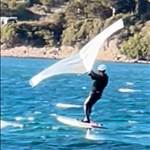
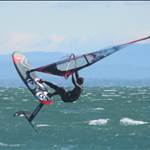
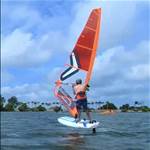
I keep trying different harness line lengths, due most recently to forearm soreness, and have been shortening my Quiktune lines more and more to find a length that holds 100% of the sail pressure in the hook. Looks like 23.5 inches is the magic length for me, it does make things tricky when a gust hits, and need to plan unhooking, but learning to adjust. I use a seat harness (Dakine Reflex) and have boom a little above shoulder height. Today when on the 23.5" lines found I had the energy to practice my foiling gybes at the end of the 3/4-1 mile runs, getting close!
36 inches.
Longer lines keeps the rig away from my body which helps my balance in strong winds and bigger swells.
Butt-out stance with straight arms - low waist harness, chin-high boom.
Works well but I'm seldom 100% committed to the harness 
Started 4 years ago with my normal windsurfing 30" lines. Then i figured that i need shorter ones, so i had adjustable ones with i had short while foiling and long while fin windsurfing, and sometimes adjust the lines during the session.
Now i am back to use my 30" lines always, fin or foil.
Foiling with wavesails 3.4 - 5.0 and small foilboards with big wings. Waist harnes.
As a beginner I went shorter, down to 24 or something, now I'm between 30 and 32 depending on style and conditions.
Its very natural to go shorter if you're starting out, as hiking out takes a whole different skillset. Dont be afraid to go longer again over time though.
I often ride longer lines with smaller sails, back when I was foilracing I was down to 28" sometimes if it was flat / underpowered!
Short guy here with waist harness shoulder to nose high boom depending on sail size. Prior to foil was 24 with small stuff, 26 with big sails up to 9.5. Started foiling at 24 for all my sails. Now at 26ish for small sails and 27-29 with big sails. Helps to have long lines to get into the frog position overpowered which I am a good bit of the time. Use adjustables on 5.4 and up.
Short lines for upright, strapless freeright foiling in lighter wind. About 2-4 inches longer for stronger winds, straps, powered foiling (but nowhere close to pushing the upper limits, which might require even longer lines).
Wondering how much board width affects harness line length, my Goya Bolt 135 is 80 cm wide with relatively narrow tail, and with longer lines I do not get enough support from the sail to lean out, but with short lines I can lean out and really put pressure on the rails when the gusts hit, then have the arch of my rear foot on the rail (heel over water).
Select to expand quoteWhen I was first starting was down to 26", now I foil with my wavesailing 32". That's on narrow foil boards and freeride foils. Needing short lines is a crutch for poor technique IMO.
If I was on wider/faster gear I'd probably be running very long lines like the IQfoil crew do.
Wide boards need longer lines, just like windsurfing.
Formula needs 30"
But narrow boards and inboard straps don't.
One size does not fit all.
Select to expand quoteWhiteofHeart said..
As a beginner I went shorter, down to 24 or something, now I'm between 30 and 32 depending on style and conditions.
Its very natural to go shorter if you're starting out, as hiking out takes a whole different skillset. Dont be afraid to go longer again over time though.
I often ride longer lines with smaller sails, back when I was foilracing I was down to 28" sometimes if it was flat / underpowered!
I had the same experience as I started short 24 inch and now went to 30. It appears the most racers are also using even longer lines based on the pictures and youtube videos.
I started out with long lines, but could not get enough support from the sail to lean out on my Goya Bolt freerace board 80 cm wide, so used my arms to hold the boom. With the short lines I stand fairly straight in normal winds for the sail, and can lean out when hit with a gust and be supported by the sail even in 8-10 knots, with my front foot in the outboard strap and the arch of my rear foot on the rail next to the rear foot strap rearward screw holes (no rear foot strap).
Im very average height 5'10, I run 30in lines with a waist harness. I can't imagine how you are running 24" lines with a seat harness ??
Maybe something else wrong with the balance in your setup if you are finding you are getting sore arms from needing to muscle your sail with longer lines. I wouldn't think that line length should make any difference to forearm soreness, but has been a long time since I've run short lines.
Maybe it's a combo of board width, boom height, mast base placement, arm length, footstrap placement, ..........
5'10", 24" lines, seat harness, exactly the same as for freeride windsurfing.
Select to expand quoteswoosh said..
Im very average height 5'10, I run 30in lines with a waist harness. I can't imagine how you are running 24" lines with a seat harness ??
Maybe something else wrong with the balance in your setup if you are finding you are getting sore arms from needing to muscle your sail with longer lines. I wouldn't think that line length should make any difference to forearm soreness, but has been a long time since I've run short lines.
well my fore arms get sore because I am holding the sail with my arms so much of the time while in flight, i.e., the hook is not holding enough of the sail pressure. The Dakine Reflex seat harness can be adjusted so that the hook is the same place as a standard waist harness hook, I checked using a boom in a store that allowed me to hook in with my seat harness and a waist harness the store, and lean out.
Select to expand quoteswoosh said..
Im very average height 5'10, I run 30in lines with a waist harness. I can't imagine how you are running 24" lines with a seat harness ??
Maybe something else wrong with the balance in your setup if you are finding you are getting sore arms from needing to muscle your sail with longer lines. I wouldn't think that line length should make any difference to forearm soreness, but has been a long time since I've run short lines.
well my fore arms get sore because I am holding the sail with my arms so much of the time while in flight in gusty conditions, because the hook is not holding enough of the sail pressure with long lines, 23.5" lines allow me to load the sail in my hook standing fairly upright in steady wind, and lean out when a gust hits me (line length measured along the center contour of rope from the front face of the boom, for each end of the rope). The Dakine Reflex seat harness can be adjusted so that the hook is the same place as a standard waist harness hook, I checked using a boom/mast training stand in a store that allowed me to hook in with my seat harness, and a waist harness from the store, and then lean out.
Not being able to use decent length lines has nothing to do with board width and everything to do with poor technique. Just as it is on a waveboard or anything else.
Even with centerline waveboard style straps, on a narrow 70cm board, with a low boom and waist harness I can easily fly 1 handed using 32" lines.
Select to expand quoteGrantmac said..
Not being able to use decent length lines has nothing to do with board width and everything to do with poor technique. Just as it is on a waveboard or anything else.
Even with centerline waveboard style straps, on a narrow 70cm board, with a low boom and waist harness I can easily fly 1 handed using 32" lines.
How tall and how much do you weigh Grantmac, and what kind of wing are you using? I am 6'0" 86 kg on an AFS W95 88 cm fuse. (but actually shorter) with F1080 and F770 wings, have not tried the S670 yet. All I can say is 23.5" lines work perfect for me even after spending plenty of time with longer lines.
well, with 24" lines, I can "fly" one handed with a 78 liter wave, 85 liter bump, 95-111 slalom, and 73cm foil boards...
Does that really mean anything?
My bad!
Didn't realize this was limited to wide boards.
My 111 is 68.5 cm wide.
78 liter wave is 54cm wide.
5'10" 3/4, 163 lbs.
Sure you can be humped over and inefficient one handed. Getting the rig upright and efficient requires a long set of lines, if you don't have good technique you won't be able to keep those longer lines engaged.
6' 92kg everything from a 1700cm2 low aspect to 800cm race foil use the same line length. Proper race board probably 34" like the good sailors use.
Select to expand quoteLeeD said..
My bad!
Didn't realize this was limited to wide boards.
My 111 is 68.5 cm wide.
78 liter wave is 54cm wide.
5'10" 3/4, 163 lbs.
Thanks LeeD, discussion not limited to wide boards!
Select to expand quoteGrantmac said..
Sure you can be humped over and inefficient one handed. Getting the rig upright and efficient requires a long set of lines, if you don't have good technique you won't be able to keep those longer lines engaged.
6' 92kg everything from a 1700cm2 low aspect to 800cm race foil use the same line length. Proper race board probably 34" like the good sailors use.
Ah, a really wide board Grantmac, of course you have longer lines, you need them for proper stance. For my Goya Bolt at 31.5"wide in the middle but only 17" wide at the tail where I place my rear foot, the 23.5" lines work perfect!
Select to expand quoteLeeD said.. well, with 24" lines, I can "fly" one handed with a 78 liter wave, 85 liter bump, 95-111 slalom, and 73cm foil boards...
Does that really mean anything?
Yes, it means there are at least two foilers here that use really short lines, even though we have very different builds/weights, and that means there is something in the geometry of balancing the board separate from the foiler.
This is taken from Windsurfing magazine that professionals providing some perspective on fast foiling.
Full discussion in the link
www.windsurf.co.uk/fast-foiling-pwa-top-guns/
"The most important thing for me is to be stable. If you are not stable and comfortable you can go fast for a few seconds, but then you will crash or have to shut down. For this I think using long harness lines is one of the key things that helps. The equipment has to be stable and the sail is also important. This is why we are using different sails for foiling also. The foil sails are more stable than a regular slalom sail. In the Israel PWA event, when it was windy enough for my 6.2 sail, I just used my normal 6.2 on the foil. I used it with the same settings as in fin windsurfing. But sometimes I use the lower clew, that is the only difference, as well as the long harness lines. When you are unstable you go up and down and it is much harder to sail in the same direction, plus you will not reach your top speed."
I've been playing with line length some. I think I need it shorter to be completely hiked out and legs knees and hips aligned for upwind. Reaching, longer, but I bend my knees more. Not sure if this is right or not because I'm still not that fast...
I'm 172cm 75kg and ride Naish Micro & Slingshot super short 103, Fanatic 900 & 1250 flow, Ezzy sails. I find adjustables (stainless V cleats 22-30") essential for a few reasons. Upwind I shorten them right up and really load them (waist harness). On a reach I loosen them a bit. Downwind, high wind and variable wind I let them right out allowing for plenty of back hand release. I've even started working on making a new type of harness line that is 2 harness lines in one to allow for even more options.
I'm definitely not about speed and prefer smallest sail possible for flowy fun. Maybe its horses for courses so to speak.
I really don't think there is one answer to this question (too many variables)
Select to expand quoteSA_AL said..
This is taken from Windsurfing magazine that professionals providing some perspective on fast foiling.
Full discussion in the link
www.windsurf.co.uk/fast-foiling-pwa-top-guns/
"The most important thing for me is to be stable. If you are not stable and comfortable you can go fast for a few seconds, but then you will crash or have to shut down. For this I think using long harness lines is one of the key things that helps. The equipment has to be stable and the sail is also important. This is why we are using different sails for foiling also. The foil sails are more stable than a regular slalom sail. In the Israel PWA event, when it was windy enough for my 6.2 sail, I just used my normal 6.2 on the foil. I used it with the same settings as in fin windsurfing. But sometimes I use the lower clew, that is the only difference, as well as the long harness lines. When you are unstable you go up and down and it is much harder to sail in the same direction, plus you will not reach your top speed."
I agree, the pros know how to go fast, but they are on foil boards 90-100 cm wide "at the tail", and that makes long lines necessary due to the geometry. Last Thursday I had 3/4-1 mile runs back and forth in 8-10 knots, with stable level flights and good speed, using the 23.5" lines on a narrow tailed slalom board. I was close to up right in the lulls and when pumping the foil in flight, and when the gusts hit me I leaned out pulling the sail over and got a nice increase in speed. All that without having to use my arms to hold the sail at the correct sheeted out position.
With longer lines I would have been using my arms to sheet out in the gusts and sheet in in the lulls, and that gets tiring after 2+ hrs, because when the winds are that light I have to go out to the middle of the bay and avoid going back to shore because of the long slog back.
So you and anyone else can tell me long lines are important in foiling, but it will always be in reference to a wide tailed foil board.
Select to expand quoteAnt-man said..
I'm 172cm 75kg and ride Naish Micro & Slingshot super short 103, Fanatic 900 & 1250 flow, Ezzy sails. I find adjustables (stainless V cleats 22-30") essential for a few reasons. Upwind I shorten them right up and really load them (waist harness). On a reach I loosen them a bit. Downwind, high wind and variable wind I let them right out allowing for plenty of back hand release. I've even started working on making a new type of harness line that is 2 harness lines in one to allow for even more options.
I'm definitely not about speed and prefer smallest sail possible for flowy fun. Maybe its horses for courses so to speak.
I really don't think there is one answer to this question (too many variables)
For back and forth runs I keep the lines at 23.5", but if there is plenty of wind and I am doing a long 1+ mile down wind run then I will often unhook to get my weight way out over the rail with the sail sheeted way out too and arms fully extended, in those conditions there is not a lot of sail pressure on my arms. But if I wanted to stay hooked in I would have to let the lines way out, and I will try that but usually only do a long downwind run when coming back to shore from the middle of the bay in well powered conditions, and that does not happen a lot even in a session with good enough wind.