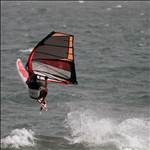
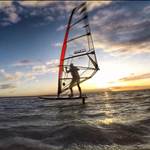
I've been dabbling with wind foiling for about 2 years and, as my 73rd birthday approached and with deteriorating balance, I thought I'd better make a concerted effort or give it away. (I've been W/S for about 30yrs less 7yrs kiting.) So, I've been making steady progress with help from Sam and others at Boggy Lake but have started to breach more often than before and would like people's comments on how to fix the problem. I'm 73 kg and am using a Fanatic 140 lt Stingray with Axis 90cm mast, 910PNG (1250cm2) & 1150PNG (1750cm2) front wings, 899 fuse (no, actually 880 fuse), 500 anhedral rear wing (350cm2), and 3m to 6m sails. Sailing in 12-22knot, quite gusty winds. I find that, when a puff hits, it takes a very big move forward to tilt the board down. Part of the problem is that I am slow to adjust my fore & aft balance, but I think that is partly because, at the top end of the wind range, I am using too big front and rear foils. I suspect that I should use my 400 RW (280) with the 910 FW and possibly change down from 910 to my older 900 HA FW, which seems to have a bit less lift. I've only come up with that since I've been out of action with a knee twist (that is repairing well) (otherwise I'd have tried that already). The next step might be to buy an 830HPS FW (1,014) or perhaps the 810BSC (1,070) or 850PNG (1,100) for the stronger winds. I've also considered a lower aspect FW and have tried a friend's 1040SES (similar area to my 1150) but didn't find much difference from my 1150 (in lighter winds). I would really appreciate any comments & suggestions!
First off, absolute kudos to you for doing this at 73 years of age, I think that's great and hope I can emulate that when I get there (which will be a while!).
I'm a relative newcomer to foiling (also ~30 years windsurfing), maybe 18 months in total on the Windfoil, with most experiments on my wife's kit ( ), but I'll add what made it work well for her as she did 3000km this year alone. It may not work for you (and there's so many things you can trim on a foil setup).
In the beginning we also had a fair amount of breaching but the best advice (here) that worked for us was to try and get just enough front-foot bias, in the order of 60/40, that it neither breached, nor dived (nor hopped like a rodeo bull). My wife is only 60kg so is also overpowered by larger foils, but also by the placement of the foil mast (under the board). Her current foil is an SABfoil 799 (around 1100cm2) with a 399 stab, 93cm mast, 899 fuse and she loves it. Previous foil was a NP Glide HP series 11/13/15 (was OK once we changed to the tracks from the tuttle, but the NP Glide has a shorter fuse); I have now 'inherited' these ...
We found on her JP 115L Freefoil that using the foil twin-tracks, rather than the fixed Tuttle (which we started off with), allowed her to tune the lift for that 60/40 bias; the same setting on all but very strong days, when we move the foil around 2mm~3mm (yes 2mm, not a Typo) back towards the tail. We tried it 1cm further back at one stage and she hated it, nose kept going down (front foot bias went out of whack), for the same mast base placement in the mast track.
I read somehwere that 1cm on the foil mast track is like 10cm on the sail mast track and this rings true at least for us, as with bigger sails she moves the mast track back a wee bit (towards the back of the board, the bigger (5.3) sail being heavier - this allows the board to still release nicely, while in stronger winds with her 4.0 and 3.3, she has it almost all the way forward in the sail mast track; all with the same foil track placement (2mm exception as noted above), which is FORWARD of the fixed Tuttle location, even though she is light.
We haven't tried any shims yet and of course the bias is different for different footstrap placement as well (as noted above...sooo many variables).
My last comment would be that one of the things about coming from windsurfing is the tendency to want to hang out the side; but with windfoiling (at least on our set up) we found that's a no-no as it changes the geometry somehow and thus the lift and stability (sorry I cannot explain why), so I'd recommend gently hooking in when you need to, but stay reasonably upright and just sway the hips fore and aft along the board to trim it, (and not ass-out over the side) :-).
HTH and suggest you try one thing at a time, if you cannot move the foil relative to the tracks, maybe take off the back foot strap and play around with the front ones to see if you can get that balance about right.
cheers and all the best
k.
Thanks JKSmurf. I'll try the 60/40 stance for sure. I haven't seen that suggestion before. All commentary seems to recommend neutral stance, which I've always adopted. I'm using the twin US box tracks and have the mast base fully back in them, so I'll try moving both feet forward a bit. I haven't used foot loops because I have broken my left foot/ankle twice and can't afford more such mistakes. I use an old foot hook at the back (mounted using the tuttle box holes), but nothing up front. All the videos suggest front loops, so I'll try a pair of Slingshot half hooks, as the general advice that you need something to help locate your front feet in exactly the right spot is probably correct. As it's summer, I'll be able to survive without booties and that will help letting my feet slide out if/when I crash!
Re the windsurfing habits, I do move my front foot outboard then lean out in the puffs as I find it helps - and in the lulls I come inboard and sometimes have to move my front foot in also. I haven't found that it plays around with geometry or balance. (I can't understand how people in the videos can stay out in footstraps on the rail in apparently light winds, but then they always seem to have bigger sails than I'd be using.) Speaking of which, I have been influenced by Greg Glazier to use big foils and small sails. Possibly I need to reverse that as a relative beginner?? (Certainly, it would help with water-starting!)
Hope you are wearing a helmet, do not want to end up like Jose (see Gofundme for Jose windsurfer, who is actually a windfoiler). You are breaching because your wings are WAY too big for your weight and the conditions! Though I would also want to know if you kit is balanced, like straddling a seesaw, versus too far on one side of the pivot point (in your case too far back). So can move sail mast base forward, or negatively shim stabilizer for less lift.
In comparison, I am 82 kg on an AFS foil with the largest wing a F1080 cm2 for light winds (8-10 knots) with Aerotech Freespeed 8.0-7.2 sail. And as soon as there are decent white caps I switch to the F770 cm2 wing and Freespeed 7.2-5.8 and Phantom 4.5, then once over ~18 knots I am on S670 cm2 wing with Phantom 4.5 sail and it does NOT breach even in gusts up to 30 knots. Breaching means you have way too much lift from the foil AND sail too, of course. Breaching was a problem for me when I used the F1080 cm2 wing all the way up to 24 knots with the 5.8 sail!, that sounds so crazy to me now.
The Aerotech Phantom cross over wave sail is great for gusty conditions because it has On/Off power with just a small amount of sheeting out, very easy to let an over powering gust pass by without breaching.
As for balance, can not recommend enough using balance trainers like the Indo Board (dynamic) and Bosu (stationary), amazing what they can do for balance, after you get used to them just get on for a couple of minutes before leaving for a session as a quick balance refresher.
Big foil and small sail with a floaty board to uphaul at the beginning. Keeps things slower. If you're breaching often then you may want to downsize the sail first to keep that from overwhelming things.
A smaller foil will just speed everything up, including takeoff speed, crashes, etc. which you probably don't want.
jksmurf made great points about not hooking in at the beginning and staying over the board and not out over the rail.
There is no shame in strapless and without a harness on a big front wing. Good freeriders here stay on their ~1500cm2 front wings and are making almost all their jibes, they just downsize to 4.0 plus or minus some area when it gets to around 20kts or more to keep it manageable.
Select to expand quoteaeroegnr said..
Big foil and small sail with a floaty board to uphaul at the beginning. Keeps things slower. If you're breaching often then you may want to downsize the sail first to keep that from overwhelming things.
A smaller foil will just speed everything up, including takeoff speed, crashes, etc. which you probably don't want.
jksmurf made great points about not hooking in at the beginning and staying over the board and not out over the rail.
There is no shame in strapless and without a harness on a big front wing. Good freeriders here stay on their ~1500cm2 front wings and are making almost all their jibes, they just downsize to 4.0 plus or minus some area when it gets to around 20kts or more to keep it manageable.
A smaller wing does increase speed for the same wind speed, true, but is not a huge increase maybe 15-20% in speed, and the smaller wing also prevents breaching and crashes which can damage the board, mast, and foiler! But aero loves to crash and also break masts, last I heard you were up to 3 masts!
Select to expand quoteSandman1221 said..aeroegnr said..
Big foil and small sail with a floaty board to uphaul at the beginning. Keeps things slower. If you're breaching often then you may want to downsize the sail first to keep that from overwhelming things.
A smaller foil will just speed everything up, including takeoff speed, crashes, etc. which you probably don't want.
jksmurf made great points about not hooking in at the beginning and staying over the board and not out over the rail.
There is no shame in strapless and without a harness on a big front wing. Good freeriders here stay on their ~1500cm2 front wings and are making almost all their jibes, they just downsize to 4.0 plus or minus some area when it gets to around 20kts or more to keep it manageable.
A smaller wing does increase speed for the same wind speed, true, but is not a huge increase maybe 15-20% in speed, and the smaller wing also prevents breaching and crashes which can damage the board, mast, and foiler! But aero loves to crash and also break masts, last I heard you were up to 3 masts!
I'm tired of you and your nonsense
Select to expand quoteaeroegnr said..Sandman1221 said..aeroegnr said..
Big foil and small sail with a floaty board to uphaul at the beginning. Keeps things slower. If you're breaching often then you may want to downsize the sail first to keep that from overwhelming things.
A smaller foil will just speed everything up, including takeoff speed, crashes, etc. which you probably don't want.
jksmurf made great points about not hooking in at the beginning and staying over the board and not out over the rail.
There is no shame in strapless and without a harness on a big front wing. Good freeriders here stay on their ~1500cm2 front wings and are making almost all their jibes, they just downsize to 4.0 plus or minus some area when it gets to around 20kts or more to keep it manageable.
A smaller wing does increase speed for the same wind speed, true, but is not a huge increase maybe 15-20% in speed, and the smaller wing also prevents breaching and crashes which can damage the board, mast, and foiler! But aero loves to crash and also break masts, last I heard you were up to 3 masts!
I'm tired of you and your nonsense
Hey, you are the one telling everyone about all the masts you have broken! And then you come back with an immature response. I am just trying to help them avoid crashes and getting hurt, and you?
And for the record, I have never broken a mast, but I was probably on track to until I switched to smaller wings and stopped having "uncontrolled" breaches that led to crashes.
Hi taveray, as others have said, kudos for embracing the challenge whether at 23 or 73. I have a friend who started windfoiling a couple of years ago at about your age (he just turned 74) and he's loving it.
A bit of a different take from the above advice which is all good stuff. When I learned, I was about your size and am a bit lighter now. Also, having seen a number of friends go through the process,here's what I've observed.
First, your big wing is big for guys our size. It's great on those light days but as someone here once sagely put it: once you get out of the water, you have all the lift you need. After that as you speed up, it's about controlling and limiting the lift it's generating. So, if you are popping out of the water at about 7-8 kts of board speed, you are dealing with a lot more lift at 14-15. Smaller wings will end up having, imho, a bit of a wider wind range. For your size, I think you'll end up enjoying your 1250 more. It will get up relatively quickly but not overpower you as easily. Big wings also tend to have more drag so when you are powered up, they hit a drag wall and that tends to increase the sail pressure in your arms - just something to keep in mind. Several of my buddies got really big wings (2100cm2) to start on (low wind flying and all) and they work great for getting you out of the water but they'd get quickly overwhelmed in gusts. They've moved to smaller wings in the 1300-1500 range for most of their riding and are much happier. They still break out the big stuff on light days but certainly as the sails get smaller, the wings do a bit. At my weight, I like to freeride on an 1100 cm2 wing. Don't go too far down the wing rabbit hole - Axis seems prone to having a thousand variations on a theme - you already have a couple good options to sort out the technique bit until you have a better idea of what kind of riding you'll want to do.
Second, as others have mentioned is body position. It's so important to remain vertical and over the board. If you aren't already, aim to bend the knees or as Sam Ross puts it in his excellent youtube series, hinge at the waist as you get overpowerd. I do see beginning foilers stand very erect and stiff ; and that inhibits the ability to hang down on the boom and depower. Newer windfoilers also tend to have the boom too low and harness lines short so in gusts hits harder to get the rig away from you and put down pressure on the mast base by putting more weight on the boom (rather than just trying to shift your weight alone).
I think I read correctly that you are moving your back foot in and forward when overpowered. That's good and a big reason why a lot of beginners and freeriders go without a back strap.
Last, when you get hit by a gust, learn to feather out the power rather than pulling hard on the back hand and leaning back against the sail. Pulling hard on the back hand tends to put pressure on the back foot (action - reaction) and back foot pressure is what you don't want in a gust. Rather concentrate on pulling in with the front hand to gently release some of the power but still keeping downward pressure on the boom.
Take a look at this similar thread if you haven't already: www.seabreeze.com.au/forums/Windsurfing/Foiling/hooking-
Edit: one last thought. Some of us when we began, spent way too much time staring at the nose of our board which makes it much harder to ride level. Again, if you aren't doing this already, look at some point at a distance in front of your board or even the horizon. It makes things so much easier and your peripheral vision will be enough to monitor your height. btw, there's no shame in occasionally skipping along the surface so don't feel like you have to have a meter of foil mast showing to be legit. 
I wonder if it's not more about technique than gear. If you've been windsurfing and kiting you may have an ingrained tendency to move back as the power comes on, and that is murder for foiling because the foil angle of attack goes up and blasts you out of the water. Likewise the windsurfing tendency to sheet out in a gust is dangerous because you'll lose mastfoot pressure. Instead, really committing weight forward, not just to the front foot but driving down into the mastfoot will keep you more level. Sheeting IN, hardening up into the wind, railing the board to windward will all help, and they're all more or less backwards from finning techniques. You probably know all this...
As far as gear, I may be talking through my hat since the only way I'd get to 73 kg is by sawing a leg off, but fwiw: I really like the idea of half-straps in front and no back straps. Gives you something to push against and with the front foot in the strap you'll often just bring your back foot right next to it as the lift comes on. I'd definitely try shimming that big back wing for less lift. I bet a longer fuse would give you much more pitch stability even though it would increase the power of the front wing. I assume you're moving the sail's mastfoot forward when the foil starts lifting too much? That helps a lot.
For us older guys I think there's a lot to be said for bigger sails. With small rigs it's really easy to lose mastfoot pressure and then you'll breach even at moderate speeds.
See if you can get @Milsurf involved in the discussion before you invest in a new wing - good sailor both on fin and foil and he's on the Axis gear also. I'd guess he's around 85kg and I think his big wing is 1300ish on the 899 fuselage.
Select to expand quoteAwalkspoiled said..
Sheeting IN, hardening up into the wind, railing the board to windward will all help, and they're all more or less backwards from finning techniques.
Sheeting in and going hard upwind or going deep down wind depowered both work very well. For some reason, a lot of people beginning to foil are reluctant to push the angles very much. For that reason, I made my feather recommendation. I think maybe it's the fear of getting caught upwind and thinking getting back down will be a horror show (it won't be if you go deep enough). I do think having more front foot pressure will naturally encourage railing to windward instead of just leaning out fin style and carving up into the wind.
Awalkspoiled, can I borrow said sawed-off leg for my occasional race? Really blows when I'm on a meter less and still getting blasted out of the water.
Select to expand quote I have been influenced by Greg Glazier to use big foils and small sails. Possibly I need to reverse that as a relative beginner?? (Certainly, it would help with water-starting!)
You and The DOOR are inspiring doing this at that age. I'm 60 and hope I can make it as long as you guys. 35 years jumping mountain bikes has done a number on my joints  . I'm of the bigger wing, smaller sail group. Way easier on the joints + small sails in big wind is just fun.
I started I'm on the SS Infinity 76, 114L board.). I'm 63kg, and when I started, had a big problem breaching.
My end solution was moving the foil all the way back which wasn't enough. So drilled some holes 1" farther forward on the mast pedestal to move further back in the tracks. That was the ticket for me. Keep in mind the is relative to the most forward foot strap position to get my weight as far forward as possible. Strapless, it didn't matter, I could move as far forward as I wanted. I wish I had started learning strapless. Not because it's better, but to find out where the balance needed to be. Everything got so much easier and obvious where the problem was. Then I adjusted UJ base and foil to work with the front foot strap position, and re-installed the straps.
FYI, I had a couple foot injuries but wanted to use snug straps, so made these. Been almost a year in testing and will be available this spring.
A bit of front foot bias is good. If you are getting that a low to medium speed but then foiling out once you go faster then what you need to do is shim the stabilizer.
I'm 75 and started windfoiling at age 70 after 30 years of windsurfing and formula racing.
There is nothing wrong with a great big giant wing as long as it is all balanced (see below). 60/40 (front/back) is fine if you like that. Lots of foilers do. I prefer 50/50 at speed, and even back foot heavy (45/55) until I get up to about 18 mph board speed, at which speed things even out to 50/50.
Balance. I define balance as the front wing being at about the mid point between your feet. You achieve this with adjustable footstraps or adjustable twin tracks. Then only after that can you fine-tune the dynamic balance with sail mast base location.
If you are using a deep tuttle connection, you cannot adjust the fore and aft position of the foil. All you then have is footstraps (or feet if you foil strapless). I made a little youtube 4 years ago that shows the extreme case of non-adjustable footstraps and non-adjustable deep tuttle finbox location. I had to center the front wing by changing the position of the finbox structurally. It all worked out, and I still windfoil with that board for experimenting.
Wait, the rake of the foil mast in the video seems opposite of what's recommended. I was going to recommend a 2-3 degree rake in the opposite direction to help with the breaching and control issue. Also sheet out the sail until muscle memory takes over.
From reading between the lines, I don't think it's anything to do with your equipment, it sounds like your rig mast base is too far back and the whole balance is out of whack when you're flying, and you are getting pitched.
Try moving the rig mast base forward 1 - 1.5cm at a time (many people make huge adjustments forward or aft and they miss the critical part of dialing it in).
Also, a good experiment is to not hook into the harness line and use rig pressure to stabilize the pitch... then when comfortable start hooking in a little at a time and keep the foil and board height lower, no need to go full foil mast height.
Select to expand quoteAll these points above are all great advise
How ever at the end of the day foiling is so technical and feeling oriented.
Time on the water is the no 1 tip I can give and I mean regular atleast 2 or 3 40mins sessions
A week to realy get the feel for what is right and what needs adjusting.
Just moving changing stuff is like trying to geuse lottery numbers
If I was to pic 3 key points fram all that information it would be 1 vision look at the horizon (look down you go down)
2 Ride a front foot weighted bias(it's easier to shift more forwards when you are already leaning that way )
3 sheting out in gusty conditions destroys mast foot pressure and causes breaches (try to drive power from the rig into the front foot)
Keep it simple and practice practic practic
Select to expand quoteWsurfAustin said..I have been influenced by Greg Glazier to use big foils and small sails. Possibly I need to reverse that as a relative beginner?? (Certainly, it would help with water-starting!)
You and The DOOR are inspiring doing this at that age. I'm 60 and hope I can make it as long as you guys. 35 years jumping mountain bikes has done a number on my joints . I'm of the bigger wing, smaller sail group. Way easier on the joints + small sails in big wind is just fun.
I started I'm on the SS Infinity 76, 114L board.). I'm 63kg, and when I started, had a big problem breaching.
My end solution was moving the foil all the way back which wasn't enough. So drilled some holes 1" farther forward on the mast pedestal to move further back in the tracks. That was the ticket for me. Keep in mind the is relative to the most forward foot strap position to get my weight as far forward as possible. Strapless, it didn't matter, I could move as far forward as I wanted. I wish I had started learning strapless. Not because it's better, but to find out where the balance needed to be. Everything got so much easier and obvious where the problem was. Then I adjusted UJ base and foil to work with the front foot strap position, and re-installed the straps.
FYI, I had a couple foot injuries but wanted to use snug straps, so made these. Been almost a year in testing and will be available this spring.
Hang on. I might look old but everything from the neck down is low 50s .
PS: Not sure a helmet is going to prevent spinal cord injury but it's good to minimize the risk of needing stitches and it stops bald bastards getting sunburn
Learning to control a lifting wing is part of the learning curve of foiling. So I would try the stance suggestions mentioned above first and avoid racking the sail back and if you need to sheer out avoid losing mast foot pressure.
If you are doing all that and you cannot ride across the wind for 50-100ft I would move mast foot fwd or foil back or adjust stabilizer shim.
Once you get past the stable flights across the wind for 50-100 ft stage you need to learn how to handle increase lift with speed or gusts. The main way to do that is to head up wind
Referring to JKSmurf's suggestion, on second thoughts, I'll need to go back a bit to get to 60/40. I can go back 25mm with my centred back hook, which sounds too much, so I'll try just bringing my front foot back, maybe about 10mm, and try to get 2 half hooks in the correct spots.
Select to expand quotethedoor said..
Learning to control a lifting wing is part of the learning curve of foiling. So I would try the stance suggestions mentioned above first and avoid racking the sail back and if you need to sheer out avoid losing mast foot pressure.
If you are doing all that and you cannot ride across the wind for 50-100ft I would move mast foot fwd or foil back or adjust stabilizer shim.
Once you get past the stable flights across the wind for 50-100 ft stage you need to learn how to handle increase lift with speed or gusts. The main way to do that is to head up wind
Thanks thedoor. Yes, I'm painfully aware of the need to control ride height and how long it's taking me. By "sheer out" I understand you to be referring to what, in sailing terms is called "hiking out"? If so, I can see that's a good point. I'm not really aware of whether or not I'm raking the sail back or losing mast-foot pressure, so those could be part of my problem.
I'm probably averaging 100-150m before crashing or otherwise stopping and I long for some steady winds to learn in but, alas, even with the sea breezes now appearing, we still have unusually gusty conditions. I usually do 'retreat' upwind in puffs, but with partial success only. I note in one of Andy Brandt's videos that he says to ensure one doesn't swing the mast to windward in the process. So that's something I need to watch for. I'm also not sure whether I do that when easing the sail in a puff. Now I've got lots to work on!
Select to expand quoteSandman1221 said..aeroegnr said..Sandman1221 said..aeroegnr said..
Big foil and small sail with a floaty board to uphaul at the beginning. Keeps things slower. If you're breaching often then you may want to downsize the sail first to keep that from overwhelming things.
A smaller foil will just speed everything up, including takeoff speed, crashes, etc. which you probably don't want.
jksmurf made great points about not hooking in at the beginning and staying over the board and not out over the rail.
There is no shame in strapless and without a harness on a big front wing. Good freeriders here stay on their ~1500cm2 front wings and are making almost all their jibes, they just downsize to 4.0 plus or minus some area when it gets to around 20kts or more to keep it manageable.
A smaller wing does increase speed for the same wind speed, true, but is not a huge increase maybe 15-20% in speed, and the smaller wing also prevents breaching and crashes which can damage the board, mast, and foiler! But aero loves to crash and also break masts, last I heard you were up to 3 masts!
I'm tired of you and your nonsense
Hey, you are the one telling everyone about all the masts you have broken! And then you come back with an immature response. I am just trying to help them avoid crashes and getting hurt, and you?
And for the record, I have never broken a mast, but I was probably on track to until I switched to smaller wings and stopped having "uncontrolled" breaches that led to crashes.
With apologies to other Seabreezers for making another reply in this thread to this person, I just want to give an example of the kind of person Sandman is.
He witnessed me break a mast while pumping to get on foil. He, apparently, was at the same spot, sailed right by me and saw it happen, and did not ask if I was okay or even stop apparently.
He even told me in a message that he witnessed it afterwards. Then, he insults me and other people here, and calls me immature after saying I "love to crash and also break masts" after not offering help when a mast broke while I was pumping and wasn't even due to a crash (and I've crashed plenty, never snapped a mast even due to a catapult thankfully, but there was that one fish enounter)
With "help" like this...

Select to expand quotethedoor said..WsurfAustin said..I have been influenced by Greg Glazier to use big foils and small sails. Possibly I need to reverse that as a relative beginner?? (Certainly, it would help with water-starting!)
You and The DOOR are inspiring doing this at that age. I'm 60 and hope I can make it as long as you guys. 35 years jumping mountain bikes has done a number on my joints . I'm of the bigger wing, smaller sail group. Way easier on the joints + small sails in big wind is just fun.
I started I'm on the SS Infinity 76, 114L board.). I'm 63kg, and when I started, had a big problem breaching.
My end solution was moving the foil all the way back which wasn't enough. So drilled some holes 1" farther forward on the mast pedestal to move further back in the tracks. That was the ticket for me. Keep in mind the is relative to the most forward foot strap position to get my weight as far forward as possible. Strapless, it didn't matter, I could move as far forward as I wanted. I wish I had started learning strapless. Not because it's better, but to find out where the balance needed to be. Everything got so much easier and obvious where the problem was. Then I adjusted UJ base and foil to work with the front foot strap position, and re-installed the straps.
FYI, I had a couple foot injuries but wanted to use snug straps, so made these. Been almost a year in testing and will be available this spring.
Hang on. I might look old but everything from the neck down is low 50s .
PS: Not sure a helmet is going to prevent spinal cord injury but it's good to minimize the risk of needing stitches and it stops bald bastards getting sunburn
Lol,
Ya, as a bald bastard, I'm always wearing a skull cap or something unless its dead of winter. When your bald you will sunburn your head once... and never again.
I've been looking at helmets. But it getts frikin hot here.
Select to expand quotetaveray said..thedoor said..
Learning to control a lifting wing is part of the learning curve of foiling. So I would try the stance suggestions mentioned above first and avoid racking the sail back and if you need to sheer out avoid losing mast foot pressure.
If you are doing all that and you cannot ride across the wind for 50-100ft I would move mast foot fwd or foil back or adjust stabilizer shim.
Once you get past the stable flights across the wind for 50-100 ft stage you need to learn how to handle increase lift with speed or gusts. The main way to do that is to head up wind
Thanks thedoor. Yes, I'm painfully aware of the need to control ride height and how long it's taking me. By "sheer out" I understand you to be referring to what, in sailing terms is called "hiking out"? If so, I can see that's a good point. I'm not really aware of whether or not I'm raking the sail back or losing mast-foot pressure, so those could be part of my problem.
I'm probably averaging 100-150m before crashing or otherwise stopping and I long for some steady winds to learn in but, alas, even with the sea breezes now appearing, we still have unusually gusty conditions. I usually do 'retreat' upwind in puffs, but with partial success only. I note in one of Andy Brandt's videos that he says to ensure one doesn't swing the mast to windward in the process. So that's something I need to watch for. I'm also not sure whether I do that when easing the sail in a puff. Now I've got lots to work on!
Sorry bro not sheer out (although that might be good :). I meant sheet out
Select to expand quotetaveray said..
Referring to JKSmurf's suggestion, on second thoughts, I'll need to go back a bit to get to 60/40. I can go back 25mm with my centred back hook, which sounds too much, so I'll try just bringing my front foot back, maybe about 10mm, and try to get 2 half hooks in the correct spots.
I don't see how going back further will give you better control. It will only make shifting weight forward in gusts harder. Equal weight on both feet works quite well to control ride height.
Your large foil is quite large in 22 knot gusts for your weight. A 1250 foil should be manageable, but a lower aspect foil would give you a bit more time to react. If the trim is wrong, though, control is always hard. You may want to post pictures or a description of your setup . Is your foil mounted to tuttle box, or to the track? I track, where? Where in the mast track is your mast base? On my Stringray 140, I usually have the mast base at 131 cm.
The one tip that has helped me most with controlling flight height is "stiff legs". Windsurfers are trained to bend the knees quite dynamically to even out chop. Doing this while on the foil is natural, but usually way too much, causing dolphin rides. Keeping the legs straight, or almost straight, and relatively rigid can make flights a lot steadier.
Select to expand quoteboardsurfr said..The one tip that has helped me most with controlling flight height is "stiff legs". Windsurfers are trained to bend the knees quite dynamically to even out chop. Doing this while on the foil is natural, but usually way too much, causing dolphin rides. Keeping the legs straight, or almost straight, and relatively rigid can make flights a lot steadier.
To confuse things, I'm just the opposite - straighter torso but legs very much dynamic. A hard day in swell will leave my legs feeling like a hard 40 mile bike ride. Straighter legs helps in lighter winds but when it's puffy and/or the water state is no longer flat, I'm definitely bending something.
Also, one of the keys, for me, is learning to sheet out without letting off (much) mast base pressure. That's one reason I find learning to use a harness beneficial. Having a higher boom helps with this, too. And when I say sheeting out, I'm not talking about dumping power to zero. I'm talking about going from 100% to 90, 80 or 70. Totally dumping it does make for a yoyo experience. That's why I used the term "feather" ie controlling the power.
Hey phoilingphil, the rake on the AFS-2 is the natural mast rake they built into the structure. If you mount the DT box to a perfect fit, the mast is raked forward as shown in the video. The board rides just right this way with this foil: nose angle in the goldilocks zone. Most foils are ~90 deg normal with no rake. You rake those by adjusting the fit into the DT box (I don't recommend this for structural reasons--point loads inside the box).
I don't know why AFS did this. On their later foils they went back to 90 deg. What I do know is the the AFS-2 foil is, by far, the stiffest foil I own (and that includes SAB).
Longer harness lines are a huge component of being able to control MBP independent of sheeting. +32" would be pretty standard.
Select to expand quoteGrantmac said..
Longer harness lines are a huge component of being able to control MBP independent of sheeting. +32" would be pretty standard.
Absolutely agree, however, not everyone has [that] long arms. You may wish to put it in context of your size so others may scale accordingly. T-rex crowd, represent.
Select to expand quoteGrantmac said..
Longer harness lines are a huge component of being able to control MBP independent of sheeting. +32" would be pretty standard.
yes; in fact, 32" was already standard for high-wind fin slalom; for high wind foil slalom we're more in the 40" range now... #rex
ps: where's the popcorn?! 
Select to expand quotePaducah said..Grantmac said..
Longer harness lines are a huge component of being able to control MBP independent of sheeting. +32" would be pretty standard.
Absolutely agree, however, not everyone has [that] long arms. You may wish to put it in context of your size so others may scale accordingly. T-rex crowd, represent.
I have very stubby arms for my height and run my boom chest high. 32" is on the short side for foil.