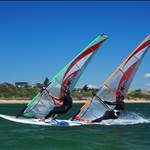
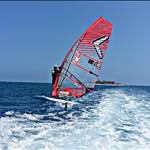
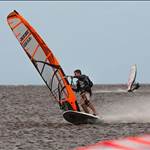
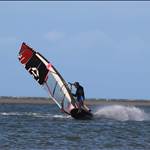
I've watched plenty of Foil Moths over the years in 10 knots of wind. From a distance they look deceptively like Windsurfers. They seem to all use KA sails.
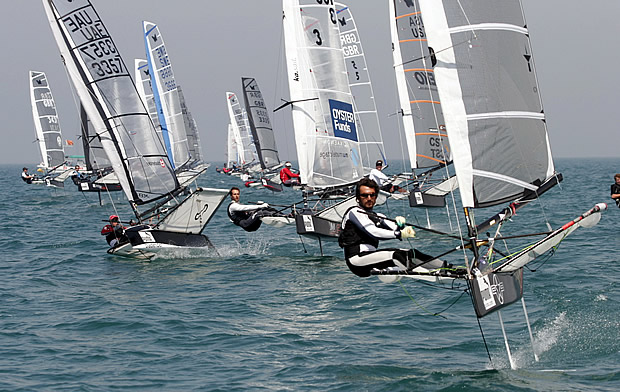
These things fly in 10 knots. Really high angles too. I was lucky enough to watch them against an Olympic class windsurfer a couple of weekends ago and they left it for dead.
Last weekend I was at Cronulla and watched a kite surfer with a foil attached out in 10 knots. Same thing. looked like he was nudging 20 knots at times. Cranked up and down wind.
There's gotta be a market specifically for a light wind foil setup on a windsurfer. Surely.
not a single white cap in sight for the first 15seconds, cant be using more than 6.5m of sail
3 observations.
1. The foil looks like an aeroplane. I like it.
2. When its foiling its looks freakish as it 'levitates" across the water
3. The rider stands a lot more upright than we windsurfers.
nice pics Julien, wonder where they were taken ??? :-)
NC5 got his foil too now, using it on the new isonic ;-)
sailing above the chop, probably very quiet, little wind required - it`s a magic carpet !
Foils are a really cool idea... my personal opinion is that, if you want to build a windsurf board with foils, the "single foil" isn't really suited for mowing the grass....
As Steve mentioned, you are more upright than normal stance... this looks to be as a result of either, not having enough sail area, or a center of effort problem. In either case, it looks like it could be solved using two-foil-plus-sensor-wand configuration.
ie: if you are going to use a different board design, (ie: foil box in different position to fin box, or different board width at the tail), then you might as well go to the next level and build a foil design similar to a moth, with a self/auto-leveling foil
How much pressure does the foil place on the fin box, it looks like a lot of leverage/force over what is a small mounting point
well the two guys that use them here on all type of boards haven't had issued with the fin box. (for the time being :-) )
Ed has been sailing with a foil at Manly for a few years now. Takes a bit to get used to and is ok in 8-15knots only.
Main problem is control in stronger winds. Many versions have been tried OS but are slower than a normal windsurfer in windier conditions due to the drag. More lift=more drag!
The foil he uses is adjustable but only when on the beach.
You can buy them as a standard item, with board as they have a big whole through the front of board to eliminate wind lifting board up at speed.
Lack of control of the foil is the issue. Moths have overcome that, where they can control the pitch and ride height etc.
Select to expand quoteWaiting4wind said..
How much pressure does the foil place on the fin box, it looks like a lot of leverage/force over what is a small mounting point
I was thinking exactly that looking at that looping sequence. Imagine the forces landing that thing sideways - hard to believe a finbox deals with those loads!
PS - Des, I mailed those washers off last Tuesday too.
Select to expand quoteJungleman said..
sailing above the chop, probably very quiet, little wind required - it`s a magic carpet !
I suspect that this 'quiet' ride would detract from the experience. The thrill associated with windsurfing at speed is the close connection of the rider with the board and the board with the surface of the water.
Select to expand quoteJohn340 said..Jungleman said..
sailing above the chop, probably very quiet, little wind required - it`s a magic carpet !
I suspect that this 'quiet' ride would detract from the experience. The thrill associated with windsurfing at speed is the close connection of the rider with the board and the board with the surface of the water.
I'm with Jungleman on this one. I have seen a kite foil surfer only once, but it definitely looked like magic. Most days, I like 30 knots a lot more on chitter-chatter water than on chop.
I think kite races are now dominated by foils, which are 20% or so faster. The potential speed advantage from foiling windsurfers comes from eliminating all the slapping into chop. In theory, a foil can be designed that reduces drag as speed increases. At places like West Kirby when the wind is too far offshore, staying above the chop could create new records. But chances are it will happen in kiting first. it's much easier to add a foil to a kite board than to a windsurfer; foils are already used for racing, which will drive further development; and there's tons of young kiters out there who firmly believe in their own immortality and thus are not afraid of being hit by a foil in a crash.
I've tried it, but only on a really crappy foil, I plan to get a better foil sometime from the kiters and use it.
I got a lot of nasty bruises to show for it.
A couple of things> yes, I think from 7 to 15 knots this is the future of windsurfing. If ws has a future that is.
Upwind angle is similar to what the foil kiters are getting, according to Antoine Albeau (I asked him, and he was nice enough to answer my email) and speed is rumored to be better than what they are getting.
The kite foils aren't going that fast in top end, it's the angle that is amazing. The 70cm course boards they had before were faster, just didn't have the angle. But they are fast when it's light. For me on a slalom board, on a broad reach, they are faster in 10-15, about even in 15-20, and I pull away from them above that. But I don't have any really big gear anymore either. But something like that.
In higher winds for WS what AA said was that smaller foils needed to be developed.
You don't need or want 2 foils-this was an idea tried and rejected decades back for good reasons. You have enough lift for one thing. Nor do you need to adjust trims on the wings like a Windrider Rave does, you can do this with your feet in the straps.
I'm not sure how long tuttle boxes are going to last without reinforcing them...and I'm not sure if the boxes are really in the right place either.
The other thing is that there may need to be changes to sail design, I'm not sure..but some people seem to be using newer sails designed not to be raked back as much...which makes sense.
Select to expand quoteevlPanda said...
[br]
These things fly in 10 knots. Really high angles too. I was lucky enough to watch them against an Olympic class windsurfer a couple of weekends ago and they left it for dead.
Last weekend I was at Cronulla and watched a kite surfer with a foil attached out in 10 knots. Same thing. looked like he was nudging 20 knots at times. Cranked up and down wind.
Well, everything leaves an RSX for dead.
Yes, in 10-12 knots or so I would expect foil kiters to hit 18-22 upwind, which is the same more or less to what a formula board can do, but (I think) at a higher angle.
Select to expand quotesausage said...Waiting4wind said..
How much pressure does the foil place on the fin box, it looks like a lot of leverage/force over what is a small mounting point
I was thinking exactly that looking at that looping sequence. Imagine the forces landing that thing sideways - hard to believe a finbox deals with those loads!
...and here's what can happen

Select to expand quoteWaiting4wind said...
How much pressure does the foil place on the fin box, it looks like a lot of leverage/force over what is a small mounting point
In normal sailing the leverage the foil places on the fin box can only be equal and opposite to the leverage the rider can apply through the footstraps. That's no more than with a normal fin, possibly even less looking at how relaxed the hike out looks.
Straight up and down forces would be much more but in that direction the fin box should handle the weigh of rider, board and rig.
As long as the foil is fully immersed it should be OK, but landing, where one wing catches the water first, that would load it up.
Ian,
I would have thought that the bending moment on the fin box would be higher than a normal fin given the length of the lever associated with the increased length of the foil over the fin
Select to expand quoteJohn340 said...
Ian,
I would have thought that the bending moment on the fin box would be higher than a normal fin given the length of the lever associated with the increased length of the foil over the fin
If the board was mounted in a solid vice yes, it'd be much easier to lever out the fin box. But it's not, the foil can only lever until the rider can no longer stabilise the board from the topside. Take moments about a longitudinal axis through the fin box, the leverage of the fin has to be equal to the leverage that the rider can apply to the board with his feet. (the mast base is on the same axis as the fin box so has no leverage moment). The way to make it fail would be to jump on a starboard tack, land on the starboard wing with all your weight on the starboard rail. Jumping a standard fin can't load up the fin box like that.
Select to expand quotesausage said...sausage said...Waiting4wind said..
How much pressure does the foil place on the fin box, it looks like a lot of leverage/force over what is a small mounting point
I was thinking exactly that looking at that looping sequence. Imagine the forces landing that thing sideways - hard to believe a finbox deals with those loads!
...and here's what can happen
If you knew the guy who did that, you wouldn't be surprised...
And it wasn't even his board 
Select to expand quotejusavina said...sausage said...sausage said...Waiting4wind said..
How much pressure does the foil place on the fin box, it looks like a lot of leverage/force over what is a small mounting point
I was thinking exactly that looking at that looping sequence. Imagine the forces landing that thing sideways - hard to believe a finbox deals with those loads!
...and here's what can happen
If you knew the guy who did that, you wouldn't be surprised...
And it wasn't even his board
Looks like something Sausage would do 
Select to expand quotePaul Kelf said...jusavina said...sausage said...sausage said...Waiting4wind said..
How much pressure does the foil place on the fin box, it looks like a lot of leverage/force over what is a small mounting point
I was thinking exactly that looking at that looping sequence. Imagine the forces landing that thing sideways - hard to believe a finbox deals with those loads!
...and here's what can happen
If you knew the guy who did that, you wouldn't be surprised...
And it wasn't even his board
Looks like something Sausage would do 

Select to expand quoteIan K said...John340 said...
Ian,
I would have thought that the bending moment on the fin box would be higher than a normal fin given the length of the lever associated with the increased length of the foil over the fin
If the board was mounted in a solid vice yes, it'd be much easier to lever out the fin box. But it's not, the foil can only lever until the rider can no longer stabilise the board from the topside. Take moments about a longitudinal axis through the fin box, the leverage of the fin has to be equal to the leverage that the rider can apply to the board with his feet. (the mast base is on the same axis as the fin box so has no leverage moment). The way to make it fail would be to jump on a starboard tack, land on the starboard wing with all your weight on the starboard rail. Jumping a standard fin can't load up the fin box like that.
I agree
Select to expand quoteBFlood said...
not a single white cap in sight for the first 15seconds, cant be using more than 6.5m of sail
Yeah, check the board without the foil in the back ground doing twice the speed of the foil board.
Select to expand quotejusavina said...
And it wasn't even his board
I'll be it's his now though...