Select to expand quotegorgesailor said..Sandman1221 said..gorgesailor said..Sandman1221 said..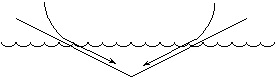 Ventilation occurs when air gets sucked down to the lifting surfaces. Although ventilation can occur on vertical struts, 'V' foils are particularly prone to this problem because of the shallow angle the foil makes with the water surface.
In other words, ventilation is not something that normally happens on a vertical foil mast. You guys are just throwing stuff out there to cover up the fact that there is a design/construction problem with some of the iQ foils.
And, When cavitation occurs, the foil no longer generates enough lift and the boat crashed down onto the water. So cavitation does occur with foils, and that is exactly what you see with Nico, cavitation followed by the board crashing to the water. Ventilation would in comparison be a more gradual process on a vertical mast, and you would see the air getting sucked down the side of the mast, but you do not see that in Nico's video, instead you see an expansion of air bubbles below the water due to cavitation.
Wrong
And your source of information?, I just copied that from a hydrofoil website, and they should know!
From another Hydrofoil website ... though your source also mentions the speed at which cavitation occurs: "Cavitation and ventilation both appear as bubbles attached to the surface of the operating hydrofoil. This phenomenon particularly occurs over the section back (suction side) of the hydrofoil with the bubbles varying both as to size and extent. The formation of vapor bubbles will occur within a liquid in a region where the static pressure of the liquid's flow field is equal to, or less than, the saturation (vapor) pressure of the liquid. The resulting low pressure is a consequence of the local acceleration of the liquid to a relatively high velocity over the hydrofoil surface. In order for cavitation to develop, the surface pressures on the suction side of the hydrofoil must be lower than water vapor pressure. Ventilation will develop when surface pressures exist which are lower than the ambient pressure of an externally available gas supply. The gas supplied is usually air from an atmospheric source. Cavitation invariably occurs in conventional hydrofoil craft above a certain operating speed (typically over 50-60 knots). Ventilation can occur at much lower speeds."
So it is much more likely ventilation is causing the issues than cavitation considering the speeds Windfoil are currently capable of...
You guys are confusing cavitation, and the damaging effects of cavitation which occurs at higher speeds, you can have cavitation without the damaging effects at low speeds. ventilation does not drop you instantly out of the air, cavitation does!
Heck, I can make my kayak paddle blade cavitate if I pull it too fast through the water at any speed. The paddle blade is not ventilating by sucking air down the shaft, it is cavitating.
From MIT, lancet.mit.edu/decavitator/Basics.html
Explanations of ventilation and cavitation are at the bottom.
Hydrofoil Basics
Many people are familiar with airfoils. Foil is simply another word for the a wing (such as the wing on an airplane). A hydrofoil is a wing that 'flies' in water. Hydrofoil is also used to refer to the boat to which the water wings are attached. A hydrofoil boat has two modes of operation: (1) as a normal boat with a hull that displaces water and (2) with the hull completely out of the water and only the foils submerged. Hydrofoils let a boat go faster by getting the hull out of the water. When a normal boat moves forward, most of the energy expended goes into moving the water in front of the boat out of the way (by pushing the hull through it). Hydrofoils lift the hull out of the water so that you only have to overcome the drag on the foils instead of all of the drag on the hull. The foils on a hydrofoil boat are much smaller than the wings (foils) on an airplane. This is because water is about 1000 times as dense as air. The higher density also means that the foils do not have to move anywhere near as fast as a plane before they generate enough lift to push the boat out of the water. The hydrofoils generate lift only when they are in the water; if they leave the water, the boat will crash down onto the surface of the water (and thus submerge the foils) until the foils generate enough lift to lift it back out. Like an airplane, a hydrofoil must be controllable in terms of pitch, roll, and yaw. Unlike an airplane, a hydrofoil must also maintain a consistent depth. Whereas an airplane has a range of about 40,000 feet in which to maintain its altitude, a hydrofoil is limited to the length of the struts which support the boat above the foils.Most commercial hydrofoils are boats with ladder foils (wings stacked one above another with space between them). This configuration is analogous to a biplane. But the reason for stacking hydrofoils is different than the reason for stacking two wings on an airplane. Ladder foils make the boat easier to control when the water is not flat. If the boat is flying through waves, the wings will generate lift only in the crests; when the boat hits a trough the wings will leave the water and the boat will crash down. When a stack of ladder foils moves through the waves, chances are that some of the foils will be submerged even if some leave the water (unless the waves are really big).
There are two particularly persistent problems faced by designers of hydrofoils: cavitation and ventilation.
1) Ventilation occurs when part of a hydrofoil pierces the surface of the water and air gets sucked down the lifting surface of the foil. Since air is much less dense than water, the foil generates much less lift and the boat crashes down. Ventilation can occur at any air-water interface. Ventilation occurs when air gets sucked down to the lifting surfaces. Although ventilation can occur on vertical struts, 'V' foils are particularly prone to this problem because of the shallow angle the foil makes with the water surface.
2) Cavitation occurs when the water pressure is lowered to the point where the water starts to boil. This frequently happens with propellors. When a propellor is turned fast enough, the blades generate so much lift (i.e. the pressure on the lifting surface of the blades goes down) that the water flowing over the propellor blades begins to boil. When cavitation occurs, the foil no longer generates enough lift and the boat crashed down onto the water.
Select to expand quoteSandman1221 said..Paducah said..Grantmac said..
I've actually held AFS and IQ foil setups, the AFS is very flexible in comparison. Even the regular Starboard setup is significantly stiffer.
Yes and not really.  In torsion, the orig 95 and AFS are very close but the IQ is much stiffer. In flex (side to side), the AFS is significantly stiffer than the orig or IQ.
windfoilfan.glissattitude.com/devices/foil/chart/tors_module
windfoilfan.glissattitude.com/devices/foil/chart/flex_module
And, yes, Nico is a big boy and pushing a lot harder and faster than most anyone on this forum.
According to windfoilfan data, the 2019 AFS W95 foil is the 4th stiffest/most rigid mast behind 1st 2021 F4 slalom race, 2nd 2019 Phantom Iris, and 3rd 2018 AFS W105!
You might want to revise and clarify that information. It is one of the test they did on flex that it scored in 4th. Tell me about torsional & young module. Was the 2020/21 Phantom R included? I assure you that the AFS W95 would be much lower down the list just in the flex test alone. Improvements have been made and Eric Collard doesn't test them all. The list has been static for some time.
Select to expand quoteZeroVix said..Sandman1221 said..Paducah said..Grantmac said..
I've actually held AFS and IQ foil setups, the AFS is very flexible in comparison. Even the regular Starboard setup is significantly stiffer.
Yes and not really. In torsion, the orig 95 and AFS are very close but the IQ is much stiffer. In flex (side to side), the AFS is significantly stiffer than the orig or IQ.
windfoilfan.glissattitude.com/devices/foil/chart/tors_module
windfoilfan.glissattitude.com/devices/foil/chart/flex_module
And, yes, Nico is a big boy and pushing a lot harder and faster than most anyone on this forum.
According to windfoilfan data, the 2019 AFS W95 foil is the 4th stiffest/most rigid mast behind 1st 2021 F4 slalom race, 2nd 2019 Phantom Iris, and 3rd 2018 AFS W105!
You might want to revise and clarify that information. It is one of the test they did on flex that it scored in 4th. Tell me about torsional & young module. Was the 2020/21 Phantom R included? I assure you that the AFS W95 would be much lower down the list just in the flex test alone. Improvements have been made and Eric Collard doesn't test them all. The list has been static for some time.
I did clarify the information, the test was for mast rigidity, so sideways bending, if you want to learn more go to the website and read! The test includes 2021 model year foils, so it has not "been static for some time", but is up to date for many foils including the 2021 model year F4 results I mentioned!
Select to expand quoteSandman1221 said..ZeroVix said..Sandman1221 said..Paducah said..Grantmac said..
I've actually held AFS and IQ foil setups, the AFS is very flexible in comparison. Even the regular Starboard setup is significantly stiffer.
Yes and not really. In torsion, the orig 95 and AFS are very close but the IQ is much stiffer. In flex (side to side), the AFS is significantly stiffer than the orig or IQ.
windfoilfan.glissattitude.com/devices/foil/chart/tors_module
windfoilfan.glissattitude.com/devices/foil/chart/flex_module
And, yes, Nico is a big boy and pushing a lot harder and faster than most anyone on this forum.
According to windfoilfan data, the 2019 AFS W95 foil is the 4th stiffest/most rigid mast behind 1st 2021 F4 slalom race, 2nd 2019 Phantom Iris, and 3rd 2018 AFS W105!
You might want to revise and clarify that information. It is one of the test they did on flex that it scored in 4th. Tell me about torsional & young module. Was the 2020/21 Phantom R included? I assure you that the AFS W95 would be much lower down the list just in the flex test alone. Improvements have been made and Eric Collard doesn't test them all. The list has been static for some time.
I did clarify the information, the test was for mast rigidity, so sideways bending, if you want to learn more go to the website and read! The test includes 2021 model year foils, so it has not "been static for some time", but is up to date for many foils including the 2021 model year F4 results I mentioned!
I am glad you just signed up. Since you are new, the last test was done some time ago. Others that have been part of the community there know that. You also need to understand the process and why certain foils are not included. I am sure that the AFS W95 would be competitive today... to you. :)
Select to expand quoteZeroVix said..Sandman1221 said..ZeroVix said..Sandman1221 said..Paducah said..Grantmac said..
I've actually held AFS and IQ foil setups, the AFS is very flexible in comparison. Even the regular Starboard setup is significantly stiffer.
Yes and not really. In torsion, the orig 95 and AFS are very close but the IQ is much stiffer. In flex (side to side), the AFS is significantly stiffer than the orig or IQ.
windfoilfan.glissattitude.com/devices/foil/chart/tors_module
windfoilfan.glissattitude.com/devices/foil/chart/flex_module
And, yes, Nico is a big boy and pushing a lot harder and faster than most anyone on this forum.
According to windfoilfan data, the 2019 AFS W95 foil is the 4th stiffest/most rigid mast behind 1st 2021 F4 slalom race, 2nd 2019 Phantom Iris, and 3rd 2018 AFS W105!
You might want to revise and clarify that information. It is one of the test they did on flex that it scored in 4th. Tell me about torsional & young module. Was the 2020/21 Phantom R included? I assure you that the AFS W95 would be much lower down the list just in the flex test alone. Improvements have been made and Eric Collard doesn't test them all. The list has been static for some time.
I did clarify the information, the test was for mast rigidity, so sideways bending, if you want to learn more go to the website and read! The test includes 2021 model year foils, so it has not "been static for some time", but is up to date for many foils including the 2021 model year F4 results I mentioned!
I am glad you just signed up. Since you are new, the last test was done some time ago. Others that have been part of the community there know that. You also need to understand the process and why certain foils are not included. I am sure that the AFS W95 would be competitive today... to you. :)
You are just trying to contradict me, why? The windfoilfan website has data on 2021 foils, so the last tests were done this year, that means it is very up to date for at least for some foils.
Oh, I now I understand you ZeroVix, you are from another solar system and you think you have traveled to Earth at greater than the speed of light, and so naturally think this is calendar year 2024, and since you do not see data on foils for 2022, 2023, and 2024 you think the webstie is out of data. Greeting to you space traveler!, please note the current Earth year is 2021. And you may want to check with your chief of hyperdrive engineering, you apparently passed through an anomaly in the space time continuum and forgot to correct your clocks. That is tricky, so I forgive you for your ignorance of how those anomalies affect time! Be careful on your way back!
Select to expand quoteSandman1221 said..ZeroVix said..Sandman1221 said..ZeroVix said..Sandman1221 said..Paducah said..Grantmac said..
I've actually held AFS and IQ foil setups, the AFS is very flexible in comparison. Even the regular Starboard setup is significantly stiffer.
Yes and not really. In torsion, the orig 95 and AFS are very close but the IQ is much stiffer. In flex (side to side), the AFS is significantly stiffer than the orig or IQ.
windfoilfan.glissattitude.com/devices/foil/chart/tors_module
windfoilfan.glissattitude.com/devices/foil/chart/flex_module
And, yes, Nico is a big boy and pushing a lot harder and faster than most anyone on this forum.
According to windfoilfan data, the 2019 AFS W95 foil is the 4th stiffest/most rigid mast behind 1st 2021 F4 slalom race, 2nd 2019 Phantom Iris, and 3rd 2018 AFS W105!
You might want to revise and clarify that information. It is one of the test they did on flex that it scored in 4th. Tell me about torsional & young module. Was the 2020/21 Phantom R included? I assure you that the AFS W95 would be much lower down the list just in the flex test alone. Improvements have been made and Eric Collard doesn't test them all. The list has been static for some time.
I did clarify the information, the test was for mast rigidity, so sideways bending, if you want to learn more go to the website and read! The test includes 2021 model year foils, so it has not "been static for some time", but is up to date for many foils including the 2021 model year F4 results I mentioned!
I am glad you just signed up. Since you are new, the last test was done some time ago. Others that have been part of the community there know that. You also need to understand the process and why certain foils are not included. I am sure that the AFS W95 would be competitive today... to you. :)
You are just trying to contradict me, why? The windfoilfan website has data on 2021 foils, so the last tests were done this year, that means it is very up to date for at least for some foils.
Oh, I now I understand you ZeroVix, you are from another solar system and you think you have traveled to Earth at greater than the speed of light, and so naturally think this is calendar year 2024, and since you do not see data on foils for 2022, 2023, and 2024 you think the webstie is out of data. Greeting to you space traveler!, please note the current Earth year is 2021. And you may want to check with your chief of hyperdrive engineering, you apparently passed through an anomaly in the space time continuum and forgot to correct your clocks. That is tricky, so I forgive you for your ignorance of how those anomalies affect time! Be careful on your way back!
I can't help you. Please seek professional help with your rambling. If you can't figure out why the Phantom 2021 R foil isn't there.... your problem. Or why the Moses Race foil is missing. The Slingshot Phantasm, which was actually on the market early 2021 in Europe. The Phantom R is now even made at a new factory (end of 2020) for better quality control. Please tell us more. We like to hear 80% of your post that talk about the AFS 95. We get it. You got the foil. Not going to respond anymore to a weekend know it all warrior.
Select to expand quoteSandman1221 said..gorgesailor said..Sandman1221 said..gorgesailor said..Sandman1221 said..Ventilation occurs when air gets sucked down to the lifting surfaces. Although ventilation can occur on vertical struts, 'V' foils are particularly prone to this problem because of the shallow angle the foil makes with the water surface.
In other words, ventilation is not something that normally happens on a vertical foil mast. You guys are just throwing stuff out there to cover up the fact that there is a design/construction problem with some of the iQ foils.
And, When cavitation occurs, the foil no longer generates enough lift and the boat crashed down onto the water. So cavitation does occur with foils, and that is exactly what you see with Nico, cavitation followed by the board crashing to the water. Ventilation would in comparison be a more gradual process on a vertical mast, and you would see the air getting sucked down the side of the mast, but you do not see that in Nico's video, instead you see an expansion of air bubbles below the water due to cavitation.
Wrong
And your source of information?, I just copied that from a hydrofoil website, and they should know!
From another Hydrofoil website ... though your source also mentions the speed at which cavitation occurs: "Cavitation and ventilation both appear as bubbles attached to the surface of the operating hydrofoil. This phenomenon particularly occurs over the section back (suction side) of the hydrofoil with the bubbles varying both as to size and extent. The formation of vapor bubbles will occur within a liquid in a region where the static pressure of the liquid's flow field is equal to, or less than, the saturation (vapor) pressure of the liquid. The resulting low pressure is a consequence of the local acceleration of the liquid to a relatively high velocity over the hydrofoil surface. In order for cavitation to develop, the surface pressures on the suction side of the hydrofoil must be lower than water vapor pressure. Ventilation will develop when surface pressures exist which are lower than the ambient pressure of an externally available gas supply. The gas supplied is usually air from an atmospheric source. Cavitation invariably occurs in conventional hydrofoil craft above a certain operating speed (typically over 50-60 knots). Ventilation can occur at much lower speeds."
So it is much more likely ventilation is causing the issues than cavitation considering the speeds Windfoil are currently capable of...
You guys are confusing cavitation, and the damaging effects of cavitation which occurs at higher speeds, you can have cavitation without the damaging effects at low speeds. ventilation does not drop you instantly out of the air, cavitation does!
Heck, I can make my kayak paddle blade cavitate if I pull it too fast through the water at any speed. The paddle blade is not ventilating by sucking air down the shaft, it is cavitating.
Wrong again. Your Kayak paddle is ventilating. Your MIT article does not talk about the speed at which cavitation occurs. But ventilation can & does occur very quick & can lead to sudden loss of lift. Just like in fin sailing with spin out(ventilation) see the ventilation video posted earlier. They had to slow the video down to tell it was ventilation not cavitation because it happened in a split second.
I remember reading about these issues back when boards started to get wider, culminating in the formula boards.
Ventilation, not cavitation, is why Ken Winner originally patented the AVS (anti-ventilation system), which we all call the flapper. Roberts and Mike's Lab (and maybe a few others) put flappers on their wide slalom and formula boards.
Funny thing is that Nico agreed in several responses to comments that he is seeing ventilation, not cavitation. Unfortunately, updating videos on Youtube is not possible, so he can't correct it on the video. And even to foilers who go fast enough that the same thing might happen, it does not matter what you call it - what matters is that sanding the mast may make the difference.
I'd love to know what Nico Goyard does. He reads a lot about the theory, and tries a lot of different things to see what works.
Interesting related foiling features for ventilation prevention for more foil freestyle from Balz's feed:


Nice post, that makes sense. I wonder if the ragged front edges on foils like the Takuma Kujira also address this issue?
Hot glue lines may be the solution for alu masts, where sanding is a bad idea because it causes corrosion. But then, who goes fast enough with alu masts for ventilation to become in issue?
I am somewhat tempted to add glue lines to one of my speed delta fins, though.
The Kujira shape does prevent spanwise flow by adding vortices.
GoFoil is playing with fences of a sort as well.
Both are doing it to allow more extreme maneuvers rather than higher speed or efficiency however.
Select to expand quoteboardsurfr said..
... But then, who goes fast enough with alu masts for ventilation to become in issue?
IQFoil Jrs. But they can't do squat to their kit anyway. I'd also say the WA crew pre-Phantasm were going plenty fast, too. But your point is well-taken - the majority of those pursuing speed are using cf masts.
aeroengineer - quality post. I doubt my glue lines would be anywhere that straight though. That looks like a task for the ocd which I'm certainly not. Again, the pdf you linked in the other thread continues to inform. Great definition of ventilation and answers the point brought up elsewhere about slanted and vertical struts. For those who haven't read it, vertical struts are much less likely to ventilate (drum roll) as long as the flow is straight over the strut ie the pressures on both sides are pretty much identical. As we all know, the flow over a windfoil mast is not straight unless you are going dead downwind. Once you have any sort of side pressure differential element, it's a completely different game. This absolutely vexed early foil designers (some to the point of thinking foils had no future) because if the hydrofoil yawed the least bit, all sorts of nasty things happened.
It would be nice to have some more experiments on this.
I'm curious if the high aspect foils are more sensitive to this due to geometry effects or just speed. It would be interesting to have some videos of the bubble progression with a typical race foil. Does the bubble ventilate the mast then block the stab? Or is ventilation of the mast enough to just cause the spinout and loss of control? The weirdest crashes I've had on the race setup have been while the board is quite flat without heel. That may result in the mast acting more like a fin, putting an angle of attack on it. Seems to me like some heel puts more lateral lift sideways so the mast isn't as loaded? Even just going flat now, like mid-jibe, it feels quite loose, but that may be unrelated.
Whatever it is, seems like lift on the mast will generate spanwise flow, which gets you that ventilation. Those were pretty small angles of attack that they got it in.
So at first you said, many of you, that ventilation was occurring down the vertical foil mast (which is difficult to do based on the information I provided from MIT), but that does not happen in Nico's video, or with my kayak paddle via the shaft to blade tip, because I can see the cavitation occurring at the blade edge with no sucking of air down the nearly vertical paddle shaft.
So now you are switching the topic to ventilation down a foil's wing during a low angle breach, and well yes that is easy to understand why it ventilates based on the information and diagram I provided from the MIT website!
This sounds like a cover-up to me, how many of you are affiliated with SB?
And aeroengr, if ventilation is causing your foil to drop out of flight, then all you have to do is put hot glue lines at intervals down your mast, but I bet it does not work, because the mast is not ventilating.
Think of it this way Sandman, if the loss of flow attachment on the foil or fin has occurred through a breach in connection to the surface of the water, then it's ventilation. You can clearly see it happen in Nicos' video. He changes direction a bit too quick, and the foil mast loses flow attachment all the way down, which results in the stabilizer catching some of the air off the mast ventilation, which results in the stabilizer ventilating as well. Ventilation =air pocket.
if the loss of flow attachment occurs without a breach at the surface (think of a submarine prop) then it's cavitation, a partial vacuum.
Sanding the mast as Nico does creates a surface that gives more traction with the water, and helps to maintain flow attachment/avoid ventilation. the reason you don't hear the manufacturers telling us all to sand our new masts is because sanding removes the finish that helps protect the foil mast from weathering. The reason the pros do it, is because they want to minimise the chances of boo boos mid race, and they know they'll be getting a new mast next year. They're not to worried about wear and tear.
Select to expand quoteSubsonic said..
Think of it this way Sandman, if the loss of flow attachment on the foil or fin has occurred through a breach in connection to the surface of the water, then it's ventilation. You can clearly see it happen in Nicos' video. He changes direction a bit too quick, and the foil mast loses flow attachment all the way down, which results in the stabilizer catching some of the air off the mast ventilation, which results in the stabilizer ventilating as well. Ventilation =air pocket.
if the loss of flow attachment occurs without a breach at the surface (think of a submarine prop) then it's cavitation, a partial vacuum.
Sanding the mast as Nico does creates a surface that gives more traction with the water, and helps to maintain flow attachment/avoid ventilation. the reason you don't hear the manufacturers telling us all to sand our new masts is because sanding removes the finish that helps protect the foil mast from weathering. The reason the pros do it, is because they want to minimise the chances of boo boos mid race, and they know they'll be getting a new mast next year. They're not to worried about wear and tear.
Cavitation = air pocket generated with sudden loss of lift!
ventilation = air relatively slowly being sucked down a surface that is close to level with the water, resulting in relatively slow loss of lift.
As for sanding the mast, Nico never showed that solved the problem! You are all grasping on something that has not been proven to work.
And as for manufacturers not telling use to sand the new masts, that is BS for a carbon mast like the iQ, sanding does not damage it in anyway, there is no finish on a carbon mast that prevents it from weathering!, you are just making this stuff up Subsonic! Of course on an anodized aluminum mast that is true, the anodized layer prevents corrosion, but we are talking about a iQ foil carbon mast!
The pros sand their mast?, well they all have carbon masts, see above!
Just as a reminder, we have at least two examples of the iQ foil suddenly losing lift. The iQ foil is an Olympic class foil, and expensive to boot. The last thing SB wants to admit is that there is either a design, or construction, flaw that results in some of the foils suddenly losing lift under normal foiling conditions. That is a nightmare for SB because they can't just fix the problem with a redesigned mast and/or construction method since it is an Olympic class foil that has a design and construction standard, and because they probably have thousands of iQ foils out there in user's hands.
Select to expand quoteSandman1221 said..
Cavitation = air pocket generated with sudden loss of lift!
ventilation = air relatively slowly being sucked down a surface that is close to level with the water, resulting in relatively slow loss of lift.
Incorrect on both counts.
Cavitation is a water vapor bubble.
Ventilation can happen vary fast. It can also be a slow, limited problem. Fins illustrate that quite nicely with very different spinout behaviors. Some slip a little bit, some let go fully all of the sudden. For the fins I own, pointers tend to have the very rapid, brutal spinouts, while many weedies and deltas are more gradual.
Seems that ventilation requires flow separation (amongst other things). Flow separation can be limited to a small area, or rapidly expand over the entire foil.Select to expand quoteSandman1221 said..
we have at least two examples of the iQ foil suddenly losing lift
...
they probably have thousands of iQ foils out there in user's hands.
Think about that a bit, will you?
Select to expand quoteSandman1221 said..Subsonic said..
Think of it this way Sandman, if the loss of flow attachment on the foil or fin has occurred through a breach in connection to the surface of the water, then it's ventilation. You can clearly see it happen in Nicos' video. He changes direction a bit too quick, and the foil mast loses flow attachment all the way down, which results in the stabilizer catching some of the air off the mast ventilation, which results in the stabilizer ventilating as well. Ventilation =air pocket.
if the loss of flow attachment occurs without a breach at the surface (think of a submarine prop) then it's cavitation, a partial vacuum.
Sanding the mast as Nico does creates a surface that gives more traction with the water, and helps to maintain flow attachment/avoid ventilation. the reason you don't hear the manufacturers telling us all to sand our new masts is because sanding removes the finish that helps protect the foil mast from weathering. The reason the pros do it, is because they want to minimise the chances of boo boos mid race, and they know they'll be getting a new mast next year. They're not to worried about wear and tear.
Cavitation = air pocket generated with sudden loss of lift!
ventilation = air relatively slowly being sucked down a surface that is close to level with the water, resulting in relatively slow loss of lift.
As for sanding the mast, Nico never showed that solved the problem! You are all grasping on something that has not been proven to work.
And as for manufacturers not telling use to sand the new masts, that is BS for a carbon mast like the iQ, sanding does not damage it in anyway, there is no finish on a carbon mast that prevents it from weathering!, you are just making this stuff up Subsonic! Of course on an anodized aluminum mast that is true, the anodized layer prevents corrosion, but we are talking about a iQ foil carbon mast!
The pros sand their mast?, well they all have carbon masts, see above!
You're clutching at straws now sandman, and making a mountain out of your own mole hill. There is no starboard conspiracy.
Select to expand quoteboardsurfr said..
I'd love to know what Nico Goyard does. He reads a lot about the theory, and tries a lot of different things to see what works.
I asked as a comment to Nico Prien's video if Nico Goyard sands his foil masts, and got a response from a French guy. Apparently, Nico Goyard sands his masts. Good enough for me. I bet he tested the effects, probably in direct comparison with his brother, silver medalist at the last Olympics and not a slouch on the foil, judging by how he did at the Defi Wind.
Select to expand quoteboardsurfr said..boardsurfr said..
I'd love to know what Nico Goyard does. He reads a lot about the theory, and tries a lot of different things to see what works.
I asked as a comment to Nico Prien's video if Nico Goyard sands his foil masts, and got a response from a French guy. Apparently, Nico Goyard sands his masts. Good enough for me. I bet he tested the effects, probably in direct comparison with his brother, silver medalist at the last Olympics and not a slouch on the foil, judging by how he did at the Defi Wind.
That does not answer the question as to whether sanding of the mast that was dropping Nico Prien out of flight stopped the problem!
Sanding a "smooth" surface that is in contact with water has been done for a long time in other sports, like rowing hulls, because it makes the water flow over the surface faster/with less resistance. That is an entirely different reason than why Nico was sanding the iQ mast to TRY to prevent it from dropping him out of flight. But of course he never got back about that, for a good reason I am sure.
Select to expand quoteSubsonic said..Sandman1221 said..Subsonic said..
Think of it this way Sandman, if the loss of flow attachment on the foil or fin has occurred through a breach in connection to the surface of the water, then it's ventilation. You can clearly see it happen in Nicos' video. He changes direction a bit too quick, and the foil mast loses flow attachment all the way down, which results in the stabilizer catching some of the air off the mast ventilation, which results in the stabilizer ventilating as well. Ventilation =air pocket.
if the loss of flow attachment occurs without a breach at the surface (think of a submarine prop) then it's cavitation, a partial vacuum.
Sanding the mast as Nico does creates a surface that gives more traction with the water, and helps to maintain flow attachment/avoid ventilation. the reason you don't hear the manufacturers telling us all to sand our new masts is because sanding removes the finish that helps protect the foil mast from weathering. The reason the pros do it, is because they want to minimise the chances of boo boos mid race, and they know they'll be getting a new mast next year. They're not to worried about wear and tear.
Cavitation = air pocket generated with sudden loss of lift!
ventilation = air relatively slowly being sucked down a surface that is close to level with the water, resulting in relatively slow loss of lift.
As for sanding the mast, Nico never showed that solved the problem! You are all grasping on something that has not been proven to work.
And as for manufacturers not telling use to sand the new masts, that is BS for a carbon mast like the iQ, sanding does not damage it in anyway, there is no finish on a carbon mast that prevents it from weathering!, you are just making this stuff up Subsonic! Of course on an anodized aluminum mast that is true, the anodized layer prevents corrosion, but we are talking about a iQ foil carbon mast!
The pros sand their mast?, well they all have carbon masts, see above!
You're clutching at straws now sandman, and making a mountain out of your own mole hill. There is no starboard conspiracy.
You are making stuff up Subsonic in order to obscure the facts, and you know it!
Select to expand quoteSubsonic said..Sandman1221 said..Subsonic said..
Think of it this way Sandman, if the loss of flow attachment on the foil or fin has occurred through a breach in connection to the surface of the water, then it's ventilation. You can clearly see it happen in Nicos' video. He changes direction a bit too quick, and the foil mast loses flow attachment all the way down, which results in the stabilizer catching some of the air off the mast ventilation, which results in the stabilizer ventilating as well. Ventilation =air pocket.
if the loss of flow attachment occurs without a breach at the surface (think of a submarine prop) then it's cavitation, a partial vacuum.
Sanding the mast as Nico does creates a surface that gives more traction with the water, and helps to maintain flow attachment/avoid ventilation. the reason you don't hear the manufacturers telling us all to sand our new masts is because sanding removes the finish that helps protect the foil mast from weathering. The reason the pros do it, is because they want to minimise the chances of boo boos mid race, and they know they'll be getting a new mast next year. They're not to worried about wear and tear.
Cavitation = air pocket generated with sudden loss of lift!
ventilation = air relatively slowly being sucked down a surface that is close to level with the water, resulting in relatively slow loss of lift.
As for sanding the mast, Nico never showed that solved the problem! You are all grasping on something that has not been proven to work.
And as for manufacturers not telling use to sand the new masts, that is BS for a carbon mast like the iQ, sanding does not damage it in anyway, there is no finish on a carbon mast that prevents it from weathering!, you are just making this stuff up Subsonic! Of course on an anodized aluminum mast that is true, the anodized layer prevents corrosion, but we are talking about a iQ foil carbon mast!
The pros sand their mast?, well they all have carbon masts, see above!
You're clutching at straws now sandman, and making a mountain out of your own mole hill. There is no starboard conspiracy.
Maybe Sandy is on to something. Is it possible starboard started the COVID virus as a distraction from their foils??
Select to expand quoteSandman1221 said..Subsonic said..Sandman1221 said..Subsonic said..
Think of it this way Sandman, if the loss of flow attachment on the foil or fin has occurred through a breach in connection to the surface of the water, then it's ventilation. You can clearly see it happen in Nicos' video. He changes direction a bit too quick, and the foil mast loses flow attachment all the way down, which results in the stabilizer catching some of the air off the mast ventilation, which results in the stabilizer ventilating as well. Ventilation =air pocket.
if the loss of flow attachment occurs without a breach at the surface (think of a submarine prop) then it's cavitation, a partial vacuum.
Sanding the mast as Nico does creates a surface that gives more traction with the water, and helps to maintain flow attachment/avoid ventilation. the reason you don't hear the manufacturers telling us all to sand our new masts is because sanding removes the finish that helps protect the foil mast from weathering. The reason the pros do it, is because they want to minimise the chances of boo boos mid race, and they know they'll be getting a new mast next year. They're not to worried about wear and tear.
Cavitation = air pocket generated with sudden loss of lift!
ventilation = air relatively slowly being sucked down a surface that is close to level with the water, resulting in relatively slow loss of lift.
As for sanding the mast, Nico never showed that solved the problem! You are all grasping on something that has not been proven to work.
And as for manufacturers not telling use to sand the new masts, that is BS for a carbon mast like the iQ, sanding does not damage it in anyway, there is no finish on a carbon mast that prevents it from weathering!, you are just making this stuff up Subsonic! Of course on an anodized aluminum mast that is true, the anodized layer prevents corrosion, but we are talking about a iQ foil carbon mast!
The pros sand their mast?, well they all have carbon masts, see above!
You're clutching at straws now sandman, and making a mountain out of your own mole hill. There is no starboard conspiracy.
You are making stuff up Subsonic in order to obscure the facts, and you know it!
I personally don't give a $h!t whether Starboard IQ should have sanded the masts or the paint is too rough etc... but you a very wrong in your assumptions about cavitation & ventilation. Get your facts straight.
Select to expand quotegorgesailor said..Sandman1221 said..Subsonic said..Sandman1221 said..Subsonic said..
Think of it this way Sandman, if the loss of flow attachment on the foil or fin has occurred through a breach in connection to the surface of the water, then it's ventilation. You can clearly see it happen in Nicos' video. He changes direction a bit too quick, and the foil mast loses flow attachment all the way down, which results in the stabilizer catching some of the air off the mast ventilation, which results in the stabilizer ventilating as well. Ventilation =air pocket.
if the loss of flow attachment occurs without a breach at the surface (think of a submarine prop) then it's cavitation, a partial vacuum.
Sanding the mast as Nico does creates a surface that gives more traction with the water, and helps to maintain flow attachment/avoid ventilation. the reason you don't hear the manufacturers telling us all to sand our new masts is because sanding removes the finish that helps protect the foil mast from weathering. The reason the pros do it, is because they want to minimise the chances of boo boos mid race, and they know they'll be getting a new mast next year. They're not to worried about wear and tear.
Cavitation = air pocket generated with sudden loss of lift!
ventilation = air relatively slowly being sucked down a surface that is close to level with the water, resulting in relatively slow loss of lift.
As for sanding the mast, Nico never showed that solved the problem! You are all grasping on something that has not been proven to work.
And as for manufacturers not telling use to sand the new masts, that is BS for a carbon mast like the iQ, sanding does not damage it in anyway, there is no finish on a carbon mast that prevents it from weathering!, you are just making this stuff up Subsonic! Of course on an anodized aluminum mast that is true, the anodized layer prevents corrosion, but we are talking about a iQ foil carbon mast!
The pros sand their mast?, well they all have carbon masts, see above!
You're clutching at straws now sandman, and making a mountain out of your own mole hill. There is no starboard conspiracy.
You are making stuff up Subsonic in order to obscure the facts, and you know it!
I personally don't give a $h!t whether Starboard IQ should have sanded the masts or the paint is too rough etc... but you a very wrong in your assumptions about cavitation & ventilation. Get your facts straight.
Well my facts are coming from MIT, where are you pulling your facts from gorgesailer?, hope it is not the gorge!
Select to expand quoteSandman1221 said..
Well my facts are coming from MIT, where are you pulling your facts from gorgesailer?, hope it is not the gorge!
Your "facts" are on a dumbed down one page explanation - literally "Hydrofoil Basics" - of hydrofoils on an project page that was posted 25 years ago. It does not say that vertical struts can't ventilate, it says that shallowed angled struts are a "particularly prone" to ventilation. Did you ever wonder why? Horizontally angled struts also have a lifting element. And, as we've discussed elsewhere, when you have pressure differentials on a strut like windsurf foil mast or a angled strut, it's much more prone to ventilate. Therefore, the "facts" you keep talking about actually demonstrate what the rest of us have been saying all along.
The reason they take the time to talk about V shaped foils is that their original design using them was very problematic. Using T-shaped foils reduced the problem. Moreover, their entire objective was to have a human powered foiling craft that could reach 20 kts and claim the DuPont prize. Sadly, they were never able to. While they did reach a commendable 18.5 kts, this is nowhere near the 25-30 kt range in open water that pros like Nico Prien are sailing.
Please take the time to read at least Chapter 1 from the excellent pdf, a doctoral thesis, aeroengr posted. It is enlightening.
etheses.whiterose.ac.uk/11335/1/646388.pdf
Edit/correction: they didn't reach 20 kts but they did claim the prize as the fastest entry as of Dec 1992.
Select to expand quotePaducah said..Sandman1221 said..
Well my facts are coming from MIT, where are you pulling your facts from gorgesailer?, hope it is not the gorge!
Your "facts" are on a dumbed down one page explanation - literally "Hydrofoil Basics" - of hydrofoils on an project page that was posted 25 years ago. It does not say that vertical struts can't ventilate, it says that shallowed angled struts are a "particularly prone" to ventilation. Did you ever wonder why? Horizontally angled struts also have a lifting element. And, as we've discussed elsewhere, when you have pressure differentials on a strut like windsurf foil mast or a angled strut, it's much more prone to ventilate. Therefore, the "facts" you keep talking about actually demonstrate what the rest of us have been saying all along.
The reason they take the time to talk about V shaped foils is that their original design using them was very problematic. Using T-shaped foils reduced the problem. Moreover, their entire objective was to have a human powered foiling craft that could reach 20 kts and claim the DuPont prize. Sadly, they were never able to. While they did reach a commendable 18.5 kts, this is nowhere near the 25-30 kt range in open water that pros like Nico Prien are sailing.
Please take the time to read at least Chapter 1 from the excellent pdf, a doctoral thesis, aeroengr posted. It is enlightening.
etheses.whiterose.ac.uk/11335/1/646388.pdf
A doctoral thesis?, are you kidding me Paducah, that is all you have? How about a paper published in a peer reviewed journal? That I would take the time to read.
Select to expand quoteSandman1221 said..
A doctoral thesis?, are you kidding me Paducah, that is all you have? How about a paper published in a peer reviewed journal? That I would take the time to read.
Coming from a guy who posted from a one page "Hydrofoil Basics" and has cited it about a dozen times?
Keep digging, dude. You're almost out of the hole.