The board I'm using has quite a bit of tail rocker, I haven't actually measured the angle just eyeballed it. I know once I tweaked the fuselage into a slight positive trim that my low power take offs improved.
Likely most foils have the front wing running at a higher angle of attack than the fuselage. So unless you know the aerodynamic chord of that particular foil it's all guesswork.
Measured my 95 today (swapped from 85). About 1.5 degrees along bottom of fuse vs board bottom.
Select to expand quotePaducah said..
Measured my 95 today (swapped from 85). About 1.5 degrees along bottom of fuse vs board bottom.
okay, thanks for checking. Rechecked my 95 and with the flange flat against the board the rake angle is 0.7 degrees (Bubble Level app using flat edge of phone with no buttons), but I was told to ignore the flange and set to 0 degrees (local windsurfing shop owner). Was out yesterday and was not paying close attention to setting foil, got out and was a little difficult to get up, checked flange (was a little off the board) and angle was 0.4, so reset foil to 0.0 and then I got up easily. So with the shim I have the ability to make small adjustments to the rake angle and it will stay at that angle. At 0.0 the front of the flange is touching the board and the rest of the flange angles slightly away from the board, like a thumb nail thickness.
Select to expand quoteGrantmac said..
The board I'm using has quite a bit of tail rocker, I haven't actually measured the angle just eyeballed it. I know once I tweaked the fuselage into a slight positive trim that my low power take offs improved.
Likely most foils have the front wing running at a higher angle of attack than the fuselage. So unless you know the aerodynamic chord of that particular foil it's all guesswork.
okay thanks for checking, Will make a shim to get 0.5 degrees forward rake angle and see, but 0.0 works good especially in light winds.
In my experience, the rake angle's effect on takeoff is very very minimal. The effects in flight however are huge. Rake trim affects stability in gusty conditions, power once flying, trim between front and rear foot power (really, I can make my racefoil backfooted just by applying a lot of forward rake, while normally it flies fairly balanced with my front foot in the strap and backfoot against my front foot), and especially softness when touching the water in flight or during jibes.
Forward rake might seem in theory to increase lift to takeoff, but it causes the nose of the board to stick, because you are essentially foiling noselow. This increases drag, possibly even catapults in the planing phase if you really overdo it. The end result is a minimal increase in early flight potential.
Additionally to not really adding much low end, your board will become more backfoot powered and have a tendency to dip in gusts, with the resulting touches with water being fairly rough. For me, a rake angle below 1.5 degrees is pretty much not gonna do it, and I've tried my fair share of foils (Moses W107, Phantom, Lokefoil race & LK1, Starboard IQ among others, also the AFS105, albeit a little short, so didnt have the time to dabble with the tuning), on different boards, and all liked more or less backward rake, with the minima being around 1.5 degrees. My trim depends on the speeds I'm going for. For up/down racing I go 1.5-2, for slalom / speed I go 2.5-3 degrees. This is because the higher the speed, the flatter the board will fly, with too little rake angle the board will start flying nose low if you go fast (for me around 30 knots), resulting in an inevitable catapult once hitting the water.
The best measure for rake trim I've found is the stability in gusts. If your board tends to rise in gusts you need less rake, if it dips you need more rake, although this is also a little dependent on your boards noserocker and might not apply for a freerace board compared to a foilboard.
If your board rises sometimes and dips others / your flightd are not really that stable yet, your technique is not really on the point you have to dabble with raketrim and I'd just use factory standard, unless crashes are brutal, then increase (backward!!) rake a little.
Thanks for that detailed information. I have tried one foil/wing combination (AFS Wind95 and F800 wing) on one board (Goya Bolt 135)! So with that said, I find inflight I am perfectly balanced and can drop in and surf waves/swell (board on the water), and then go back in the air smoothly. I got into the rake angle because some lighwind days I would get up, and then other days I would not, that is when I started looking at how the foil flange met the board, and realized the rear screw could pull the foil back increasing the rake angle even when the front screw was tight. I do occasionly foil out in gusts when I do not get enough front foot pressure soon enough, but when I stay on top of it I do not have a problem. Never catapult when in the planing stage, but then that is in lightwind. I definitely need more experience, but where I have the rake angle now makes a difference in light winds (8-11 knots), once the wind gets stronger it is not an issue since I usually have more sail than I need and just take off without having to get the board planing. The AFS stabilizer shims also make a big difference in lighter winds, 1 for 15 knots and below, 2 for 10 knots and below, And that became very noticable once I started using the mast head shim, since it allowed me to lock in the foil at a set rake angle. Used to find the rear screw loose after a session, but with the shim the rear screw now stays tight.
This picture below may help anyone struggling to visualize things - it's a promo pic for new Duotone sails. Note that a planing board has a pretty pronounced angle of attack, larger than a foil. If you set the foil parallel to the bottom, when you are planing, your foil would be at a similar angle. Probably okay for lift off but draggy if you are just skimming the water (foil angled too high).
Moreover, if you are descending into a touchdown (say mid jibe or riding through chop, you can see that a parallel (0 degree angle) is going to pound the front part of the rocker curve into the water, significantly slowing the board down.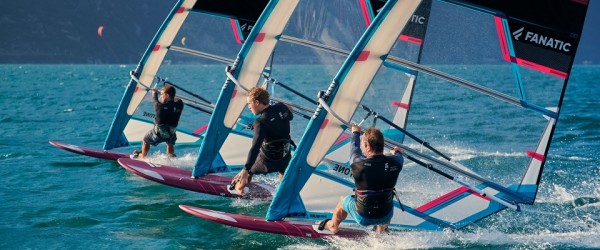
Select to expand quotePaducah said..
This picture below may help anyone struggling to visualize things - it's a promo pic for new Duotone sails. Note that a planing board has a pretty pronounced angle of attack, larger than a foil. If you set the foil parallel to the bottom, when you are planing, your foil would be at a similar angle. Probably okay for lift off but draggy if you are just skimming the water (foil angled too high).
Moreover, if you are descending into a touchdown (say mid jibe or riding through chop, you can see that a parallel (0 degree angle) is going to pound the front part of the rocker curve into the water, significantly slowing the board down.
So interesting observation, and one I have noticed which is some windsurfers look like they are pulling a wheelie with the nose high above the water when they are planing (slower I think but easier to get on the plane), versus having the nose of the board closer to the water like these guys (faster I think but harder to get on the plane, need more wind/sail). The mast foot position controls that with a fin. When I am planing with a foil the nose of the board is just off the water and I feel like I am skipping across the water really fast. I hear people talk about hard touchdowns, but I do not feel that, in fact I will briefly touchdown skimming the water and then go back into the air, definitely do not feel any pounding, just a smooth transition from air to water back to air. On the Goya Bolt with a foil I have the mast foot at nearly the identical distance from the center of the foil mast as I did on my JP MagicRide 142 from the center of the fin, and they both plane the same way, nose close to the water. Now in waves that is a problem for a fined board, but I would drop into the wave trough and shoot along it (glassy water), with a foil I just rise above or do the same and surf the wave trough (board on the water).
For a finning board the optimum lift-to-drag occurs at about 6 degrees. You can find this in the literature. I saw a detailed calculation of this once presented by a Boeing aeronautical engineer. Granted, airplanes fly through air, but the equations are the same for water, just different constants.
You can easily adapt this youtube method to measuring the angle between fuselage and board bottom. Instead of using a caliper for wing edges, just use the straight edge of the Wixey guage directly.
Yeah, I was thinking of putting a level along the fuselage and board bottom to get a more accurate reading. The Buble Level app reads to 1/10th of a degree and seems accurate and is very reproducible with my Samsung phone.
Okay, used a steel 12" long level with the smooth long edge of my phone on it running the free/no ads Bubble Level app 1st on the bottom of the fuselage right up against the back of the wing and across the mast/fuselage joint, and then 2nd on the board bottom next to the mast, no difference between them to within 1/10 of a degree. Board was on a solid surface and foil was screwed in tight, and same result when the foil was not screwed in.
And for anyone else who makes a shim, do not forget to take it out after removing the foil, because the next thing I do is flip the board over to slide into the board bag, today it fell out on the sand and I did not see it, fortunately I remembered later and live close by the beach.
Select to expand quotePaducah said..
This picture below may help anyone struggling to visualize things - it's a promo pic for new Duotone sails. Note that a planing board has a pretty pronounced angle of attack, larger than a foil. If you set the foil parallel to the bottom, when you are planing, your foil would be at a similar angle. Probably okay for lift off but draggy if you are just skimming the water (foil angled too high).
Moreover, if you are descending into a touchdown (say mid jibe or riding through chop, you can see that a parallel (0 degree angle) is going to pound the front part of the rocker curve into the water, significantly slowing the board down.
So looked today while I was foiling just on the surface of fairly flat water, my nose looked lower than the two in the forefront and a little lower than the one in the back. At 0.0 degree rake angle the board is pretty flat on the water and in the air.
Select to expand quotePaducah said..
This picture below may help anyone struggling to visualize things - it's a promo pic for new Duotone sails. Note that a planing board has a pretty pronounced angle of attack, larger than a foil. If you set the foil parallel to the bottom, when you are planing, your foil would be at a similar angle. Probably okay for lift off but draggy if you are just skimming the water (foil angled too high).
Moreover, if you are descending into a touchdown (say mid jibe or riding through chop, you can see that a parallel (0 degree angle) is going to pound the front part of the rocker curve into the water, significantly slowing the board down.
I thought angle of attack was determined by the stabilizer angle.
Select to expand quoteSandman1221 said..
I thought angle of attack was determined by the stabilizer angle.
Partly, it's a dynamic system of which stab angle is part. How do we change the AoA to take off? Shift our weight back. 
Another way to think of it is to think of airplane trim tabs. Small changes in pitch necessary for stable/level flight are done with trim tabs - changing load placement (passengers, cargo) and amount (fuel burn) will affect the plane's tendency to fly level. Trim tab adjustments are used so the pilot or autopilot isn't having to yank on the stick/wheel all the time. Similarly, if a foil is very back footed, you can pitch your stab up a bit. If it's too lifty (too front footed) you can flatten it. There are secondary effects (flatter stab tends to be less draggy) but if you flatten a stab unnecessarily, then you are forced to overcome that by a lot of back foot pressure and a higher AoA than necessary which is ... draggy.
I added a tether made out of dental floss tied through the hole in the shim to make it easy to remove, does not affect the fit.
Third session with the foil mast head shim, have used it in winds from 10-22 knots, do not see any cracks in or around the Goya foil box, or any deformed surfaces on the top/bottom of the board. Now I have not hit anything with the foil since I have been using the shim, but that is due to experience when it comes to sandbars and shallow water.
Select to expand quoteSandman1221 said..
Third session with the foil mast head shim, have used it in winds from 10-22 knots, do not see any cracks in or around the Goya foil box, or any deformed surfaces on the top/bottom of the board. Now I have not hit anything with the foil since I have been using the shim, but that is due to experience when it comes to sandbars and shallow water.
Fifth session today with the shim, Goya foil box and board look good, no cracks or deformed surfaces, and no change in how the foil sits in the box.
on my 10th session with the mast head shim on the Goya Bolt Pro 135, everything still looks good with no cracks or deformations, and I did hit a sandy high spot in the bay on a low tide, dropped me out of the air but was just off the water so landed flat on the water.
have hit a manatee, just scraped the back, as well as other things, in the last 4 months over dozens of sessions and the Goya Bolt 135 DT/foil box is still crack free including the deck after always using my home made shim. In the right box mast head shims are a good thing.