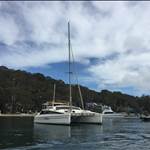
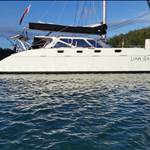
So another one of the projects I need to work through is the old water tanks on Felix. I want to ask how much water you guys carry because both my tanks need replacing. For now we just do overnight and day trips but in a couple of years I would love to use long service leave to cruise from Sydney to the Whitsundays and so I am kind of planning upgrades around that.
The port hull has the galley which has 2 taps: A fresh water tap supplied by a 200L tank and also a salt water tap. I was told they washed dishes with salt water and then rinsed with fresh water. I've never bothered with the salt water but I guess its a good idea when needing to save water.
The starboard hull has the head which has a small hand basin supplied by a 30L tank.
The old tanks were made of just sealed sections of hull coated in waterproof membrane. The membrane was failing and small bits of blue plastic were coming through the faucets  when I took on Felix a year ago. Each tank had a small access hatch which was too small to get in and clean/repair the tanks so I have cut them open, and drained them.
I would prefer to fit hard plastic tanks inside the existing space (I cant find replacement bladders in a suitable shape). It will cost more than restoring the old ones, but installation will be quicker and make it possible to give them a thorough clean out once per year (is that about the right timing?) and the plastic tanks should last as long as the boat does.
Two plastic tanks would give me 64L of water in each hull. Which at 128L total seems like it be would touch-and-go- for coastal cruising with 2 adults and 1-2 kids (in this scenario we bring our own soft drinks, beer, bottled water etc with us when we go somewhere). Being a small boat we just use those portable 25L shower bags to heat water on deck. So we can control how much is used in showering.
Ive never sailed outside of Sydney so I have no idea how often I would be able to refill the tanks once I head north......
WIll it be enough or should I try to squeeze more in?
Thoughts appreciated!!
128 L won't get you far if you are cruising with crew. I found I averaged about 10 L per day cruising solo, (no shower) and carried about 180L to allow maximum flexibility about where I had to stop . I used the salt water tap to pre-rinse messy items, like the coffee plunger and pots, finishing up with a fresh water rinse. I'd suggest you do a few trips to find out your and your crew's average daily usage.
One useful thing I found was to take a number of 20 L collapsible camping water containers (Kathmandu, Ray's etc have them). They have a few advantages: they're quite cheap, are reasonably flexible to fit into various stowage spaces, can be stowed for best boat trim, are small and light when empty. They also fit nicely in a milk crate, and a couple of these with a collapsible trolley allows a fairly low exertion way to get 40 L at a time if the water supply is some distance away.
As to bits of plastic coming through, I suggest you put a filter on the line, preferably activated carbon, which will also minimise tank-taint.
Cheers, Graeme
I carry 160 litres in 20 litre jerry cans that are secured throughout my boat to distribute the weight where I want it down below. These fill up two ten litre cans that are used for drinking and cooking. I also have a salt water tap for washing. Plus a 80 litre water tank that is used for rinsing after a salt water wash. This works for 2 people easily for nearly two weeks without having to worry. I found using jerry cans I know pretty much exactly how much water I have left to drink. Had an electric pump on the water tank but went back to a hand pump as people seemed to think it it was connected magically to warragamba dam just like home because it worked the same lol. To fill up we topped up water when I got diesel. Showering was via a bucket of salt water in the cockpit followed by a fresh water rinse from a garden sprayer. If any one came for coffee it was byo water ,no I'm not that bad. That's my experience I'm sure there are better ways to manage it.
As an aside, we put one of these in, which is great for monitoring water usage, very accurate, and dead easy to install. If not fully filling the water tank, use a garden tap flow meter etc to measure fill and reset the Topargee at filled level.
www.topargee.com.au/water-tank-gauges.html

Haven't had much success with water bladders in past boats, and had one leaking in the stb hull of Gemini. I've replaced them with Diablo tanks. Various sizes and you can undo the lid and clean them out. As others have said, using salt water with a fresh water spray bottle significantly reduces your demand for fresh water.
You're talking a 25ft Cat, not a 40ft Condo. Think camping. 150 litres plus 50 litres drinking water containers should be all you could expect to carry, even for a long trip. That's an extra 1-2 crew weight, which will impact on sailing characteristics. Plan for the minimum you can safely get away with, not the maximum you might want to keep everyone happy.
Performance (and comfort) of small Cats, especially to windward, is weight dependent. Before you fill you boat with stuff, take the opportunity to get used to how it handles unladen. After having completed a couple of shorter trips, you'll be looking at what you can offload more than what you can fit in...
One's fresh water carrying capacity is a worry on most cruisers of small size.
My 28 feet cruiser has two built in tanks for fresh water about 60L each side with closeable cross over pipes and large inspection covers as well as a foot and electric pumps. I carry about 15-20 1.25 liter plastic bottles for good measure, as well.

The tanks are built in, made of vinylester resin just like the rest of the hull and so, not particularly prone to soilage like most plastic ones are. The water stays clear even if not used for a while, which seldom happens. I sail single handed most of times and so, l got no problem with undisciplined water wasters.
I would be able to drag out each refill to a month - 30 days, 4 liter per day - if l had to but rather not think of it. It would be rather Spartan.
A week or two would be more the norm with showers.
To save fresh water, salt water cooking, washing up and showers must be considered. Perhaps with fresh water rinses, which water could be collected and used later for after shower rinses of one's person. The use of shower mittens and a bucket is a good way to make one's shower last longer.
Replenish one's water supply is mostly thought of as getting to the Marina and open the tap.
However, catching rain water, and it rains more often than one would think of, is a perfect way to fill up the tanks, bottles and have big showers.
To catch rain water the main sail is ideal or a clean sheet of plastic stretched btwn the boom and the rails would collect a lot of otherwise wasted resources.
Plugging up the scuppers in the cockpit would make an instant swimming pool.
MB has 300 litres in three stainless tanks. I have a salt water tap but prefer to just dip a bucket over the side to get washing up and personal washing water. I carry 3 X 15 litre plastic containers which I refill from a tap ashore. These are for tea/coffee only as the stainless tanks impart a slight metal taste to the water which some don't like.
3 people for 2 weeks we use about 2/3 of this ie 200 litres from the tanks, 2 of the plastic containers. This provides reserve for the unexpected like someone leaving the domestic water pump on and a hose coming off putting fresh water into the bulge. These accidents will happen.
On my 30 footer I am going for two 100 litre baldder tanks, port and stbd for extended coastal cruising, mainly for cooking and showering and then 2 x 20 litre containers stowed for best ballast and then maybe a number of supermarket 10 or 5 litre packs for coffee and drinks.
Hi Felix,
2 x 200ltr tanks near centre line under the cabin settees. No bladders, tanks are moulded into the hull, thankfully with big inspection hatches, so we use bottled 10ltr water for drinks coffee. This comfortably lasted two weeks of cruising with three of us, but that was not used for showers, salt water on deck job. We do have a hot water boiler and showers in both heads and they're pretty frugal,, but when the girls are on board they tend to simply stay in there too long!
SB
Select to expand quoteshaggybaxter said..
Hi Felix,
2 x 200ltr tanks near centre line under the cabin settees. No bladders, tanks are moulded into the hull, thankfully with big inspection hatches, so we use bottled 10ltr water for drinks coffee. This comfortably lasted two weeks of cruising with three of us, but that was not used for showers, salt water on deck job. We do have a hot water boiler and showers in both heads and they're pretty frugal,, but when the girls are on board they tend to simply stay in there too long!
SB
Ladies (young or old ) always use more water than blokes. It's why they smell so nice.
Thanks Guys thats really good feedback.
My female crew will probably not be interested in being away from land for more than 2-3 nights so it sounds like 150L capacity will be ok if we are water wise. This is less than what was onboard when I started so im still lighter than before.
The 64L diablo tank fits perfectly on the starboard side, so that's a quick win.
But the port side had a big tank pictured below. Its much bigger and has a very curved bottom, which leads me to think of doing a custom stainless tank. What are the pro's / con's of stainless tanks (this one supplies the galley)??

100L tank ( soon to become 300) and 15 10L supermarket dimijons is what we cruised the nsw coast with last year,with a crew of two. I like the 10L jobs they're easier to carry and stow than the 20s, also the cheapest way to buy water storage. We didn't do marinas and had no trouble finding waterside hose taps to fill our 10s and ferry them back.
Select to expand quoteFelixdeCat said..
Thanks Guys thats really good feedback.
My female crew will probably not be interested in being away from land for more than 2-3 nights so it sounds like 150L capacity will be ok if we are water wise. This is less than what was onboard when I started so im still lighter than before.
The 64L diablo tank fits perfectly on the starboard side, so that's a quick win.
But the port side had a big tank pictured below. Its much bigger and has a very curved bottom, which leads me to think of doing a custom stainless tank. What are the pro's / con's of stainless tanks (this one supplies the galley)??
Smooth surface, out of the way location. I'd put a bladder in there, at least to start. 10% the cost of a fabricated SS tank, and no metallic taste. Use work out your inlet hose route.
Select to expand quoteFelixdeCat said..
Thanks Guys thats really good feedback.
My female crew will probably not be interested in being away from land for more than 2-3 nights so it sounds like 150L capacity will be ok if we are water wise. This is less than what was onboard when I started so im still lighter than before.
The 64L diablo tank fits perfectly on the starboard side, so that's a quick win.
But the port side had a big tank pictured below. Its much bigger and has a very curved bottom, which leads me to think of doing a custom stainless tank. What are the pro's / con's of stainless tanks (this one supplies the galley)??
Smooth surface, out of the way location. I'd put a bladder in there, at least to start. 10% the cost of a fabricated SS tank, and no metallic taste. You need to work out your inlet hose route.
In ten months at sea I used 2 litres a day max including 3 coffees or teas and carried all my water in plastic bottles. The water in the tanks was for emergency use.
Using bottles is great because you can easily monitor your usage and it's difficult to imagine a total water loss catasrophy and the used bottles add to your emergency floatation reserve.
Jon Sanders uses old wine cask bladders because they fit into nooks and crannies.
One thing was most of my food had a high water content eg curries and stews etc.
We carry approx. 300lts , which lasts the missus and myself around 14 days , a lot less with daily showers.
we got sick of having to go to town and pick up water only . So we purchased the portable water maker from rain main.
Is advertised output at 140lts/hr and we have been avg120lt/hr.
No more water issues and no more diversions back to civilisation for water ... just Beer and food now
Select to expand quoteDAMA said..
We carry approx. 300lts , which lasts the missus and myself around 14 days , a lot less with daily showers.
we got sick of having to go to town and pick up water only . So we purchased the portable water maker from rain main.
Is advertised output at 140lts/hr and we have been avg120lt/hr.
No more water issues and no more diversions back to civilisation for water ... just Beer and food now
That looks pretty cool Dama, I didnt know this existed .
Neat!
Select to expand quoteDAMA said..
We carry approx. 300lts , which lasts the missus and myself around 14 days , a lot less with daily showers.
we got sick of having to go to town and pick up water only . So we purchased the portable water maker from rain main.
Is advertised output at 140lts/hr and we have been avg120lt/hr.
No more water issues and no more diversions back to civilisation for water ... just Beer and food now
Dama, just a question on water purity. Does a water maker produce water that is TOO pure. Distilled water is very pure but is not fit to drink because it has no 'goodness' in it. Do you need to add mineral pills to your water tank to make the water 'good' or does it produce drinkable water anyway ?.
RE watermakers: although I don't have one, I've done a fair bit of research on them. My understanding is that it's best to use them very frequently (say every day or second day), with no more than around 5-7 continuous days without use. Extended time without use will allow bacteria to build up within the filters. For longer idle periods, you've got to pickle the whole system with sodium metabisulfite. This takes some effort, and of course when you want to make water again, you've got to flush the metabisulfite first.
They use a lot of power. You'd probably need 400W or more of solar, and house batteries to match.
Sam - yes, the water is very pure, but it's not a problem. All you need from your drinking water is H20, nothing else. See here for lots of opinions: www.cruisersforum.com/forums/f115/watermaker-no-trace-elements-kills-25120.html
If one is thinking of having a tank built for water, one would do well by building it of GRP. My vinylester tanks don't need much cleaning, they just don't foul like most bladders and some plastic tanks and no metallic taste from s/s.
Afloat magazin has an ad for plastic tanks. My mate uses one of those tanks made for measure and he is very satisfied with it.
Gee those water makers are expensive though. I think its out of the plan just based on cost, and power consumption.
I am leaning towards two new stainless tanks, so I can position them optimally for weight distribution. 100L in each tank located as close as possible to the centre, down low in each hull.
This should make the overall vessel more balanced than where they were before, and it will be pretty cheap for me to weld up from 1.2mm sheet, and symmetrical. I am curious about the idea of GRP tanks but I reckon they would weigh about the same as 1.2mm stainless anyway. With a charcoal filter I should be able to fix the taste from what I have read of other peoples experiences?
I'll make a plywood prototype to make sure I can get it into the hull once made.


From your original post, it seems Port small tank had a manual pump at the hand basin? A good idea to leave the water maker till you retire onto a much larger Cat! Tank location looks good. You should probably plan a line from both tanks to a central pump, with taps so you can have both or either supplying the pump.
Select to expand quoteBushdog said..
From your original post, it seems Port small tank had a manual pump at the hand basin? A good idea to leave the water maker till you retire onto a much larger Cat! Tank location looks good. You should probably plan a line from both tanks to a central pump, with taps so you can have both or either supplying the pump.
Yep I think you are right, tanks will be fine. Its a long time till I retire so by then I will should have some idea of what I am doing 
Here's the same image but with location of old tanks marked in orange. I think this will give a bit more balance. Its also got me thinking about other ways to improve weight dist in the future.
Port side is galley and starboard is head. Sinks marked in red. Both with hand pump faucets. (this is just an image I grabbed off the net of a cat with similar layout)
The tank on the galley side will form a bench seat to sit on while cooking etc and on starboard side I will be relocating the batteries to sit on top. At the moment the only battery on board does all the work and sits next to the fuel tank (not my design!)

If you chose s/s - which you are going to regret - at least make a good sized man-hole on the top of each so you can clean it properly. You'll need it. Charcoal filters are good but don't work well with s/s tanks.
The other suggestion, to utilize the huge deck area and use it for rain collection to fill your tanks.
Gday Felix
I would just build the tanks into the hull. There is no reason to build a tank and drop it in, you have the bulkheads at each end of your compartment, the hull and an open top. Add some epoxy glassed ply baffles, an inlet, a breather and then epoxy the top of the tank down. Add an inspection port if required.
I did this on our boat 17 years ago and never carry water in anything but the tanks and 3 jerry cans. I am very anti plastic bottles and really don't like the idea of lots of disposable plastic waste along with me when cruising, or buying something that I can get pure for free. So for me epoxy tanks are the bees knees. Polyester tanks may taste, but my ply/epoxy tanks are fine. The worst thing is pulling into Bundaberg the first time and filling the tanks up with their nasty tasting water - fill up somewhere else and fill the shower water at Bundy.
Epoxy goes over the poly you have fine.
cheers
Phil
Just had another look at the photo - it looks like you already have a tank, it is probably poly and has no baffles but this is an easy fix. Rebuilding this tank with epoxy would be the easiest and cheapest option.
The main reason for making drop in tanks is that I would be able to make them in my garage and take my time getting them right, and then drop them in rather than having to make them a little bit at a time on board. I only work on the mooring one night per week, while I have 6 other nights of the week to make something at home after the family goes to bed. So the quality is normally better at home.
The other reason was that when they need cleaning I can easily take them home and give them a thorough clean.
Still not quite sure what the downside of SS tanks is? Aside from taste? Or maybe weight? I could weld up a miniature prototype out of scrap, fill it up, leave it for a month before drinking it to see for myself.....
I could definitely catch lots of water off the deck but it would need to be pretty well filtered. Plenty of birds love to spend time on Felix.
Stainless is fine. Drain them to empty and refill and the taste is minimal. They don't break or leak.