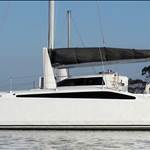
It's also worth keeping in mind also that many (most?) Cats don't have a boom vang, due to the mast being further back/closer to the (often) hard dodger/cabin top. There's also no/limited space for a Cunningham. As a result, the main sheet is loaded with all boom and sail pressures - upward, outward, and onward! The masts also have more prebend designed into them than your cruising mono, and I guess this is also factored into sail design. This may make the rig slower to de power, and also changes/limits your sail tuning and de power options.
I totally agree with reefing early to avoid getting into a situation where you're out of control, and not heeling suddenly becomes a major design liability...
Maybe designers could provide a chart of recommended sail plans for various wind strengths and angles.
another factor could be that fully battened sails made out of modern stiff cloths dont tend to flog around like older sails did. This means you can depower a full main by letting it twist off or luff a bit and everything feels under control. The problem is when a big gust hits, maybe from a different angle you can end up with a very poweful sail at the worst posible moment. Same goes if running and you bury into the back of a wave, your apparent wind strength may go from 15 knots up to 25 in a flash.
Select to expand quotecrustysailor said..
On that though, a comment on one of the cat youtubes I saw 2 weeks ago highlighted something I thought interesting, that sails infront of the mast are lifting and pulling the boat up and forward/along , yet the main behind obviously tends to drive it down and forward.
That's a common belief, but wrong according to modern CFD studies of rig aerodynamics.
In Taipans and other small cats, the common way to depower quickly downwind is to let the jib flog, just like 49ers etc do with their kite when they are about to nosedive. Similarly in windsurfers, which have an angled luff just like a jib, you sheet ON to keep the bow down at high speeds downwind, and if you ease the sail off the board will leap skywards. If the angled luff of a jib was lifting, then the opposite would happen.
The rig is driving the boat from about the centre of the geometric area, which is a long way above the deck. Imagine if you were being towed by a rope tied to the mast say 20 feet up - the force would be pulling the boat forward and also pivoting it down.
Even if you have the rope angling up a bit, to allow for any supposed jib lift, the overall force of the sails is still up above the centre of drag (ie the hulls) and is still therefore trying to pivot the bows down. If you reduce the force by easing the jib, the bows can lift back up again.
Just to make it more complicated, there are plenty of times when a spinnaker seems to lift the bow, but it's all very complicated because there are effects like the centre of the dynamic lift on the hull, boatspeed, apparent wind angles etc getting involved. For example if you are trying to get a skiff around a top mark without a spinnaker it is in big danger of nosediving and once you get the kite up the bow lifts - but is that because of the lift of the spinnaker, or because of the lift created by the hull which is being driven much faster by the spinnaker?
Select to expand quoteBushdog said..
It's also worth keeping in mind also that many (most?) Cats don't have a boom vang, due to the mast being further back/closer to the (often) hard dodger/cabin top. There's also no/limited space for a Cunningham. As a result, the main sheet is loaded with all boom and sail pressures - upward, outward, and onward! The masts also have more prebend designed into them than your cruising mono, and I guess this is also factored into sail design. This may make the rig slower to de power, and also changes/limits your sail tuning and de power options.
I totally agree with reefing early to avoid getting into a situation where you're out of control, and not heeling suddenly becomes a major design liability...
Cats don't need a vang because they have such a wide sheeting base often twin mainsheets are used on cats and double as a vang but not all that popular , as a general rule if on the wind reef headsail first , running mainsheet first.
Select to expand quoteslammin said..
Shaggy on the wind rush forum the fast guys agree , the mainsheet provides shape the traveller sets power BUT only after using the downhaul. Slim belly for gusts and fat for lulls. If it's too much for the downhaul then ease the traveller.
Thanks Slammin, I just learnt something!
At the risk of appearing a bit of a numpty, I'm not familiar with a 'downhaul'. Is that the same thing as a Cunningham?
Select to expand quoteshaggybaxter said..slammin said..
Shaggy on the wind rush forum the fast guys agree , the mainsheet provides shape the traveller sets power BUT only after using the downhaul. Slim belly for gusts and fat for lulls. If it's too much for the downhaul then ease the traveller.
Thanks Slammin, I just learnt something!
At the risk of appearing a bit of a numpty, I'm not familiar with a 'downhaul'. Is that the same thing as a Cunningham?
Yep. It's that simple. As a dinghy sailor I'd bear up or off or use the mainsheet accordingly (I'm a cruiser not a racer) traveller if I'm feeling lucky, but that's what the winners talk about doing . Look for the bullets and downhaul accordingly then traveller and then mainsheet only at the last adjust steering. I'll advise so read carefully, I'm only repeating something that's too difficult for me as a single hander to achieve.
That being said it makes perfect sense. Have a search through catsailor.com? Another fantastic forum.
/\
Is that a reference to upwind or downwind sailing? In fast cats downwind, steering is critical and the sheets are adjusted less than in many monos.
Similarly, in many fast small cats the traveller is little used; it basically just sits on the centreline upwind, and guys like MItch Booth say that almost all cat sailors should use more mainsheet. There's a lot of difference between the way different cats are sailed.
One of the big issues, to me, is that multis are so stable and use such rigid rigs that their sheet loads are extremely high. The lack of a vang and the big squaretops of cruising cats can put even more load on the mainsheet, making it harder to handle and to dump. On our 36' mono we used to have the mainsheet leading to winches each side of the cockpit. It was a pain to adjust so I just went to a standard mainsheet system, and as an example of the load difference I put the mainsheet system of our old 20 foot day racing cat onto our 5 ton 36 foot fractional rig mono with no real problems.
I have to say, though, that although my family has had a bunch of cruising multis and my wife and I have had small racing cats, I'm not an expert on them in any way.
I will try not to say anything that could be seen as hurtful for anyone but hopefully we can learn something from this.
The Spirited 380 has a reasonably high rig and the one I have seen sailing around the Lake here does nicely in a blow, but it does heel more than less racey or beamier cats - so obviously you will reef to reef earlier than a cat with a lower rig.
I have a different slant on a few things said so far -
- Leeward daggerboards - I am very unsure about pulling up the leeward daggerboard a lot when going to windward. I am wary of bearing away under a press of sail when beating. If the boat was to slide to leeward when lifting a hull I want it to head up, not bear away. With the rudder in the water still I would be worried about the boat bearing away and then loading up the boat some more - so boards down and keep someone good on the helm if you are close to reefing. Heading up requires good contact with the water so I leave the boards down when beating.
- large headsails - I very much do not want a large headsail up in heavy conditions. On my cat I have a small staysail that I love when it blows. A large headsail will get fuller with forestay sag and give more lee helm. This will cause you to bear away which is a very bad thing in a blow. When going upwind in a blow, you want weather helm and a nice blade shaped jib. If you reef a large genoa and main then the centre of effort goes forward and you get lee helm.
- Don't get lee helm - lee helm is okay in some breezes but on autopilot, upwind in a blow on a cat it is a real worry. You are going along at 7-8 knots in 18-22 or so. A gust comes along and your boat bears away 5-10 degrees or so because of a wave. All of a sudden the boat jumps up to 10-12 knots and the apparent heads right up and you jump for the wheel and get her headed up again. Reefing the sailplan on a typical cat (with no staysail) gives most cats lee helm - just what I don't want in a blow to windward. Monos don't do this as much, probably due to heel.
One friend amended the rig on his Jeff Schionning cat to include a staysail (no lee helm and great blade jib in blow). Other friends were really clever and use the screecher furler to haul up a furled staysail when beating to windward in a blow. So they don't need any special hardware, and get the benefits of a staysail only when needed.
- One problem with cats is that getting snug can leave them quite underpowered in lulls. In a short and confused sea, it is nice to have plenty of power to drive through the chop. If you have not got a nice flat blade jib and good reefing, you may have too large a gap in your wardrobe - for the 18-22 knot breeze, where you can leave the boat on autopilot. For some cats this may force you to keep someone on the helm so that they can steer then knife edge between over powered and underpowered. I know I would love a larger staysail for 15-25 knots offshore.
- Don't bear away. Some forums have people on them saying you should bear away to depower on cats. Sail a fast off the beach cat to learn more here. Safety is either depowered by heading up when sailing to windward or bearing away and reducing apparent when downwind. The nasty zone is a beam reach when either may be too far away. I was lucky enough to crew on Sean Langman's ORMA 60 tri to deliver it from Southport to Sydney. Off Forster we had 18-20 knot soutwesterlies. Sean sat on the helm for about 4-6 hours and drove that thing like a skiff or beach cat. We trucked along at 15 knots upwind when a gust came he shoved her up in the wind and kept her level. When the gust left, he would bear away to sail the tufts. I did not want to helm her - it was such a huge responsibility but he did it beautifully. As for dumping traveller - there was no real option. The rig was canted so heavily that the traveller dump was useless.
- Don't use self tailers as cleats - again an 80s thing. Back then, it was really bad form to even have self tailers on sheet winches. I once sailed with Bill Salisbury - a really old hand from the 60s who had done heaps - the wind was lightish - 10-12 and I was winching the genoa in and leaving it on the self tailer - every time I did (about twice before I learned) he would waggle his finger at me and I would unwind the self tailer and put the sheet in the cleat. Don't ever use self tailers to cleat a sheet. (I couldn't afford self tailers when I built my boat and so can be safe all the time, even though I could afford them now). You can't ride shotgun with a self tailer like you can with a cam cleat.
- Capsize prevention/design - As someone who had multis in the 80s (when it seemed like everyone I knew had capsized) we all talked about capsize but the topic is much less discussed now. The boats are much better now but we should ensure that we have a spot to stay safe after inversion. Maybe an axe to cut back into a special spot to wait for rescue, non skid on the bridgedeck and ropes along the bridgedeck to hold onto. Does your crew know where the calamity pack is? Is the Epirb available both inverted and upright? These are questions we used to ask in the 80s but don't do so much anymore. Yet our boats can still sink or capsize.
Select to expand quoteKankama said..
I will try not to say anything that could be seen as hurtful for anyone but hopefully we can learn something from this.
The Spirited 380 has a reasonably high rig and the one I have seen sailing around the Lake here does nicely in a blow, but it does heel more than less racey or beamier cats - so obviously you will reef to reef earlier than a cat with a lower rig.
I have a different slant on a few things said so far -
- Leeward daggerboards - I am very unsure about pulling up the leeward daggerboard a lot when going to windward. I am wary of bearing away under a press of sail when beating. If the boat was to slide to leeward when lifting a hull I want it to head up, not bear away. With the rudder in the water still I would be worried about the boat bearing away and then loading up the boat some more - so boards down and keep someone good on the helm if you are close to reefing. Heading up requires good contact with the water so I leave the boards down when beating.
- large headsails - I very much do not want a large headsail up in heavy conditions. On my cat I have a small staysail that I love when it blows. A large headsail will get fuller with forestay sag and give more lee helm. This will cause you to bear away which is a very bad thing in a blow. When going upwind in a blow, you want weather helm and a nice blade shaped jib. If you reef a large genoa and main then the centre of effort goes forward and you get lee helm.
- Don't get lee helm - lee helm is okay in some breezes but on autopilot, upwind in a blow on a cat it is a real worry. You are going along at 7-8 knots in 18-22 or so. A gust comes along and your boat bears away 5-10 degrees or so because of a wave. All of a sudden the boat jumps up to 10-12 knots and the apparent heads right up and you jump for the wheel and get her headed up again. Reefing the sailplan on a typical cat (with no staysail) gives most cats lee helm - just what I don't want in a blow to windward. Monos don't do this as much, probably due to heel.
One friend amended the rig on his Jeff Schionning cat to include a staysail (no lee helm and great blade jib in blow). Other friends were really clever and use the screecher furler to haul up a furled staysail when beating to windward in a blow. So they don't need any special hardware, and get the benefits of a staysail only when needed.
- One problem with cats is that getting snug can leave them quite underpowered in lulls. In a short and confused sea, it is nice to have plenty of power to drive through the chop. If you have not got a nice flat blade jib and good reefing, you may have too large a gap in your wardrobe - for the 18-22 knot breeze, where you can leave the boat on autopilot. For some cats this may force you to keep someone on the helm so that they can steer then knife edge between over powered and underpowered. I know I would love a larger staysail for 15-25 knots offshore.
- Don't bear away. Some forums have people on them saying you should bear away to depower on cats. Sail a fast off the beach cat to learn more here. Safety is either depowered by heading up when sailing to windward or bearing away and reducing apparent when downwind. The nasty zone is a beam reach when either may be too far away. I was lucky enough to crew on Sean Langman's ORMA 60 tri to deliver it from Southport to Sydney. Off Forster we had 18-20 knot soutwesterlies. Sean sat on the helm for about 4-6 hours and drove that thing like a skiff or beach cat. We trucked along at 15 knots upwind when a gust came he shoved her up in the wind and kept her level. When the gust left, he would bear away to sail the tufts. I did not want to helm her - it was such a huge responsibility but he did it beautifully. As for dumping traveller - there was no real option. The rig was canted so heavily that the traveller dump was useless.
- Don't use self tailers as cleats - again an 80s thing. Back then, it was really bad form to even have self tailers on sheet winches. I once sailed with Bill Salisbury - a really old hand from the 60s who had done heaps - the wind was lightish - 10-12 and I was winching the genoa in and leaving it on the self tailer - every time I did (about twice before I learned) he would waggle his finger at me and I would unwind the self tailer and put the sheet in the cleat. Don't ever use self tailers to cleat a sheet. (I couldn't afford self tailers when I built my boat and so can be safe all the time, even though I could afford them now). You can't ride shotgun with a self tailer like you can with a cam cleat.
- Capsize prevention/design - As someone who had multis in the 80s (when it seemed like everyone I knew had capsized) we all talked about capsize but the topic is much less discussed now. The boats are much better now but we should ensure that we have a spot to stay safe after inversion. Maybe an axe to cut back into a special spot to wait for rescue, non skid on the bridgedeck and ropes along the bridgedeck to hold onto. Does your crew know where the calamity pack is? Is the Epirb available both inverted and upright? These are questions we used to ask in the 80s but don't do so much anymore. Yet our boats can still sink or capsize.
Hi Kankama I might be showing my ignorance here but what's wrong with using self tailers as cleats?
Select to expand quoteKankama said..
I will try not to say anything that could be seen as hurtful for anyone but hopefully we can learn something from this.
The Spirited 380 has a reasonably high rig and the one I have seen sailing around the Lake here does nicely in a blow, but it does heel more than less racey or beamier cats - so obviously you will reef to reef earlier than a cat with a lower rig.
I have a different slant on a few things said so far -
- Leeward daggerboards - I am very unsure about pulling up the leeward daggerboard a lot when going to windward. I am wary of bearing away under a press of sail when beating. If the boat was to slide to leeward when lifting a hull I want it to head up, not bear away. With the rudder in the water still I would be worried about the boat bearing away and then loading up the boat some more - so boards down and keep someone good on the helm if you are close to reefing. Heading up requires good contact with the water so I leave the boards down when beating.
- large headsails - I very much do not want a large headsail up in heavy conditions. On my cat I have a small staysail that I love when it blows. A large headsail will get fuller with forestay sag and give more lee helm. This will cause you to bear away which is a very bad thing in a blow. When going upwind in a blow, you want weather helm and a nice blade shaped jib. If you reef a large genoa and main then the centre of effort goes forward and you get lee helm.
- Don't get lee helm - lee helm is okay in some breezes but on autopilot, upwind in a blow on a cat it is a real worry. You are going along at 7-8 knots in 18-22 or so. A gust comes along and your boat bears away 5-10 degrees or so because of a wave. All of a sudden the boat jumps up to 10-12 knots and the apparent heads right up and you jump for the wheel and get her headed up again. Reefing the sailplan on a typical cat (with no staysail) gives most cats lee helm - just what I don't want in a blow to windward. Monos don't do this as much, probably due to heel.
One friend amended the rig on his Jeff Schionning cat to include a staysail (no lee helm and great blade jib in blow). Other friends were really clever and use the screecher furler to haul up a furled staysail when beating to windward in a blow. So they don't need any special hardware, and get the benefits of a staysail only when needed.
- One problem with cats is that getting snug can leave them quite underpowered in lulls. In a short and confused sea, it is nice to have plenty of power to drive through the chop. If you have not got a nice flat blade jib and good reefing, you may have too large a gap in your wardrobe - for the 18-22 knot breeze, where you can leave the boat on autopilot. For some cats this may force you to keep someone on the helm so that they can steer then knife edge between over powered and underpowered. I know I would love a larger staysail for 15-25 knots offshore.
- Don't bear away. Some forums have people on them saying you should bear away to depower on cats. Sail a fast off the beach cat to learn more here. Safety is either depowered by heading up when sailing to windward or bearing away and reducing apparent when downwind. The nasty zone is a beam reach when either may be too far away. I was lucky enough to crew on Sean Langman's ORMA 60 tri to deliver it from Southport to Sydney. Off Forster we had 18-20 knot soutwesterlies. Sean sat on the helm for about 4-6 hours and drove that thing like a skiff or beach cat. We trucked along at 15 knots upwind when a gust came he shoved her up in the wind and kept her level. When the gust left, he would bear away to sail the tufts. I did not want to helm her - it was such a huge responsibility but he did it beautifully. As for dumping traveller - there was no real option. The rig was canted so heavily that the traveller dump was useless.
- Don't use self tailers as cleats - again an 80s thing. Back then, it was really bad form to even have self tailers on sheet winches. I once sailed with Bill Salisbury - a really old hand from the 60s who had done heaps - the wind was lightish - 10-12 and I was winching the genoa in and leaving it on the self tailer - every time I did (about twice before I learned) he would waggle his finger at me and I would unwind the self tailer and put the sheet in the cleat. Don't ever use self tailers to cleat a sheet. (I couldn't afford self tailers when I built my boat and so can be safe all the time, even though I could afford them now). You can't ride shotgun with a self tailer like you can with a cam cleat.
- Capsize prevention/design - As someone who had multis in the 80s (when it seemed like everyone I knew had capsized) we all talked about capsize but the topic is much less discussed now. The boats are much better now but we should ensure that we have a spot to stay safe after inversion. Maybe an axe to cut back into a special spot to wait for rescue, non skid on the bridgedeck and ropes along the bridgedeck to hold onto. Does your crew know where the calamity pack is? Is the Epirb available both inverted and upright? These are questions we used to ask in the 80s but don't do so much anymore. Yet our boats can still sink or capsize.
That's a great post. Thanks Kankama.
I'm with Andy though. I use self tailors for locking the jib, spinnaker and main sheets. Halyards are always cleated of course.
I didn't ever really think about it, not saying you're wrong, I just haven't experienced them fail.
Is it the potential for an uncontrolled release that is bad?
i cleat my jib sheets in self-tailers too.
i guess the point would be that when you have multiple wraps on the drum and high tension then dumping the sheet is not 100% reliable and fast like popping a cam cleat. it's mostly avoidable but still easy to get an override on the winch or a hockle jammed in a block when unloading a self-tailer in a big hurry...
In the 80s and 90s there was a fair bit more racing of racer cruisers, and a few capsizes and close calls. The problem was sometimes traced back to crews having sheets in self tailers.
With a sheet in a cam cleat you can take the sheet with you, up to windward and have it in your lap or at your feet, if needed a quick snap and it will be uncleated and eased in less than 1 second. Cat cockpits are wide - mine is about 3.5 metres across. If I need to get from the windward side to over the top of the self tailer and then unwrap the sheet, I will need about 3 seconds to do so if I am really fast. That 3 seconds could be gold for saving a capsize.
Remember that cat cockpits are flat and usually free of handholds. This can also cause problems. When I worked in a boatyard in Brisbane building a cat, the builder designer told of how a crew on a 38ft fast cruiser were racing and most crew were inside. She got hit by a gust and went up on one hull and only one crew could make it out and finally got to the genoa winch and unwrapped the sheet as the boat just hung there, then she came down, right side up.
If you read race reports from the 80s and 90s, capsize stories were far better researched that today, I guess that is because we were so scared of capsizing ourselves. Getting across the large cat cockpit, designed to have few aids for footing when heeled and the widely separated winch/helm controls is a real issue. Most monos have nice cockpits where a single helmsman can throw off the main, traveller and genoa with one or two steps. Doing the same in a cat is often highly problematic, especially when a wheel may be to windward or in a god pod and the genoa on a self tailer to leeward, with the mainsheet winch a couple of metres away from either and the traveller somewhere else again. I would say that most cats would require about 5 seconds for the helm to release sheets if all went well.
No prizes for guessing how my boat is set up in a blow - small staysail that is actually storm jib sized - so it won't blow us over and the mainsheet (I don't have a traveller) through a cam cleat which can follow me anywhere I am. I like the system and I can ease the main within a second of needing to - not that my rig is very tall anyway. ( my winches are Andersens which only need two or three turns and never get overrides)
Going downwind in a blow, you need to be able to dump sail too so the main comes down first. In late January I sailed Kankama back from Jervis in a strong wind warning that got much nastier. When I sailed past Port Kembla, they gave a securite saying they had consistent 40-45 knots gusts. It was very blowy right up the bum, I had pulled the main down (you must have nice slides!!) and the boat was still hitting 18s. I half reefed the genoa and she was hitting 13s. I started getting the drogue ready and the breeze didn't get up anymore. I was running a deadline to get back home for work and this was the last southerly forecast and I thought - be very careful mate, because if anything goes wrong, you are on your own and no one will think you were anything but an idiot for going out in a forecast like that. So I was a bit concerned, asked the boat what she wanted, looked after her and she was nice to me, but it wasn't very sensible. Then again, I may get hit by something similar if I go to Noumea next year so it was good to see her perform better than me. But if I had something go wrong I would have had someone like me writing how I was dumb, and in some ways I was, but I got home okay, thanks to a very nice boat and by being very in the moment with the weather.
OK, I get it, that makes a lot of sense.
Its having the ability to release without needing to get to the winch.
The larger winches with bigger purchase makes sense, as you don't need as many wraps. , where too many wraps means you need to be back to the winch again.
This also mitigates the impact of dodgy winch handles acting up and jamming in the winch when you're trying to clear the self tailor.
Nice.
Select to expand quoteKankama said..
In the 80s and 90s there was a fair bit more racing of racer cruisers, and a few capsizes and close calls. The problem was sometimes traced back to crews having sheets in self tailers.
With a sheet in a cam cleat you can take the sheet with you, up to windward and have it in your lap or at your feet, if needed a quick snap and it will be uncleated and eased in less than 1 second. Cat cockpits are wide - mine is about 3.5 metres across. If I need to get from the windward side to over the top of the self tailer and then unwrap the sheet, I will need about 3 seconds to do so if I am really fast. That 3 seconds could be gold for saving a capsize.
Remember that cat cockpits are flat and usually free of handholds. This can also cause problems. When I worked in a boatyard in Brisbane building a cat, the builder designer told of how a crew on a 38ft fast cruiser were racing and most crew were inside. She got hit by a gust and went up on one hull and only one crew could make it out and finally got to the genoa winch and unwrapped the sheet as the boat just hung there, then she came down, right side up.
If you read race reports from the 80s and 90s, capsize stories were far better researched that today, I guess that is because we were so scared of capsizing ourselves. Getting across the large cat cockpit, designed to have few aids for footing when heeled and the widely separated winch/helm controls is a real issue. Most monos have nice cockpits where a single helmsman can throw off the main, traveller and genoa with one or two steps. Doing the same in a cat is often highly problematic, especially when a wheel may be to windward or in a god pod and the genoa on a self tailer to leeward, with the mainsheet winch a couple of metres away from either and the traveller somewhere else again. I would say that most cats would require about 5 seconds for the helm to release sheets if all went well.
No prizes for guessing how my boat is set up in a blow - small staysail that is actually storm jib sized - so it won't blow us over and the mainsheet (I don't have a traveller) through a cam cleat which can follow me anywhere I am. I like the system and I can ease the main within a second of needing to - not that my rig is very tall anyway. ( my winches are Andersens which only need two or three turns and never get overrides)
Going downwind in a blow, you need to be able to dump sail too so the main comes down first. In late January I sailed Kankama back from Jervis in a strong wind warning that got much nastier. When I sailed past Port Kembla, they gave a securite saying they had consistent 40-45 knots gusts. It was very blowy right up the bum, I had pulled the main down (you must have nice slides!!) and the boat was still hitting 18s. I half reefed the genoa and she was hitting 13s. I started getting the drogue ready and the breeze didn't get up anymore. I was running a deadline to get back home for work and this was the last southerly forecast and I thought - be very careful mate, because if anything goes wrong, you are on your own and no one will think you were anything but an idiot for going out in a forecast like that. So I was a bit concerned, asked the boat what she wanted, looked after her and she was nice to me, but it wasn't very sensible. Then again, I may get hit by something similar if I go to Noumea next year so it was good to see her perform better than me. But if I had something go wrong I would have had someone like me writing how I was dumb, and in some ways I was, but I got home okay, thanks to a very nice boat and by being very in the moment with the weather.
So you are going downwind in a cat, with the main up, and a powerful gust hits. Assuming you are not sailing by the lee, and your main is already nearly touching the shrouds, what do you do? This also assumes that there is a swell or sea running, which might tip you over if you turn towards the gust.
Are we back to the old axiom of "reef the first time you think about it"?
Select to expand quoteYara said..Kankama said..
In the 80s and 90s there was a fair bit more racing of racer cruisers, and a few capsizes and close calls. The problem was sometimes traced back to crews having sheets in self tailers.
With a sheet in a cam cleat you can take the sheet with you, up to windward and have it in your lap or at your feet, if needed a quick snap and it will be uncleated and eased in less than 1 second. Cat cockpits are wide - mine is about 3.5 metres across. If I need to get from the windward side to over the top of the self tailer and then unwrap the sheet, I will need about 3 seconds to do so if I am really fast. That 3 seconds could be gold for saving a capsize.
Remember that cat cockpits are flat and usually free of handholds. This can also cause problems. When I worked in a boatyard in Brisbane building a cat, the builder designer told of how a crew on a 38ft fast cruiser were racing and most crew were inside. She got hit by a gust and went up on one hull and only one crew could make it out and finally got to the genoa winch and unwrapped the sheet as the boat just hung there, then she came down, right side up.
If you read race reports from the 80s and 90s, capsize stories were far better researched that today, I guess that is because we were so scared of capsizing ourselves. Getting across the large cat cockpit, designed to have few aids for footing when heeled and the widely separated winch/helm controls is a real issue. Most monos have nice cockpits where a single helmsman can throw off the main, traveller and genoa with one or two steps. Doing the same in a cat is often highly problematic, especially when a wheel may be to windward or in a god pod and the genoa on a self tailer to leeward, with the mainsheet winch a couple of metres away from either and the traveller somewhere else again. I would say that most cats would require about 5 seconds for the helm to release sheets if all went well.
No prizes for guessing how my boat is set up in a blow - small staysail that is actually storm jib sized - so it won't blow us over and the mainsheet (I don't have a traveller) through a cam cleat which can follow me anywhere I am. I like the system and I can ease the main within a second of needing to - not that my rig is very tall anyway. ( my winches are Andersens which only need two or three turns and never get overrides)
Going downwind in a blow, you need to be able to dump sail too so the main comes down first. In late January I sailed Kankama back from Jervis in a strong wind warning that got much nastier. When I sailed past Port Kembla, they gave a securite saying they had consistent 40-45 knots gusts. It was very blowy right up the bum, I had pulled the main down (you must have nice slides!!) and the boat was still hitting 18s. I half reefed the genoa and she was hitting 13s. I started getting the drogue ready and the breeze didn't get up anymore. I was running a deadline to get back home for work and this was the last southerly forecast and I thought - be very careful mate, because if anything goes wrong, you are on your own and no one will think you were anything but an idiot for going out in a forecast like that. So I was a bit concerned, asked the boat what she wanted, looked after her and she was nice to me, but it wasn't very sensible. Then again, I may get hit by something similar if I go to Noumea next year so it was good to see her perform better than me. But if I had something go wrong I would have had someone like me writing how I was dumb, and in some ways I was, but I got home okay, thanks to a very nice boat and by being very in the moment with the weather.
So you are going downwind in a cat, with the main up, and a powerful gust hits. Assuming you are not sailing by the lee, and your main is already nearly touching the shrouds, what do you do? This also assumes that there is a swell or sea running, which might tip you over if you turn towards the gust.
Are we back to the old axiom of "reef the first time you think about it"?
This is a really good point - most of the time boats can't reef on a square. I normally can but in the big blow I wrote of above, all that happened was that the halyard slackened and about 30 or so knots held the sail where it was. That was a bit of an "Oh s___" moment for me as this has been my go to trick for 18 years. So I waited for a smaller wave, and a slight slackening - not much - of the breeze (had the genoa furled already). Then I wound the wheel around, ran forward and pulled the main down as she got to about beam reach stage, within 10 secs the main was down, I ran back and pulled the wheel around the other way, the genoa came out with alacrity and we were off. No motor, no worries but very glad to have the main down. I had put silicone spray on the slides that day because I knew the slides had to work and was very glad I had. Still the main came down when it started luffing and there was not too much sea yet. So maybe "Reef when you first think of it" should also include - "Drop the main (when square) as soon as you think you may need to." (before the sea gets up)
There is no point in a cruising boat leaving the main up (on a square) until you are in danger because of rounding up to drop it. It is faster to drop the main and put out full genoa. So round up early and drop the sail you can't ease.
In a squall you just have to wear it. It helps to have a boat with good all round stability. My old Twiggy was the worst boat for this. She was very stable sideways but would push her bows under on a square - not Lock's best design in the end.
I employ the same reefing practice as well. I get reefs in while i can do it without having to round up, often running under a full genoa and 3 reefs in around 25 knots of breeze.
I have always had reefing at the mast which has some advantages over cockpit reefing.
You tend to reef earlier because you dont want to go to the mast when the weather gets worse.
there is very little friction and you can see exactly whats happening so you can get a reef in quickly.
Also going to the mast gives a very good feel for the conditions which often prompts you to go for 2 reefs not 1.
Keeping mainsail slides lubed makes a big difference to reefing off the wind as well. In my current job as a sailmaker I regularly see tight slides and systems with heaps of friction which means you cant feel whats going on because you have lines on a winch just to tack up slack.
Ideally when not under load, a main should just drop to the boom under its own weight, but many have to be hauled down due to friction.
if you can eliminate most of the friction in slides and halyard, reefing on a run becomes much easier and a far better option to rounding up.
Select to expand quotestray said..
...
Keeping mainsail slides lubed makes a big difference to reefing off the wind as well.
...
What product do you use as slides lube?
Select to expand quotejdol said..stray said..
...
Keeping mainsail slides lubed makes a big difference to reefing off the wind as well.
...
What product do you use as slides lube?
Hi Jdol,
I carry both CRC-56 and Silicon spray.
CRC for freeing up things and for spraying on any shiny metal surface I am trying to protect.
Silicon spray for any torlon bearings, so any blocks or bits that turn, like furlers, travellers etc.
Silicon spray holds better than CRC. CRC is better for cleaning/freeing up seized actions, so I use silicon spray on my mast cars.
I blast the turning blocks with fresh water when we hose her down after a sail, so I typically try to go over the deck hardware and mainsail cars with silicon spray at least once a month. The furler base and traveller gets a squirt every second outing as it typically being dunked in salt water, the cars I sometimes forget about. If the halyard won't run smoothly it's time for the squirty squirty, as tensioning a sail with tight spots is really good way to stretch your sail.
I love good mainsail cars. Stray is exactly right, lube every now and then and the main is on the boom in seconds. If I get slack and haven't lubed the cars for a few months we have to assist the main down, no wraps on the winch and pulling down at the mast.
In a race we wouldn't luff up to reef, just ease the mainsheet a foot or so to depower a little and take the tension out. The halyard will run cleanly even when close hauled when it's properly lubed.
I don't like to reef when running square only because the sail is dragging over the spreaders. If it wasn't for that I wouldn't think twice about it.
I fully agree with Shaggy about ability to drop mainsain very quickly. I had problems and had to go to the mast and haul my sail down. It could take 5 minutes to complete the job into jack stays. I replaced 10mm double braid with 8mm spectra. Releasing the halyard in the cockpit now drops the sail under its own weight in about 3 seconds. Probably the most effective safety improvement I have made on my 30 foot boat.
Nice downwind reefing-while-racing video here:
. Only in a race...wouldn't inflict that wear on the mainsail if not racing hard.
Select to expand quotesydchris said..
Nice downwind reefing-while-racing video here: . Only in a race...wouldn't inflict that wear on the mainsail if not racing hard.
Thanks Sydchris, nice vid, it's true about a picture paints a thousand words.
I started yelling at the screen to release the vang when he was grinding on the reef line though 
Nicely done, took their time, hardly any discernible change in boat speed, looked well under control the entire time.
Edit: That reminds me to look at my reef protective patch on the sail. I have the same issue where it needs to be a few inches longer for when your re-tensioning the halyard.
Hi Folks
Sad to hear about the tragedy it spooked me off what could go wrong
I am in the process of delivering a cat North for the Brisbane to Hammo race left yesterday from Melb , the cat flipping was on my mind couple of days prior . We left port Phillip with a strong wind warning yesterday morning .we had gusts of 38 kts average wind speed about 30 kts for about 20 hrs , seas were confused with 3-4 mtr sail we sailed with 2 reefs and a staysail this combination our speed was about 10 -11 knots top was about 18 kts with a TWA I tried to sail about 130 , a few gybes around the prom , changed course and hugged the coast of 90 mile beach , seas flattened .
We are now in Lakes entrance to avoid the gale warning forecasted .
Took us 23 hrs
At no time were we out of control ,we stayed dry , ate, sleeping was a nightmare.We were on autopilot adjusting our course down in the gusts , up in the lows not surfing square and slowing down when hitting 18 s by adjusting our course.
2 crew are experienced sailing cat 2 crew novices and one crew experience on yachts.
Peccadillo is a good Ocean cat , Proven heavy weather cat , with the correct sails , solid reliable autopilot, good rudders and plenty of flotation at the bow.
we new when we left it was going to be nasty so we reefed early , had a passage plan ,had a good idea of our capabilities and the boats capabilities .
Just sharing how we planned a bouncy night
G'day Spiggie,
great info, and fresh from the deck!
It must be awesome sailing, hope you guys have a great delivery. When are you due in, where are you parking up?
Glad you got cross the paddock ok Spiggie, especially with the wind we've had.
Peccadillo is a good example of a larger,sports cat than the typical discussed above.
I'd be interested to see what you'd let go if you suddenly needed to offload the main, and how quickly it can be done.
ie the config of the traveller,mainsheet, back to winches each side, cluteches or cleated off?
Select to expand quotelauriel said..
I fully agree with Shaggy about ability to drop mainsain very quickly. I had problems and had to go to the mast and haul my sail down. It could take 5 minutes to complete the job into jack stays. I replaced 10mm double braid with 8mm spectra. Releasing the halyard in the cockpit now drops the sail under its own weight in about 3 seconds. Probably the most effective safety improvement I have made on my 30 foot boat.
I have always been very hesitant to completely drop the main on a mono not sure if it it's the same on a cat having never owned one , but if the main is gone in a storm it would be nearly impossible to get it back up if you needed it on a lee shore , I like my third reef snugged in and well supported by the rigging .
Select to expand quotecrustysailor said..
Glad you got cross the paddock ok Spiggie, especially with the wind we've had.
Peccadillo is a good example of a larger,sports cat than the typical discussed above.
I'd be interested to see what you'd let go if you suddenly needed to offload the main, and how quickly it can be done.
ie the config of the traveller,mainsheet, back to winches each side, cluteches or cleated off?
Hi
We have clutches for traveler ,Mainsheet is on a which .
try to sail with small staysail and reef early balance the helm ,then it is easier to helm more responsive, to much main you tend to drive up,too much ,jib keeps pushing you down
It is quicker to drop the traveller in conditions last night than dump the main sheet ,my trim was. A bit of main ,drop traveller about a two meters we have another meter of redundancy,after all I am sailingabout 140 TWA can drop down to 170
i tend to look at the clouds ,waves, check weather observations behind and below .after all if you are on watch you look at the sea state trim accordingly. ,look ahead when to gybe,dodge ships,islands ,use the lee of the land ,islands for sail menouvers always expect the unexpected.
sailing between the islands at the prom ,I stuck to the windward. side in case a gust came I needed to bear off, or a gear failure always have a plan B
Golden rule is Boat Safety ,Crew Comfort,Compass course
if Delivering we don't sail over pressed ,racing is different you blow the kite traveller ,think of your traveller like a vang on a yacht.
waiting for this front to pass then leave for Gabo ,then upwind ,stop at Port Stevens to drop crew,hopefully reach RQYS Tues.
Select to expand quotejdol said..stray said..
...
Keeping mainsail slides lubed makes a big difference to reefing off the wind as well.
...
What product do you use as slides lube?
Inox or silicone spray. Do it just before hoisting so some of it is taken up the track. I think the inox tends to last a bit longer and coats the mast better.
Vague update.
Local Newcastle radio news have said the location is the catamaran is now unknown to the authorities and it is up to insurance company to salvage if they want to.
Guess it will be floating around in the ocean currents for a while.
Select to expand quoteCraig66 said..
Vague update.
Local Newcastle radio news have said the location is the catamaran is now unknown to the authorities and it is up to insurance company to salvage if they want to.
Guess it will be floating around in the ocean currents for a while.
Ya might have to go out there, tow it into a secluded beach, then take anything off it that's worth anything Craig. 
Select to expand quoteShanty said..Craig66 said..
Vague update.
Local Newcastle radio news have said the location is the catamaran is now unknown to the authorities and it is up to insurance company to salvage if they want to.
Guess it will be floating around in the ocean currents for a while.
Ya might have to go out there, tow it into a secluded beach, then take anything off it that's worth anything Craig.
Actually you'd need to retrieve at own expense and claim costs against insurance company for out of pockets and/or come to some agreement otherwise what you described would be theft. Although I'd rather do as you say