Select to expand quotetheselkie said..
The quiet achiever. Go Andy
Kind regards
Tracey 
sure is.
If it wasn't for the go fund me, I reckon we wouldn't have known at all.
He's making good progress according to the Yellow Brick Tracker
www.facebook.com/7NewsGoldCoast/videos/1033312006767487/
I'm interested in why the S&S 34 is such a strong boat. I have a Northshore 27 and started to get interested in how it gets its torsional etc strength. Seems a lot of the fibreglass moulded furniture gives it that, like the births etc. I know the chain plates come right down and attach to the mid ship births. I know an S&S is much more blue water than my NS but interested as to why. I can so far tell it gets seaworthiness from;
- the type and way the glass / resin was layed up
- three chain plates per side
- skeg hung rudder
- large robust forward bulkhead
- cabin roof upright to resist crashing waves
- pinched stern to dissipate crashing waves from stern
I'm not sure they are all correct but there must be more.
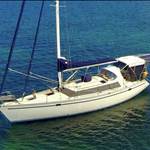
The SS34 is a much older design built to the IOR rule as an ocean racer. The rule encouraged fairly heavy construction and ballast ratios [stix].
The Northshore 27 was built as a harbour/club racer and fairly light construction. The pinched in stern is probably a downside of the IOR designed yachts and some report them as been difficult to sail down wind in fresh conditions. The SS34 has been the choice of Australian solo long distance sailors for a long time so it makes it a good choice if your considering the same. They are not necessarily vice free though.
Jesse Martin's Lionheart is for sale again!http://yachthub.com/list/yachts-for-sale/used/sail-monohulls/sparkman-stephens-34-lionheart/183706
Wishing Andy fair winds and good luck. Wow he is off to a great start, from the marine traffic link above (thanks for those links):
Speed recorded (Max / Average)?8.3 / 6.5 knots
I guess he probably has some assistance from the current. I am waving as he is going by but he is out of sight over the horizon. The SS34 is great for this record attempt, she is really fine at the bow and has awesome performance to windward.Select to expand quotekeensailor said..
I'm not sure they are all correct but there must be more.
The wine glass hull shape seems to provide a stronger attachment for the keel.
Select to expand quotekeensailor said..
I'm interested in why the S&S 34 is such a strong boat. I have a Northshore 27 and started to get interested in how it gets its torsional etc strength. Seems a lot of the fibreglass moulded furniture gives it that, like the births etc. I know the chain plates come right down and attach to the mid ship births. I know an S&S is much more blue water than my NS but interested as to why. I can so far tell it gets seaworthiness from;
- the type and way the glass / resin was layed up
- three chain plates per side
- skeg hung rudder
- large robust forward bulkhead
- cabin roof upright to resist crashing waves
- pinched stern to dissipate crashing waves from stern
I'm not sure they are all correct but there must be more.
It's my opinion there is a lot of myth surrounding the S&S 34, people seem to believe that because it is an S&S 34 it must be good... bull dog tough but I have seen far better construction and finish in other boats. I always seem to feel a little disappointed that they are not what I think they should be.
To be fair the one thing that the S&S 34 has over a lot of other boats of its size is the pipe like tubular hull tumble-home which is inherently strong and the ballast ratio that Ramona mentioned,,, which probably isn't that much of an advantage when you start adding huge deck stepped masts.
When looking at S&S 34's you may find eight different rig set ups in the one marina.
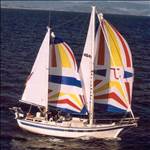
Like the hand full of record breakers, Andy's boat has the short rig, keel stepped double lowers which probably is the classic offshore rig on these older IOR boats. Because these Australian 34's where mostly built in Perth, a lot of them ended up being deck stepped with a single lower inline shroud. A very simple rig found on a lot of older IOR boats only these where deck stepped for easy mast lowering for the Freo bridges, not what I would call a blue water rig. A lot of S&S 34 where never really built for any thing more than Swan river racing and the occasional trip up the west coast.
Swarbricks layed up the Hulls and deck and the buyers finished them. A lot where completed in driveways, workshops and backyards in Perth. Unfortunately there was no real quality standard to which the boats where built and in some the construction was kept to a minimum for a minimum budget.
Even the hull layup changed through out the years.
Jolene and Ramona have covered most S&S34 issues. Swarbricks made 119 from 1970 to 1984, MacAlpine another 10 or so about 1985/86 and Winfields made about 70 in the UK in 1968/69 (different deck to the Oz ones).
A lot of Swarbrick S&S34s do have a factory fitout, Morning Bird being one of them. The quality of the home fitouts is variable, I haven't seen a too many good ones and some have been horrible.
They are bulldog tough by design and construction but of course they are now at least 32 years old (MB is the last Swarbricks built one launched in 84). Most are now old boats and like many that age poorly maintained.
They have an over spec rig and spars. As noted above the hull shape is inherently strong.
The 2.5 tonnes of lead in the keel with a 1.85 metre draft makes them very stiff. S&S34s similar to MB have been certified as having an angle of vanishing stability of 140 degrees. You can afford to lose a bit of that and still be stiffer than nearly anything else.
They did have a standard rig plan (two actually, short single spreader and taller double spreader) but not all were built to it and most would have been rerigged many times since build. MB is unusual, it has the inline lowers but is deck stepped and not hinged. Even with a big deck stepped mast and furler MB rarely heels more than 15 degrees.
The Mk1 keel/rudder is truly a hand full under spinnaker in quartering seas. Fast racing would have been tiring. This was partly solved with the Mk2 rudder. In non spinnaker conditions the MK1 sails beautifully on all points of sail. Into the wind and trimmed properly they need no steering assistance from a helmsman to point at 45-50 degrees.
The hull layup changed a bit about the time they went from a round hatch to the square hatch (1980??). The later boats had a epoxy resin outside layer to resist osmosis. When MB was soda blasted a few years ago there were no signs of osmosis anywhere. Earlier boats may not be so lucky. Other wise all the hulls are the same until the few Mk2 hulls with a slightly modified keel and spade rudder were made from about 1982 to 84. Very few Mk2s were made.
Actually most of the folding masts I have seen are keel stepped rigs not deck stepped. Mb is the only deck stepped 34 of the dozen or so I have been on. I wouldn't like a folding mast offshore but none have broken yet so they must be ok. A lot of the S2H boats in the 70s/80s would have had the hinged mast as they are the most common.
The deck stepped version has a massive tabernacle which interfered with the hinge. Mine is off at the moment and it took the chippies hours to remove it.
There are two recorded rollovers of the S&S34, one in the 98 S2H which made it to port under her own sail and one mid Tasman that was abandoned and later recovered and is still sailing in NZ.
One S&S34 has been lost at sea. Morning Tide sank a few years ago off Ballina when the rudder post broke and cracked the riser tube. She had a skeg hung rudder that had been modified years previously by extending it deeper. The extra strain appeared to be too much for the bottom pintle in a savage knock down.
The S&S34 has the pedigree of extensive offshore racing, cruising and record setting with few breakages and almost no sinkings. They are over solid, very stiff and easy to sail.
Thanks Jolene and MB, that makes interesting reading. I wonder if there is an equivalent modern design nowadays that acheives those design standards for toughness. Some of the Euro designs are pretty tough, Hallberg-Rassy etc
Select to expand quote
It looks that way, but there is a high directly over him so he could be becalmed. He has been travelling very slow the last day or so and it is strange for him to be travelling north at present as the southerly set should be carrying him south. We will have to wait and see.
He would be in for some nasty head winds if he kept going south and it will get worse for the next day or so. I notice his speed on the tracker at less than a knot heading north so maybe he's hove to and catching up on some sleep.
Select to expand quoteGuitz said..
He would be in for some nasty head winds if he kept going south and it will get worse for the next day or so. I notice his speed on the tracker at less than a knot heading north so maybe he's hove to and catching up on some sleep.
that's what i was thinking/hoping too. his drift direction makes sense if he is hove to.